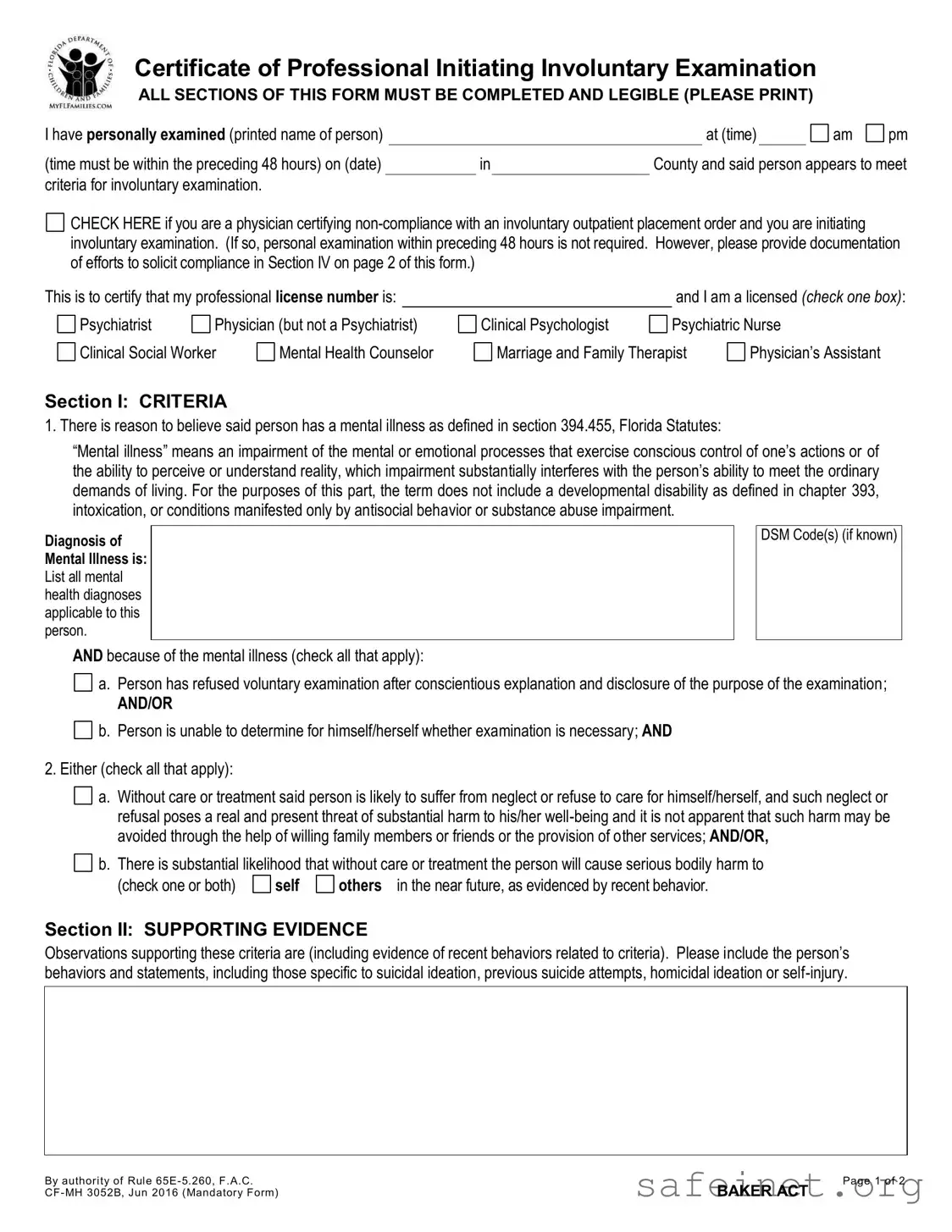
The Baker Act form plays a crucial role in the mental health system in Florida. It is designed for professionals who need to initiate an involuntary examination of an individual suspected of having a mental illness. This form requires the professional to complete all sections clearly and legibly, ensuring that the necessary information is accurately conveyed. Key aspects of the form include a certification from the examining professional, detailing their qualifications and the reasons for the involuntary examination. The criteria for mental illness must be met, including evidence that the person poses a threat to themselves or others. Supporting evidence, such as recent behaviors or statements, is also required to substantiate the need for examination. If the individual has previously been ordered for outpatient treatment but has not complied, that information must be documented as well. Additionally, the form collects identifying information for law enforcement, should they need to assist in locating the individual. Finally, the professional must sign and date the form, ensuring it is transported with the individual to the receiving facility for further evaluation and care.


| Fact Name | Details |
|---|---|
| Purpose | The Baker Act form is used to initiate an involuntary examination for individuals believed to have a mental illness. |
| Governing Law | The form is governed by Florida Statutes, specifically section 394.455, which defines mental illness. |
| Professional Requirement | A licensed professional, such as a psychiatrist or clinical psychologist, must complete the form after personally examining the individual. |
| Criteria for Examination | The individual must meet specific criteria, including the likelihood of substantial harm to themselves or others without treatment. |
| Documentation | Supporting evidence must be provided, detailing observations and behaviors that justify the need for involuntary examination. |
| Transport Requirement | The completed form must accompany the individual to the receiving facility and be retained in their clinical record. |
Completing the Baker Act form is a crucial step in initiating an involuntary examination. Ensure that all sections are filled out clearly and accurately. Once the form is complete, it will need to be submitted to the appropriate authorities for processing.
What is the Baker Act form?
The Baker Act form is a legal document used in Florida to initiate an involuntary examination of an individual suspected of having a mental illness. This form must be completed by a qualified mental health professional who has personally examined the individual within the last 48 hours. It serves to ensure that individuals receive the necessary mental health care when they are unable to seek help voluntarily.
Who can complete the Baker Act form?
The form can be completed by various licensed professionals, including psychiatrists, physicians, clinical psychologists, psychiatric nurses, clinical social workers, mental health counselors, marriage and family therapists, and physician assistants. Each professional must have the appropriate credentials and training to assess mental health conditions.
What criteria must be met for the Baker Act to be applied?
To apply the Baker Act, there must be reason to believe that the individual has a mental illness and that they meet certain criteria. This includes refusal of voluntary examination, inability to determine the need for examination, and a likelihood of suffering harm without treatment. The form requires specific details about the individual's mental health diagnosis and recent behaviors that support these criteria.
What information is required in the Baker Act form?
The form requires detailed information, including the individual's name, the time and date of examination, the professional's license number, and a description of the mental health diagnosis. It also asks for observations supporting the criteria for involuntary examination, information about the individual’s behaviors, and any relevant sources of information, such as reports from family or law enforcement.
What happens after the Baker Act form is completed?
Once the Baker Act form is completed, it must be transported with the individual to the receiving facility. This ensures that the clinical record is maintained, and the facility has the necessary information to provide appropriate care. Copies of the form may be retained by the initiating professional and the law enforcement agency involved.
Can the Baker Act be used for outpatient treatment?
Yes, the Baker Act can also apply to individuals who are non-compliant with an involuntary outpatient placement order. In such cases, a physician must document the non-compliance and the efforts made to encourage adherence to the treatment plan. This is included in a specific section of the form.
What should I do if I believe someone needs to be Baker Acted?
If you believe someone is in need of involuntary examination under the Baker Act, it is crucial to contact a qualified mental health professional. They can assess the situation and determine if the criteria for the Baker Act are met. If immediate danger is present, contacting law enforcement may be necessary to ensure the individual's safety.
Is the information on the Baker Act form confidential?
Yes, the information on the Baker Act form is considered confidential and is protected under mental health privacy laws. However, it may be shared with relevant parties, such as law enforcement and the receiving facility, to ensure the individual receives appropriate care. It is important to handle this information with sensitivity and respect for the individual's privacy.
Incomplete Sections: Failing to fill out all sections of the form can lead to delays or rejections. Each part is crucial for a thorough evaluation.
Illegible Handwriting: If the form is not legible, it may create confusion. Clear and readable handwriting is essential.
Missing Time and Date: Not including the time and date of the examination can invalidate the form. This information must be current and accurate.
Incorrect License Information: Entering an incorrect professional license number can cause issues. Ensure that the license information is accurate and up to date.
Failure to Document Observations: Not providing specific observations and behaviors can weaken the case. Detailed accounts of the individual's actions are necessary.
Ignoring Supporting Evidence: Omitting relevant evidence from family or other professionals can undermine the justification for the examination. Include all sources of information.
Not Checking Appropriate Criteria: Failing to check all applicable criteria for involuntary examination may lead to misunderstandings. Review the criteria thoroughly before submission.
Neglecting Section IV: If applicable, not completing the section on non-compliance with outpatient placement orders can lead to complications. Ensure this section is filled out if relevant.
Inadequate Law Enforcement Information: Providing insufficient identifying information for law enforcement can hinder their ability to assist. Include as many details as possible.
The Baker Act is a critical document used in Florida for the involuntary examination of individuals with mental health issues. However, it is often accompanied by several other forms that provide additional context or support for the examination process. Below is a list of five commonly used forms and documents that may be utilized alongside the Baker Act form.
These forms work together to create a comprehensive approach to mental health care under the Baker Act. Each document plays a specific role in ensuring that individuals receive the appropriate evaluation and treatment while safeguarding their rights and well-being.
The Baker Act form is similar to the Mental Health Commitment Petition. Both documents serve to initiate involuntary mental health evaluations for individuals who may pose a danger to themselves or others. The Mental Health Commitment Petition outlines the reasons for seeking commitment, including specific behaviors and mental health diagnoses. Like the Baker Act form, it requires a detailed account of the individual's condition and the necessity for immediate intervention. The petition is often filed by family members or mental health professionals and must be supported by evidence of the individual’s mental state.
Another document that shares similarities with the Baker Act form is the Emergency Detention Order. This order is typically issued by law enforcement or a mental health professional when an individual is deemed a danger to themselves or others. The Emergency Detention Order allows for the immediate transport of the individual to a mental health facility for evaluation. Both documents require a clear articulation of the individual’s mental health status and the urgency of the situation, ensuring that appropriate care is provided swiftly.
The Involuntary Treatment Order is also akin to the Baker Act form. This order is issued by a court following a hearing, allowing for the mandatory treatment of individuals who are unable to make informed decisions regarding their mental health care. Similar to the Baker Act, it necessitates a thorough assessment of the individual's mental health and their capacity to consent to treatment. Both documents emphasize the importance of protecting the individual’s well-being while ensuring that legal protocols are followed.
The Psychiatric Evaluation Report shares characteristics with the Baker Act form as well. This report is typically prepared by a mental health professional after assessing an individual’s mental health status. It includes observations, diagnoses, and recommendations for treatment. While the Baker Act form is focused on initiating an involuntary examination, the Psychiatric Evaluation Report provides a comprehensive overview of the individual’s mental health, which may be used in subsequent legal or treatment decisions.
Another related document is the Consent for Treatment form. This form is used when an individual voluntarily agrees to receive mental health treatment. While the Baker Act form is used in situations where consent cannot be obtained due to the individual’s mental state, both documents highlight the importance of informed consent and the individual's right to receive appropriate care. The Consent for Treatment form ensures that individuals understand their treatment options, while the Baker Act form emphasizes the need for intervention when individuals cannot make informed decisions.
The Risk Assessment Tool is another document that aligns with the Baker Act form. This tool is utilized by mental health professionals to evaluate the potential risks an individual may pose to themselves or others. Similar to the Baker Act form, it requires a detailed examination of the individual's behavior, mental health history, and any previous incidents of self-harm or violence. Both documents aim to assess the urgency of the situation and determine the best course of action for the individual’s safety.
Lastly, the Crisis Intervention Plan is comparable to the Baker Act form in that it outlines strategies for addressing an individual’s mental health crisis. This plan is often developed by mental health professionals and includes specific steps to stabilize the individual and ensure their safety. While the Baker Act form is used to initiate involuntary examinations, the Crisis Intervention Plan provides a framework for managing crises effectively, emphasizing proactive measures to support individuals in distress.
When filling out the Baker Act form, attention to detail is crucial. Here are five important dos and don'ts to keep in mind:
By following these guidelines, you can contribute to a more effective and efficient process when dealing with the complexities of mental health evaluations under the Baker Act.
The Baker Act is a law in Florida that allows for the involuntary examination of individuals who may be experiencing a mental health crisis. Unfortunately, there are several misconceptions surrounding the Baker Act form that can lead to confusion. Here are six common misconceptions:
Understanding these misconceptions can help clarify the purpose and process of the Baker Act, ensuring that individuals in crisis receive the appropriate care and support they need.
Here are key takeaways regarding the Baker Act form: