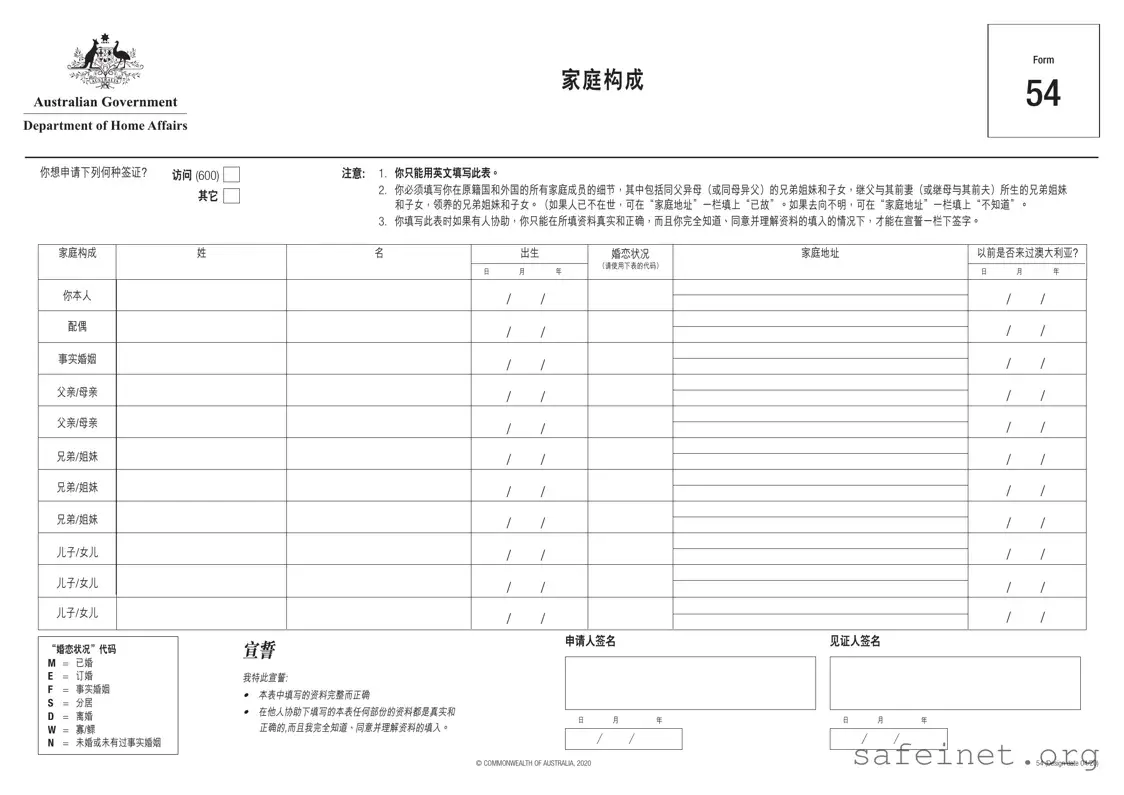
The Australia 54 form, known as the Family Composition form, plays a crucial role in the visa application process, particularly for those seeking a Visitor visa (subclass 600) or other visa types. This form requires applicants to provide detailed information about their family members, both in their home country and abroad. It is essential to include not only immediate family members like parents and siblings but also half-siblings, step-siblings, and adopted children. For any deceased family members, applicants should indicate this by writing 'Deceased' in the home address section. The form emphasizes the importance of accuracy and honesty; if assistance was received in completing it, the applicant must ensure that all information is true and that they fully understand what has been provided. Additionally, the form includes a declaration section where the applicant and a witness must sign, confirming the correctness of the information submitted. By gathering comprehensive family details, the Australia 54 form helps immigration authorities better assess the applicant's situation and intentions, ultimately aiding in the visa decision-making process.
| Fact Name | Description |
|---|---|
| Form Title | The form is officially titled "Family Composition Form 54." It is used for visa applications in Australia. |
| Visa Types | Applicants can use this form to apply for a Visitor visa (600) or other types of visas. |
| Language Requirement | The form must be completed in English only. This ensures clarity and consistency in processing. |
| Family Member Details | Applicants must provide details for all family members, including half-siblings, step-siblings, and adopted children. |
| Address Information | If a family member is deceased or their whereabouts are unknown, the applicant can indicate this in the address section. |
| Declaration Requirement | Applicants must sign a declaration confirming that all information provided is true and correct, and that they understand the content. |
| Witness Signature | A witness must also sign the form, verifying the applicant's identity and the authenticity of the declaration. |
| Relationship Status Codes | The form includes specific codes for relationship status, such as M for Married and D for Divorced, to simplify data entry. |
| Governing Law | This form is governed by Australian immigration law, specifically under the Migration Act 1958. |
| Form Design Date | The current design date of the form is October 2015, indicating the last major update for its format. |
Completing the Australia 54 form is a necessary step for those applying for a visitor visa or other types of visas. This form requires detailed information about your family members, both in your home country and abroad. Ensure all information is accurate and complete before submission.
What is the purpose of the Australia 54 Form?
The Australia 54 Form, also known as the Family Composition Form, is used to gather detailed information about your family members when applying for a visa to Australia. This form is essential for ensuring that all relevant family connections are documented, which can impact your visa application process.
Who needs to be included in the Australia 54 Form?
You must provide information about all family members living both in your home country and abroad. This includes your parents, siblings (half, step, and adopted), and children. If any family member is deceased, you can indicate this by writing 'Deceased' in the home address section. For those whose whereabouts are unknown, simply write 'Unknown.'
Can I fill out the Australia 54 Form in a language other than English?
No, the form must be completed in English only. This requirement helps ensure that the information is clear and can be accurately assessed by the authorities reviewing your application.
What should I do if I need assistance filling out the form?
If you receive help while completing the form, you must ensure that the information provided is true and correct. You can only sign the declaration if you fully understand and agree with the details included in the form. This is crucial for maintaining the integrity of your application.
What information is required regarding previous visits to Australia?
You need to provide details about any previous visits to Australia, including the dates of your visits. This helps immigration authorities understand your travel history and assess your application more effectively.
What is the significance of the 'Relationship status' codes?
The 'Relationship status' codes are used to categorize your marital status and relationships accurately. These codes include options such as Married (M), Engaged (E), De Facto (F), Separated (S), Divorced (D), Widowed (W), and Never married (N). Using these codes helps streamline the processing of your application.
Do I need to provide my signature on the form?
Yes, your signature is required on the form. This signature serves as a declaration that the information you provided is complete and accurate. Additionally, a witness must also sign the form to validate your declaration.
What happens if I provide false information on the form?
Providing false information on the Australia 54 Form can lead to serious consequences, including the rejection of your visa application or even legal repercussions. It is essential to be honest and thorough when filling out the form to avoid any complications.
Where can I find the Australia 54 Form?
The Australia 54 Form can typically be found on the official website of the Australian Department of Home Affairs. Make sure to download the most recent version to ensure that you are using the correct format and guidelines.
Not Completing the Form in English: One of the most common mistakes is failing to fill out the Australia 54 form in English. This is a strict requirement, and submissions in other languages will not be accepted. Ensure that every section is completed in English to avoid delays.
Omitting Family Members: Applicants often forget to include all family members, including half-siblings, step-siblings, and adopted children. It’s crucial to list every relevant family member, even if they are not living. If someone has passed away, indicate this by writing "Deceased" in the home address column.
Incorrect Relationship Status Codes: Using the wrong codes for relationship status can lead to confusion and delays. Make sure to accurately represent your relationship status using the provided codes (e.g., M for Married, E for Engaged). Double-check this information before submission.
Signing Without Understanding: Some applicants sign the declaration without fully understanding the information provided in the form. It’s vital to ensure that all details are correct and that you comprehend the implications of your declaration before signing.
When applying for a visa in Australia, several forms and documents accompany the Australia 54 form. Each of these documents serves a specific purpose in the application process. It is crucial to understand their importance to ensure a smooth submission and review of your application.
Each of these documents plays a vital role in the visa application process. Ensuring that they are complete and accurate can significantly impact the outcome of your application. It is advisable to gather and prepare these documents thoroughly to avoid delays or complications.
The Form I-130, Petition for Alien Relative, is a document used in the United States immigration process. It allows a U.S. citizen or lawful permanent resident to establish a relationship with a foreign relative who wishes to immigrate to the U.S. Similar to the Australia 54 form, the I-130 requires detailed information about family members, including names, dates of birth, and relationships. Both forms aim to collect comprehensive family composition data to assess eligibility for immigration benefits.
The DS-260, Immigrant Visa Electronic Application, is another document that shares similarities with the Australia 54 form. It is used by individuals applying for an immigrant visa to enter the United States. Like the Australia 54 form, the DS-260 requires applicants to provide information about family members, including their relationship to the applicant and their addresses. Both forms serve the purpose of verifying familial connections in the context of immigration applications.
The Form N-400, Application for Naturalization, is relevant for individuals seeking U.S. citizenship. This form also requires applicants to disclose information about their family members, including spouses and children. Much like the Australia 54 form, the N-400 seeks to ensure that all relevant familial relationships are documented, which can impact the applicant's eligibility for citizenship.
The Form I-485, Application to Register Permanent Residence or Adjust Status, is used by individuals already in the U.S. who wish to become permanent residents. This form, similar to the Australia 54, requires detailed family information, including the names and relationships of family members. The focus on family composition in both forms highlights the importance of familial ties in immigration processes.
Lastly, the G-325A, Biographic Information, is a form that collects personal information about individuals applying for certain immigration benefits. It requires details about the applicant's family members, including parents and spouses, similar to the Australia 54 form. Both forms aim to provide a clear picture of the applicant's family structure, which is essential for processing immigration requests.
When filling out the Australia 54 form, it is essential to follow specific guidelines to ensure accuracy and compliance. Below is a list of things to do and avoid during this process.
There are several misconceptions surrounding the Australia 54 form that can lead to confusion. Here’s a list of nine common misunderstandings and clarifications for each:
This is incorrect. The Australia 54 form must be completed in English only.
In fact, you must provide details of all family members, including half-siblings, step-siblings, and adopted children.
On the contrary, if a family member is deceased, you should indicate this by writing 'Deceased' in the home address column.
Abbreviations are not permitted. You must clearly state the relationship of each family member.
This is a misconception. You should only sign if you fully understand and agree with all the information provided.
This is false. You must provide details of any previous visits, using the specified codes.
Actually, you should include all family members, regardless of their current status or location.
This is not true. A witness signature is required to validate your declaration.
In reality, completing the Australia 54 form is a mandatory requirement for certain visa applications.
Here are key takeaways for filling out and using the Australia 54 form: