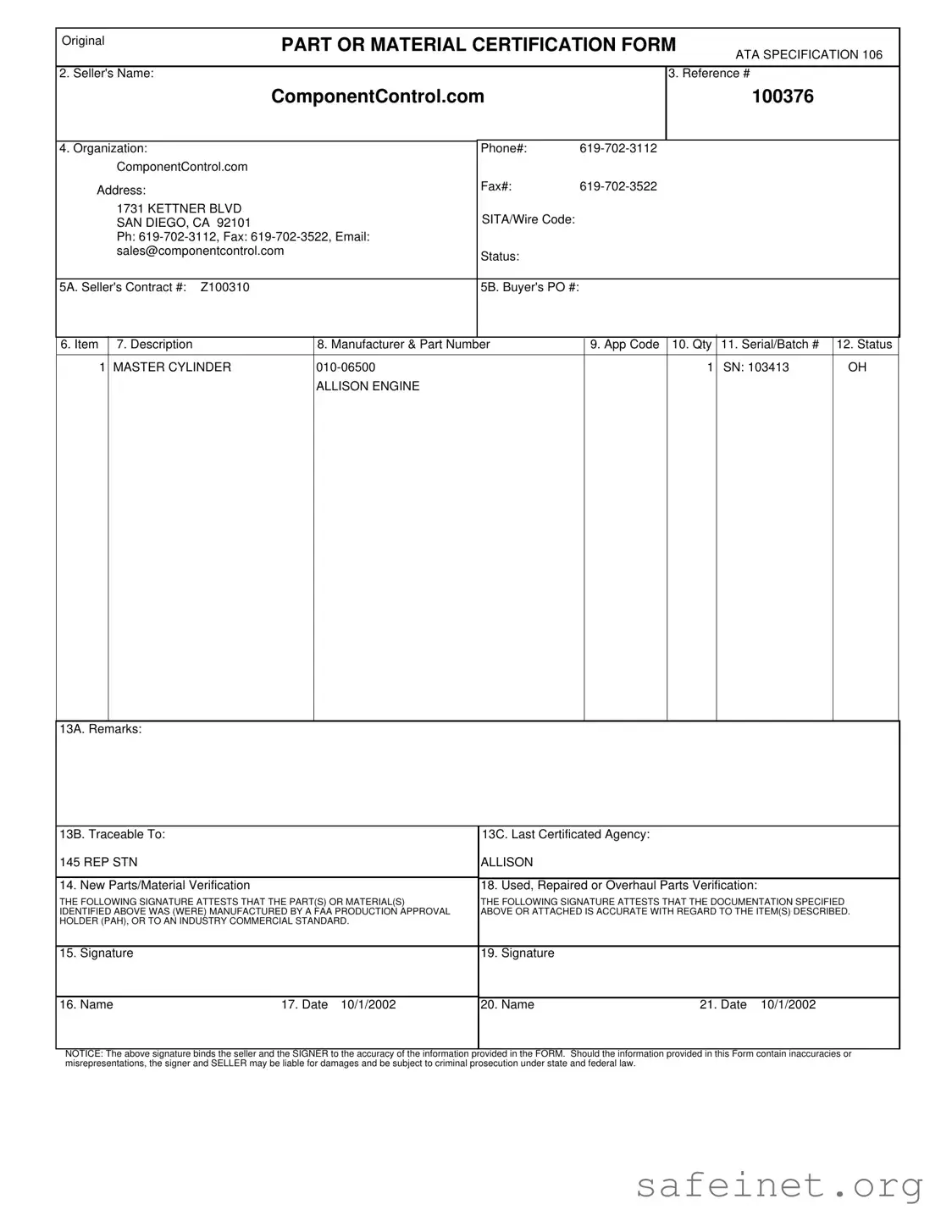
The ATA 106 form serves as an essential document for certifying parts or materials in the aviation industry. This form is primarily utilized to ensure that the components being sold meet the necessary standards for safety and quality. It includes key details such as the seller's information, including their name, address, and contact details, as well as a reference number for tracking purposes. The form also requires the seller's contract number and the buyer's purchase order number, ensuring both parties are aligned on the transaction. Each item listed on the form is accompanied by a description, manufacturer and part number, quantity, and serial or batch number, which aids in verifying the authenticity and traceability of the parts. Additionally, the form includes sections for remarks and traceability, allowing for a clear record of the part's history and certification status. The signatures of both the seller and the certifying agency are critical, as they attest to the accuracy of the information provided and bind the parties to its validity. Overall, the ATA 106 form plays a vital role in maintaining compliance and ensuring that all aviation components meet regulatory standards.
| Fact Name | Details |
|---|---|
| Form Title | Original PART OR MATERIAL CERTIFICATION FORM ATA SPECIFICATION 106 |
| Seller's Name | ComponentControl.com |
| Reference Number | 100376 |
| Seller's Address | 1731 KETTNER BLVD, SAN DIEGO, CA 92101 |
| Seller's Contact | Phone: 619-702-3112, Fax: 619-702-3522, Email: [email protected] |
| Contract Number | Seller's Contract #: Z100310 |
| Part Description | MASTER CYLINDER, Manufacturer & Part Number: 010-06500 |
| Verification Type | New Parts/Material Verification and Used, Repaired or Overhaul Parts Verification |
| Governing Law | Federal Aviation Administration (FAA) Regulations |
Completing the ATA 106 form requires careful attention to detail to ensure that all necessary information is accurately provided. After filling out the form, it will serve as a certification for parts or materials, affirming their compliance with specified standards.
What is the ATA 106 form?
The ATA 106 form is a certification document used for parts or materials in the aviation industry. It verifies that the parts have been manufactured according to specific standards and are traceable to a certified source. This form helps ensure safety and compliance in aviation maintenance and operations.
Who is responsible for filling out the ATA 106 form?
The seller of the parts or materials is responsible for completing the ATA 106 form. This includes providing accurate information about the items being sold, such as descriptions, manufacturer details, and certification statuses. The seller must also sign the form to attest to the accuracy of the information provided.
What information is required on the ATA 106 form?
The form requires several key pieces of information, including the seller's name and contact details, the buyer's purchase order number, item descriptions, manufacturer part numbers, and serial or batch numbers. It also asks for verification of whether the parts are new or used, repaired, or overhauled.
How does the ATA 106 form ensure the quality of parts?
The ATA 106 form ensures quality by requiring that the parts or materials be traceable to a certified source, such as a FAA Production Approval Holder. The seller must provide a signature that attests to the accuracy of the information, which holds them accountable for any misrepresentations.
What happens if the information on the ATA 106 form is inaccurate?
If the information on the ATA 106 form is found to be inaccurate, the signer and the seller may be held liable for damages. Additionally, they could face criminal prosecution under state and federal laws. This highlights the importance of providing truthful and precise information on the form.
Can the ATA 106 form be used for both new and used parts?
Yes, the ATA 106 form can be used for both new and used parts. The form includes sections for verifying the condition of the parts, whether they are new, repaired, or overhauled. This flexibility allows it to be applicable in various scenarios within the aviation industry.
Where can I get the ATA 106 form?
The ATA 106 form can typically be obtained from aviation regulatory bodies, industry associations, or directly from sellers who are familiar with the form. It may also be available online through various aviation-related websites and resources.
Incomplete Information: One common mistake is leaving out essential details. All fields must be filled out completely. For instance, failing to provide the Buyer's PO # can lead to confusion and delays in processing.
Incorrect Contact Information: Providing inaccurate contact details can hinder communication. Ensure that the phone number, fax number, and email address are correct. Double-check these entries to avoid any issues.
Missing Signatures: Both signatures on the form are crucial. Neglecting to sign can render the form invalid. Make sure both the seller and buyer sign and date the document.
Failure to Verify Part Information: It's important to accurately verify the part numbers and descriptions. Inaccuracies here can lead to significant problems down the line. Always cross-reference the information with your records before submission.
The ATA 106 form is essential for certifying parts and materials in the aviation industry. It is often used in conjunction with several other documents to ensure compliance and traceability. Here are some of the common forms and documents that accompany the ATA 106 form:
These documents work together to create a comprehensive compliance framework, ensuring that all parts and materials used in aviation are safe and reliable. Understanding the role of each document is crucial for maintaining high standards in the industry.
The ATA 105 form, similar to the ATA 106, serves as a certificate of compliance for aircraft parts. This document assures that the parts meet the necessary regulatory standards set by the Federal Aviation Administration (FAA). Like the ATA 106, the ATA 105 includes details such as the part number, manufacturer information, and a declaration of compliance. Both forms require signatures to validate the accuracy of the information provided, thereby holding the seller accountable for any discrepancies.
The ATA 104 form is another document that shares similarities with the ATA 106. It is used to certify the airworthiness of aircraft components. This form provides essential information about the part, including its history and maintenance records. Both the ATA 104 and ATA 106 require a declaration from the seller regarding the authenticity and condition of the parts. The primary difference lies in the ATA 104's focus on airworthiness, while the ATA 106 emphasizes material certification.
The FAA Form 8130-3 is a widely recognized document that parallels the ATA 106 in purpose. This form is issued by the FAA to certify that a part is in compliance with applicable regulations. It includes detailed information about the part, similar to the ATA 106, such as serial numbers and manufacturing details. Both documents require signatures from authorized personnel, ensuring that the information is accurate and verifiable, thus protecting both buyers and sellers in the aviation industry.
The EASA Form 1 is akin to the ATA 106 as it certifies the conformity of aircraft parts to European standards. This form is used primarily in Europe but serves a similar function to the ATA 106 in the United States. Both forms contain critical information about the parts, including their manufacturing and certification status. The EASA Form 1 also requires signatures, ensuring accountability for the information provided, much like its ATA counterpart.
The Bill of Sale for Aircraft Parts can be compared to the ATA 106, as it documents the transfer of ownership of aircraft components. While the ATA 106 focuses on certification and compliance, the Bill of Sale serves to establish legal ownership. Both documents require detailed information about the part, including serial numbers and descriptions. Signatures from both the buyer and seller are necessary to validate the transaction, ensuring that all parties are in agreement regarding the transfer.
Lastly, the Certificate of Release to Service (CRS) is another document that resembles the ATA 106. This certificate is issued by a licensed maintenance organization to confirm that a part has been inspected and deemed airworthy. Like the ATA 106, the CRS includes information about the part and requires signatures from authorized personnel. Both documents play a crucial role in maintaining safety and compliance within the aviation industry, ensuring that all components meet regulatory standards before being used in aircraft.
When filling out the ATA 106 form, it is essential to ensure accuracy and completeness. Here are four key do's and don'ts to consider:
Misconceptions about the ATA 106 form can lead to confusion and errors in the certification process. Here are nine common misunderstandings:
Understanding these misconceptions can help streamline the certification process and ensure compliance with industry standards.
Here are some key takeaways regarding the ATA 106 form: