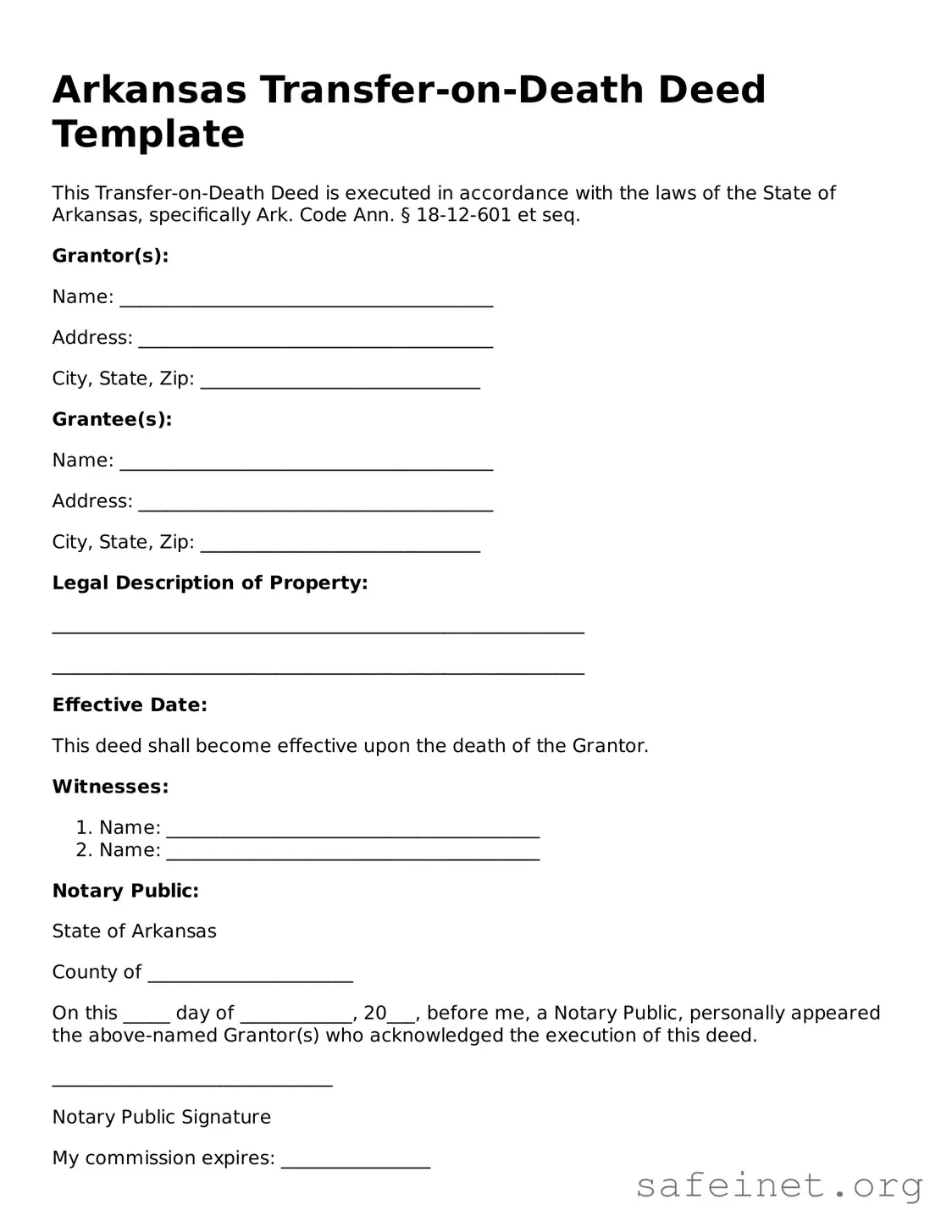
The Arkansas Transfer-on-Death Deed form offers a straightforward way for property owners to designate beneficiaries who will receive their real estate upon their passing. This legal tool allows individuals to retain full control over their property during their lifetime, avoiding the complexities of probate after death. With this deed, property owners can specify one or more beneficiaries, ensuring that their wishes are clearly documented. Importantly, the form must be properly executed and recorded with the county clerk to be valid. By using this deed, individuals can simplify the transfer process, providing peace of mind to both themselves and their heirs. Additionally, it serves as a cost-effective alternative to traditional estate planning methods, making it accessible for many Arkansas residents. Understanding the nuances of this form can empower property owners to make informed decisions about their estate and legacy.
Arkansas Transfer-on-Death Deed Template
This Transfer-on-Death Deed is executed in accordance with the laws of the State of Arkansas, specifically Ark. Code Ann. § 18-12-601 et seq.
Grantor(s):
Name: ________________________________________
Address: ______________________________________
City, State, Zip: ______________________________
Grantee(s):
Name: ________________________________________
Address: ______________________________________
City, State, Zip: ______________________________
Legal Description of Property:
_________________________________________________________
_________________________________________________________
Effective Date:
This deed shall become effective upon the death of the Grantor.
Witnesses:
Notary Public:
State of Arkansas
County of ______________________
On this _____ day of ____________, 20___, before me, a Notary Public, personally appeared the above-named Grantor(s) who acknowledged the execution of this deed.
______________________________
Notary Public Signature
My commission expires: ________________
This document serves as a formal declaration of the Grantor's intent to transfer the specified property to the Grantee upon the Grantor's death.
| Fact Name | Description |
|---|---|
| Definition | The Arkansas Transfer-on-Death Deed allows property owners to transfer real estate to beneficiaries upon their death without going through probate. |
| Governing Law | This deed is governed by Arkansas Code Annotated § 18-12-601 to § 18-12-606. |
| Requirements | The deed must be signed by the property owner and notarized to be valid. |
| Revocability | Property owners can revoke or change the deed at any time before their death. |
| Beneficiary Designation | Multiple beneficiaries can be designated, and the property will be divided according to the owner's wishes. |
| Filing | The deed must be filed with the county clerk's office where the property is located to be effective. |
Once you have the Arkansas Transfer-on-Death Deed form ready, you can begin filling it out. This form allows you to designate a beneficiary for your property, ensuring a smooth transfer upon your passing. Follow these steps carefully to complete the form accurately.
What is a Transfer-on-Death Deed in Arkansas?
A Transfer-on-Death Deed (TOD) is a legal document that allows a property owner in Arkansas to designate a beneficiary who will receive the property automatically upon the owner’s death. This type of deed helps avoid the probate process, which can be lengthy and costly. The property remains under the owner’s control during their lifetime, and they can sell or transfer it without the beneficiary’s consent. It only takes effect after the owner passes away.
How do I create a Transfer-on-Death Deed in Arkansas?
To create a Transfer-on-Death Deed, you must fill out the appropriate form with accurate information about the property and the designated beneficiary. The deed must be signed by the property owner in the presence of a notary public. After signing, the deed should be filed with the county clerk’s office where the property is located. It’s important to ensure that the deed is recorded before the owner’s death for it to be valid.
Can I change or revoke a Transfer-on-Death Deed after it has been created?
Yes, a Transfer-on-Death Deed can be changed or revoked. The property owner has the right to create a new deed that supersedes the previous one or file a revocation form with the county clerk. It is essential to follow the proper legal procedures to ensure that any changes are valid. This flexibility allows the property owner to adjust their estate plan as circumstances change.
What happens if the beneficiary of a Transfer-on-Death Deed dies before the property owner?
If the designated beneficiary passes away before the property owner, the Transfer-on-Death Deed will not automatically transfer the property to that beneficiary’s heirs. In such cases, the property owner may want to create a new Transfer-on-Death Deed to designate a different beneficiary. It’s advisable to review and update the deed periodically to reflect any changes in the owner’s intentions or family circumstances.
Are there any tax implications associated with a Transfer-on-Death Deed in Arkansas?
Generally, a Transfer-on-Death Deed does not trigger immediate tax consequences for the property owner. However, the property may be subject to estate taxes if the total value of the estate exceeds certain thresholds. Additionally, the beneficiary may face capital gains taxes when they sell the property after inheriting it. Consulting with a tax professional is recommended to understand the specific tax implications related to the Transfer-on-Death Deed and the property involved.
Incorrect Property Description: Many individuals fail to provide a precise description of the property. It’s crucial to include the full legal description, not just the address. Omitting details can lead to confusion or disputes later.
Not Signing the Form: A common oversight is neglecting to sign the deed. Without a signature, the document is not valid. Ensure that all required parties sign in the appropriate places.
Improper Witnessing or Notarization: Some people forget that the deed must be witnessed or notarized. This step is essential for the deed to be legally binding. Double-check the requirements to avoid issues.
Filing the Deed Late: Timeliness is key. Failing to file the deed with the county clerk’s office in a timely manner can result in complications. Make sure to submit the form as soon as it is completed.
Not Understanding the Consequences: Many individuals do not fully grasp the implications of a Transfer-on-Death Deed. It’s important to understand how it affects your estate and beneficiaries. Seek guidance if needed.
The Arkansas Transfer-on-Death Deed form allows property owners to designate beneficiaries who will receive their property upon their death, bypassing probate. However, several other documents and forms may be necessary or beneficial in conjunction with this deed to ensure a smooth transfer of assets. Below is a list of commonly used forms and documents that complement the Transfer-on-Death Deed in Arkansas.
Utilizing these documents alongside the Arkansas Transfer-on-Death Deed can help ensure that your wishes regarding property transfer are honored and that the process is as efficient as possible. It is always advisable to consult with a legal professional to ensure all documents are properly prepared and executed.
The Arkansas Transfer-on-Death Deed (TODD) form shares similarities with a traditional will. Both documents serve the purpose of distributing assets after a person’s death. However, while a will goes through probate, a TODD allows for the direct transfer of property to beneficiaries without the need for court involvement. This can lead to a quicker and more efficient transfer process, reducing costs and delays for the heirs.
A revocable living trust is another document akin to the Transfer-on-Death Deed. Like a TODD, a revocable living trust allows property to be transferred outside of probate. The key difference lies in the management of assets during the grantor's lifetime. With a trust, the grantor can manage the assets and make changes as needed, while a TODD is effective only upon the grantor's death.
When filling out the Arkansas Transfer-on-Death Deed form, it’s crucial to approach the process with care and attention. Here are ten important dos and don’ts to keep in mind:
Taking these steps can help ensure that your wishes are honored and that the transfer process goes smoothly. Act promptly to avoid complications in the future!
Understanding the Arkansas Transfer-on-Death Deed form can be tricky. Here are four common misconceptions people have about it:
Many believe that once the Transfer-on-Death Deed is signed, the property immediately transfers to the beneficiary. In reality, the transfer only occurs after the owner's death. Until then, the owner retains full control of the property.
Some think that this deed can apply to all kinds of property. However, it is primarily designed for real estate. Other assets, like bank accounts or personal property, require different legal tools.
While a Transfer-on-Death Deed can simplify the transfer process, it does not replace a will. A will is still important for addressing any remaining assets and ensuring that all wishes are fulfilled.
People often think that beneficiaries can access the property right away. However, they must wait until the owner passes away and the deed is properly recorded. Until that time, the owner can change their mind about the beneficiaries.
When filling out and using the Arkansas Transfer-on-Death Deed form, it is important to consider the following key takeaways: