When it comes to settling the affairs of a loved one who has passed away, navigating the legal landscape can often feel overwhelming, especially for those dealing with small estates. In Arkansas, the Small Estate Affidavit provides a streamlined process for heirs to claim assets without the need for formal probate proceedings, which can be time-consuming and costly. This form is particularly beneficial for estates valued at $100,000 or less, allowing heirs to access bank accounts, real estate, and personal property with greater ease. By completing the Small Estate Affidavit, individuals can assert their right to inherit while also affirming that no debts will remain unpaid, thus protecting the interests of both the estate and the heirs. Additionally, the form requires specific information, including details about the deceased, the heirs, and the assets involved, ensuring that all necessary information is clearly outlined. Understanding how to properly utilize this form can significantly simplify the process of transferring assets, making it an essential tool for anyone facing the daunting task of settling a small estate in Arkansas.
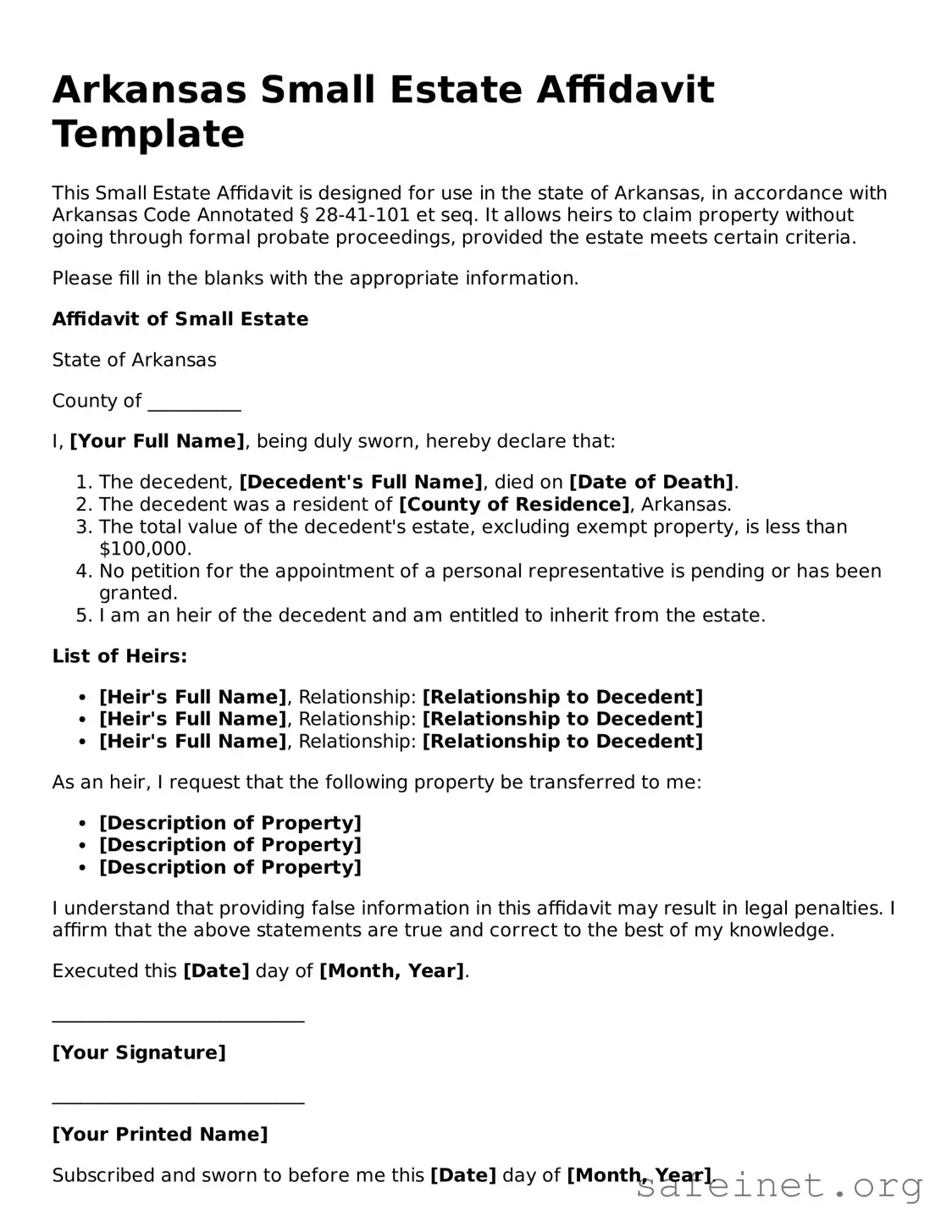
Arkansas Small Estate Affidavit Template
This Small Estate Affidavit is designed for use in the state of Arkansas, in accordance with Arkansas Code Annotated § 28-41-101 et seq. It allows heirs to claim property without going through formal probate proceedings, provided the estate meets certain criteria.
Please fill in the blanks with the appropriate information.
Affidavit of Small Estate
State of Arkansas
County of __________
I, [Your Full Name], being duly sworn, hereby declare that:
List of Heirs:
As an heir, I request that the following property be transferred to me:
I understand that providing false information in this affidavit may result in legal penalties. I affirm that the above statements are true and correct to the best of my knowledge.
Executed this [Date] day of [Month, Year].
___________________________
[Your Signature]
___________________________
[Your Printed Name]
Subscribed and sworn to before me this [Date] day of [Month, Year].
___________________________
[Notary Public's Signature]
My commission expires: [Expiration Date]
| Fact Name | Description |
|---|---|
| Purpose | The Arkansas Small Estate Affidavit allows heirs to claim assets of a deceased person without going through formal probate. |
| Eligibility | This form is applicable when the total value of the estate is less than $100,000, excluding certain assets like real estate. |
| Governing Law | The use of the Small Estate Affidavit in Arkansas is governed by Arkansas Code Annotated § 28-41-101 et seq. |
| Required Information | Affidavit must include details such as the decedent's name, date of death, and a list of assets. |
| Who Can Use It | Heirs or beneficiaries of the estate can use this affidavit to access the deceased's assets. |
| Filing Process | The affidavit must be signed in front of a notary public and can be presented to banks or other institutions holding the assets. |
| Limitations | Not all assets can be claimed through this affidavit; for example, real property typically requires formal probate. |
| Timeframe | The affidavit must be filed within three years of the decedent's death to be valid for asset claims. |
After obtaining the Arkansas Small Estate Affidavit form, you will need to complete it accurately to proceed with settling the estate. This form allows you to claim assets of a deceased person without going through a lengthy probate process. Follow the steps below to fill out the form correctly.
What is an Arkansas Small Estate Affidavit?
The Arkansas Small Estate Affidavit is a legal document that allows certain heirs to claim the assets of a deceased person without going through the full probate process. This form is typically used when the total value of the estate is below a specified threshold, which, as of 2023, is $100,000 for personal property and $25,000 for real property. By using this affidavit, heirs can simplify the transfer of assets and avoid the time and expense associated with probate court.
Who is eligible to use the Small Estate Affidavit?
To qualify for the Small Estate Affidavit in Arkansas, the estate must meet specific criteria. The deceased must have been a resident of Arkansas, and the total value of the estate must fall below the limits mentioned earlier. Additionally, the person filing the affidavit must be an heir or a beneficiary named in the will, if one exists. It is important to ensure that all debts and taxes owed by the estate are settled before using this affidavit to claim assets.
How do I complete the Small Estate Affidavit?
Completing the Arkansas Small Estate Affidavit involves filling out the form with accurate information about the deceased, the assets involved, and the heirs. You will need to provide details such as the date of death, a list of assets, and any outstanding debts. After filling out the affidavit, it must be signed in front of a notary public. Once notarized, the affidavit can be presented to financial institutions or other entities holding the deceased's assets to facilitate the transfer.
What happens after I file the Small Estate Affidavit?
Once the Small Estate Affidavit is completed and notarized, it can be submitted to the appropriate institutions to claim the assets. These may include banks, insurance companies, or property title offices. It is essential to keep copies of the affidavit for your records. If the affidavit is accepted, the assets will be transferred to the heirs listed in the document. If there are complications or disputes, it may be necessary to seek legal assistance to resolve the issues.
Failing to provide accurate information about the deceased.
It is essential to include the full legal name of the deceased, along with their date of birth and date of death. Inaccuracies can lead to delays or rejections.
Not listing all assets owned by the deceased.
All assets, regardless of their value, should be documented. This includes real estate, bank accounts, and personal property. Omitting assets can result in complications.
Incorrectly signing the affidavit.
The affidavit must be signed by the person who is claiming the estate. Ensure that the signature is dated and matches the name provided in the form.
Neglecting to provide necessary supporting documents.
Attach required documents, such as a death certificate and any relevant financial statements. Failing to include these can hinder the processing of the affidavit.
Not understanding the eligibility requirements.
Individuals must ensure they meet the criteria for using the Small Estate Affidavit. This includes understanding the limits on the value of the estate and the relationship to the deceased.
The Arkansas Small Estate Affidavit is a useful tool for settling small estates without going through the full probate process. When using this affidavit, several other forms and documents may also be necessary to ensure a smooth process. Here is a list of commonly used documents that accompany the Small Estate Affidavit in Arkansas.
Gathering these documents will help facilitate the process of settling a small estate in Arkansas. Each document plays a vital role in ensuring that the estate is handled correctly and efficiently.
The Arkansas Small Estate Affidavit is similar to the Affidavit of Heirship. Both documents serve to establish the rightful heirs of a deceased person's estate without the need for formal probate. The Affidavit of Heirship is often used when the estate is not large enough to warrant a full probate process. It allows heirs to claim property by providing a sworn statement that identifies them as the deceased's legal heirs. This can simplify the transfer of assets and reduce legal costs.
Another document that resembles the Small Estate Affidavit is the Will. A Will outlines how a person wishes to distribute their assets after death. While the Small Estate Affidavit is used when the estate qualifies as small and avoids probate, a Will may require probate proceedings. Both documents aim to ensure that the deceased's wishes are honored, but the processes for executing them differ significantly.
The Affidavit of Title is another document that shares similarities with the Small Estate Affidavit. This affidavit is often used in real estate transactions to confirm ownership of property. Like the Small Estate Affidavit, it involves a sworn statement, but it specifically addresses the ownership of real estate rather than the distribution of an entire estate. Both documents help clarify ownership and facilitate the transfer of property without lengthy legal processes.
The Transfer on Death Deed (TODD) is also comparable to the Small Estate Affidavit. A TODD allows individuals to designate beneficiaries for their real property, which automatically transfers upon their death. This document avoids probate, similar to the Small Estate Affidavit. Both serve to simplify the transfer of assets, but a TODD specifically pertains to real estate, while the Small Estate Affidavit can cover a broader range of assets.
Lastly, the Petition for Summary Administration is akin to the Small Estate Affidavit in that it provides a streamlined process for settling an estate. This petition is used in certain jurisdictions to expedite the probate process for smaller estates. While the Small Estate Affidavit allows heirs to bypass probate entirely, the Petition for Summary Administration still involves some court oversight. Both documents aim to simplify the distribution of assets, but they operate within different legal frameworks.
When filling out the Arkansas Small Estate Affidavit form, it's important to approach the process with care. Here’s a list of what to do and what to avoid:
Understanding the Arkansas Small Estate Affidavit can help streamline the process of settling an estate. However, several misconceptions exist about this form. Here are nine common misunderstandings:
By dispelling these misconceptions, individuals can better navigate the process of settling small estates in Arkansas.
When dealing with the Arkansas Small Estate Affidavit form, it is essential to understand the key aspects of this legal document. Below are some important takeaways to consider:
Understanding these points can help ensure a smoother experience when navigating the Small Estate Affidavit process in Arkansas.