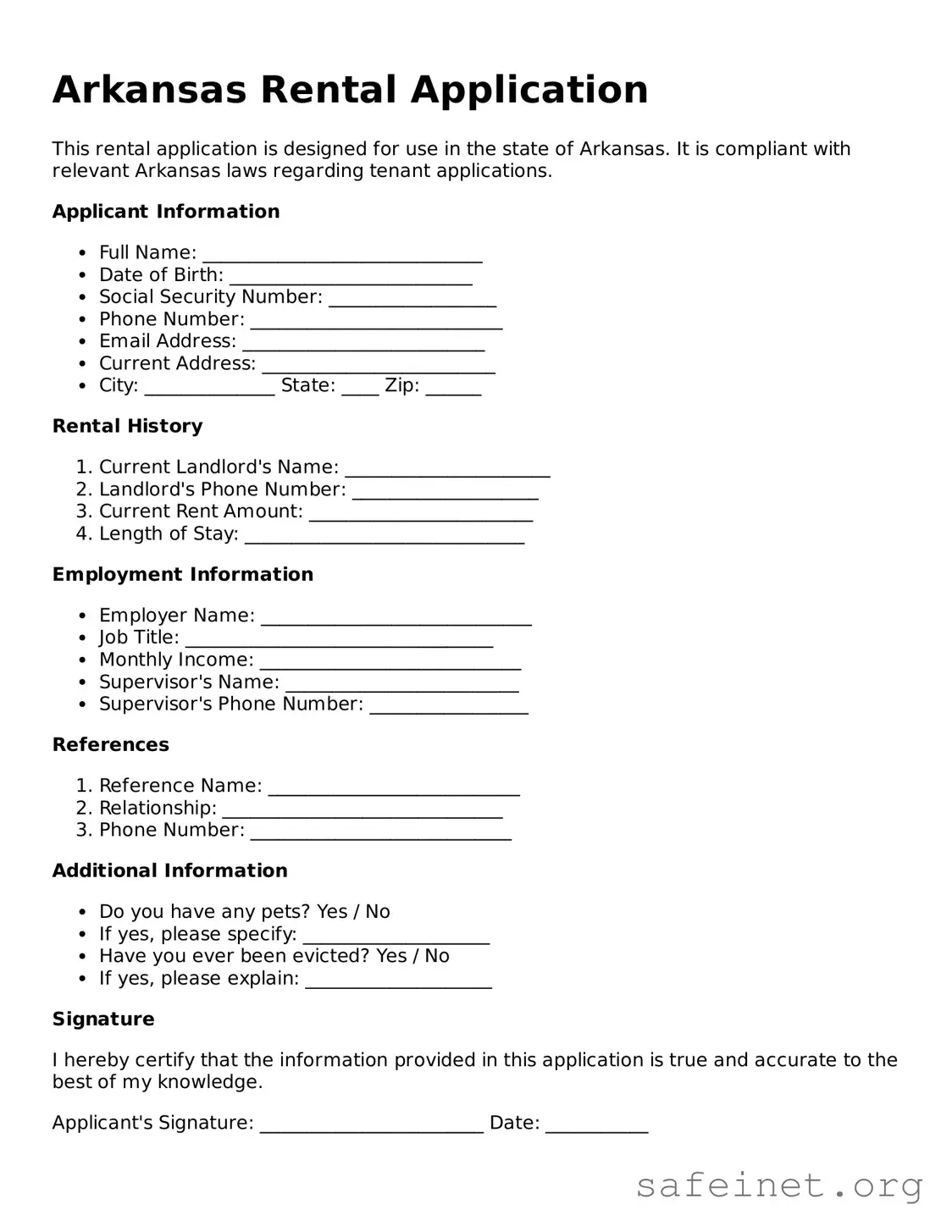
The Arkansas Rental Application form serves as a crucial tool for both landlords and prospective tenants in the rental process. This form typically gathers essential information about the applicant, including personal details such as name, address, and contact information. It often requires applicants to provide their employment history and income details, which help landlords assess financial stability and ability to pay rent. Additionally, applicants may need to disclose rental history, including previous addresses and landlord references. The form also usually includes sections for background checks, which may cover credit history and criminal records, ensuring that landlords can make informed decisions about potential tenants. By completing this application, individuals take an important step toward securing a rental property while landlords gain valuable insights into the suitability of applicants for their rental units.
Arkansas Rental Application
This rental application is designed for use in the state of Arkansas. It is compliant with relevant Arkansas laws regarding tenant applications.
Applicant Information
Rental History
Employment Information
References
Additional Information
Signature
I hereby certify that the information provided in this application is true and accurate to the best of my knowledge.
Applicant's Signature: ________________________ Date: ___________
| Fact Name | Description |
|---|---|
| Purpose | The Arkansas Rental Application form is used by landlords to collect essential information from potential tenants. |
| Required Information | Applicants typically need to provide personal details, rental history, employment information, and references. |
| Application Fee | Landlords may charge an application fee to cover the cost of background checks and processing. |
| Background Check | Landlords often conduct background checks, which may include credit history and criminal records. |
| Fair Housing Laws | The application process must comply with federal and state fair housing laws, prohibiting discrimination based on race, color, religion, sex, disability, familial status, or national origin. |
| Governing Laws | In Arkansas, the rental application process is governed by the Arkansas Residential Landlord-Tenant Act (Arkansas Code Annotated § 18-17-101 et seq.). |
| Security Deposit | While not part of the application itself, landlords may require a security deposit, which is often collected after the application is approved. |
| Approval Process | Once the application is submitted, landlords review the information, which can lead to either approval or denial. |
| Privacy Concerns | Landlords must handle applicants' personal information with care, ensuring compliance with privacy laws. |
Completing the Arkansas Rental Application form is an essential step in securing a rental property. Once you have filled out the form, the landlord or property manager will review your information to determine your eligibility as a tenant. It's important to provide accurate and complete information to enhance your chances of approval.
After completing the form, review it carefully to ensure all information is correct. Submitting a well-filled application can make a significant difference in the rental process.
What is the purpose of the Arkansas Rental Application form?
The Arkansas Rental Application form is used by landlords to collect essential information from prospective tenants. This information helps landlords assess the suitability of applicants based on their rental history, creditworthiness, and ability to pay rent. It serves as a preliminary screening tool to determine which applicants may be invited for a lease agreement.
What information is typically required on the application?
The application generally requires personal information such as the applicant's name, contact details, and social security number. Additionally, it may ask for employment history, income details, rental history, and references. Some applications also include questions about criminal history or pets.
Is there a fee associated with submitting the rental application?
Many landlords charge a non-refundable application fee to cover the costs of background checks and processing. This fee can vary widely depending on the property and the landlord's policies. It is advisable to inquire about the fee before submitting the application.
How long does it take for a landlord to process the application?
The processing time can vary based on several factors, including the landlord's procedures and the volume of applications received. Typically, it may take anywhere from a few hours to several days. Applicants should ask the landlord for an estimated timeline when submitting their application.
Can a landlord deny an application, and what are common reasons for denial?
Yes, a landlord can deny an application for various reasons. Common reasons include a poor credit history, insufficient income to cover rent, negative rental history, or failure to provide accurate information. Landlords must comply with fair housing laws when making these decisions.
What should I do if my application is denied?
If an application is denied, the landlord is typically required to provide a reason. Applicants can request this information in writing. If the denial is based on credit issues, individuals may consider reviewing their credit report for inaccuracies or taking steps to improve their credit before reapplying.
Is it possible to appeal a rental application denial?
While there is no formal process to appeal a rental application denial, applicants can communicate with the landlord to discuss the reasons for denial. In some cases, providing additional documentation or references may help. However, landlords are not obligated to change their decision.
Failing to provide complete personal information. Applicants often leave out essential details such as their full name, current address, or contact information. This can lead to delays in processing the application.
Not disclosing rental history accurately. Some applicants forget to include all previous addresses or provide incorrect dates. This omission can raise red flags for landlords.
Overlooking income verification documentation. Many applicants do not attach necessary proof of income, such as pay stubs or bank statements. Without this information, landlords may reject the application.
Ignoring credit and background check consent. Some individuals neglect to sign the section that allows landlords to conduct background checks. This can result in automatic disqualification.
Providing inaccurate references. Applicants sometimes list friends or family members as references instead of professional contacts. This may not provide landlords with the information they need to assess reliability.
When applying for a rental property in Arkansas, several additional forms and documents may be required alongside the Arkansas Rental Application. These documents help landlords assess potential tenants and ensure that all necessary information is collected. Here’s a list of common forms and documents that are often used in conjunction with the rental application:
Having these forms and documents ready can streamline the rental process and ensure that both landlords and tenants have a clear understanding of their rights and responsibilities. Being prepared can make a significant difference in securing a rental property.
The Arkansas Rental Application form shares similarities with the standard Lease Agreement. Both documents are essential in the rental process. A Lease Agreement outlines the terms of tenancy, including rent amount, duration, and responsibilities of both landlord and tenant. Like the rental application, it requires personal information and may include background checks to ensure the tenant is a good fit for the property.
Another document akin to the Arkansas Rental Application is the Tenant Screening Report. This report often accompanies the application and provides landlords with a detailed background check on potential tenants. It typically includes credit history, rental history, and any criminal records. Both documents aim to help landlords make informed decisions about prospective tenants.
The Rental Agreement is also similar to the Arkansas Rental Application. While the application collects information to evaluate potential tenants, the Rental Agreement formalizes the rental relationship once a tenant is approved. It includes similar personal information and terms that were initially requested in the application, ensuring both parties are clear on expectations.
The Eviction Notice can be compared to the Arkansas Rental Application in that both documents are crucial in the rental process. While the application is used to assess potential tenants, the eviction notice is used when a tenant fails to meet the terms of the lease. Both documents reflect the importance of clear communication and adherence to rental terms.
The Move-In Checklist is another document that shares a connection with the Arkansas Rental Application. After a tenant is approved through the application, the checklist helps document the condition of the property at move-in. This ensures that both landlord and tenant are aware of existing issues, similar to how the application seeks to clarify tenant responsibilities.
The Rental History Verification form is similar as it provides landlords with information about a prospective tenant's past rental experiences. This document often requires the tenant to authorize their previous landlords to share details about their payment history and behavior as tenants. It complements the rental application by offering insights into the applicant's reliability.
The Security Deposit Receipt is another document related to the Arkansas Rental Application. Once a tenant is approved, they typically pay a security deposit to secure the rental. The receipt serves as proof of this transaction. Both documents are part of the financial aspects of renting, ensuring transparency between the landlord and tenant.
The Pet Agreement is similar in that it often accompanies the rental application for tenants with pets. This document outlines the rules and responsibilities regarding pet ownership in the rental unit. Like the rental application, it requires specific information and helps set clear expectations for both parties regarding pet-related issues.
Finally, the Background Check Authorization form is closely related to the Arkansas Rental Application. This document allows landlords to conduct background checks on potential tenants. It typically requires the applicant's consent and is a critical step in the application process, ensuring that landlords can verify the information provided in the rental application.
When filling out the Arkansas Rental Application form, it’s important to approach the process with care. Here are some key dos and don’ts to keep in mind:
By following these guidelines, you can enhance your chances of securing the rental property you desire. Good luck!
Understanding the Arkansas Rental Application form is essential for both landlords and tenants. However, several misconceptions can lead to confusion. Here are nine common misunderstandings regarding this important document:
Being aware of these misconceptions can help prospective tenants navigate the rental process with greater confidence. Understanding the purpose and requirements of the Arkansas Rental Application form is key to a successful rental experience.
When filling out and using the Arkansas Rental Application form, it's important to keep several key points in mind. Here are ten takeaways to consider:
By keeping these points in mind, you can navigate the rental application process more smoothly and increase your chances of securing a rental property.