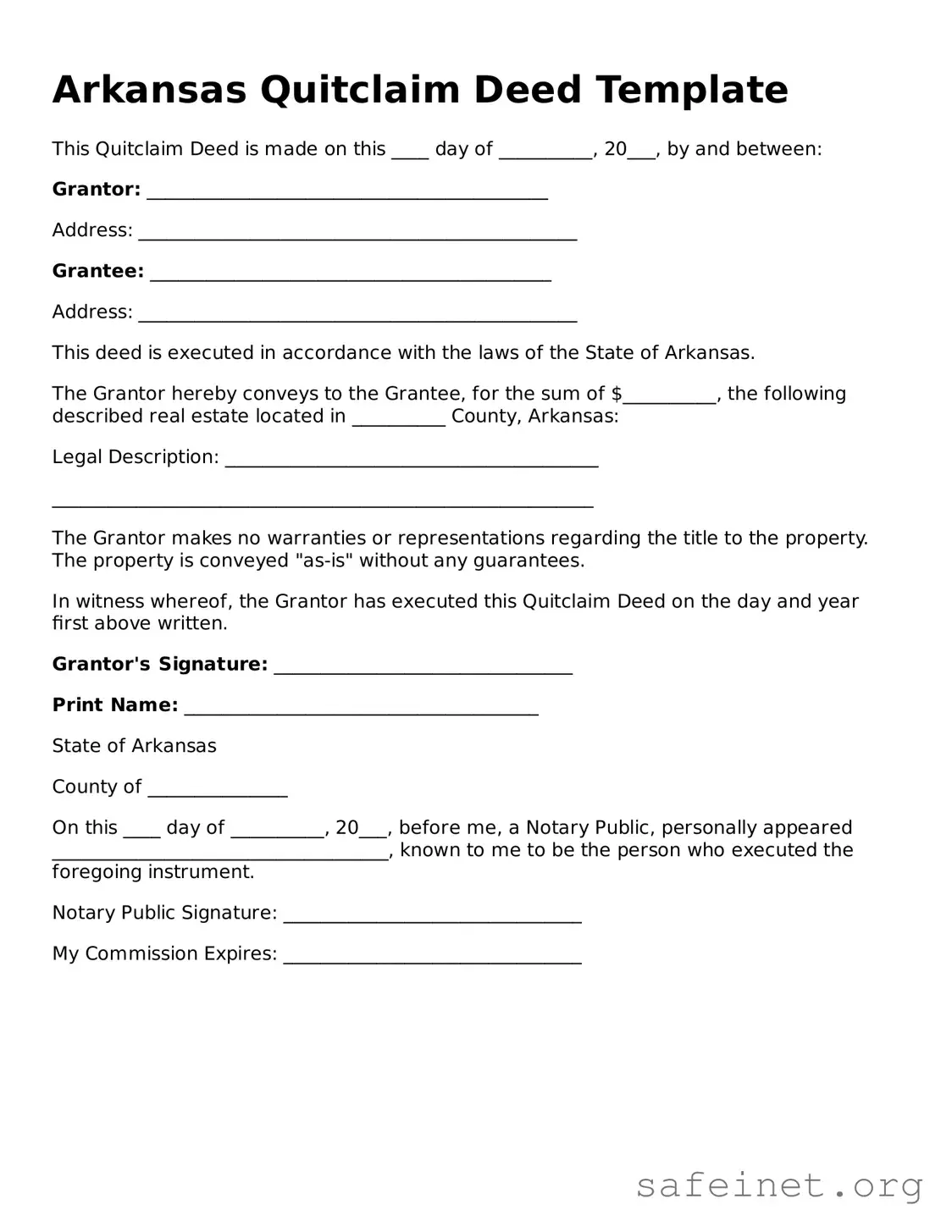
The Arkansas Quitclaim Deed is a crucial legal document used in real estate transactions, particularly when transferring property ownership. This form allows a property owner, known as the grantor, to convey their interest in a property to another party, called the grantee, without guaranteeing the quality of the title. Unlike warranty deeds, which provide a level of protection against claims, a quitclaim deed simply transfers whatever interest the grantor has, if any. This makes it a popular choice for situations involving family transfers, divorces, or clearing up title issues. The form must include specific details, such as the names of both parties, a description of the property, and the date of the transfer. Additionally, it requires the signature of the grantor and may need to be notarized to be legally binding. Understanding the nuances of this document is essential for anyone looking to navigate property transfers in Arkansas effectively.
Arkansas Quitclaim Deed Template
This Quitclaim Deed is made on this ____ day of __________, 20___, by and between:
Grantor: ___________________________________________
Address: _______________________________________________
Grantee: ___________________________________________
Address: _______________________________________________
This deed is executed in accordance with the laws of the State of Arkansas.
The Grantor hereby conveys to the Grantee, for the sum of $__________, the following described real estate located in __________ County, Arkansas:
Legal Description: ________________________________________
__________________________________________________________
The Grantor makes no warranties or representations regarding the title to the property. The property is conveyed "as-is" without any guarantees.
In witness whereof, the Grantor has executed this Quitclaim Deed on the day and year first above written.
Grantor's Signature: ________________________________
Print Name: ______________________________________
State of Arkansas
County of _______________
On this ____ day of __________, 20___, before me, a Notary Public, personally appeared ____________________________________, known to me to be the person who executed the foregoing instrument.
Notary Public Signature: ________________________________
My Commission Expires: ________________________________
| Fact Name | Description |
|---|---|
| Definition | A quitclaim deed is a legal document that transfers ownership of real estate from one party to another without any warranties regarding the title. |
| Governing Law | The Arkansas Quitclaim Deed is governed by the Arkansas Code Annotated, Title 18, Chapter 12. |
| Use Cases | Commonly used in property transfers between family members, divorce settlements, or to clear up title issues. |
| Execution Requirements | The deed must be signed by the grantor and acknowledged before a notary public. |
| Recording | To provide public notice of the transfer, the quitclaim deed should be recorded with the county clerk's office where the property is located. |
| Limitations | A quitclaim deed does not guarantee that the grantor has clear title to the property, which may leave the grantee vulnerable to claims from other parties. |
After obtaining the Arkansas Quitclaim Deed form, you will need to complete it accurately to ensure the transfer of property rights is legally recognized. Follow the steps below to fill out the form correctly.
What is a Quitclaim Deed in Arkansas?
A Quitclaim Deed is a legal document used to transfer ownership of real estate in Arkansas. Unlike a warranty deed, it does not guarantee that the property title is free from claims or liens. Instead, it simply conveys whatever interest the grantor has in the property at the time of the transfer. This type of deed is often used among family members or in situations where the parties know each other well, as it provides less protection for the buyer.
How do I complete an Arkansas Quitclaim Deed?
To complete a Quitclaim Deed in Arkansas, you need to gather specific information, including the names of the grantor (the person transferring the property) and the grantee (the person receiving the property), a legal description of the property, and the date of the transfer. The form must be signed by the grantor in the presence of a notary public. After signing, it should be filed with the county clerk’s office in the county where the property is located.
Are there any fees associated with filing a Quitclaim Deed in Arkansas?
Yes, there are fees for filing a Quitclaim Deed in Arkansas. The exact amount can vary by county, so it’s advisable to check with your local county clerk’s office for the current filing fees. Additionally, there may be costs associated with obtaining a notary public’s services if you do not have access to one.
Do I need an attorney to create a Quitclaim Deed in Arkansas?
While it is not legally required to have an attorney to create a Quitclaim Deed in Arkansas, consulting one can be beneficial. An attorney can help ensure that the deed is completed correctly and meets all legal requirements. This can prevent potential issues or disputes in the future regarding property ownership.
Can a Quitclaim Deed be revoked in Arkansas?
Once a Quitclaim Deed is executed and filed, it cannot be revoked unilaterally. However, the grantor can create a new deed to reverse the transfer or convey the property back to themselves. This process involves drafting a new deed, signing it, and filing it with the county clerk. It’s important to keep in mind that any new deed must also comply with Arkansas laws regarding property transfers.
Incorrect Property Description: One common mistake is failing to provide a complete and accurate description of the property. This includes not specifying the correct parcel number or omitting details about the property's boundaries.
Missing Signatures: Another frequent error is neglecting to obtain the necessary signatures from all parties involved. A quitclaim deed requires the signature of the grantor, and in some cases, the grantee's signature may also be needed.
Improper Notarization: Many individuals overlook the requirement for notarization. A quitclaim deed must be notarized to be valid. Without this step, the document may not be enforceable.
Failure to Record the Deed: After completing the form, some people forget to file the quitclaim deed with the appropriate county office. Recording the deed is crucial to ensure that the transfer of property rights is legally recognized.
A Quitclaim Deed is a vital document used in property transactions in Arkansas. However, it often works in conjunction with several other forms and documents to ensure a smooth transfer of property ownership. Understanding these additional documents can help clarify the process and safeguard the interests of all parties involved.
Each of these documents plays a significant role in the property transfer process. Familiarity with them can help individuals navigate the complexities of real estate transactions in Arkansas, ensuring that their rights and interests are protected throughout the process.
A Warranty Deed serves a similar purpose to a Quitclaim Deed, as both are used to transfer ownership of real estate. However, the key difference lies in the level of protection offered to the buyer. A Warranty Deed guarantees that the seller holds clear title to the property and has the right to transfer it. This means that if any issues arise regarding the title, the seller is legally responsible for resolving them. In contrast, a Quitclaim Deed does not provide such assurances, leaving the buyer with less security regarding the property’s title.
A Bargain and Sale Deed is another document that shares similarities with a Quitclaim Deed. This type of deed conveys property from one party to another but does not include warranties about the title. Like a Quitclaim Deed, a Bargain and Sale Deed transfers the interest in the property without guaranteeing that the title is free from encumbrances. Buyers may find this type of deed useful in certain situations, especially when they are aware of the property’s history and are willing to accept the risks involved.
An Executor’s Deed is often used in the context of estate settlements and can resemble a Quitclaim Deed in its function. This document is utilized when an executor of an estate transfers property to heirs or beneficiaries. While it may not provide the same level of assurance as a Warranty Deed, it serves to facilitate the transfer of property rights. The Executor’s Deed typically confirms that the executor has the authority to make the transfer, similar to how a Quitclaim Deed confirms the seller’s interest in the property.
A Special Purpose Deed, such as a Deed in Lieu of Foreclosure, can also be likened to a Quitclaim Deed. This type of deed is used when a property owner voluntarily transfers the title to a lender to avoid foreclosure. Like a Quitclaim Deed, it does not provide warranties regarding the title. Instead, it allows the lender to take ownership of the property directly, often simplifying the process for both parties. The lack of guarantees means that the lender assumes the risks associated with the property’s title.
Finally, a Deed of Trust, while primarily a security instrument, shares some characteristics with a Quitclaim Deed. This document is used in real estate transactions to secure a loan with the property itself as collateral. Although it serves a different primary purpose, both documents involve the transfer of property rights. A Deed of Trust allows the lender to take possession of the property if the borrower defaults on the loan, similar to how a Quitclaim Deed transfers interest without guarantees. This connection highlights the various ways property rights can be conveyed or secured in real estate transactions.
Filling out a Quitclaim Deed form in Arkansas can seem daunting, but following a few straightforward guidelines can help ensure the process goes smoothly. Here’s a list of things you should and shouldn’t do when completing this important document.
By following these guidelines, you can help ensure that your Quitclaim Deed is completed accurately and efficiently. Taking the time to do it right now can save you headaches in the future.
When it comes to the Arkansas Quitclaim Deed form, several misconceptions can lead to confusion. Here are four common misunderstandings:
Many people believe that a Quitclaim Deed guarantees clear title to the property. In reality, it transfers whatever interest the grantor has, if any, without any promises regarding the title's validity. This means the grantee may not receive full ownership rights.
While it's true that Quitclaim Deeds are often used among family members, they are not limited to such transactions. They can be used in various situations, including sales or transfers between unrelated parties.
Some individuals think that by using a Quitclaim Deed, they can avoid any future claims or liabilities associated with the property. However, the grantor may still face legal repercussions if there are existing liens or other issues tied to the property.
Many believe that recording a Quitclaim Deed is optional. However, to protect the grantee's interests and ensure the transfer is recognized legally, it is essential to record the deed with the appropriate county office.
Here are some key takeaways about filling out and using the Arkansas Quitclaim Deed form: