In Arkansas, a prenuptial agreement serves as a crucial tool for couples planning to marry, allowing them to outline the division of assets and responsibilities in the event of a divorce or separation. This legally binding document can address various aspects of a couple's financial future, including property rights, debt responsibilities, and spousal support. By discussing these matters before tying the knot, partners can foster transparency and reduce potential conflicts down the road. The form typically includes sections detailing each party's assets and liabilities, provisions for the management of property acquired during the marriage, and stipulations regarding inheritance rights. Additionally, it may outline how to handle financial matters during the marriage, ensuring both individuals feel secure and understood. Ultimately, a well-crafted prenuptial agreement can help couples enter into marriage with a clear understanding of their financial landscape, promoting harmony and mutual respect in their relationship.
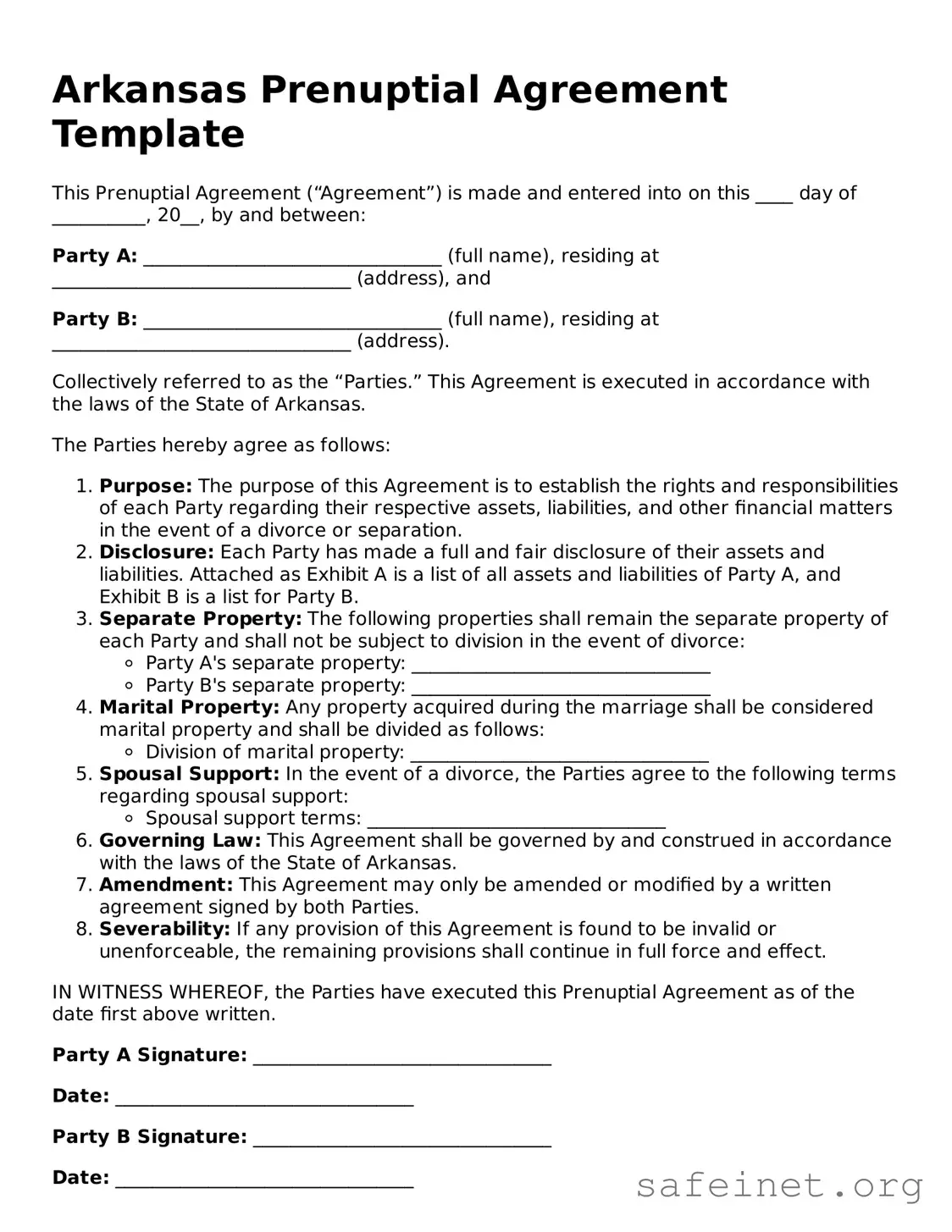
Arkansas Prenuptial Agreement Template
This Prenuptial Agreement (“Agreement”) is made and entered into on this ____ day of __________, 20__, by and between:
Party A: ________________________________ (full name), residing at ________________________________ (address), and
Party B: ________________________________ (full name), residing at ________________________________ (address).
Collectively referred to as the “Parties.” This Agreement is executed in accordance with the laws of the State of Arkansas.
The Parties hereby agree as follows:
IN WITNESS WHEREOF, the Parties have executed this Prenuptial Agreement as of the date first above written.
Party A Signature: ________________________________
Date: ________________________________
Party B Signature: ________________________________
Date: ________________________________
| Fact Name | Details |
|---|---|
| Definition | An Arkansas prenuptial agreement is a contract between two individuals before marriage that outlines the distribution of assets and financial responsibilities in the event of divorce or separation. |
| Governing Law | Arkansas Code Annotated § 9-11-401 governs prenuptial agreements in the state. |
| Written Requirement | In Arkansas, a prenuptial agreement must be in writing to be legally enforceable. |
| Voluntary Execution | Both parties must voluntarily sign the agreement without any coercion or undue influence. |
| Full Disclosure | Each party should fully disclose their assets and liabilities to ensure fairness and transparency. |
| Notarization | While notarization is not required, it is recommended to strengthen the agreement's validity. |
| Modification | Parties can modify the prenuptial agreement after marriage, but any changes must also be in writing. |
| Enforceability | A prenuptial agreement can be challenged in court if it is deemed unconscionable or if one party did not have legal representation. |
| Scope of Agreement | The agreement can cover various issues, including property division, spousal support, and debt responsibilities. |
Filling out the Arkansas Prenuptial Agreement form is a straightforward process that requires careful attention to detail. This document serves as a way for couples to outline their financial arrangements before marriage. By taking the time to complete it accurately, you can ensure that both parties are on the same page regarding their assets and liabilities.
Once the form is filled out and signed, it’s important to keep a copy for your records. Both parties should have access to the finalized document, as it can be referred to in the future if needed. This proactive step can help maintain clarity and understanding in your financial relationship as you embark on your marriage journey.
What is a prenuptial agreement in Arkansas?
A prenuptial agreement, often called a "prenup," is a legal document that couples create before getting married. It outlines how assets and debts will be divided in the event of a divorce or separation. In Arkansas, this agreement can also address issues like spousal support and property rights, helping to clarify expectations and reduce potential conflicts in the future.
Why should I consider a prenuptial agreement?
Many couples find that a prenuptial agreement provides peace of mind. It allows both parties to discuss their financial situations openly and set clear terms for how assets will be managed. This can be especially important for individuals entering a marriage with significant assets, business interests, or children from previous relationships.
What should be included in an Arkansas prenuptial agreement?
While each prenuptial agreement can be tailored to fit the couple's needs, common elements include the identification of separate and marital property, the division of assets and debts, and provisions for spousal support. It’s important to be thorough and clear to avoid misunderstandings later on.
Are there any requirements for a prenuptial agreement in Arkansas?
Yes, for a prenuptial agreement to be valid in Arkansas, it must be in writing and signed by both parties. Additionally, both individuals should fully disclose their financial situations, including assets and liabilities, to ensure fairness and transparency.
Can a prenuptial agreement be changed after marriage?
Yes, a prenuptial agreement can be modified after marriage. Both parties must agree to the changes, and it is advisable to document any amendments in writing. This ensures that both individuals are on the same page and helps maintain clarity regarding financial matters.
Is a prenuptial agreement enforceable in Arkansas?
Generally, prenuptial agreements are enforceable in Arkansas as long as they meet the legal requirements. However, if one party can prove that the agreement was signed under duress, fraud, or without full disclosure, it may be challenged in court. It’s crucial to approach the agreement with transparency and mutual consent.
Do I need a lawyer to create a prenuptial agreement?
While it is not legally required to have a lawyer, it is highly recommended. An attorney can help ensure that the agreement is legally sound, fair, and tailored to your specific needs. They can also provide valuable guidance throughout the process, helping to avoid potential pitfalls.
How can I ensure my prenuptial agreement is fair?
To create a fair prenuptial agreement, both parties should engage in open discussions about their financial situations and expectations. Each person should have independent legal counsel to ensure their interests are protected. Being honest and transparent about assets and debts is key to achieving a balanced agreement.
What happens if we don’t have a prenuptial agreement?
If a couple does not have a prenuptial agreement and later divorces, the division of property and debts will be determined by Arkansas law. This can sometimes lead to unexpected outcomes, as the court will make decisions based on state guidelines rather than the couple’s preferences. Having a prenup can provide clarity and control over these matters.
Neglecting to Disclose All Assets: One of the most common mistakes individuals make is failing to fully disclose their assets. It’s crucial to list all property, income, and debts. Omitting information can lead to disputes later on.
Using Ambiguous Language: Clarity is key when drafting a prenuptial agreement. Vague terms can create confusion and lead to different interpretations. Ensure that all terms are clearly defined to avoid misunderstandings.
Not Seeking Legal Advice: Many individuals attempt to fill out the form without consulting a legal professional. This can result in overlooking important legal requirements or implications. It’s wise to seek guidance to ensure that the agreement is enforceable.
Failing to Update the Agreement: Life circumstances can change, and so should your prenuptial agreement. Failing to revisit and update the document after significant life events, such as the birth of a child or a change in financial status, can lead to complications.
When preparing a prenuptial agreement in Arkansas, several other forms and documents may be necessary to ensure a comprehensive understanding of the parties' intentions and financial situations. Below is a list of related documents that can complement the prenuptial agreement.
These documents can help create a clearer picture of each party's financial landscape and intentions, ultimately leading to a more effective prenuptial agreement. Being thorough and organized can ease the process and strengthen the relationship moving forward.
The Arkansas Prenuptial Agreement form shares similarities with a Marital Settlement Agreement. Both documents outline the division of assets and responsibilities between spouses, particularly during a divorce. A Marital Settlement Agreement is typically executed after marriage, while a Prenuptial Agreement is established before the marriage takes place. Both serve to protect individual interests and clarify financial arrangements, ensuring that both parties have a clear understanding of their rights and obligations.
Another document that resembles the Arkansas Prenuptial Agreement is a Postnuptial Agreement. Like a prenuptial agreement, a postnuptial agreement addresses the division of assets and liabilities. However, it is created after the marriage has occurred. Couples may choose to draft a postnuptial agreement to reflect changes in their financial situation or to clarify terms that were not addressed prior to marriage. Both agreements aim to provide clarity and security for both parties.
The Arkansas Prenuptial Agreement also aligns with a Cohabitation Agreement. This document is designed for couples who live together but are not married. Similar to a prenuptial agreement, a cohabitation agreement specifies how assets will be divided if the relationship ends. It can also outline responsibilities related to shared expenses. Both documents help establish expectations and protect individual rights, promoting transparency in financial matters.
A Separation Agreement is another document that shares characteristics with the Arkansas Prenuptial Agreement. This agreement is utilized when a couple decides to separate but not divorce. It addresses the division of property, debts, and other financial matters. Like a prenuptial agreement, a separation agreement aims to provide a clear framework for both parties, ensuring that their interests are protected during the separation process.
The Arkansas Prenuptial Agreement is also similar to a Domestic Partnership Agreement. This document is often used by couples in domestic partnerships to outline their rights and responsibilities regarding property and finances. Both agreements serve to clarify the terms of the relationship and protect individual interests, particularly in states where domestic partnerships are recognized. They provide a legal framework for couples who may not choose to marry but still want to establish financial security.
Another comparable document is the Financial Disclosure Statement. While not an agreement itself, this document often accompanies prenuptial agreements. It requires both parties to disclose their financial assets, debts, and income. This transparency is crucial for ensuring that both parties make informed decisions and understand the financial implications of the agreement. Both documents work together to promote fairness and clarity in financial matters.
The Arkansas Prenuptial Agreement also resembles a Will in that both documents address the distribution of assets. A will outlines how a person's estate will be handled after their death, while a prenuptial agreement governs the distribution of assets during marriage or in the event of divorce. Both documents are essential for ensuring that individual wishes are respected and that assets are allocated according to the individual's desires.
Similar to a Trust Agreement, the Arkansas Prenuptial Agreement can establish how assets will be managed and distributed. Trusts are often used to protect assets and provide for beneficiaries, while prenuptial agreements outline the financial rights of each spouse during and after marriage. Both documents provide a mechanism for asset protection and management, helping individuals secure their financial future.
Lastly, the Arkansas Prenuptial Agreement can be compared to a Power of Attorney. While a power of attorney grants someone the authority to make decisions on behalf of another, it can also include financial matters. Both documents empower individuals to make choices regarding their finances, ensuring that their interests are upheld, whether during marriage or in the event of incapacity.
When filling out the Arkansas Prenuptial Agreement form, it is essential to follow certain guidelines to ensure that the document is valid and meets your needs. Below is a list of things you should and shouldn't do during this process.
By adhering to these guidelines, you can create a prenuptial agreement that is clear, fair, and legally enforceable.
Understanding prenuptial agreements in Arkansas can be challenging due to common misconceptions. Here are seven prevalent myths:
This is not true. Prenuptial agreements can benefit anyone, regardless of income. They help clarify financial responsibilities and protect individual assets.
While often associated with divorce, these agreements can also outline financial expectations during the marriage, providing clarity and reducing conflict.
When properly drafted and executed, prenuptial agreements are legally enforceable in Arkansas, provided they meet state requirements.
There are limitations. For instance, agreements cannot include child custody or support arrangements, as these must be determined based on the child's best interests at the time of divorce.
First-time marriages can also benefit from prenuptial agreements. They help ensure that both parties understand their financial situation and responsibilities.
While they can be complex, many couples find that with clear communication and the help of a qualified attorney, the process can be straightforward and affordable.
This misconception can create unnecessary tension. Many couples view prenuptial agreements as a proactive step to protect their relationship and financial interests.
Addressing these misconceptions can help individuals make informed decisions about prenuptial agreements in Arkansas.
When considering a prenuptial agreement in Arkansas, there are several important points to keep in mind. Here are key takeaways to help you navigate the process:
Taking these steps can help create a solid foundation for your marriage and protect both partners' interests.