In Arkansas, the Power of Attorney for a Child form serves as a crucial legal document that allows a parent or legal guardian to designate another individual to make decisions on behalf of their child. This form can be particularly useful in various situations, such as when a parent is temporarily unable to care for their child due to work commitments, medical issues, or travel. By granting this authority, the designated agent can manage the child's day-to-day needs, including decisions related to education, healthcare, and general welfare. It is important to note that this power is typically limited in duration, often expiring after a set period or upon the return of the parent. Additionally, the form requires the signatures of both the parent and the designated agent, ensuring that all parties are in agreement and that the child's best interests are prioritized. Understanding the implications and proper use of this form can help parents navigate challenging circumstances while ensuring their child's well-being is maintained.
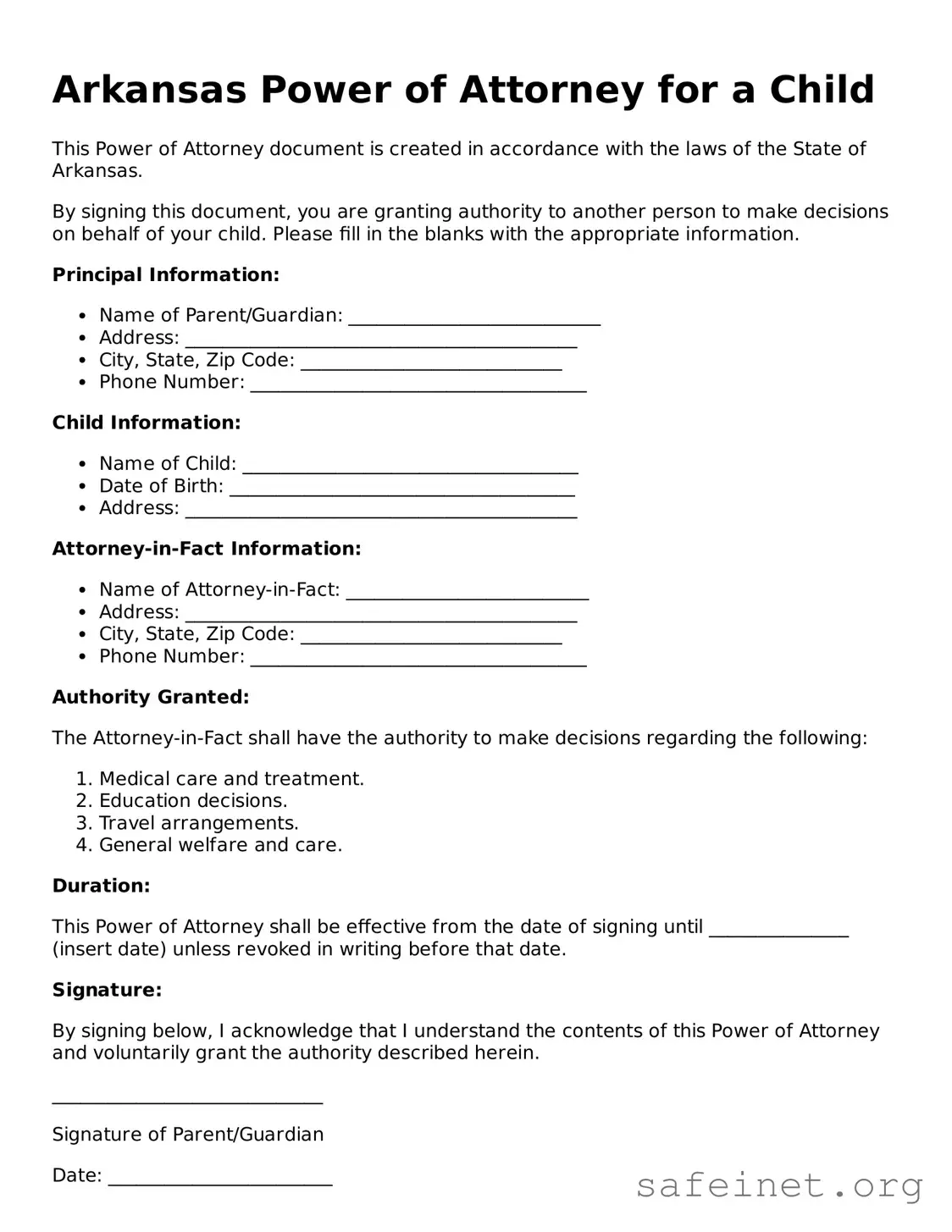
Arkansas Power of Attorney for a Child
This Power of Attorney document is created in accordance with the laws of the State of Arkansas.
By signing this document, you are granting authority to another person to make decisions on behalf of your child. Please fill in the blanks with the appropriate information.
Principal Information:
Child Information:
Attorney-in-Fact Information:
Authority Granted:
The Attorney-in-Fact shall have the authority to make decisions regarding the following:
Duration:
This Power of Attorney shall be effective from the date of signing until _______________ (insert date) unless revoked in writing before that date.
Signature:
By signing below, I acknowledge that I understand the contents of this Power of Attorney and voluntarily grant the authority described herein.
_____________________________
Signature of Parent/Guardian
Date: ________________________
Notary Acknowledgment:
State of Arkansas
County of _____________________
Subscribed and sworn to before me this _____ day of ______________, 20__.
_____________________________
Notary Public
My commission expires: _______________
| Fact Name | Details |
|---|---|
| Purpose | The Arkansas Power of Attorney for a Child form allows a parent or legal guardian to grant another adult the authority to make decisions on behalf of their child. |
| Governing Law | This form is governed by Arkansas Code Annotated § 9-26-101 et seq., which outlines the legal framework for powers of attorney in the state. |
| Duration | The authority granted through this form can be set for a specific duration or remain in effect until revoked by the parent or guardian. |
| Revocation | A parent or guardian can revoke the power of attorney at any time, provided that they notify the designated agent and any relevant parties. |
| Notarization | The form typically requires notarization to ensure its validity and to protect against potential disputes regarding authority. |
Filling out the Arkansas Power of Attorney for a Child form is an important step in ensuring that someone you trust can make decisions on behalf of your child when you are unavailable. Follow these steps to complete the form accurately.
What is a Power of Attorney for a Child in Arkansas?
A Power of Attorney for a Child in Arkansas is a legal document that allows a parent or guardian to designate another adult to make decisions on behalf of their child. This can include decisions about education, healthcare, and general welfare. It is particularly useful when parents are temporarily unable to care for their child due to travel, illness, or other circumstances.
Who can be designated as an agent in the Power of Attorney for a Child?
The agent can be any responsible adult, such as a relative, family friend, or neighbor. However, it is essential to choose someone trustworthy and capable of making decisions in the best interest of the child. The selected agent should be informed about their responsibilities and willing to accept the role.
How long is the Power of Attorney for a Child valid?
The Power of Attorney for a Child remains in effect until the specified expiration date, if one is provided. If no expiration date is included, the document typically remains valid until the child reaches the age of majority, which is 18 years old in Arkansas. Parents can also revoke the document at any time by providing written notice.
Do I need to have the Power of Attorney for a Child notarized?
Yes, in Arkansas, the Power of Attorney for a Child must be signed in the presence of a notary public to be considered valid. Notarization helps to ensure that the document is legally binding and can be recognized by schools, healthcare providers, and other institutions.
Can the Power of Attorney for a Child be used for medical decisions?
Yes, the Power of Attorney for a Child can grant the agent the authority to make medical decisions on behalf of the child. However, it is advisable to specify this authority clearly in the document to avoid any confusion. Parents should also discuss their wishes regarding medical care with the agent.
What happens if the designated agent is unavailable?
If the designated agent is unavailable or unable to fulfill their responsibilities, the Power of Attorney does not automatically appoint a new agent. Parents should consider naming an alternate agent in the document to ensure that there is someone else available to make decisions if needed.
Can I use a Power of Attorney for a Child for educational purposes?
Absolutely! The Power of Attorney for a Child can be used to authorize the agent to make educational decisions, such as enrolling the child in school, signing permission slips, or attending parent-teacher meetings. Clear communication about educational preferences is essential to ensure that the agent acts in the child’s best interest.
Is there a fee associated with creating a Power of Attorney for a Child?
While there may be no official fee for creating the Power of Attorney document itself, there could be costs associated with notarization. Additionally, if you seek legal assistance to draft the document, attorney fees may apply. It’s wise to consider these potential costs when planning.
Can I revoke the Power of Attorney for a Child once it is created?
Yes, parents have the right to revoke the Power of Attorney for a Child at any time. This can be done by providing a written notice to the agent and any institutions that were relying on the document. It’s important to ensure that all parties are informed to avoid any misunderstandings.
Where can I obtain a Power of Attorney for a Child form in Arkansas?
Power of Attorney for a Child forms can often be obtained from legal stationery stores, online legal services, or local family law attorneys. Additionally, some state government websites may provide templates or resources to help parents create this document. Always ensure that the form complies with Arkansas law.
Not providing complete information about the child. Ensure that you fill in the child's full name, date of birth, and any other required details.
Forgetting to include the agent's information. The person you choose to act on your behalf must be clearly identified with their full name and contact details.
Neglecting to specify the powers granted. Clearly outline what decisions the agent can make. This may include medical decisions, educational choices, or travel permissions.
Failing to sign and date the form. Without your signature and the date, the document is not valid. Make sure to double-check this before submission.
Not having the form notarized. In Arkansas, a notary public must witness your signature to make the document legally binding. This step is crucial.
When establishing a Power of Attorney for a Child in Arkansas, several additional forms and documents may be beneficial to ensure comprehensive legal coverage. These documents can help clarify responsibilities, rights, and other important aspects of child care and custody. Below is a list of forms commonly used alongside the Power of Attorney for a Child.
Utilizing these forms in conjunction with the Power of Attorney for a Child can help provide clarity and ensure that the child's needs are met effectively. Each document serves a specific purpose and can be crucial in various situations involving child care and custody.
The Arkansas Power of Attorney for a Child form is similar to a General Power of Attorney, which allows one person to act on behalf of another in various legal matters. Both documents grant authority to an agent, enabling them to make decisions and sign documents. However, the General Power of Attorney can cover a wide range of issues, including financial and healthcare decisions, while the Power of Attorney for a Child is specifically tailored for decisions related to the care and custody of a minor child.
Another related document is the Medical Power of Attorney. This form specifically empowers someone to make medical decisions on behalf of another person. Like the Power of Attorney for a Child, it is focused on a specific area—in this case, healthcare. The Medical Power of Attorney is often used when an individual is unable to communicate their healthcare wishes, while the Power of Attorney for a Child is used when parents or guardians need someone else to care for their child temporarily.
The Guardianship Agreement shares similarities with the Power of Attorney for a Child as both involve the care of minors. A Guardianship Agreement is a legal arrangement where a guardian is appointed to take care of a child, usually in situations where the biological parents are unable to do so. While the Power of Attorney allows for temporary delegation of authority, guardianship is typically a more permanent solution, involving court approval and oversight.
The Child Custody Agreement is another document that relates closely to the Power of Attorney for a Child. This agreement outlines the legal and physical custody arrangements for a child, detailing who has the right to make decisions regarding the child's upbringing. While the Power of Attorney grants temporary authority for specific decisions, a Child Custody Agreement is often more formal and long-term, established during divorce or separation proceedings.
The Temporary Guardianship form is similar in purpose to the Power of Attorney for a Child, as both documents allow for the care of a child by someone other than the parent. A Temporary Guardianship form is often used in emergencies or when parents are unavailable. It provides legal authority to the guardian for a limited time, just as the Power of Attorney for a Child allows parents to designate someone to care for their child during specific circumstances.
The Adoption Agreement also bears resemblance to the Power of Attorney for a Child, particularly in the context of parental rights. An Adoption Agreement transfers parental rights from biological parents to adoptive parents. While the Power of Attorney for a Child does not terminate parental rights, it allows parents to delegate their authority temporarily. Both documents involve significant decisions regarding a child's upbringing and welfare.
The Foster Care Agreement is another document that relates to child welfare. This agreement outlines the terms under which a child is placed in foster care. Like the Power of Attorney for a Child, it involves the temporary care of a child by a person who is not their biological parent. However, a Foster Care Agreement typically involves state intervention and oversight, while the Power of Attorney is a private arrangement between parents and their chosen agent.
Lastly, the Consent to Travel form is similar in that it allows a designated individual to make decisions regarding a child's travel. This document is often used when a child is traveling with someone other than their parents. Like the Power of Attorney for a Child, it serves to clarify authority and responsibility for the child’s welfare during the travel period, ensuring that the designated individual can act on behalf of the parents.
When filling out the Arkansas Power of Attorney for a Child form, there are important steps to follow. Here’s a list of what to do and what to avoid.
Understanding the Arkansas Power of Attorney for a Child form is essential for parents and guardians. However, several misconceptions can lead to confusion. Here are eight common misunderstandings:
Many believe this form is only useful in crisis situations. In reality, it can be used for various circumstances, including travel or temporary guardianship, providing flexibility for parents.
This form is not limited to legal guardians. Parents can designate anyone they trust, such as relatives or close friends, to act on their behalf.
Some assume the Power of Attorney lasts indefinitely. However, it is essential to specify an expiration date or event, as the authority may not be valid forever.
While legal advice can be beneficial, it is not mandatory to have a lawyer draft the form. Parents can fill it out themselves, as long as they follow the guidelines.
Many fear that signing this form relinquishes their parental rights. In fact, it grants temporary authority, and parents retain their rights unless stated otherwise.
Some think the form is limited to healthcare decisions. However, it can also cover education and general welfare, allowing for a broader range of responsibilities.
This form is often confused with guardianship. A Power of Attorney is temporary and can be revoked, while guardianship is a more permanent legal status.
Many believe the form is only valid within Arkansas. However, it can be recognized in other states, although checking local laws is advisable for specific requirements.
Clearing up these misconceptions can help parents and guardians use the Power of Attorney for a Child form effectively, ensuring their child's needs are met in various situations.
Filling out and using the Arkansas Power of Attorney for a Child form is straightforward, but there are important details to keep in mind. Here are key takeaways to ensure a smooth process:
Following these steps will help ensure that the power of attorney is effective and that your child’s needs are met when you are not available.