When forming a limited liability company (LLC) in Arkansas, one crucial document comes into play: the Operating Agreement. This form serves as the backbone of your business, outlining the management structure, operational procedures, and member responsibilities. It addresses essential topics such as ownership percentages, voting rights, and profit distribution, ensuring that all members are on the same page. By clearly defining roles and expectations, the Operating Agreement helps prevent disputes and fosters a collaborative environment among members. Additionally, while Arkansas law does not require an Operating Agreement, having one in place can significantly enhance the credibility of your LLC and provide legal protection. Understanding the key elements of this agreement is vital for any entrepreneur looking to navigate the complexities of business ownership in the Natural State.
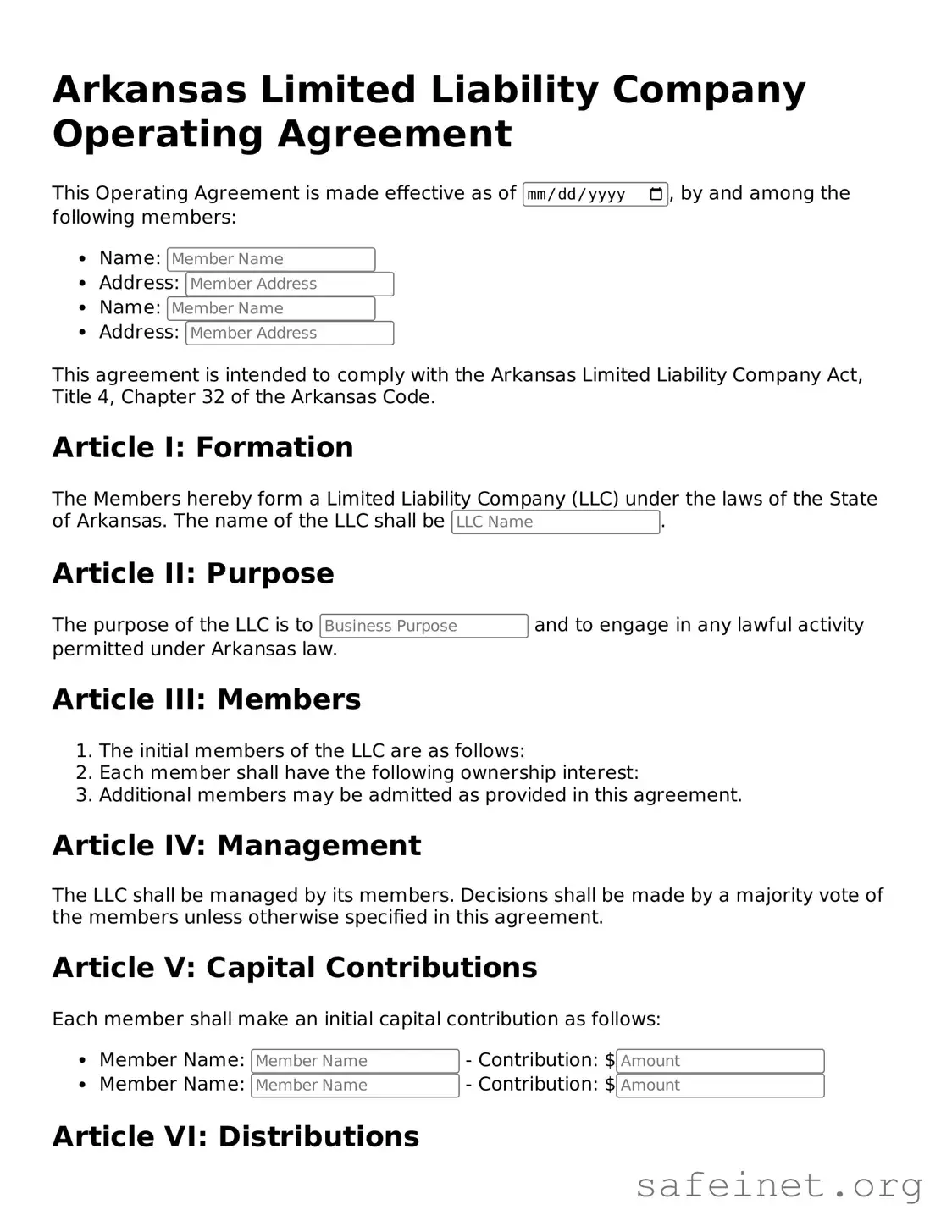
Arkansas Limited Liability Company Operating Agreement
This Operating Agreement is made effective as of , by and among the following members:
This agreement is intended to comply with the Arkansas Limited Liability Company Act, Title 4, Chapter 32 of the Arkansas Code.
Article I: Formation
The Members hereby form a Limited Liability Company (LLC) under the laws of the State of Arkansas. The name of the LLC shall be .
Article II: Purpose
The purpose of the LLC is to and to engage in any lawful activity permitted under Arkansas law.
Article III: Members
Article IV: Management
The LLC shall be managed by its members. Decisions shall be made by a majority vote of the members unless otherwise specified in this agreement.
Article V: Capital Contributions
Each member shall make an initial capital contribution as follows:
Article VI: Distributions
Distributions of profits and losses shall be made to the members in proportion to their ownership interests unless otherwise agreed upon.
Article VII: Indemnification
The LLC shall indemnify its members to the fullest extent permitted by Arkansas law against any losses or damages incurred in connection with the LLC.
Article VIII: Amendments
This Operating Agreement may be amended only by a written agreement signed by all members.
Article IX: Governing Law
This agreement shall be governed by and construed in accordance with the laws of the State of Arkansas.
IN WITNESS WHEREOF, the undersigned members have executed this Operating Agreement as of the date first above written.
| Fact Name | Description |
|---|---|
| Governing Law | The Arkansas Operating Agreement is governed by the Arkansas Limited Liability Company Act. |
| Purpose | This document outlines the management structure and operational procedures of an LLC in Arkansas. |
| Members' Rights | The agreement specifies the rights and responsibilities of each member of the LLC. |
| Management Structure | It can establish either a member-managed or manager-managed structure for the LLC. |
| Profit Distribution | The agreement details how profits and losses will be allocated among members. |
| Amendments | Members can outline procedures for amending the Operating Agreement in the document. |
| Indemnification | Provisions for indemnification of members and managers can be included to protect them from certain liabilities. |
| Dispute Resolution | Members may choose to include methods for resolving disputes, such as mediation or arbitration. |
| Duration | The agreement can specify the duration of the LLC, whether it is perpetual or for a limited time. |
| Filing Requirement | While not required to be filed with the state, it is recommended to keep the agreement on record for internal purposes. |
Filling out the Arkansas Operating Agreement form is an important step for those establishing a limited liability company (LLC) in the state. This document outlines the management structure and operating procedures of the LLC. After completing the form, it is advisable to review it carefully for accuracy before submitting it to the appropriate authorities.
What is an Arkansas Operating Agreement?
An Arkansas Operating Agreement is a legal document that outlines the management structure and operating procedures of a limited liability company (LLC). It serves as an internal guide for members, detailing their rights, responsibilities, and the distribution of profits and losses. While not required by state law, having an Operating Agreement is highly recommended to clarify expectations and prevent disputes among members.
Who should create an Operating Agreement in Arkansas?
All LLCs in Arkansas, regardless of size or number of members, should create an Operating Agreement. This document is beneficial for both single-member and multi-member LLCs. For single-member LLCs, it helps establish a clear framework for management and operations. Multi-member LLCs benefit even more, as the agreement can prevent misunderstandings and outline how decisions are made.
What key elements should be included in the Operating Agreement?
Your Operating Agreement should cover several essential elements. Start with the basic information about the LLC, such as its name and address. Include details about the members, their ownership percentages, and how profits and losses will be distributed. Outline the management structure, decision-making processes, and procedures for adding or removing members. Additionally, consider including provisions for handling disputes and the process for dissolving the LLC if necessary.
Is the Operating Agreement filed with the state?
No, the Operating Agreement is not filed with the state of Arkansas. Instead, it is an internal document that should be kept with your business records. However, maintaining a well-organized and accessible Operating Agreement is crucial, as it may be required for banking purposes or in case of legal disputes.
Can the Operating Agreement be amended?
Yes, the Operating Agreement can be amended. It is essential to include a provision in the original document that outlines the process for making changes. Typically, amendments require the consent of all members or a specified majority. Document any amendments in writing and keep them with the original Operating Agreement to ensure clarity and avoid confusion in the future.
What happens if there is no Operating Agreement?
If an LLC does not have an Operating Agreement, it will be governed by the default rules set forth by Arkansas state law. These default rules may not reflect the specific needs or intentions of the members. This lack of a tailored agreement can lead to misunderstandings and disputes, potentially harming relationships and the business itself. Therefore, having an Operating Agreement is a proactive step to protect all members involved.
Incomplete Information: Failing to provide all required details, such as names and addresses of members, can lead to delays or rejection.
Incorrect Member Designation: Misidentifying members as managers or members can create confusion about roles and responsibilities.
Omitting Important Clauses: Leaving out key provisions, such as profit distribution or decision-making processes, may result in disputes later.
Not Updating the Agreement: Failing to revise the Operating Agreement after significant changes, like adding or removing members, can lead to inconsistencies.
Ignoring State Requirements: Overlooking specific Arkansas regulations can invalidate the agreement or lead to penalties.
Not Having All Members Sign: All members must sign the agreement. An unsigned document may not hold up in legal situations.
Using Vague Language: Ambiguous terms can lead to different interpretations. Clear language is essential for understanding.
Failing to Seek Legal Advice: Not consulting with a legal professional can result in overlooking important legal implications.
Neglecting to Keep Records: Failing to maintain copies of the Operating Agreement and any amendments can lead to disputes over what was agreed upon.
In the context of forming a limited liability company (LLC) in Arkansas, various documents are often utilized alongside the Arkansas Operating Agreement. Each of these documents serves a specific purpose and is essential for ensuring compliance with state regulations and for the effective management of the LLC. Below is a list of commonly used forms and documents.
Understanding these documents and their purposes can greatly assist individuals in navigating the complexities of establishing and managing an LLC in Arkansas. Proper documentation fosters clarity and helps prevent disputes among members, contributing to the overall success of the business.
The Arkansas Operating Agreement is similar to the LLC Membership Agreement. Both documents outline the rights and responsibilities of the members in a limited liability company. They serve to clarify how the business will operate, including decision-making processes and profit distribution. By establishing these guidelines, the agreements help prevent disputes among members and provide a clear framework for the company's operations.
Another document that resembles the Arkansas Operating Agreement is the Partnership Agreement. Like the Operating Agreement, this document details the roles and obligations of each partner in a business partnership. It addresses issues such as profit sharing, management responsibilities, and procedures for resolving conflicts. Both agreements aim to ensure smooth operations and protect the interests of all parties involved.
The Shareholders Agreement is also comparable to the Arkansas Operating Agreement. This document is used by corporations and outlines the rights and responsibilities of shareholders. It includes provisions for voting, transfer of shares, and other important governance matters. Similar to the Operating Agreement, it helps maintain order within the company and ensures that all shareholders are on the same page regarding their roles and contributions.
The Bylaws of a corporation share similarities with the Arkansas Operating Agreement as well. Bylaws govern the internal management of a corporation, detailing how meetings will be conducted, how directors will be elected, and other essential operational procedures. Both documents serve as foundational guidelines that help maintain structure and clarity within the organization.
Lastly, the Joint Venture Agreement can be likened to the Arkansas Operating Agreement. This document outlines the terms and conditions of a partnership between two or more parties working together on a specific project. It defines each party's contributions, responsibilities, and how profits or losses will be shared. Like the Operating Agreement, it is designed to protect the interests of all involved and ensure that the venture runs smoothly.
When filling out the Arkansas Operating Agreement form, it is important to approach the task with care and attention to detail. Here are five things to consider doing and avoiding:
Many people have misunderstandings about the Arkansas Operating Agreement form. Here are six common misconceptions:
When filling out and using the Arkansas Operating Agreement form, there are several important points to keep in mind. This document serves as a foundational agreement among members of a limited liability company (LLC) and outlines the management structure, roles, and responsibilities. Here are some key takeaways:
By keeping these takeaways in mind, you can create a comprehensive Operating Agreement that supports the smooth operation of your LLC and helps protect the interests of all members involved.