The Arkansas Notary Acknowledgment form plays a crucial role in the notarization process, ensuring that documents are properly authenticated. This form is essential for verifying the identity of the signer and confirming that they willingly signed the document. It includes key elements such as the name of the signer, the date of the acknowledgment, and the notary’s signature and seal. By using this form, individuals can establish the legitimacy of important documents, which can be vital in legal situations. Additionally, the form helps protect against fraud by providing a clear record of the notarization process. Understanding its components and the steps involved in completing it is important for anyone looking to ensure their documents hold up in legal settings.
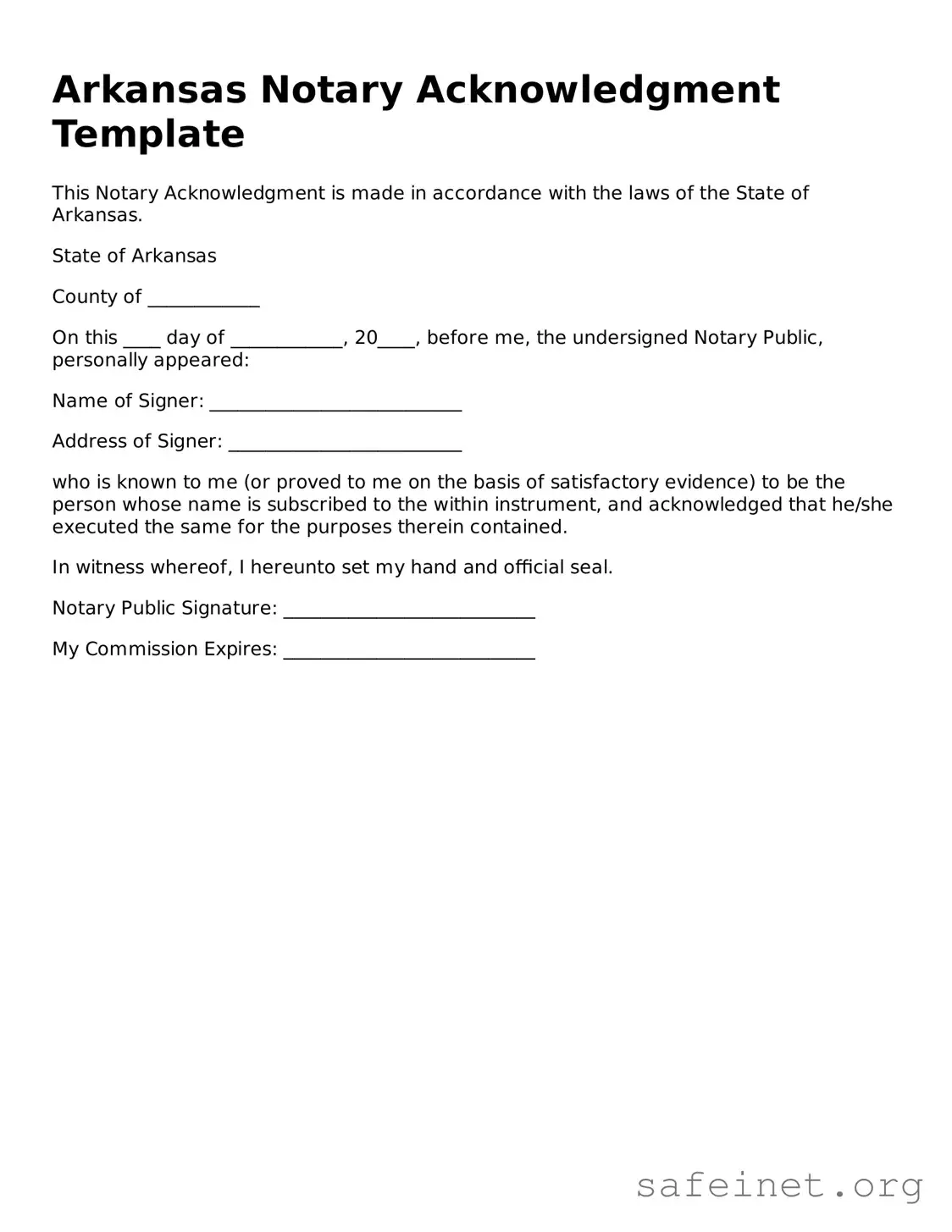
Arkansas Notary Acknowledgment Template
This Notary Acknowledgment is made in accordance with the laws of the State of Arkansas.
State of Arkansas
County of ____________
On this ____ day of ____________, 20____, before me, the undersigned Notary Public, personally appeared:
Name of Signer: ___________________________
Address of Signer: _________________________
who is known to me (or proved to me on the basis of satisfactory evidence) to be the person whose name is subscribed to the within instrument, and acknowledged that he/she executed the same for the purposes therein contained.
In witness whereof, I hereunto set my hand and official seal.
Notary Public Signature: ___________________________
My Commission Expires: ___________________________
| Fact Name | Details |
|---|---|
| Governing Law | The Arkansas Notary Acknowledgment form is governed by Arkansas Code Annotated § 21-14-101 et seq. |
| Purpose | This form is used to verify the identity of the signer and confirm that they signed the document voluntarily. |
| Signature Requirement | The signer must personally appear before the notary public at the time of acknowledgment. |
| Notary Seal | A notary public must affix their official seal to the acknowledgment form to validate it. |
| Document Types | The acknowledgment form can be used for various documents, including deeds, contracts, and affidavits. |
Once you have the Arkansas Notary Acknowledgment form in hand, you will need to complete it accurately to ensure its validity. This process involves providing specific information and signatures, which are crucial for the acknowledgment to be legally recognized.
Once you have completed these steps, the form is ready for submission or filing as required. Ensure that all information is accurate to avoid any potential issues in the future.
What is an Arkansas Notary Acknowledgement form?
The Arkansas Notary Acknowledgement form is a legal document that allows a notary public to certify that a signer has willingly signed a document. This form is often used in various transactions, such as property transfers, legal contracts, and other important agreements. By completing this form, the notary verifies the identity of the signer and ensures that the signature was made voluntarily.
Why is a Notary Acknowledgement important?
A Notary Acknowledgement is crucial because it helps prevent fraud and protects all parties involved in a transaction. When a document is notarized, it adds a layer of authenticity, making it more credible in legal settings. Courts and other entities often require notarized documents to ensure that the signatures are legitimate and that the signers understood what they were signing.
Who can act as a notary in Arkansas?
In Arkansas, a notary public must be at least 18 years old, a resident of the state, and able to read and write English. They must also complete an application process and be appointed by the Secretary of State. Once appointed, notaries are responsible for adhering to state laws and ethical guidelines in their duties.
How do I complete an Arkansas Notary Acknowledgement form?
To complete the form, the signer must appear in person before the notary. The signer should present a valid form of identification. The notary will then fill out the form, which includes details such as the date, the signer's name, and the notary's signature and seal. It’s important to ensure that all information is accurate to avoid any issues later on.
Is there a fee for notarization in Arkansas?
Yes, Arkansas law allows notaries to charge a fee for their services. The maximum fee for a standard acknowledgment is typically set by the state. However, notaries may choose to waive this fee or charge different rates for additional services. It’s always a good idea to confirm the fee beforehand to avoid any surprises.
Incorrect Signer Information: One common mistake is failing to provide accurate information about the signer. This includes not listing the full name as it appears on identification documents.
Missing Date: Many individuals overlook the importance of including the date of the acknowledgment. This date is crucial as it signifies when the notary performed the acknowledgment.
Notarizing Without Presence: A significant error occurs when a notary attempts to acknowledge a document without the signer being present. The signer must be physically present during the acknowledgment process.
Failure to Sign: Some people forget to sign the acknowledgment form itself. The notary's signature is essential to validate the acknowledgment.
Improper Use of Notary Seal: Using an outdated or incorrect notary seal can invalidate the acknowledgment. Ensure that the seal meets state requirements and is affixed properly.
When engaging in legal or official transactions in Arkansas, various forms and documents often accompany the Notary Acknowledgement form. Each of these documents serves a specific purpose and helps ensure that the transaction is valid and legally binding. Below is a list of commonly used forms alongside the Notary Acknowledgement.
Understanding these documents and their purposes can streamline legal processes and ensure that transactions are conducted smoothly. When in doubt, consulting a legal professional can provide clarity and guidance.
The Arkansas Notary Acknowledgment form shares similarities with the Affidavit. Both documents require a person to affirm the truthfulness of a statement. In an affidavit, an individual swears to the accuracy of the information provided, while the notary acknowledgment verifies that the person signing the document is indeed who they claim to be. This ensures that the signatures on both documents are authentic and that the signers are acting voluntarily and with an understanding of the implications of their actions.
Another document that resembles the Arkansas Notary Acknowledgment form is the Power of Attorney. A Power of Attorney grants one person the authority to act on behalf of another in legal or financial matters. Similar to the notary acknowledgment, the Power of Attorney must be signed in the presence of a notary public to confirm the identity of the signer and the voluntary nature of the agreement. Both documents require careful attention to detail to ensure that they are executed properly and legally binding.
The Deed also shares characteristics with the Arkansas Notary Acknowledgment form. A deed is a legal document that conveys property ownership from one party to another. Like the notary acknowledgment, a deed must be notarized to validate the identities of the parties involved and to affirm that the transfer of ownership is legitimate. This process helps prevent fraud and ensures that all parties are aware of their rights and obligations under the transaction.
Another document that is similar is the Mortgage. A mortgage is a legal agreement between a borrower and a lender, where the borrower pledges property as security for a loan. Just as with the notary acknowledgment, a mortgage requires notarization to authenticate the signatures of the parties involved. This serves to protect the lender’s interests and ensures that the borrower fully understands the terms of the agreement before committing to the loan.
The Last Will and Testament also bears resemblance to the Arkansas Notary Acknowledgment form. A will outlines how a person wishes to distribute their assets after death. While not all wills require notarization, having a will acknowledged by a notary can add an extra layer of authenticity and help prevent disputes among heirs. This process mirrors the notary acknowledgment's purpose of verifying identity and ensuring that the document reflects the true intentions of the signer.
Lastly, the Certificate of Incorporation is akin to the Arkansas Notary Acknowledgment form. This document establishes a corporation as a legal entity and typically requires notarization to confirm the authenticity of the signatures of the incorporators. Similar to the notary acknowledgment, the certificate serves to provide a clear record of the individuals involved and the intent to create a formal business structure, ensuring that all legal requirements are met for the establishment of the corporation.
When filling out the Arkansas Notary Acknowledgment form, it's important to follow specific guidelines to ensure the document is valid and properly executed. Here are five key things to do and not to do:
Understanding the Arkansas Notary Acknowledgement form is essential for anyone involved in legal documents. However, several misconceptions can lead to confusion. Below are nine common misconceptions, along with clarifications.
Clarifying these misconceptions can help individuals better navigate the notary process in Arkansas. Understanding the role of a notary can ensure that documents are executed correctly and legally.
When filling out and using the Arkansas Notary Acknowledgement form, there are several important considerations to keep in mind. The following key takeaways can guide you through the process:
Being informed about these aspects can help ensure that the notary acknowledgment process is conducted smoothly and legally.