In the realm of business transactions, the Arkansas Non-disclosure Agreement (NDA) form serves as a critical tool for protecting sensitive information. This legally binding document establishes a framework within which parties can share proprietary knowledge, trade secrets, and confidential data without the fear of unauthorized disclosure. It outlines the obligations of the involved parties, detailing what information is considered confidential and the duration of the agreement. Additionally, the NDA specifies the consequences for breach of contract, ensuring that all parties understand the seriousness of maintaining confidentiality. By clearly defining the scope of protected information and the responsibilities of each party, this form not only fosters trust but also encourages open communication, which is essential for collaboration and innovation. Whether in the context of a startup seeking investment or an established company negotiating a merger, an Arkansas NDA can be a vital component in safeguarding intellectual property and maintaining a competitive edge.
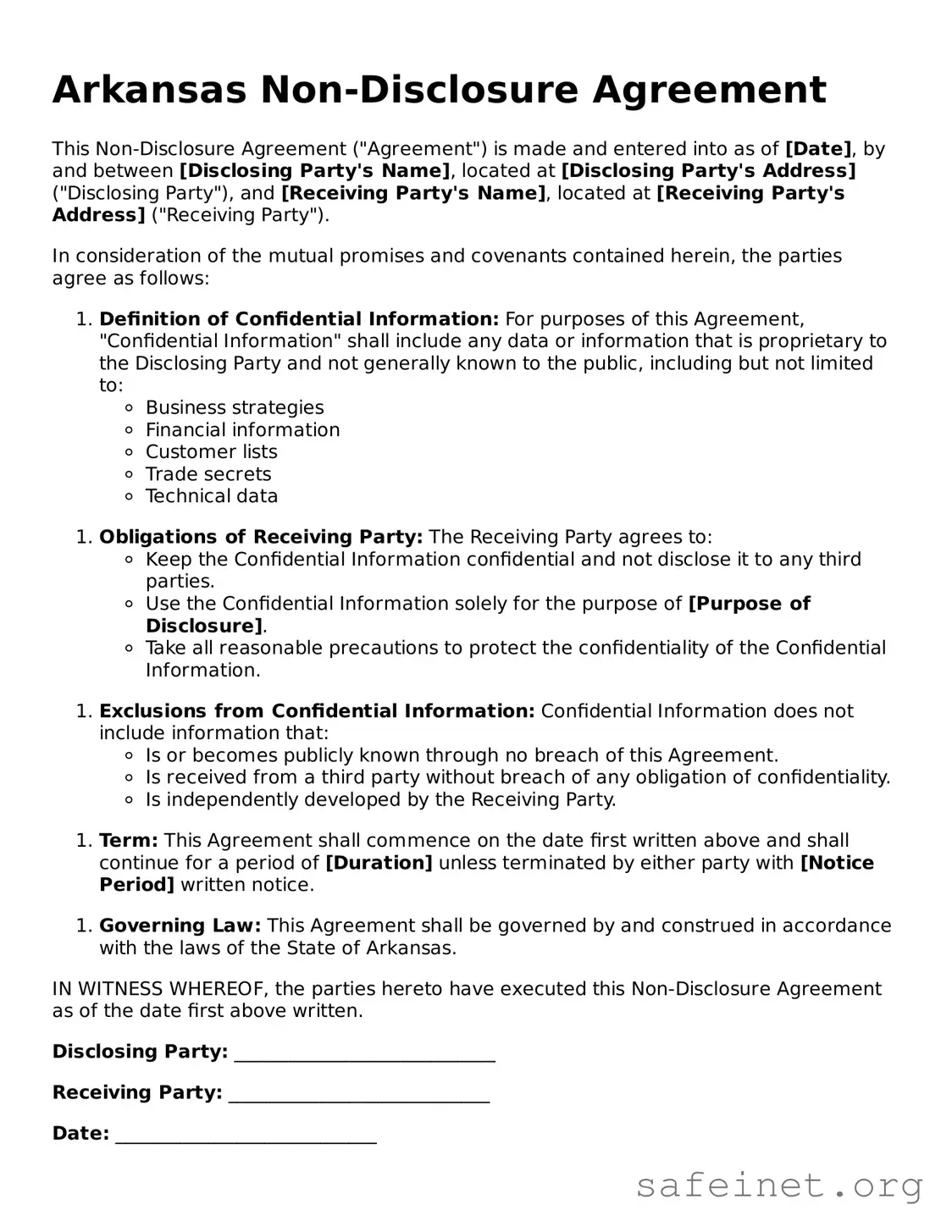
Arkansas Non-Disclosure Agreement
This Non-Disclosure Agreement ("Agreement") is made and entered into as of [Date], by and between [Disclosing Party's Name], located at [Disclosing Party's Address] ("Disclosing Party"), and [Receiving Party's Name], located at [Receiving Party's Address] ("Receiving Party").
In consideration of the mutual promises and covenants contained herein, the parties agree as follows:
IN WITNESS WHEREOF, the parties hereto have executed this Non-Disclosure Agreement as of the date first above written.
Disclosing Party: ____________________________
Receiving Party: ____________________________
Date: ____________________________
| Fact Name | Description |
|---|---|
| Definition | An Arkansas Non-disclosure Agreement (NDA) is a legal contract that protects confidential information shared between parties. |
| Purpose | The primary purpose of an NDA is to prevent the unauthorized sharing of sensitive information. |
| Governing Law | The NDA is governed by the laws of the state of Arkansas, ensuring compliance with local legal standards. |
| Parties Involved | Typically, an NDA involves at least two parties: the disclosing party and the receiving party. |
| Duration of Confidentiality | NDAs often specify how long the information must remain confidential, which can vary based on the agreement. |
| Enforcement | If a party breaches the NDA, the injured party may seek legal remedies, including damages or injunctions. |
| Mutual vs. Unilateral | NDAs can be mutual, where both parties share confidential information, or unilateral, where only one party discloses information. |
| Exceptions | Common exceptions to confidentiality include information that is publicly available or independently developed by the receiving party. |
Filling out the Arkansas Non-disclosure Agreement form is a straightforward process. By following these steps, you can ensure that all necessary information is accurately provided. Once completed, the form will serve its purpose in protecting confidential information between the involved parties.
What is a Non-disclosure Agreement (NDA) in Arkansas?
A Non-disclosure Agreement (NDA) is a legal contract between parties that outlines confidential information that cannot be disclosed to third parties. In Arkansas, NDAs are commonly used to protect sensitive information shared during business discussions, partnerships, or employment relationships.
Why should I use a Non-disclosure Agreement?
Using an NDA helps safeguard your proprietary information, trade secrets, and other confidential data. It establishes clear expectations about confidentiality and can provide legal recourse if the agreement is violated. This is especially important in competitive industries where information leaks can lead to significant losses.
Who can enter into a Non-disclosure Agreement?
Any individual or business entity can enter into an NDA. This includes employers and employees, business partners, or any two parties who wish to share confidential information. The agreement must be signed by all parties involved for it to be enforceable.
What should be included in an NDA?
An NDA should clearly define the confidential information, the purpose of sharing it, the obligations of the parties, the duration of the agreement, and any exclusions to confidentiality. It’s essential to be specific to avoid misunderstandings in the future.
How long does an NDA last?
The duration of an NDA can vary based on the agreement between the parties. Some NDAs may last for a specific period, such as two or five years, while others may remain in effect indefinitely, especially if the information remains confidential. It’s important to specify the duration in the agreement.
What happens if someone breaches the NDA?
If a party breaches the NDA, the injured party may seek legal remedies. This can include monetary damages or injunctive relief to prevent further disclosure. The specific consequences should be outlined in the NDA to ensure all parties understand the potential repercussions of a breach.
Is a Non-disclosure Agreement enforceable in Arkansas?
Yes, NDAs are generally enforceable in Arkansas, provided they meet legal requirements. The agreement must be reasonable in scope and duration, and it should not impose undue restrictions on the parties involved. Courts will evaluate the NDA based on its terms and the context in which it was created.
When filling out the Arkansas Non-disclosure Agreement (NDA) form, it's essential to be thorough and careful. Here are nine common mistakes that people often make:
By avoiding these common pitfalls, you can create a more effective and enforceable Non-disclosure Agreement. Taking the time to carefully fill out the form can protect your interests and maintain confidentiality.
The Arkansas Non-disclosure Agreement (NDA) serves as a crucial legal instrument for protecting confidential information between parties. However, various other forms and documents often accompany an NDA to ensure comprehensive legal coverage and clarity in business relationships. Below is a list of these documents, each with a brief description.
Utilizing these documents alongside an Arkansas Non-disclosure Agreement can provide a more robust framework for protecting sensitive information in various business contexts. Each document plays a distinct role in establishing clear expectations and legal protections for all parties involved.
A Non-Disclosure Agreement (NDA) is a common legal document used to protect sensitive information. It is similar to a Confidentiality Agreement, which serves the same purpose of safeguarding proprietary information. Both documents outline the obligation of the receiving party to keep certain information confidential. They typically specify what information is deemed confidential, the duration of the confidentiality obligation, and the consequences of breach. While the terms may vary slightly, the core function of both agreements is to prevent unauthorized disclosure of sensitive data.
Another document akin to an NDA is a Non-Compete Agreement. This agreement restricts an employee or business partner from engaging in activities that compete with the interests of the employer or business for a specified time and within a defined geographic area. While an NDA focuses on confidentiality, a Non-Compete Agreement emphasizes limiting competition. Both documents are often used in conjunction to protect a company’s interests and trade secrets.
A Proprietary Information Agreement (PIA) is also similar to an NDA. It specifically addresses the handling of proprietary information, which may include trade secrets, business plans, or other sensitive data. Like an NDA, a PIA outlines the obligations of the receiving party to maintain confidentiality. The distinction lies in the emphasis on proprietary information, making it particularly useful for businesses that deal with unique processes or products.
The Mutual Non-Disclosure Agreement (MNDA) shares similarities with a standard NDA but is designed for situations where both parties are sharing confidential information. Each party agrees to protect the other's sensitive information. This reciprocal nature makes it ideal for partnerships, collaborations, or joint ventures where both sides have valuable information to safeguard.
A Secrecy Agreement is another document that closely resembles an NDA. It may be used interchangeably with an NDA, as both aim to protect confidential information. However, a Secrecy Agreement may have a broader application, covering not just business information but also personal secrets or sensitive data in various contexts. The key similarity lies in the obligation to keep information confidential.
An Employment Agreement may also contain NDA provisions, especially when an employee is privy to sensitive company information. This agreement outlines the terms of employment and may include clauses that require the employee to maintain confidentiality regarding proprietary information. While the primary focus is on employment terms, the NDA component is crucial for protecting the employer's interests.
A Licensing Agreement can be similar to an NDA when it involves sharing proprietary information between the licensor and licensee. This document governs the terms under which one party can use another's intellectual property. Often, it includes confidentiality clauses to ensure that sensitive information related to the licensed material remains protected, thus resembling the protective nature of an NDA.
Finally, a Collaboration Agreement may include non-disclosure provisions. This document is used when two or more parties work together on a project. It outlines the roles, responsibilities, and contributions of each party, along with how confidential information will be handled. The inclusion of NDA-like clauses ensures that proprietary information shared during the collaboration remains confidential, mirroring the objectives of a standard NDA.
When filling out the Arkansas Non-disclosure Agreement form, it is important to follow certain guidelines to ensure the document is completed correctly. Below is a list of things you should and shouldn't do.
Following these guidelines will help ensure that the Non-disclosure Agreement is effective and enforceable.
Understanding the Arkansas Non-disclosure Agreement (NDA) is crucial for anyone considering its use. However, several misconceptions can lead to confusion. Here are ten common misconceptions about NDAs in Arkansas:
Being aware of these misconceptions can help individuals and businesses navigate the complexities of NDAs more effectively.
When considering the Arkansas Non-disclosure Agreement (NDA), it is essential to understand its key components and implications. Here are some important takeaways:
Understanding these key points can help individuals and businesses effectively use the Arkansas Non-disclosure Agreement to safeguard their sensitive information.