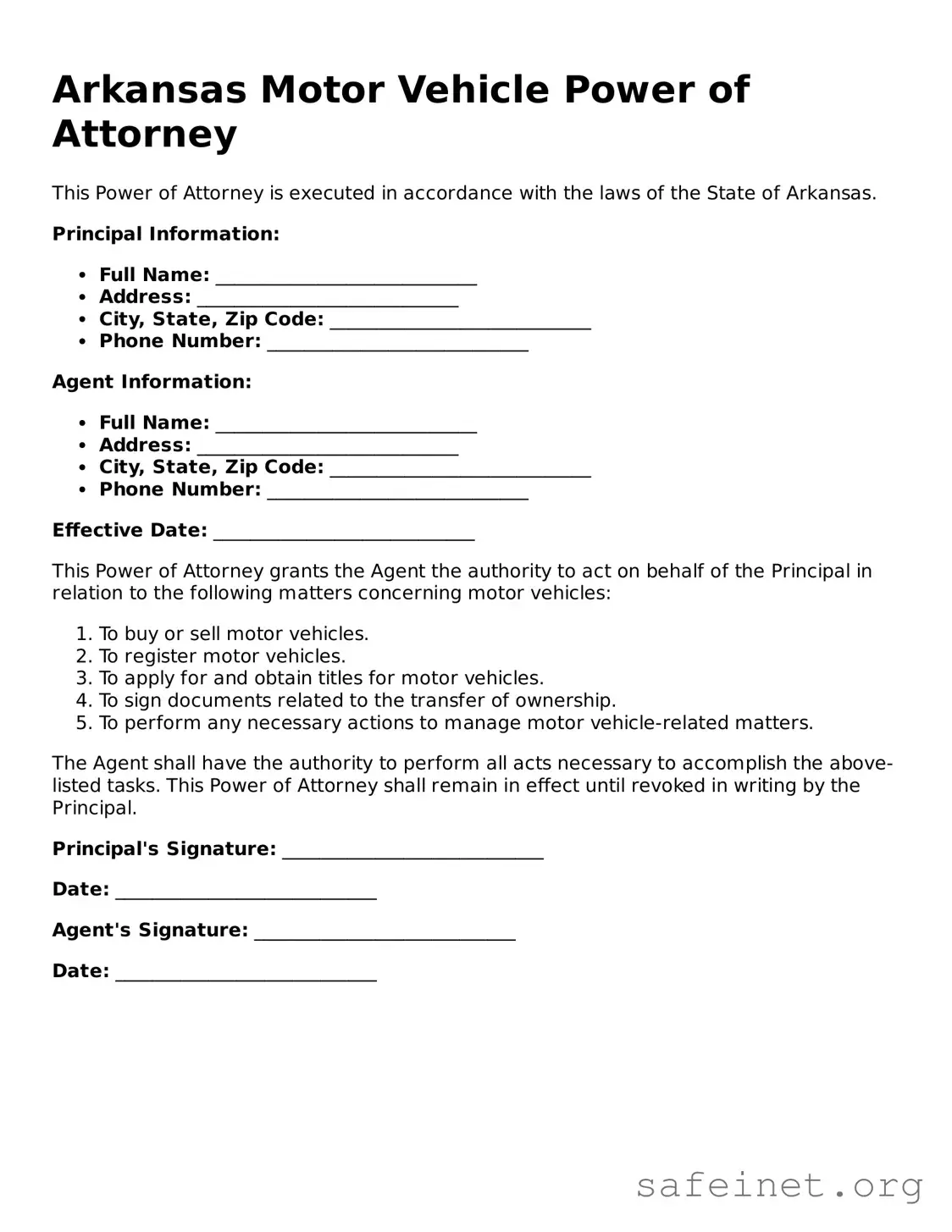
The Arkansas Motor Vehicle Power of Attorney form serves as a crucial legal document that allows individuals to delegate authority over their motor vehicle transactions to another person. This form is particularly useful when the vehicle owner cannot be present to sign necessary paperwork, such as during the sale of a vehicle or when transferring ownership. By completing this form, the vehicle owner grants specific powers to the designated agent, enabling them to handle tasks like signing titles, completing registration processes, and managing other related matters on behalf of the owner. It is important to note that the authority granted can be limited to specific transactions or can be broader, depending on the needs of the vehicle owner. Additionally, the form must be signed and dated by the vehicle owner, ensuring that the agent's authority is recognized by the state. Understanding the nuances of this form can help vehicle owners navigate the complexities of motor vehicle transactions more efficiently.
Arkansas Motor Vehicle Power of Attorney
This Power of Attorney is executed in accordance with the laws of the State of Arkansas.
Principal Information:
Agent Information:
Effective Date: ____________________________
This Power of Attorney grants the Agent the authority to act on behalf of the Principal in relation to the following matters concerning motor vehicles:
The Agent shall have the authority to perform all acts necessary to accomplish the above-listed tasks. This Power of Attorney shall remain in effect until revoked in writing by the Principal.
Principal's Signature: ____________________________
Date: ____________________________
Agent's Signature: ____________________________
Date: ____________________________
| Fact Name | Details |
|---|---|
| Purpose | The Arkansas Motor Vehicle Power of Attorney form allows an individual to appoint another person to handle vehicle-related transactions on their behalf. |
| Governing Law | This form is governed by the Arkansas Code Annotated, specifically under Title 27, Chapter 14. |
| Usage | It is commonly used for tasks such as transferring vehicle titles, registering vehicles, or obtaining license plates. |
| Signature Requirement | The form must be signed by the principal, the person granting the authority, to be considered valid. |
| Revocation | The power of attorney can be revoked at any time by the principal, provided that the revocation is documented in writing. |
Filling out the Arkansas Motor Vehicle Power of Attorney form is a straightforward process. This form allows you to designate someone to handle specific vehicle-related tasks on your behalf. Once completed, you can submit it to the appropriate authorities or keep it for your records.
After completing these steps, ensure that both you and the designated person keep a copy of the form for your records. This will help facilitate any necessary vehicle transactions in the future.
What is an Arkansas Motor Vehicle Power of Attorney form?
The Arkansas Motor Vehicle Power of Attorney form is a legal document that allows one person to authorize another to act on their behalf regarding motor vehicle transactions. This can include tasks such as signing titles, registering vehicles, or handling other related matters. It is particularly useful when the vehicle owner cannot be present to complete these transactions themselves.
Who can be designated as an agent in this form?
Any adult individual can be designated as an agent in the Arkansas Motor Vehicle Power of Attorney form. This could be a family member, friend, or a professional, such as a lawyer or a vehicle dealer. The key requirement is that the agent must be someone the vehicle owner trusts to handle their affairs responsibly.
Do I need to have the form notarized?
Yes, the Arkansas Motor Vehicle Power of Attorney form typically requires notarization. This adds a layer of authenticity to the document and ensures that the signatures are valid. Notarization helps prevent fraud and confirms that the person granting power of attorney is doing so willingly and understands the implications.
Can I revoke a Power of Attorney once it is established?
Yes, you can revoke a Power of Attorney at any time as long as you are mentally competent. To do this, you should create a written notice of revocation and provide copies to the agent and any relevant parties, such as the Arkansas Department of Finance and Administration. This ensures that everyone is aware that the previous authority has been canceled.
What transactions can be handled using this Power of Attorney?
The Arkansas Motor Vehicle Power of Attorney allows the designated agent to handle various transactions related to motor vehicles. These can include transferring ownership, signing documents for vehicle registration, obtaining license plates, and dealing with title issues. However, the specific powers granted can be customized within the document itself.
Is there a specific format I need to follow for this form?
While there is no strict format mandated by law, it is important that the form includes essential elements such as the names of both the principal and the agent, a clear description of the powers granted, and the signatures of both parties. Using a standard template can help ensure that all necessary information is included and properly formatted.
Where can I obtain the Arkansas Motor Vehicle Power of Attorney form?
You can obtain the Arkansas Motor Vehicle Power of Attorney form from various sources, including online legal services, local government offices, or legal stationery stores. It is advisable to ensure that the form you are using is up to date and complies with Arkansas state laws to avoid any issues during the transaction process.
Incomplete Information: Failing to provide all required details can lead to delays or rejection. Ensure that names, addresses, and vehicle information are fully filled out.
Incorrect Signatures: The form must be signed by the principal. If the principal does not sign, or if someone else signs on their behalf without proper authority, the form will be invalid.
Not Notarizing the Document: Some versions of the form may require notarization. Without a notary's signature, the document may not be legally recognized.
Ignoring State-Specific Requirements: Each state has its own rules regarding power of attorney forms. Failing to follow Arkansas-specific guidelines can lead to complications.
When dealing with motor vehicle transactions in Arkansas, several forms and documents may accompany the Motor Vehicle Power of Attorney form. These documents help facilitate the process and ensure that all necessary legal requirements are met. Below is a list of commonly used forms.
These forms and documents play a crucial role in ensuring that motor vehicle transactions are processed smoothly and legally. Having the right paperwork can save time and prevent potential issues down the line.
The Arkansas Motor Vehicle Power of Attorney form shares similarities with a General Power of Attorney document. Both forms allow individuals to designate someone else to act on their behalf, but the General Power of Attorney covers a broader range of decisions. This can include financial matters, healthcare choices, and other legal actions. In contrast, the Motor Vehicle Power of Attorney is specifically focused on matters related to motor vehicles, such as title transfers and registration. This distinction makes the Motor Vehicle Power of Attorney a more specialized tool for vehicle-related transactions.
Another document that parallels the Arkansas Motor Vehicle Power of Attorney is the Limited Power of Attorney. Like the Motor Vehicle form, the Limited Power of Attorney grants authority to another person, but it restricts the scope of that authority to specific tasks or time frames. For example, a Limited Power of Attorney could be used for a single transaction, such as selling a car, while the Motor Vehicle Power of Attorney is explicitly designed for vehicle transactions. Both documents aim to streamline processes by allowing designated individuals to act on behalf of the principal.
The Vehicle Title Transfer form also bears resemblance to the Arkansas Motor Vehicle Power of Attorney. Both documents are essential in the process of transferring ownership of a vehicle. While the Vehicle Title Transfer form is primarily used to officially record the change of ownership, the Motor Vehicle Power of Attorney allows one person to sign the title transfer on behalf of another. This can be particularly useful when the vehicle owner is unable to be present for the transaction, ensuring that the process can still proceed smoothly.
Additionally, the Bill of Sale for a vehicle has similarities with the Arkansas Motor Vehicle Power of Attorney. A Bill of Sale serves as a legal document that records the sale of a vehicle, detailing the terms of the transaction and the parties involved. When combined with a Motor Vehicle Power of Attorney, the two documents facilitate the transfer of ownership by providing the necessary authority to sign the Bill of Sale on behalf of the seller. This combination ensures that all legal requirements are met during the sale process.
Furthermore, the Authorization for Release of Information form is akin to the Arkansas Motor Vehicle Power of Attorney. This document allows individuals to authorize another party to obtain specific information on their behalf. In the context of motor vehicles, this could include accessing registration details or vehicle history reports. While the Motor Vehicle Power of Attorney focuses on granting authority for transactions, the Authorization for Release of Information emphasizes the sharing of data, both serving to simplify interactions with motor vehicle departments.
Lastly, the Consent to Transfer form is another document that aligns with the Arkansas Motor Vehicle Power of Attorney. This form is often used when a vehicle owner gives permission for someone else to handle the transfer of their vehicle. While the Motor Vehicle Power of Attorney grants broader authority for various vehicle-related actions, the Consent to Transfer is more focused on the act of transferring ownership. Both documents help ensure that the necessary permissions are in place for a smooth transaction, protecting the interests of all parties involved.
When filling out the Arkansas Motor Vehicle Power of Attorney form, it is important to ensure accuracy and compliance. Below are guidelines to follow and avoid.
Understanding the Arkansas Motor Vehicle Power of Attorney form can be tricky. Many people hold misconceptions that can lead to confusion or mistakes. Here are eight common misconceptions:
By clearing up these misconceptions, individuals can navigate the process more effectively and ensure their vehicle-related tasks are handled smoothly.
The Arkansas Motor Vehicle Power of Attorney form allows an individual to appoint someone else to handle vehicle-related transactions on their behalf. Here are key takeaways regarding its use: