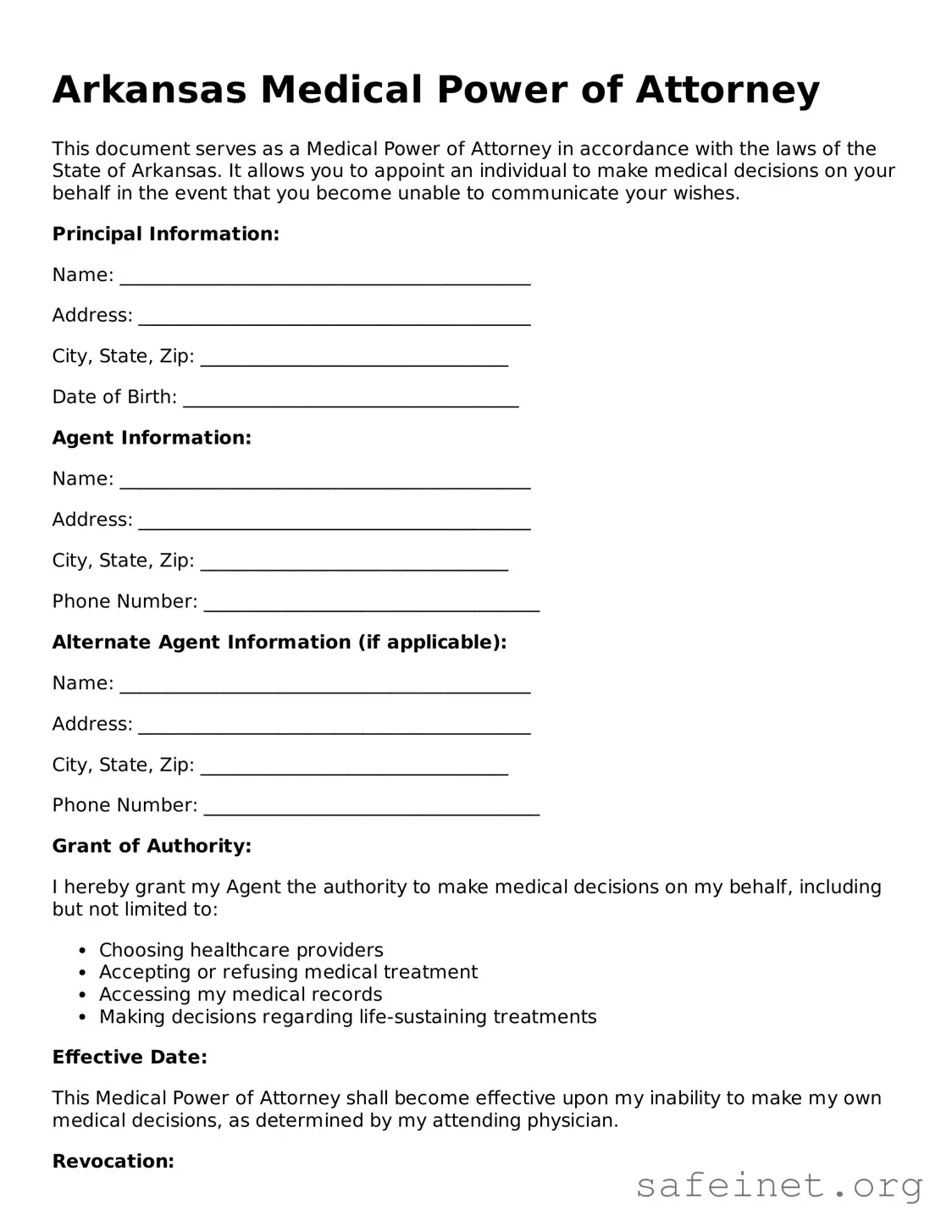
The Arkansas Medical Power of Attorney form is an essential document for anyone looking to ensure their healthcare wishes are respected in case they become unable to communicate them. This form allows individuals to appoint a trusted person, known as an agent, to make medical decisions on their behalf. It covers a wide range of healthcare choices, from routine medical care to life-sustaining treatments. By filling out this form, individuals can specify their preferences regarding various medical interventions and treatments, providing clear guidance to their healthcare providers and loved ones. It is important to understand the responsibilities of the appointed agent, as they will have the authority to make decisions based on the individual's stated wishes. Additionally, the form must be signed in the presence of a notary public or witnesses to ensure its validity. This legal tool not only empowers individuals to take control of their medical care but also alleviates the burden on family members during difficult times.
Arkansas Medical Power of Attorney
This document serves as a Medical Power of Attorney in accordance with the laws of the State of Arkansas. It allows you to appoint an individual to make medical decisions on your behalf in the event that you become unable to communicate your wishes.
Principal Information:
Name: ____________________________________________
Address: __________________________________________
City, State, Zip: _________________________________
Date of Birth: ____________________________________
Agent Information:
Name: ____________________________________________
Address: __________________________________________
City, State, Zip: _________________________________
Phone Number: ____________________________________
Alternate Agent Information (if applicable):
Name: ____________________________________________
Address: __________________________________________
City, State, Zip: _________________________________
Phone Number: ____________________________________
Grant of Authority:
I hereby grant my Agent the authority to make medical decisions on my behalf, including but not limited to:
Effective Date:
This Medical Power of Attorney shall become effective upon my inability to make my own medical decisions, as determined by my attending physician.
Revocation:
I understand that I have the right to revoke this Medical Power of Attorney at any time, provided I communicate my intention to do so in writing.
Signatures:
Principal's Signature: ____________________________ Date: _______________
Agent's Signature: _______________________________ Date: _______________
Witnesses:
This document must be signed in the presence of two witnesses who are not related to the Principal or the Agent and who are at least 18 years of age.
| Fact Name | Description |
|---|---|
| Purpose | The Arkansas Medical Power of Attorney form allows individuals to designate someone to make medical decisions on their behalf if they become incapacitated. |
| Governing Law | This form is governed by Arkansas Code Annotated § 20-13-101 et seq., which outlines the legal framework for healthcare decision-making. |
| Eligibility | Any adult resident of Arkansas can create a Medical Power of Attorney, provided they are of sound mind when signing the document. |
| Agent Requirements | The appointed agent must be at least 18 years old and cannot be the individual's healthcare provider or an employee of the healthcare provider. |
| Revocation | The individual can revoke the Medical Power of Attorney at any time, as long as they are mentally competent to do so. |
| Witnesses | Two witnesses must sign the form, confirming that the individual understands the document and is signing voluntarily. |
| Durability | This power of attorney remains effective even if the individual becomes incapacitated, ensuring continuous medical decision-making support. |
| Notarization | While notarization is not required, having the document notarized can provide additional legal validation and may help prevent disputes. |
Filling out the Arkansas Medical Power of Attorney form is an important step in ensuring your healthcare decisions are respected when you cannot communicate them yourself. Follow these steps carefully to complete the form accurately.
What is a Medical Power of Attorney in Arkansas?
A Medical Power of Attorney (MPOA) is a legal document that allows an individual to appoint someone else to make healthcare decisions on their behalf if they become unable to do so. This document ensures that your medical preferences are respected, even if you cannot communicate them. It is essential for individuals to consider creating an MPOA to ensure their healthcare wishes are honored during critical times.
Who can be appointed as an agent under the Medical Power of Attorney?
In Arkansas, any competent adult can be designated as an agent in a Medical Power of Attorney. This could be a family member, friend, or trusted individual who understands your healthcare preferences. It is crucial to choose someone who will act in your best interest and who you trust to make difficult decisions on your behalf. The selected agent should also be willing to accept this responsibility.
How do I create a Medical Power of Attorney in Arkansas?
To create a Medical Power of Attorney in Arkansas, you must fill out a specific form that complies with state laws. This form must clearly state your wishes regarding medical treatment and designate your agent. Once completed, the document should be signed by you and witnessed by at least two individuals who are not related to you or financially involved in your care. It is advisable to keep copies of the MPOA in accessible locations and provide one to your healthcare provider.
Can I revoke my Medical Power of Attorney?
Yes, you can revoke your Medical Power of Attorney at any time as long as you are mentally competent. To do this, you should create a written notice of revocation and inform your agent and any healthcare providers who have a copy of your MPOA. It is important to destroy any copies of the original MPOA to prevent confusion. Always ensure that your healthcare team is aware of the changes to your medical decision-making authority.
Failing to specify the agent clearly. It is essential to name a person who is willing and able to make medical decisions on your behalf.
Not including an alternate agent. If your primary agent is unavailable, an alternate ensures that your wishes are still honored.
Overlooking the need for witnesses. In Arkansas, the form must be signed in the presence of two witnesses who are not related to you.
Neglecting to date the document. A date is crucial for determining the validity and relevance of the form.
Using vague language when describing medical preferences. Specific instructions help guide the agent in making decisions that align with your values.
Forgetting to review and update the document regularly. Life changes, and so may your medical preferences or agent choices.
Not discussing your wishes with the appointed agent. Open communication ensures that your agent understands your preferences and values.
Failing to keep copies of the signed document. Distributing copies to your agent, family members, and healthcare providers helps ensure that your wishes are known.
When considering a Medical Power of Attorney in Arkansas, it is important to understand that several other forms and documents may be relevant. These documents can help clarify your healthcare wishes and ensure that your preferences are respected. Below is a list of commonly used forms alongside the Medical Power of Attorney.
Understanding these documents can empower you to make informed decisions about your healthcare. Each form serves a unique purpose and collectively helps ensure that your wishes are honored in various medical situations.
The Arkansas Medical Power of Attorney (MPOA) form shares similarities with the Durable Power of Attorney (DPOA). Both documents allow an individual, known as the principal, to appoint an agent to make decisions on their behalf. The DPOA covers a broader range of decisions, including financial matters, while the MPOA specifically focuses on medical and healthcare-related decisions. This distinction is crucial for individuals who want to ensure that their health care preferences are honored without extending the authority to financial matters.
The Healthcare Proxy is another document comparable to the Arkansas MPOA. Like the MPOA, a healthcare proxy allows a person to designate someone to make medical decisions if they become incapacitated. However, the healthcare proxy is often less formal and may not require the same level of detail regarding medical preferences. Both documents emphasize the importance of having a trusted individual in charge of healthcare decisions during critical times.
When filling out the Arkansas Medical Power of Attorney form, it’s essential to approach the process with care and attention. This document allows you to designate someone to make medical decisions on your behalf if you are unable to do so. Here are some important dos and don’ts to consider:
By following these guidelines, you can help ensure that your Medical Power of Attorney accurately reflects your wishes and is legally enforceable when needed.
Understanding the Arkansas Medical Power of Attorney form is crucial for ensuring that your healthcare wishes are respected. However, several misconceptions can lead to confusion. Here are eight common misunderstandings about this important legal document:
By addressing these misconceptions, individuals can make informed decisions regarding their healthcare and ensure that their wishes are honored in times of need.
Filling out and using the Arkansas Medical Power of Attorney form is an important process for ensuring that your healthcare preferences are respected. Here are some key takeaways to keep in mind:
Understanding these key points can help ensure that your medical preferences are honored and that your designated agent can act effectively on your behalf.