Creating a Last Will and Testament is a crucial step in ensuring that your wishes are honored after your passing. In Arkansas, this legal document allows individuals to specify how their assets will be distributed, appoint guardians for minor children, and designate an executor to manage their estate. The form must meet specific requirements set by state law to be considered valid, including the necessity for the testator's signature and the presence of witnesses. Additionally, individuals can include provisions for funeral arrangements and the care of pets, making the will a comprehensive tool for personal and financial planning. Understanding the components of the Arkansas Last Will and Testament form is essential for anyone looking to secure their legacy and provide clear instructions for their loved ones during a difficult time.
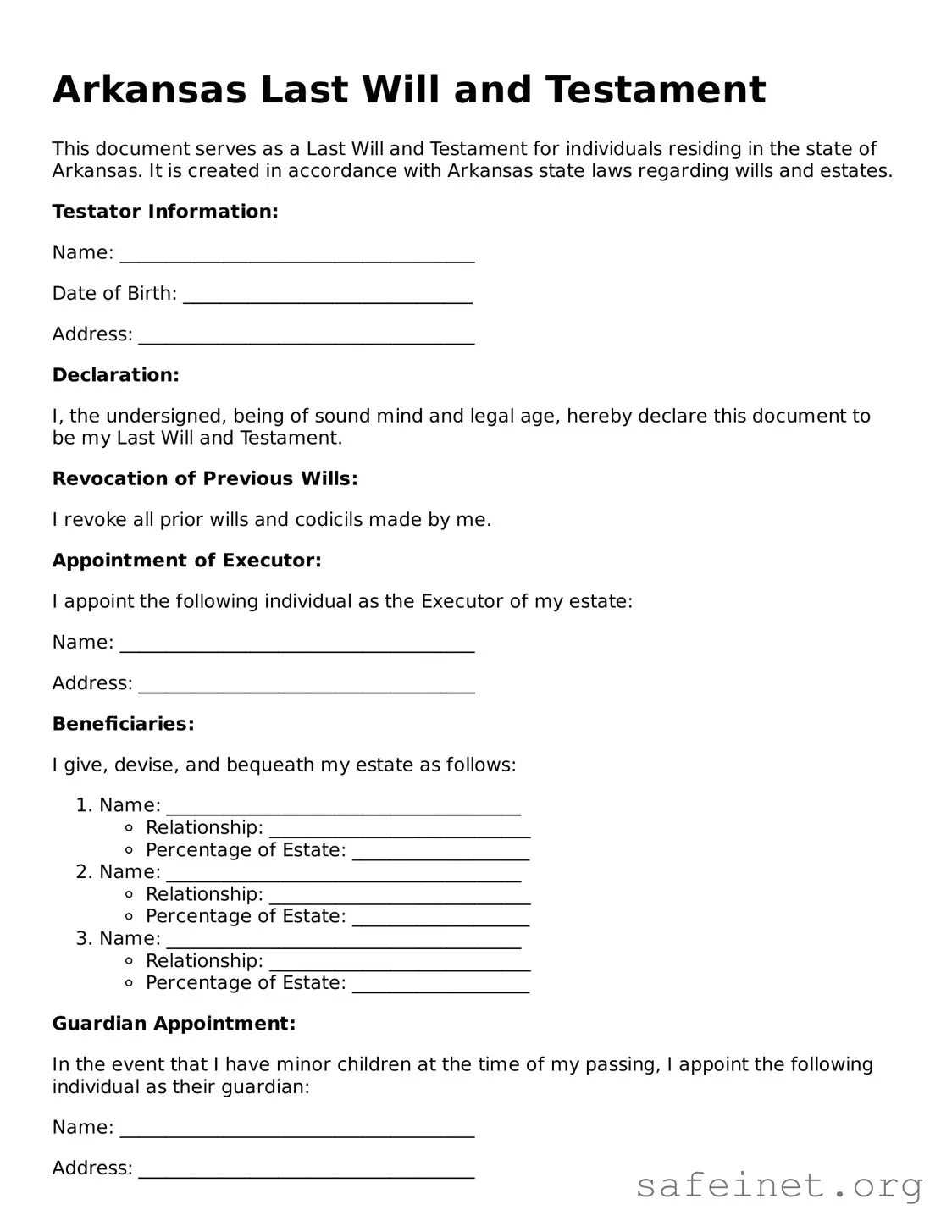
Arkansas Last Will and Testament
This document serves as a Last Will and Testament for individuals residing in the state of Arkansas. It is created in accordance with Arkansas state laws regarding wills and estates.
Testator Information:
Name: ______________________________________
Date of Birth: _______________________________
Address: ____________________________________
Declaration:
I, the undersigned, being of sound mind and legal age, hereby declare this document to be my Last Will and Testament.
Revocation of Previous Wills:
I revoke all prior wills and codicils made by me.
Appointment of Executor:
I appoint the following individual as the Executor of my estate:
Name: ______________________________________
Address: ____________________________________
Beneficiaries:
I give, devise, and bequeath my estate as follows:
Guardian Appointment:
In the event that I have minor children at the time of my passing, I appoint the following individual as their guardian:
Name: ______________________________________
Address: ____________________________________
Signatures:
In witness whereof, I have hereunto subscribed my name this ____ day of ____________, 20__.
______________________________
Signature of Testator
Witnesses:
We, the undersigned witnesses, hereby attest that the Testator signed this Last Will and Testament in our presence and that we are of legal age.
| Fact Name | Details |
|---|---|
| Governing Law | The Last Will and Testament in Arkansas is governed by the Arkansas Code, specifically Title 28, Chapter 40. |
| Age Requirement | Individuals must be at least 18 years old to create a valid will in Arkansas. |
| Written Form | A will must be in writing to be considered valid. This can be handwritten or typed. |
| Signature Requirement | The testator (the person making the will) must sign the document at the end. |
| Witnesses | At least two witnesses are required to sign the will, confirming they witnessed the testator's signature. |
| Self-Proving Wills | Arkansas allows for self-proving wills, which can simplify the probate process. |
| Revocation | A will can be revoked by creating a new will or by physically destroying the original document. |
| Holographic Wills | Holographic wills, which are handwritten and signed by the testator, are recognized in Arkansas if they meet certain criteria. |
| Probate Process | All wills must go through probate in Arkansas to ensure they are valid and to distribute the estate according to the will. |
Completing the Arkansas Last Will and Testament form is a crucial step in ensuring your wishes are honored after your passing. This process requires careful attention to detail and a clear understanding of your intentions. Once the form is filled out, it will need to be signed and witnessed to be legally valid.
What is a Last Will and Testament in Arkansas?
A Last Will and Testament is a legal document that outlines how a person's assets and affairs should be handled after their death. In Arkansas, this document allows individuals to specify their wishes regarding the distribution of their property, the care of minor children, and the appointment of an executor to manage the estate. It serves as a crucial tool for ensuring that your wishes are honored and can help prevent disputes among family members.
Who can create a Last Will and Testament in Arkansas?
In Arkansas, any person who is at least 18 years old and of sound mind can create a Last Will and Testament. This means you should be able to understand the nature of the document and the implications of your decisions. Additionally, you must not be under undue influence or duress when drafting your will.
What are the requirements for a valid will in Arkansas?
To be considered valid, a will in Arkansas must meet certain criteria. It should be in writing, either typed or handwritten. The document must be signed by the person creating the will (the testator) or by someone else at their direction and in their presence. Furthermore, at least two witnesses must sign the will, attesting that they saw the testator sign it. These witnesses should be at least 18 years old and should not be beneficiaries of the will to avoid conflicts of interest.
Can I change or revoke my will in Arkansas?
Yes, you can change or revoke your will at any time while you are still alive and of sound mind. To make changes, you can create a new will that explicitly revokes the old one, or you can make amendments known as codicils. If you choose to revoke your will entirely, it’s important to destroy the original document and any copies to avoid confusion. Always ensure that any new documents comply with Arkansas laws to maintain their validity.
What happens if I die without a will in Arkansas?
If you die without a will, you are considered to have died "intestate." In such cases, Arkansas law dictates how your assets will be distributed. Typically, your estate will be divided among your closest relatives, such as your spouse, children, or parents. This process can be lengthy and may not reflect your personal wishes, which is why having a will is highly recommended.
Can I write my own will in Arkansas?
Yes, you can write your own will in Arkansas, and many people choose to do so. However, it's crucial to ensure that it meets all legal requirements to be valid. While a handwritten will, known as a holographic will, is permissible in Arkansas, it’s often advisable to consult with a legal professional to avoid mistakes that could lead to complications later on.
Is it necessary to have a lawyer to create a will in Arkansas?
No, it is not strictly necessary to hire a lawyer to create a will in Arkansas. However, consulting with a legal expert can provide valuable guidance. A lawyer can help ensure that your will is properly drafted, complies with state laws, and accurately reflects your wishes. This can save your loved ones from potential legal disputes and confusion in the future.
How can I ensure my will is executed properly after my death?
To ensure your will is executed properly, it’s essential to choose a trustworthy executor who understands your wishes and is willing to fulfill them. Communicate your intentions clearly with your executor and family members. Store your will in a safe yet accessible location, and inform your executor of its whereabouts. Regularly reviewing and updating your will as your circumstances change can also help ensure that it remains relevant and effective.
Not Clearly Identifying the Testator: One common mistake is failing to clearly identify the person making the will. It is essential to include the full name and address to avoid any confusion about who the will belongs to.
Omitting Witness Signatures: In Arkansas, the will must be signed by at least two witnesses. Many people forget this crucial step, which can lead to the will being deemed invalid.
Neglecting to Update the Will: Life changes such as marriage, divorce, or the birth of children can impact how assets should be distributed. Failing to update the will after such events can lead to unintended consequences.
Not Clearly Specifying Assets: Vague language can create confusion about what assets are included in the will. It is important to clearly list specific items or accounts to ensure they are distributed according to the testator’s wishes.
Forgetting to Include a Residuary Clause: A residuary clause addresses any assets not specifically mentioned in the will. Omitting this can result in those assets being distributed according to state law rather than the testator’s intentions.
When preparing a Last Will and Testament in Arkansas, individuals often need to consider several additional forms and documents. Each of these serves a specific purpose and can help ensure that a person's wishes are carried out effectively after their passing. Below is a list of commonly used documents that may accompany a will.
Understanding these documents can help individuals navigate the complexities of estate planning. Each serves a vital role in ensuring that a person's wishes are honored and that their loved ones are provided for in the future.
The Arkansas Last Will and Testament is similar to the Living Will, a document that outlines a person's preferences regarding medical treatment in situations where they cannot communicate their wishes. While the Last Will and Testament deals primarily with the distribution of assets after death, the Living Will focuses on healthcare decisions. Both documents serve to express an individual's wishes, but they do so in different contexts—one for posthumous matters and the other for end-of-life medical care.
Another document comparable to the Last Will and Testament is the Durable Power of Attorney. This legal form allows an individual to designate someone else to make financial or legal decisions on their behalf if they become incapacitated. Like a will, it provides clarity and direction, ensuring that a person's affairs are handled according to their preferences, even when they are no longer able to manage them personally.
The Revocable Trust shares similarities with the Last Will and Testament in that both are used to manage and distribute a person's assets. However, a Revocable Trust can take effect during a person's lifetime, allowing for more immediate management of assets. This document can also help avoid probate, making the transfer of assets smoother and often quicker than through a will, which only takes effect after death.
A Living Trust is another document that parallels the Last Will and Testament. Like a Revocable Trust, a Living Trust allows for the management of assets during a person's life and can also specify how those assets should be distributed after death. The key difference is that a Living Trust can help minimize estate taxes and avoid probate, providing an additional layer of financial planning.
The Codicil is a document that amends an existing Last Will and Testament. This allows individuals to make changes or updates without having to create an entirely new will. A Codicil must be executed with the same formalities as a will, ensuring that any changes are legally binding and clearly articulated, similar to how a will dictates asset distribution.
Another related document is the Estate Plan. This comprehensive plan includes various legal documents, including a Last Will and Testament, trusts, and powers of attorney. An Estate Plan addresses not only asset distribution but also healthcare decisions and financial management, providing a holistic approach to managing one’s affairs during life and after death.
The Advance Healthcare Directive is akin to a Living Will but can also include a Durable Power of Attorney for healthcare decisions. This document allows individuals to specify their healthcare preferences and appoint someone to make medical decisions on their behalf. Like the Last Will and Testament, it ensures that a person's wishes are respected, though it focuses specifically on medical care.
A Beneficiary Designation form is similar in that it determines how certain assets, like life insurance policies or retirement accounts, will be distributed upon death. While the Last Will and Testament covers a broader range of assets, the Beneficiary Designation form is specific to those assets that allow for direct transfer, bypassing the probate process.
Finally, the Letter of Instruction complements a Last Will and Testament by providing additional guidance to heirs and executors. While not a legally binding document, it can outline personal wishes, funeral arrangements, and other important details that may not be covered in the will. This letter serves as a helpful tool for ensuring that a person's intentions are clearly communicated to loved ones during a challenging time.
When filling out the Arkansas Last Will and Testament form, it's essential to be thorough and careful. Here’s a list of things to do and avoid:
Understanding the Arkansas Last Will and Testament form is crucial for anyone looking to ensure their wishes are honored after their passing. However, several misconceptions can cloud this important topic. Below are nine common misunderstandings about this legal document.
Many people believe that a will must be notarized to be valid in Arkansas. While notarization can add an extra layer of authenticity, it is not a requirement for a will to be legally binding.
This misconception overlooks the importance of having a will regardless of financial status. A will helps ensure that personal belongings and assets are distributed according to one's wishes, no matter how modest.
Some think that verbal declarations can serve as a valid will. In Arkansas, oral wills are not recognized, making written documents essential for clarity and legality.
It is a common belief that the only way to modify a will is to create an entirely new document. In reality, an individual can make changes using a codicil, which is an amendment to the original will.
Some assume that every potential heir must be explicitly named in the will. While it is advisable to name heirs, Arkansas law allows for the omission of certain heirs, provided the intent is clear.
This misconception suggests that a will is set in stone. However, individuals can change their wills at any time as long as they follow the proper legal procedures.
Some people think wills only come into play after a person dies. In fact, a will can also designate guardians for minor children, ensuring their care during the parent's lifetime if necessary.
This misunderstanding implies that a will can completely bypass the probate process. While a will can simplify probate, it does not eliminate it. The probate process is still necessary to validate the will and distribute assets.
While it is possible to create a will independently, many people underestimate the complexities involved. Seeking guidance can help ensure that the will meets all legal requirements and accurately reflects one's wishes.
Being aware of these misconceptions can empower individuals to make informed decisions about their estate planning. A well-prepared will is an essential tool for ensuring that one's wishes are respected and upheld.
Filling out and using the Arkansas Last Will and Testament form is an important step in estate planning. Here are key takeaways to consider: