The Arkansas Homeschool Letter of Intent form serves as a crucial document for families wishing to educate their children at home. This form notifies the local school district of a parent's decision to homeschool, ensuring compliance with state regulations. It requires basic information such as the names and ages of the children being homeschooled, along with the address of the residence. Parents must also affirm their commitment to provide a curriculum that meets educational standards. By submitting this letter, families establish their intent to create a structured learning environment outside of traditional public schooling. Understanding the nuances of this form is essential for a smooth transition into homeschooling, as it lays the groundwork for educational freedom while adhering to legal requirements.
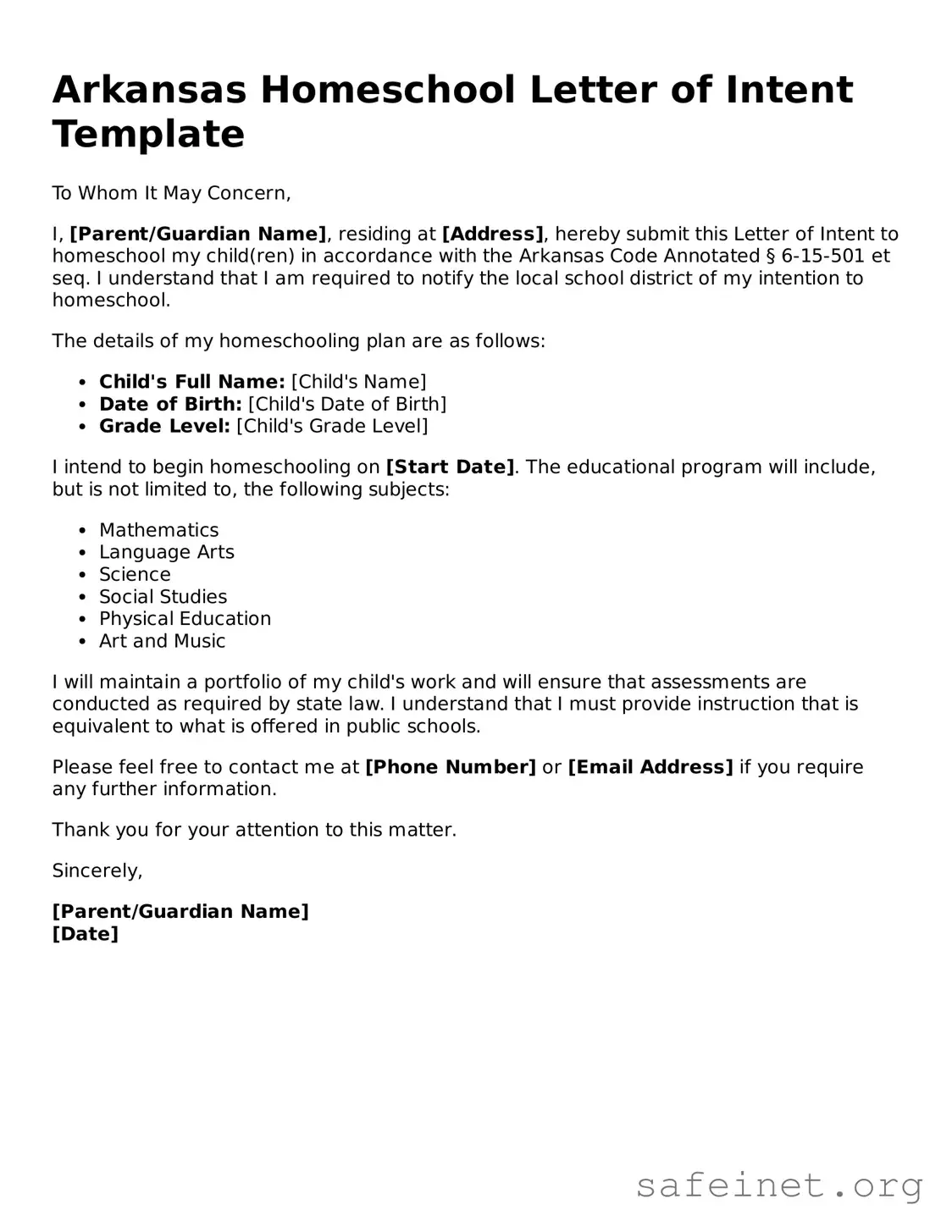
Arkansas Homeschool Letter of Intent Template
To Whom It May Concern,
I, [Parent/Guardian Name], residing at [Address], hereby submit this Letter of Intent to homeschool my child(ren) in accordance with the Arkansas Code Annotated § 6-15-501 et seq. I understand that I am required to notify the local school district of my intention to homeschool.
The details of my homeschooling plan are as follows:
I intend to begin homeschooling on [Start Date]. The educational program will include, but is not limited to, the following subjects:
I will maintain a portfolio of my child's work and will ensure that assessments are conducted as required by state law. I understand that I must provide instruction that is equivalent to what is offered in public schools.
Please feel free to contact me at [Phone Number] or [Email Address] if you require any further information.
Thank you for your attention to this matter.
Sincerely,
[Parent/Guardian Name]
[Date]
| Fact Name | Details |
|---|---|
| Governing Law | The Arkansas Homeschool Letter of Intent is governed by Arkansas Code Annotated § 6-15-503. |
| Submission Deadline | The form must be submitted to the local school district within 14 days of beginning homeschooling. |
| Required Information | The form requires the child's name, age, and the address of the homeschooling location. |
| Annual Renewal | Parents must submit a new Letter of Intent each year to continue homeschooling. |
| Notification of Changes | Any changes in the child's status or educational plan must be reported to the school district. |
| Record Keeping | Parents are advised to keep a copy of the Letter of Intent for their records. |
After obtaining the Arkansas Homeschool Letter of Intent form, you will need to fill it out carefully. This form is essential for notifying the local school district of your intention to homeschool your child. Once completed, you will submit it to the appropriate authorities to initiate your homeschooling journey.
What is the Arkansas Homeschool Letter of Intent form?
The Arkansas Homeschool Letter of Intent form is a document that parents or guardians must submit to the local school district to formally declare their intention to homeschool their child. This form is a crucial step in the homeschooling process, as it informs the school district of your educational plans and ensures compliance with state regulations.
Who needs to submit the Letter of Intent?
When should the Letter of Intent be submitted?
The Letter of Intent should be submitted at the beginning of your homeschooling journey. Ideally, it should be filed before the school year starts or as soon as you decide to homeschool. If you are transitioning from a public or private school, it is best to submit the letter promptly to avoid any gaps in your child’s education.
What information is required on the Letter of Intent?
The form typically requires basic information, including the names and ages of the children being homeschooled, the address of the residence, and the name of the parent or guardian. Some districts may request additional details about the educational plan, but the primary focus is on the intent to homeschool.
What happens after I submit the Letter of Intent?
Once you submit the Letter of Intent, the school district will process your request. You should receive confirmation that your intent to homeschool has been recorded. It is important to keep a copy of the submitted form for your records. After this, you can begin your homeschooling journey, following the educational guidelines set forth by the state of Arkansas.
Filling out the Arkansas Homeschool Letter of Intent form can be a straightforward process, but many people make common mistakes that can lead to delays or complications. Here’s a list of seven mistakes to avoid:
Incomplete Information: Failing to provide all required details can cause issues. Ensure every section of the form is filled out completely.
Incorrect Names: Double-check the spelling of names. Mistakes in the names of students or parents can lead to confusion.
Wrong Dates: Providing incorrect dates, such as the start of the homeschooling year, can lead to misunderstandings. Verify that all dates are accurate.
Missing Signatures: Forgetting to sign the form is a common oversight. Ensure that all required signatures are present before submission.
Not Keeping a Copy: Failing to keep a copy of the submitted form can create problems later. Always make a copy for your records.
Ignoring Deadlines: Submitting the form late can have repercussions. Be aware of deadlines and plan accordingly to avoid last-minute rushes.
Not Following Up: After submission, it’s important to follow up to ensure everything is in order. Don’t hesitate to contact the school district if you have questions.
By being aware of these common mistakes, you can navigate the process with confidence. Taking the time to carefully complete the form will help ensure a smooth start to your homeschooling journey.
When families decide to homeschool in Arkansas, submitting the Homeschool Letter of Intent is just the first step. There are several other forms and documents that may be necessary or beneficial throughout the homeschooling process. Understanding these documents can help ensure compliance with state regulations and support a smooth homeschooling experience.
Being aware of these documents can help families navigate the homeschooling landscape in Arkansas more effectively. Each document serves a specific purpose and can contribute to a well-rounded educational experience for students. Keeping organized records and staying informed about requirements will support a successful homeschooling journey.
The Arkansas Homeschool Letter of Intent form is similar to the Notice of Intent used in many states for families wishing to homeschool their children. This document typically requires parents to declare their intent to educate their child at home. Like the Arkansas form, it often includes basic information such as the child's name, age, and address. The Notice of Intent serves as a formal notification to the local education authority, ensuring that families comply with state regulations regarding homeschooling.
Another comparable document is the Affidavit of Intent to Homeschool, which is used in several states. This affidavit often requires parents to swear under oath that they intend to provide a home education for their children. Similar to the Arkansas form, it may ask for details about the educational plan and the qualifications of the parent or guardian. This document emphasizes the legal commitment parents make when choosing to homeschool.
The Individualized Education Plan (IEP) can also be likened to the Arkansas Homeschool Letter of Intent. While the IEP is typically used for children with special needs, it serves a similar purpose in outlining the educational framework for the child. Both documents require a clear outline of educational goals and methods, although the IEP is more focused on specific accommodations and support services for the child.
The Home Education Program Registration form found in some states bears resemblance to the Arkansas form. This registration form often serves to enroll a child in a homeschooling program officially. It includes similar information, such as the child's personal details and the educational approach the parents plan to implement. Both documents aim to keep the local education authorities informed about homeschooling activities.
The Declaration of Intent to Homeschool is another document that parallels the Arkansas Homeschool Letter of Intent. This declaration is often required by states to ensure that parents formally communicate their decision to homeschool. It typically includes similar elements, such as the child’s name and the educational philosophy of the parents. The focus is on establishing a clear record of the family's commitment to home education.
The Educational Plan for Homeschooling is akin to the Arkansas form in that it outlines the curriculum and teaching methods parents intend to use. While the Arkansas form may not require a detailed plan, the Educational Plan often asks for specifics about subjects, materials, and assessment methods. Both documents aim to provide clarity and structure to the homeschooling process.
The Notification of Home School Enrollment is another document that shares similarities with the Arkansas Homeschool Letter of Intent. This notification serves as a formal announcement to the school district that a child will be homeschooled. Like the Arkansas form, it generally requires basic information about the child and the parents’ educational intentions. This document helps ensure that local education authorities are aware of homeschooling families in their jurisdiction.
The Homeschool Registration Form used in various states also parallels the Arkansas form. This registration form typically requires parents to provide essential information about their child and the homeschooling approach. Both documents aim to establish a formal record of the family's decision to homeschool, which is important for compliance with state laws.
Finally, the Homeschooling Notification Letter can be compared to the Arkansas Homeschool Letter of Intent. This letter is often sent to local school boards to inform them of a family's decision to homeschool. It may include similar details such as the child's name and the educational philosophy. Both documents are crucial for maintaining transparency with local education authorities regarding homeschooling practices.
When filling out the Arkansas Homeschool Letter of Intent form, it’s important to follow specific guidelines. Here’s a list of things you should and shouldn’t do:
Many families considering homeschooling in Arkansas may encounter various misconceptions regarding the Homeschool Letter of Intent form. Understanding the truth behind these myths can help streamline the process and ensure compliance with state regulations. Below are some common misconceptions:
Some believe that submitting the Homeschool Letter of Intent is not necessary. However, in Arkansas, it is a legal requirement to file this form to officially register your homeschool program.
While parents are the primary individuals responsible for submitting the form, guardians or other responsible adults can also file it on behalf of the student.
Many think there is a strict deadline for submitting the Letter of Intent. In reality, it can be filed at any time during the school year, although it is advisable to do so before starting homeschooling.
Some people assume that the Letter of Intent must include extensive details about the curriculum. In fact, the form only requires basic information about the student and the educational plan.
There is a misconception that once the Letter of Intent is submitted, it cannot be modified. However, families can update their information as needed, particularly if there are changes in the educational plan or student status.
Some believe that submitting the Letter of Intent commits them to a specific educational philosophy. In reality, families have the freedom to choose their own teaching methods and curriculum.
There is a common misunderstanding that submitting the Letter of Intent automatically results in state approval. While it is a necessary step, families must still adhere to Arkansas homeschooling laws and regulations.
Some think that after filing the Letter of Intent, they are required to submit regular progress reports. In Arkansas, this is not a requirement, allowing families to manage their educational assessments independently.
Many believe that only new homeschooling families need to file this form. In fact, returning homeschoolers must also submit the Letter of Intent each year to maintain their status.
By dispelling these misconceptions, families can better navigate the homeschooling process in Arkansas and focus on providing a quality education for their children.
Filling out and using the Arkansas Homeschool Letter of Intent form is a crucial step for families choosing to educate their children at home. Here are key takeaways to consider:
These points highlight the importance of understanding the process and requirements involved in submitting the Arkansas Homeschool Letter of Intent form. Adhering to these guidelines will facilitate a smoother homeschooling experience.