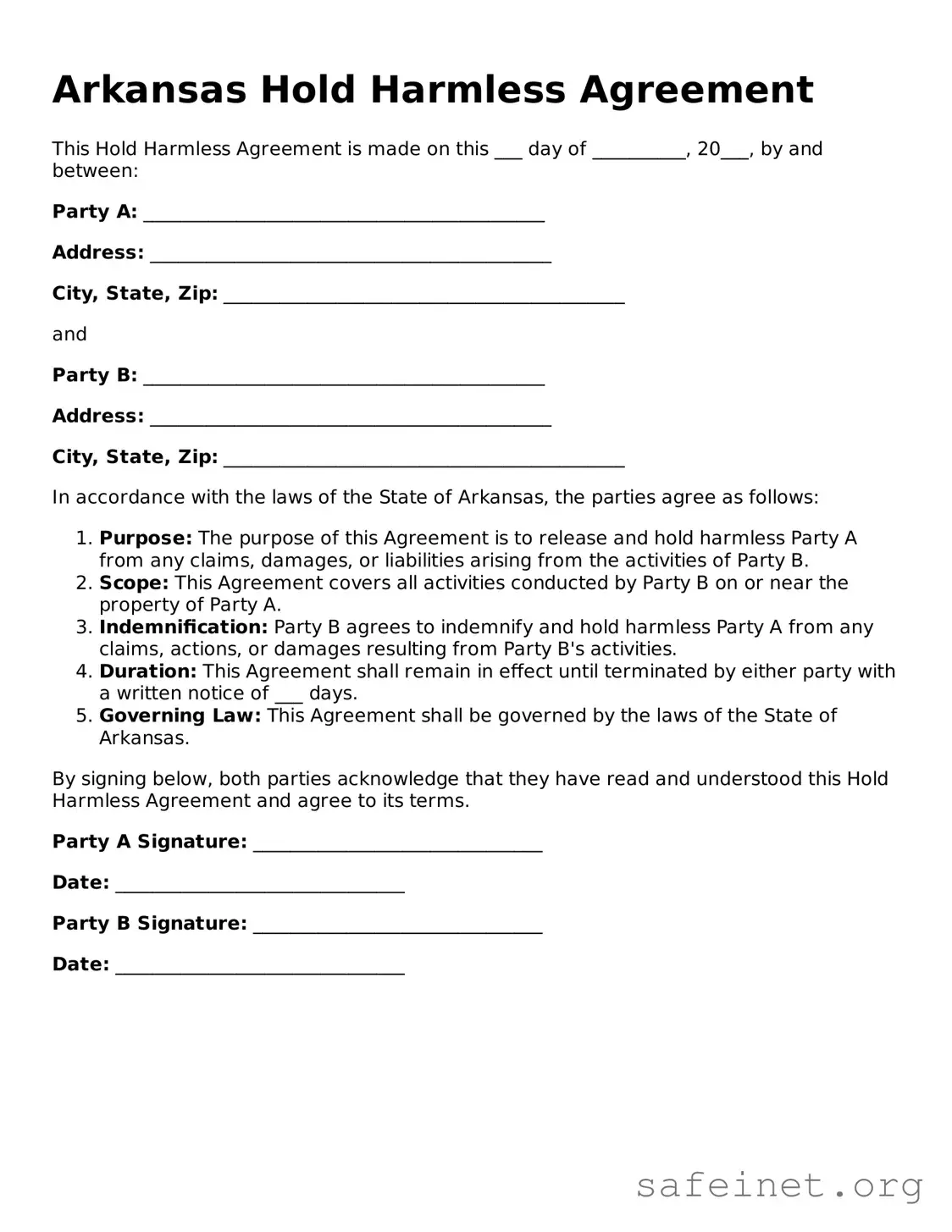
The Arkansas Hold Harmless Agreement form serves as a crucial legal tool for individuals and organizations seeking to protect themselves from liability. This agreement is designed to outline the responsibilities of each party involved in a transaction or event, ensuring that one party will not hold the other accountable for certain risks or damages that may arise. It is commonly used in various contexts, including rental agreements, event planning, and business transactions. By clearly defining the scope of liability, the form helps to mitigate potential disputes and fosters a sense of security for all parties. The agreement typically includes essential elements such as the identification of the parties, a description of the activities covered, and the specific risks being assumed. Understanding the nuances of this form is vital for anyone looking to navigate legal responsibilities effectively in Arkansas.
Arkansas Hold Harmless Agreement
This Hold Harmless Agreement is made on this ___ day of __________, 20___, by and between:
Party A: ___________________________________________
Address: ___________________________________________
City, State, Zip: ___________________________________________
and
Party B: ___________________________________________
Address: ___________________________________________
City, State, Zip: ___________________________________________
In accordance with the laws of the State of Arkansas, the parties agree as follows:
By signing below, both parties acknowledge that they have read and understood this Hold Harmless Agreement and agree to its terms.
Party A Signature: _______________________________
Date: _______________________________
Party B Signature: _______________________________
Date: _______________________________
| Fact Name | Details |
|---|---|
| Definition | The Arkansas Hold Harmless Agreement is a legal document that protects one party from liability for certain actions or events. |
| Purpose | This agreement is often used in various situations, such as events, property rentals, or services, to mitigate risk. |
| Governing Law | The agreement is governed by the laws of the State of Arkansas. |
| Key Components | It typically includes the names of the parties involved, the scope of the agreement, and the specific liabilities being waived. |
| Enforceability | For the agreement to be enforceable, it must be clear, specific, and voluntarily signed by all parties. |
| Limitations | Some liabilities, such as those arising from gross negligence or willful misconduct, may not be waived. |
| Usage Scenarios | Commonly used in sports events, community gatherings, and construction projects to protect organizers and service providers. |
| Legal Advice | Consulting with a legal professional before signing or drafting the agreement is highly recommended to ensure proper understanding. |
Filling out the Arkansas Hold Harmless Agreement form is straightforward. Follow the steps below to ensure you complete the form accurately. Once filled out, the form will require signatures from all involved parties to make it legally binding.
What is an Arkansas Hold Harmless Agreement?
An Arkansas Hold Harmless Agreement is a legal document that protects one party from liability for certain risks or damages. It is often used in contracts where one party agrees to indemnify another for any losses or claims that may arise during the execution of a specific task or activity. This agreement helps clarify responsibilities and can be crucial in minimizing legal disputes.
Who typically uses a Hold Harmless Agreement in Arkansas?
Various parties utilize Hold Harmless Agreements, including businesses, contractors, event organizers, and property owners. For instance, a contractor may ask a client to sign this agreement to limit liability for accidents that occur on the job site. Similarly, event organizers might require vendors to sign to protect against claims arising from their activities.
What are the key components of a Hold Harmless Agreement?
A typical Hold Harmless Agreement includes several essential elements: the names of the parties involved, a clear description of the activities covered, the scope of indemnification, and any limitations on liability. It may also specify the governing law and jurisdiction in case of disputes. Clarity in these components ensures that all parties understand their rights and responsibilities.
Is a Hold Harmless Agreement enforceable in Arkansas?
Yes, a Hold Harmless Agreement is generally enforceable in Arkansas, provided it meets certain legal requirements. The agreement must be clear and specific, and it should not violate public policy. Courts will typically uphold these agreements unless they are deemed overly broad or unfairly one-sided.
Can a Hold Harmless Agreement be modified after it is signed?
Yes, a Hold Harmless Agreement can be modified, but both parties must agree to the changes. It is best practice to document any modifications in writing and have both parties sign the revised agreement. This helps prevent misunderstandings and ensures that all parties are aware of the new terms.
Are there any limitations to what a Hold Harmless Agreement can cover?
Yes, there are limitations. A Hold Harmless Agreement cannot protect a party from liability for gross negligence or willful misconduct. Courts often refuse to enforce agreements that attempt to absolve a party from responsibility for serious wrongdoing. It is important to draft the agreement carefully to ensure it complies with legal standards.
How can I create a Hold Harmless Agreement in Arkansas?
Creating a Hold Harmless Agreement in Arkansas involves drafting a document that includes all necessary components. You can find templates online or consult with a legal professional to ensure compliance with state laws. Be sure to tailor the agreement to fit the specific situation and include all relevant details to protect your interests.
Incomplete Information: Failing to provide all required personal details can lead to delays or rejections. Ensure every section is filled out completely.
Incorrect Dates: Entering the wrong dates can cause confusion. Double-check the dates for accuracy before submission.
Missing Signatures: Not signing the form is a common oversight. Remember, a signature is essential for the agreement to be valid.
Incorrect Party Names: Using incorrect or inconsistent names for parties involved can invalidate the agreement. Verify that all names are spelled correctly.
Not Reading the Terms: Skimming through the terms can lead to misunderstandings. Take the time to read and understand what you are agreeing to.
Failure to Provide Contact Information: Not including a phone number or email can hinder communication. Make sure to provide accurate contact details.
Neglecting to Keep a Copy: Failing to keep a copy of the completed form can create problems later. Always retain a copy for your records.
Not Consulting a Professional: Attempting to fill out the form without guidance can lead to errors. If unsure, seek assistance from a legal professional.
Ignoring Submission Instructions: Not following the specific submission guidelines can result in delays. Pay attention to how and where to submit the form.
When engaging in agreements or contracts in Arkansas, particularly those involving liability and indemnification, it is essential to be aware of other relevant forms and documents that may accompany a Hold Harmless Agreement. These documents help clarify responsibilities and protect the interests of all parties involved. Below is a list of commonly used forms that complement the Hold Harmless Agreement.
Being aware of these additional forms can significantly enhance the effectiveness of a Hold Harmless Agreement. Each document serves a unique purpose and helps establish clear expectations and protections for all parties involved. It is advisable to consult with a legal professional to ensure that all necessary documents are properly drafted and executed.
The Indemnity Agreement is similar to the Arkansas Hold Harmless Agreement in that both documents aim to protect one party from legal liability. An Indemnity Agreement typically requires one party to compensate the other for any losses or damages incurred. This means that if something goes wrong, the indemnifying party will take on the financial burden, just as in a Hold Harmless Agreement where one party agrees not to hold the other responsible for certain risks.
The Liability Waiver is another document that shares similarities with the Hold Harmless Agreement. A Liability Waiver is often used in activities where there are inherent risks, such as sports or recreational events. Participants sign this waiver to acknowledge that they understand the risks involved and agree not to hold the organizers responsible for any injuries. Like the Hold Harmless Agreement, it serves to limit liability for one party.
The Release of Liability form also bears a resemblance to the Hold Harmless Agreement. This document is commonly used when someone agrees to release another party from any claims related to specific activities. By signing a Release of Liability, individuals acknowledge the risks and agree not to pursue legal action. Both documents aim to protect one party from potential lawsuits.
An Insurance Policy can be compared to the Hold Harmless Agreement as well. While an insurance policy provides financial protection against certain risks, a Hold Harmless Agreement shifts the responsibility for those risks from one party to another. In both cases, the goal is to manage potential liabilities and ensure that one party is not left financially vulnerable.
The Non-Disclosure Agreement (NDA) is similar in that it protects interests, though it does so in a different context. An NDA prevents one party from sharing confidential information with others. While it does not directly address liability, it protects sensitive information, which can be critical in avoiding future legal issues. Both documents emphasize the importance of protecting one party's interests.
The Service Agreement can also be likened to the Hold Harmless Agreement. This document outlines the terms of a service relationship, including responsibilities and liabilities. In many cases, a Service Agreement will include clauses that limit liability for one party, similar to how a Hold Harmless Agreement functions. Both documents are essential in clarifying expectations and protecting parties involved.
The Partnership Agreement shares some common ground with the Hold Harmless Agreement, especially in terms of liability management. A Partnership Agreement outlines the roles and responsibilities of each partner while often including provisions that address how liabilities will be handled. Both documents aim to create a clear understanding of each party's obligations and how they will protect each other from potential risks.
The Rental Agreement is another document that can be compared to the Hold Harmless Agreement. In a Rental Agreement, landlords often include clauses that protect them from liability for injuries that occur on the property. Similarly, a Hold Harmless Agreement protects one party from being held responsible for certain risks. Both documents serve to clarify responsibilities and mitigate potential legal issues.
Finally, the Employment Contract can be viewed as similar to the Hold Harmless Agreement. Employment Contracts often include terms that outline the responsibilities of both the employer and employee, including liability clauses. These clauses can limit the employer's responsibility for certain actions taken by the employee. Both documents aim to define roles and protect against unforeseen legal challenges.
When filling out the Arkansas Hold Harmless Agreement form, it is important to approach the task with care. Below are some key do's and don'ts to consider to ensure that the process is smooth and effective.
By following these guidelines, you can help ensure that your Hold Harmless Agreement is filled out correctly and serves its intended purpose.
The Arkansas Hold Harmless Agreement form is often misunderstood. Here are seven common misconceptions about it:
Understanding these misconceptions can help individuals and businesses make informed decisions about using Hold Harmless Agreements in Arkansas.
When considering the Arkansas Hold Harmless Agreement form, it is important to understand its implications and proper usage. Here are seven key takeaways:
Understanding these key aspects can help ensure that the Hold Harmless Agreement serves its intended purpose effectively.