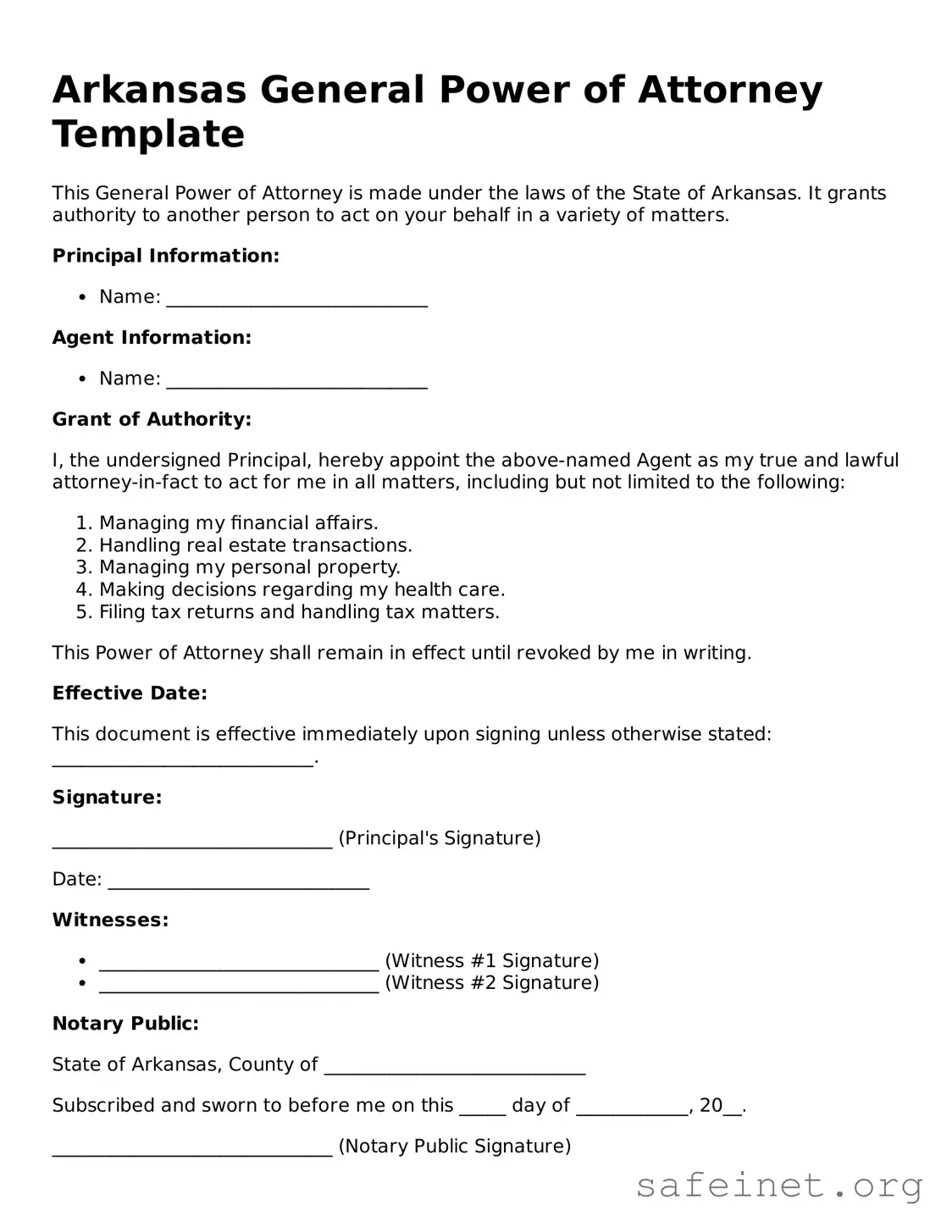
The Arkansas General Power of Attorney form is a crucial legal document that allows an individual, known as the principal, to appoint another person, referred to as the agent or attorney-in-fact, to make decisions on their behalf. This form empowers the agent to handle a wide range of financial and legal matters, including managing bank accounts, signing contracts, and making real estate transactions. It is important to note that the authority granted can be broad or limited, depending on the principal's preferences. The form must be completed, signed, and notarized to ensure its validity. Additionally, it is essential for the principal to choose a trustworthy agent, as the appointed individual will have significant control over the principal's affairs. Understanding the implications of this document is vital, as it can impact financial and legal rights significantly. Moreover, the Arkansas General Power of Attorney can be revoked at any time by the principal, provided they are mentally competent to do so, allowing for flexibility in managing one's affairs.
Arkansas General Power of Attorney Template
This General Power of Attorney is made under the laws of the State of Arkansas. It grants authority to another person to act on your behalf in a variety of matters.
Principal Information:
Agent Information:
Grant of Authority:
I, the undersigned Principal, hereby appoint the above-named Agent as my true and lawful attorney-in-fact to act for me in all matters, including but not limited to the following:
This Power of Attorney shall remain in effect until revoked by me in writing.
Effective Date:
This document is effective immediately upon signing unless otherwise stated: ____________________________.
Signature:
______________________________ (Principal's Signature)
Date: ____________________________
Witnesses:
Notary Public:
State of Arkansas, County of ____________________________
Subscribed and sworn to before me on this _____ day of ____________, 20__.
______________________________ (Notary Public Signature)
My commission expires: ____________________________
| Fact Name | Description |
|---|---|
| Definition | The Arkansas General Power of Attorney form allows an individual to appoint someone else to manage their financial and legal affairs. |
| Governing Law | This form is governed by the Arkansas Code Annotated, specifically Title 28, Chapter 68. |
| Durability | The power of attorney can be made durable, meaning it remains effective even if the principal becomes incapacitated. |
| Revocation | The principal can revoke the power of attorney at any time, as long as they are mentally competent. |
Filling out the Arkansas General Power of Attorney form is a straightforward process that requires careful attention to detail. Once completed, this document will empower an individual to act on your behalf in financial and legal matters. Ensuring that all sections are accurately filled out is crucial for the effectiveness of the document.
What is a General Power of Attorney in Arkansas?
A General Power of Attorney is a legal document that allows one person, known as the "agent" or "attorney-in-fact," to act on behalf of another person, referred to as the "principal." This document grants broad powers to the agent, enabling them to make financial and legal decisions for the principal when they are unable to do so themselves.
Why would I need a General Power of Attorney?
You might need a General Power of Attorney if you want someone you trust to handle your financial matters, manage your property, or make legal decisions on your behalf. This can be particularly important if you are traveling, facing health issues, or simply wish to delegate authority to someone you trust.
Who can be my agent in a General Power of Attorney?
Your agent can be anyone you trust, such as a family member, friend, or professional advisor. However, it’s essential to choose someone who is responsible and capable of managing your affairs. In Arkansas, the agent must be at least 18 years old and mentally competent.
What powers can I grant to my agent?
You can grant your agent a wide range of powers, including managing bank accounts, paying bills, buying or selling property, and making investment decisions. However, you can also limit the powers if there are specific areas where you do not want your agent to have authority.
Do I need to have the General Power of Attorney notarized?
Yes, in Arkansas, the General Power of Attorney must be notarized to be legally valid. This ensures that the document is recognized and accepted by banks, financial institutions, and other entities. It is also advisable to have witnesses present when signing.
Can I revoke a General Power of Attorney?
Yes, you can revoke a General Power of Attorney at any time, as long as you are mentally competent. To revoke it, you should create a written revocation document and notify your agent and any institutions that may have relied on the original document.
What happens if I become incapacitated?
If you become incapacitated, the General Power of Attorney allows your agent to make decisions on your behalf, as specified in the document. This can be crucial for ensuring that your financial and legal matters are managed according to your wishes during your incapacity.
Is a General Power of Attorney the same as a Durable Power of Attorney?
No, they are not the same. A General Power of Attorney typically becomes invalid if the principal becomes incapacitated. In contrast, a Durable Power of Attorney remains in effect even if the principal is incapacitated, allowing the agent to continue acting on their behalf.
Can I use a General Power of Attorney in other states?
While a General Power of Attorney executed in Arkansas may be recognized in other states, it’s important to check the specific laws of the state where you intend to use it. Some states may have different requirements or forms, so consulting with a legal professional in that state is advisable.
How do I create a General Power of Attorney in Arkansas?
To create a General Power of Attorney in Arkansas, you need to fill out the appropriate form, specify the powers you wish to grant, sign it in the presence of a notary, and possibly have witnesses. It’s recommended to consult with a legal professional to ensure that the document meets all legal requirements and reflects your wishes accurately.
Failing to specify the powers granted. It is essential to clearly outline what powers the agent will have. Leaving this vague can lead to confusion and potential misuse.
Not signing the document in the presence of a notary. In Arkansas, a General Power of Attorney must be notarized to be legally binding. Without this step, the document may not hold up in court.
Neglecting to date the form. A date is crucial for establishing when the powers become effective. An undated form may lead to disputes regarding its validity.
Overlooking the need for witnesses. Depending on the specific powers granted, Arkansas law may require witnesses to the signing. Failing to include witnesses can invalidate the document.
Choosing an unsuitable agent. It is important to select someone trustworthy and capable of managing the responsibilities assigned. An inappropriate choice can lead to mismanagement of affairs.
Not reviewing state-specific requirements. Each state has unique laws governing powers of attorney. Ignoring these can result in an improperly executed document.
Forgetting to revoke previous powers of attorney. If there are existing powers of attorney, it is necessary to revoke them formally to avoid conflicts.
Assuming the document is permanent. A General Power of Attorney can be revoked or modified at any time. Failing to understand this can lead to ongoing issues with outdated authority.
When considering a General Power of Attorney in Arkansas, it is essential to understand that several other documents may complement this form. Each of these documents serves a unique purpose and can enhance the effectiveness of your estate planning and decision-making processes. Below are four commonly used forms that you may want to consider.
Incorporating these documents alongside the General Power of Attorney can provide clarity and security in your personal and financial affairs. It is advisable to consult with a qualified professional to ensure that all documents align with your specific needs and intentions.
The Arkansas General Power of Attorney form shares similarities with the Durable Power of Attorney. Both documents allow an individual, known as the principal, to appoint another person, called the agent, to make decisions on their behalf. However, the key difference lies in durability. The Durable Power of Attorney remains effective even if the principal becomes incapacitated, ensuring that the agent can continue to act in the principal's best interests during times of diminished capacity. This makes it a preferred choice for long-term planning.
Another document that resembles the General Power of Attorney is the Limited Power of Attorney. While the General Power of Attorney grants broad authority to the agent, the Limited Power of Attorney restricts the agent’s powers to specific tasks or time frames. For instance, a principal might use a Limited Power of Attorney to allow someone to handle a real estate transaction while retaining control over other aspects of their affairs. This focused approach can be beneficial when a principal wants to delegate certain responsibilities without relinquishing overall authority.
The Medical Power of Attorney is another document that parallels the General Power of Attorney, but it specifically pertains to healthcare decisions. In this case, the principal designates an agent to make medical choices on their behalf if they are unable to do so themselves. This document is crucial for ensuring that a person's healthcare preferences are respected during critical situations. While the General Power of Attorney can cover financial and legal matters, the Medical Power of Attorney focuses solely on health-related decisions.
A Healthcare Proxy is similar to the Medical Power of Attorney, as it also allows an individual to appoint someone to make medical decisions. The main distinction is that a Healthcare Proxy is often used in conjunction with a living will, which outlines specific wishes regarding medical treatment. This combination ensures that the appointed agent can make informed decisions based on the principal's preferences, providing clarity during difficult times when the principal may not be able to communicate their desires.
Lastly, the Springing Power of Attorney bears resemblance to the General Power of Attorney in that it allows for the appointment of an agent. However, the Springing Power of Attorney only becomes effective under certain conditions, such as the principal's incapacity. This feature can provide peace of mind for those who wish to maintain control over their affairs until a specific event occurs. By utilizing a Springing Power of Attorney, individuals can ensure that their chosen agent steps in only when absolutely necessary, thus preserving their autonomy for as long as possible.
When filling out the Arkansas General Power of Attorney form, there are important steps to follow. Here’s a list of what to do and what to avoid:
The Arkansas General Power of Attorney form is a crucial legal document that allows one person to grant another the authority to act on their behalf. However, several misconceptions surround its use and implications. Below are nine common misconceptions along with explanations to clarify them.
This is incorrect. While many people use it for financial decisions, it can also cover health care and legal matters, depending on how it is drafted.
This is false. The agent can be any competent adult, not necessarily a legal professional. Family members or trusted friends often serve in this role.
This statement is misleading. The document typically terminates upon the principal's death, but some provisions may allow for continued authority in specific situations.
This is incorrect. A principal retains the right to revoke or amend the General Power of Attorney at any time, as long as they are mentally competent.
This is not true. The powers granted can be limited to specific tasks or decisions, depending on the principal's wishes as outlined in the document.
This is a common belief, but while notarization can enhance the document's credibility, it is not always a legal requirement in Arkansas.
This is misleading. A Durable Power of Attorney remains effective even if the principal becomes incapacitated, whereas a General Power of Attorney may not, unless specified.
This is false. The agent has a fiduciary duty to act in the principal's best interest and cannot use the principal's assets for personal benefit.
This is incorrect. The document remains in effect until revoked by the principal or until the principal's death, allowing for flexibility in its use.
Understanding these misconceptions can help individuals make informed decisions regarding the use of a General Power of Attorney in Arkansas. Clarity about its functions and limitations is essential for both principals and agents alike.
When considering the Arkansas General Power of Attorney form, it's essential to understand its significance and how to use it effectively. Here are some key takeaways:
By keeping these points in mind, you can navigate the process of creating and using a General Power of Attorney in Arkansas more confidently.