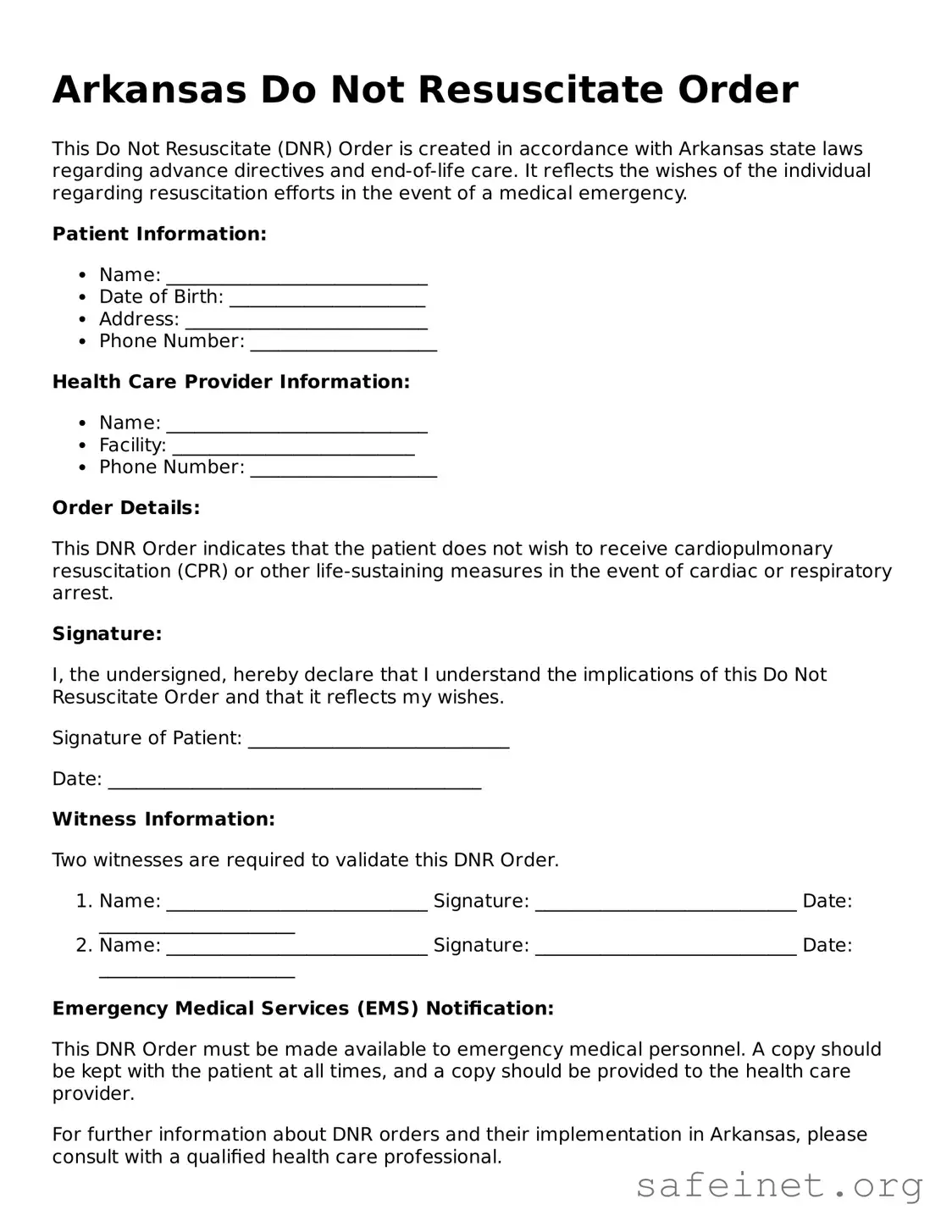
In Arkansas, the Do Not Resuscitate (DNR) Order form serves as a crucial legal document that empowers individuals to express their wishes regarding medical treatment in the event of a life-threatening situation. This form is particularly significant for those who wish to forgo cardiopulmonary resuscitation (CPR) and other life-sustaining measures, allowing them to die naturally in accordance with their personal values and preferences. The DNR Order must be completed by a licensed physician and signed by the patient or their legal representative, ensuring that the decision is both informed and voluntary. It is essential for patients and their families to understand that this document does not affect other medical treatments and can be revoked at any time. Additionally, medical personnel are required to honor the DNR Order when it is properly executed, providing peace of mind to individuals and their loved ones during difficult times. Understanding the implications and processes surrounding the DNR Order is vital for anyone considering this option, as it allows for informed decision-making about end-of-life care.
Arkansas Do Not Resuscitate Order
This Do Not Resuscitate (DNR) Order is created in accordance with Arkansas state laws regarding advance directives and end-of-life care. It reflects the wishes of the individual regarding resuscitation efforts in the event of a medical emergency.
Patient Information:
Health Care Provider Information:
Order Details:
This DNR Order indicates that the patient does not wish to receive cardiopulmonary resuscitation (CPR) or other life-sustaining measures in the event of cardiac or respiratory arrest.
Signature:
I, the undersigned, hereby declare that I understand the implications of this Do Not Resuscitate Order and that it reflects my wishes.
Signature of Patient: ____________________________
Date: ________________________________________
Witness Information:
Two witnesses are required to validate this DNR Order.
Emergency Medical Services (EMS) Notification:
This DNR Order must be made available to emergency medical personnel. A copy should be kept with the patient at all times, and a copy should be provided to the health care provider.
For further information about DNR orders and their implementation in Arkansas, please consult with a qualified health care professional.
| Fact Name | Description |
|---|---|
| Definition | The Arkansas Do Not Resuscitate (DNR) Order is a legal document that allows a person to refuse resuscitation in the event of cardiac arrest. |
| Governing Law | The DNR Order in Arkansas is governed by Arkansas Code Annotated § 20-13-2201 to § 20-13-2207. |
| Eligibility | Any adult with decision-making capacity can complete a DNR Order. This includes patients who are terminally ill or in a persistent vegetative state. |
| Signature Requirement | The form must be signed by the patient or their legally authorized representative, along with a physician's signature. |
| Form Availability | The DNR Order form is available through healthcare providers, hospitals, and online state resources. |
| Revocation | A DNR Order can be revoked at any time by the patient or their representative, either verbally or in writing. |
| Emergency Services | Emergency medical personnel are required to honor a valid DNR Order. It must be readily accessible to be effective during emergencies. |
Completing the Arkansas Do Not Resuscitate Order form is an important step in expressing your healthcare preferences. This document allows individuals to communicate their wishes regarding resuscitation in the event of a medical emergency. To ensure that the form is filled out correctly and reflects your intentions, follow these steps carefully.
What is a Do Not Resuscitate (DNR) Order in Arkansas?
A Do Not Resuscitate Order is a legal document that allows individuals to refuse certain medical treatments, specifically cardiopulmonary resuscitation (CPR), in the event of a cardiac arrest or respiratory failure. In Arkansas, this order is recognized by healthcare providers and is meant to honor a patient’s wishes regarding end-of-life care.
Who can request a DNR Order in Arkansas?
In Arkansas, a DNR Order can be requested by a patient who is at least 18 years old and has the capacity to make their own medical decisions. If the patient is unable to make decisions, a legally authorized representative, such as a family member or healthcare proxy, may request the order on their behalf.
How do I obtain a DNR Order form in Arkansas?
To obtain a DNR Order form in Arkansas, you can contact your healthcare provider or visit the Arkansas Department of Health’s website. The form is typically provided by hospitals, clinics, or can be downloaded online. It is important to ensure that the form is properly filled out and signed to be legally valid.
What information is required on the DNR Order form?
The DNR Order form requires basic information such as the patient’s name, date of birth, and medical history. It also includes sections for the patient or their representative to indicate their wishes regarding resuscitation efforts. Signatures from the patient, their representative, and a physician are necessary for the form to be valid.
Is a DNR Order valid in all healthcare settings?
Yes, once properly executed, a DNR Order is valid in all healthcare settings in Arkansas, including hospitals, nursing homes, and emergency medical services. However, it is essential to ensure that copies of the order are readily available to healthcare providers to ensure that the patient’s wishes are honored.
Can a DNR Order be revoked or changed?
Absolutely. A DNR Order can be revoked or changed at any time by the patient or their authorized representative. To revoke the order, simply inform your healthcare provider, and ensure that any copies of the original DNR Order are destroyed or marked as revoked.
What happens if a DNR Order is not followed?
If a DNR Order is not followed, it may lead to legal consequences for healthcare providers. They are required to honor the patient's wishes as stated in the DNR Order. If a patient feels that their DNR Order has been disregarded, they should discuss the situation with their healthcare provider or seek legal advice.
Are there any costs associated with obtaining a DNR Order?
Generally, there are no direct costs for obtaining a DNR Order in Arkansas. However, discussions with healthcare providers about end-of-life care may be billed as part of a medical consultation. It’s advisable to check with your healthcare provider about any potential costs involved.
Can a DNR Order be part of an advance directive?
Yes, a DNR Order can be included as part of an advance directive, which is a broader document outlining a person's healthcare preferences in various situations. Combining a DNR Order with an advance directive can provide comprehensive guidance to healthcare providers about a patient’s wishes regarding medical treatment.
Failing to include the patient's full name. This information is crucial for the document's validity.
Not signing the form. A signature is necessary to ensure that the order is legally binding.
Omitting the date. The absence of a date can lead to confusion about when the order was established.
Using unclear language. Be specific about the patient's wishes to avoid misunderstandings.
Not having a witness. Some states require a witness to validate the order, so check local regulations.
Forgetting to update the form. If the patient's condition changes, the order should reflect those changes.
Neglecting to discuss the order with family members. Open communication can help prevent disputes later on.
Failing to provide copies to healthcare providers. Ensure that all relevant parties have access to the order.
Not reviewing the form regularly. Regular reviews ensure that the order remains aligned with the patient’s wishes.
The Arkansas Do Not Resuscitate (DNR) Order form is an essential document that outlines a patient's wishes regarding resuscitation efforts in the event of a medical emergency. In addition to the DNR form, there are several other documents and forms that may be relevant for individuals planning their medical care. Each of these documents serves a specific purpose in ensuring that a person's healthcare preferences are respected.
Understanding these documents can empower individuals to make informed decisions about their healthcare. It is crucial to have these forms in place to ensure that medical professionals and loved ones respect and adhere to a person's wishes during critical moments.
The Arkansas Do Not Resuscitate (DNR) Order form shares similarities with the Advance Directive. An Advance Directive is a legal document that allows individuals to outline their preferences for medical treatment in the event they become unable to communicate those wishes. Like the DNR, it is designed to ensure that a person's healthcare decisions are respected, particularly regarding life-sustaining treatments. Both documents empower individuals to take control of their medical care, providing clarity for healthcare providers and family members during critical moments.
Another document comparable to the Arkansas DNR is the Medical Power of Attorney. This legal instrument enables individuals to designate someone to make healthcare decisions on their behalf if they are incapacitated. Similar to the DNR, the Medical Power of Attorney is rooted in the principle of patient autonomy. It ensures that the appointed agent can advocate for the individual's wishes, including the decision to forego resuscitation if that aligns with the person's values and preferences.
The Physician Orders for Life-Sustaining Treatment (POLST) form is also akin to the Arkansas DNR. POLST is a medical order that translates a patient's treatment preferences into actionable physician orders. It is often used for patients with serious illnesses or advanced age. Like the DNR, POLST provides clear guidance to medical professionals about the patient’s wishes, ensuring that their choices regarding resuscitation and other interventions are honored in urgent situations.
Living Wills are another document that parallels the Arkansas DNR. A Living Will allows individuals to specify their wishes regarding end-of-life care, including whether they wish to receive resuscitation efforts. While a DNR specifically addresses the desire not to receive CPR, a Living Will covers a broader range of medical decisions. Both documents aim to relieve families and healthcare providers from the burden of making difficult decisions during emotional times.
In addition, the Comfort Care Order shares similarities with the Arkansas DNR. This document focuses on ensuring that patients receive comfort measures rather than aggressive life-saving treatments. While a DNR explicitly states a person's wish not to undergo resuscitation, a Comfort Care Order emphasizes the importance of palliative care. Both documents prioritize the patient's comfort and dignity, particularly in end-of-life scenarios.
Lastly, the Health Care Proxy is another document that aligns with the principles of the Arkansas DNR. A Health Care Proxy allows individuals to appoint someone to make healthcare decisions on their behalf. While it does not specifically address resuscitation, it provides a framework for ensuring that a person's healthcare preferences, including decisions about DNR status, are respected. Like the DNR, it emphasizes the importance of having a trusted person advocate for the individual's wishes during critical health situations.
When filling out the Arkansas Do Not Resuscitate (DNR) Order form, it is crucial to approach the process with care. Here are ten important dos and don’ts to keep in mind:
By following these guidelines, you can ensure that your wishes regarding resuscitation are clearly communicated and respected. Taking the time to understand and properly complete the DNR order can provide peace of mind for you and your loved ones.
Understanding the Arkansas Do Not Resuscitate (DNR) Order form can be challenging. Many people hold misconceptions about what it entails and how it functions. Here are six common misconceptions:
This is not true. A DNR specifically addresses resuscitation efforts in the event of cardiac arrest or respiratory failure. You will still receive other forms of medical care and treatment.
This misconception overlooks the fact that anyone can choose to have a DNR, regardless of their health status. It is a personal choice based on individual values and preferences.
A DNR can be revoked or modified at any time. If your wishes change, you can update or cancel the order as needed.
This is not necessary. While legal advice can be helpful, you do not need a lawyer to fill out a DNR form. It is designed to be accessible for individuals to complete on their own.
This is misleading. A DNR specifically applies to resuscitation efforts. Other medical interventions, such as pain management or comfort care, are still provided.
In general, a DNR reflects your wishes. While family members may have input, your documented preferences take precedence unless you specify otherwise.
Clarifying these misconceptions can help individuals make informed decisions about their healthcare preferences. Understanding the DNR form is essential for ensuring that your wishes are respected in critical situations.
Filling out and utilizing the Arkansas Do Not Resuscitate (DNR) Order form is an important step for individuals who wish to communicate their medical preferences. Here are ten key takeaways to consider:
Taking these steps can help ensure that your medical preferences are respected when it matters most. Act now to make your wishes clear and protect your rights.