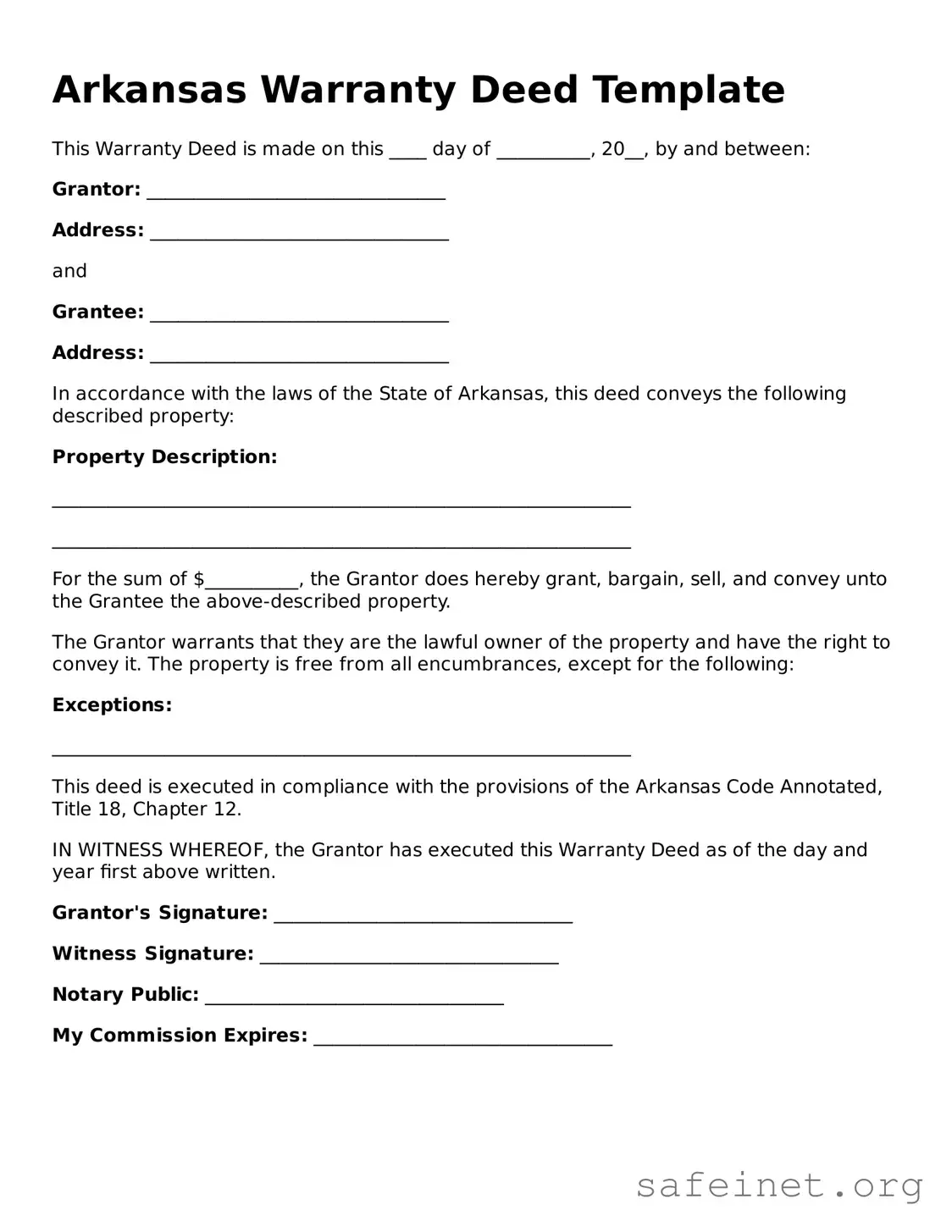
The Arkansas Deed form is a crucial document in the realm of real estate transactions, serving as a legal instrument that facilitates the transfer of property ownership. This form encompasses several key elements that ensure the validity of the transfer, including the names of the parties involved, a clear description of the property, and the signature of the grantor. Additionally, it may require notarization to enhance its legal standing. Understanding the various types of deeds available in Arkansas—such as warranty deeds, quitclaim deeds, and special warranty deeds—is essential for anyone looking to navigate the property market effectively. Each type serves a different purpose and offers varying levels of protection for the buyer. Moreover, the Arkansas Deed form must comply with state-specific regulations to be enforceable, making it imperative for both buyers and sellers to familiarize themselves with its requirements. Attention to detail in completing this form can prevent future disputes and ensure a smooth transaction process.
Arkansas Warranty Deed Template
This Warranty Deed is made on this ____ day of __________, 20__, by and between:
Grantor: ________________________________
Address: ________________________________
and
Grantee: ________________________________
Address: ________________________________
In accordance with the laws of the State of Arkansas, this deed conveys the following described property:
Property Description:
______________________________________________________________
______________________________________________________________
For the sum of $__________, the Grantor does hereby grant, bargain, sell, and convey unto the Grantee the above-described property.
The Grantor warrants that they are the lawful owner of the property and have the right to convey it. The property is free from all encumbrances, except for the following:
Exceptions:
______________________________________________________________
This deed is executed in compliance with the provisions of the Arkansas Code Annotated, Title 18, Chapter 12.
IN WITNESS WHEREOF, the Grantor has executed this Warranty Deed as of the day and year first above written.
Grantor's Signature: ________________________________
Witness Signature: ________________________________
Notary Public: ________________________________
My Commission Expires: ________________________________
| Fact Name | Description |
|---|---|
| Governing Law | The Arkansas Deed form is governed by the laws of the State of Arkansas. |
| Purpose | This form is used to transfer ownership of real property from one party to another. |
| Types of Deeds | Arkansas recognizes various types of deeds, including warranty deeds and quitclaim deeds. |
| Notarization Requirement | The deed must be notarized to be legally binding and enforceable. |
| Recording | After execution, the deed should be recorded in the county where the property is located. |
| Legal Description | A complete legal description of the property must be included in the deed. |
| Transfer Taxes | Arkansas may impose transfer taxes on the sale of real estate, which should be considered during the transaction. |
Filling out the Arkansas Deed form is an important step in transferring property ownership. Once you complete the form, it will need to be signed, notarized, and filed with the appropriate county office to ensure the transfer is legally recognized.
What is an Arkansas Deed form?
An Arkansas Deed form is a legal document used to transfer ownership of real property from one party to another within the state of Arkansas. This document outlines the details of the transaction, including the names of the parties involved, a description of the property, and any terms related to the transfer. It is essential for ensuring that the transfer is legally recognized and that the new owner has clear title to the property.
What types of Deed forms are available in Arkansas?
In Arkansas, there are several types of Deed forms, including Warranty Deeds, Quitclaim Deeds, and Special Warranty Deeds. A Warranty Deed provides the highest level of protection to the buyer, guaranteeing that the seller holds clear title to the property. A Quitclaim Deed, on the other hand, transfers whatever interest the seller has in the property without any guarantees. Special Warranty Deeds offer limited protection, as they only guarantee that the seller has not encumbered the property during their ownership.
How do I complete an Arkansas Deed form?
To complete an Arkansas Deed form, you will need to gather specific information, including the names and addresses of both the grantor (seller) and grantee (buyer), a legal description of the property, and the date of the transaction. Once you have filled out the form, both parties must sign it in the presence of a notary public. This step is crucial, as notarization validates the signatures and ensures the document's legality.
Is it necessary to record the Deed after signing?
Yes, it is highly recommended to record the Deed with the county clerk's office where the property is located. Recording the Deed provides public notice of the ownership transfer and protects the new owner's rights. Failing to record the Deed could lead to disputes regarding property ownership in the future.
Are there any fees associated with filing an Arkansas Deed form?
Yes, there are typically fees associated with filing an Arkansas Deed form. These fees can vary depending on the county and the specific requirements of the clerk's office. In addition to filing fees, there may also be costs related to notarization and any additional services you may require. It is advisable to check with your local county clerk's office for the most accurate fee schedule.
One common mistake is failing to include the correct names of the parties involved. It is essential to accurately list the full names of both the grantor (the seller) and the grantee (the buyer). Any discrepancies can lead to legal complications later on.
Another frequent error is not providing a complete legal description of the property. This description should clearly identify the boundaries and location of the property. Omitting this information can create ambiguity and confusion regarding what is being transferred.
People often forget to sign the deed. A deed without signatures is not valid. Both the grantor and, in some cases, the grantee must sign the document to ensure its enforceability.
Inaccurate dates can also pose a problem. Failing to include the date of execution or using an incorrect date can lead to questions about the timeline of the transaction.
Another mistake is not having the deed notarized. In Arkansas, a deed typically requires notarization to be legally recognized. A lack of notarization can invalidate the document.
People sometimes neglect to check for existing liens or encumbrances on the property. It is crucial to ensure that the property is free of any legal claims that could affect ownership.
Some individuals do not properly fill out the consideration section. This section should reflect the amount paid for the property or a statement indicating that it is a gift. An incomplete or inaccurate consideration can lead to misunderstandings about the transaction.
Finally, failing to record the deed with the appropriate county office is a significant oversight. Recording the deed is essential for public notice and protects the rights of the new owner. Without this step, the transaction may not be recognized legally.
When completing a property transaction in Arkansas, several important documents accompany the deed form. Each of these documents serves a specific purpose, ensuring that the transfer of ownership is clear and legally binding. Below is a list of commonly used forms and documents that you may encounter in this process.
Understanding these documents will help ensure a smoother transaction process. Each plays a crucial role in protecting the interests of both the buyer and the seller, contributing to a successful property transfer.
The Arkansas Deed form shares similarities with the Quitclaim Deed. Both documents are used to transfer property ownership, but they differ in the level of guarantee provided. A Quitclaim Deed transfers whatever interest the grantor has in the property without any warranties. This means that if the grantor has no legal claim to the property, the grantee receives nothing. The Arkansas Deed, on the other hand, often includes more assurances regarding the grantor’s ownership, providing a clearer title for the grantee.
Another document akin to the Arkansas Deed is the Warranty Deed. This form offers a higher level of protection for the grantee compared to both the Arkansas Deed and the Quitclaim Deed. A Warranty Deed guarantees that the grantor holds clear title to the property and is legally entitled to transfer it. Should any issues arise regarding ownership, the grantor is responsible for addressing them. This assurance makes the Warranty Deed a preferred option for many buyers.
The Bargain and Sale Deed is also similar to the Arkansas Deed in that it conveys property ownership but does so without any warranties against encumbrances. This means that while the grantor transfers their interest in the property, they do not guarantee that the title is free of claims or liens. Like the Arkansas Deed, it is often used in transactions where the buyer is willing to accept some risk regarding the property’s title.
The Special Purpose Deed is another document that parallels the Arkansas Deed. This type of deed is specifically designed for unique situations, such as transferring property between family members or in the context of a divorce settlement. While it serves a specific purpose, it still functions to convey ownership, similar to the Arkansas Deed, but may include specific terms that address the unique circumstances of the transfer.
Lastly, the Trustee’s Deed is comparable to the Arkansas Deed in that it is used to transfer property held in a trust. This document is executed by a trustee who has the authority to manage the property on behalf of the beneficiaries. Like the Arkansas Deed, the Trustee’s Deed facilitates the transfer of ownership, but it is specifically tailored to the context of trust management, ensuring that the rights of the beneficiaries are upheld during the transaction.
When filling out the Arkansas Deed form, it is important to follow certain guidelines to ensure accuracy and compliance. Here are some key points to consider:
Understanding the Arkansas Deed form is crucial for anyone involved in real estate transactions. However, several misconceptions can lead to confusion. Here are ten common myths about the Arkansas Deed form, along with clarifications to help you navigate the process more effectively.
By understanding these misconceptions, individuals can better navigate the complexities of real estate transactions in Arkansas. Always consider seeking professional advice to ensure compliance with local laws and regulations.
When filling out and using the Arkansas Deed form, keep these key takeaways in mind:
By following these steps, you can successfully fill out and utilize the Arkansas Deed form.