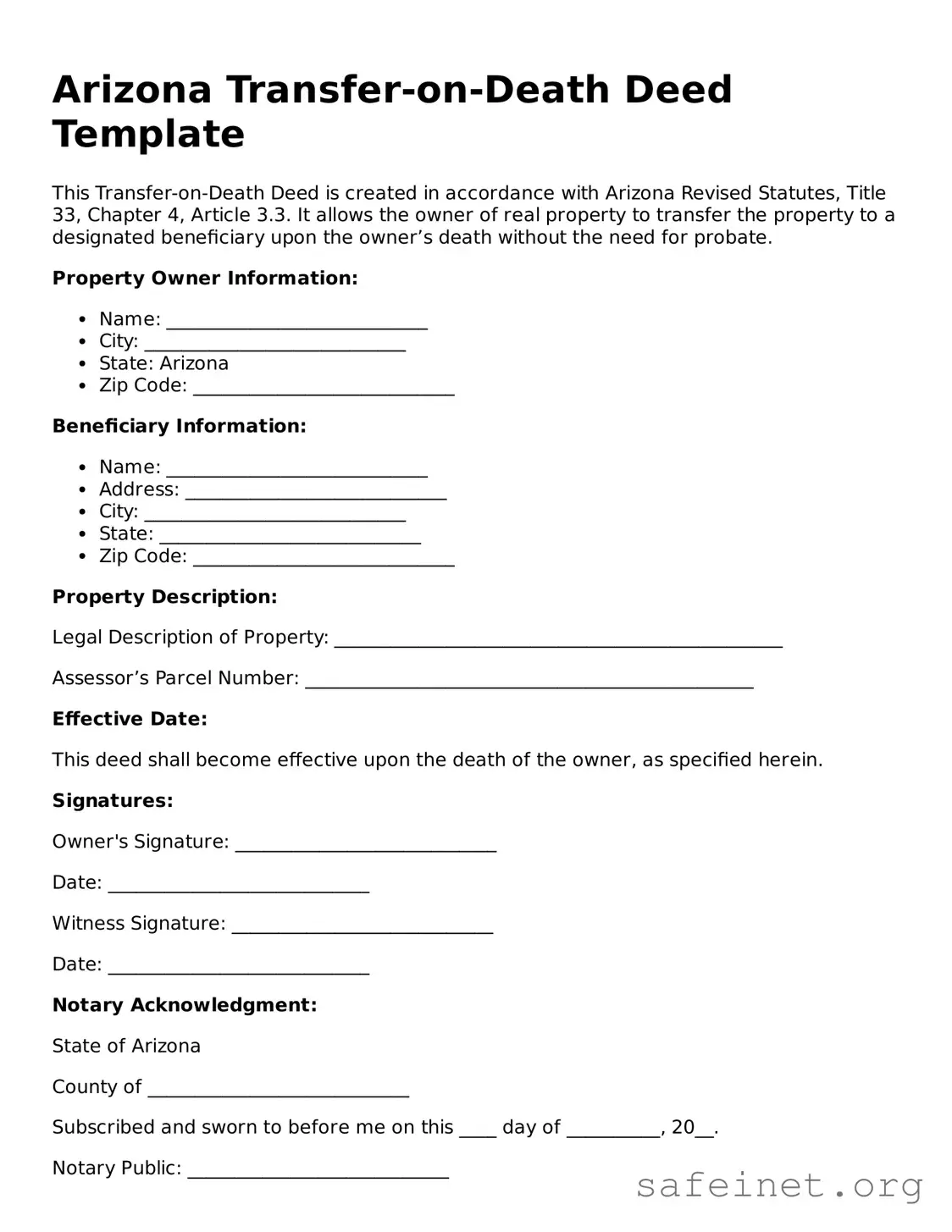
In Arizona, the Transfer-on-Death Deed (TOD) form offers a straightforward way for property owners to ensure their real estate assets are transferred to designated beneficiaries without the need for probate. This unique legal instrument allows individuals to retain full control over their property during their lifetime, while specifying who will inherit it upon their passing. By filling out the TOD form correctly, property owners can simplify the transfer process, reducing both time and costs associated with estate management. It’s important to note that the deed must be executed and recorded in accordance with Arizona law to be valid. Additionally, this form can be revoked or altered at any time before the owner's death, providing flexibility as circumstances change. Understanding the nuances of the TOD deed is crucial for anyone looking to streamline their estate planning and ensure their wishes are honored after they are gone.
Arizona Transfer-on-Death Deed Template
This Transfer-on-Death Deed is created in accordance with Arizona Revised Statutes, Title 33, Chapter 4, Article 3.3. It allows the owner of real property to transfer the property to a designated beneficiary upon the owner’s death without the need for probate.
Property Owner Information:
Beneficiary Information:
Property Description:
Legal Description of Property: ________________________________________________
Assessor’s Parcel Number: ________________________________________________
Effective Date:
This deed shall become effective upon the death of the owner, as specified herein.
Signatures:
Owner's Signature: ____________________________
Date: ____________________________
Witness Signature: ____________________________
Date: ____________________________
Notary Acknowledgment:
State of Arizona
County of ____________________________
Subscribed and sworn to before me on this ____ day of __________, 20__.
Notary Public: ____________________________
My commission expires: ____________________________
| Fact Name | Description |
|---|---|
| Definition | An Arizona Transfer-on-Death Deed allows property owners to transfer real estate to beneficiaries upon their death without going through probate. |
| Governing Law | The Arizona Transfer-on-Death Deed is governed by Arizona Revised Statutes, Title 33, Chapter 4.01. |
| Eligibility | Any individual who owns real property in Arizona can create a Transfer-on-Death Deed. |
| Beneficiaries | Property owners can designate one or more beneficiaries to receive the property after their death. |
| Revocation | The deed can be revoked at any time by the property owner, provided they follow the proper legal procedures. |
| Filing Requirements | The deed must be recorded with the county recorder in the county where the property is located to be effective. |
| No Immediate Transfer | Ownership does not transfer to the beneficiary until the property owner passes away. |
| Tax Implications | Transfer-on-Death Deeds do not affect property taxes during the owner's lifetime. |
| Limitations | This type of deed cannot be used for certain types of property, such as property held in a trust or business entities. |
| Legal Advice | It is advisable to consult with an attorney when creating a Transfer-on-Death Deed to ensure compliance with all legal requirements. |
After obtaining the Arizona Transfer-on-Death Deed form, it’s important to complete it accurately to ensure that your property transfers smoothly upon your passing. Follow these steps carefully to fill out the form correctly.
Once the form is filed, it becomes part of the public record. This means that anyone can access it, ensuring that your wishes regarding the property transfer are known and legally binding. Keeping a copy for your records is also advisable.
What is a Transfer-on-Death Deed in Arizona?
A Transfer-on-Death Deed (TODD) is a legal document that allows a property owner to transfer real estate to a designated beneficiary upon their death. This deed helps avoid probate, making the transfer process simpler and quicker for the heirs.
Who can use a Transfer-on-Death Deed?
Any property owner in Arizona can use a Transfer-on-Death Deed. This includes individuals who own residential or commercial real estate. However, the deed must be properly executed and recorded to be valid.
How do I create a Transfer-on-Death Deed?
To create a Transfer-on-Death Deed, you need to fill out the appropriate form, which includes details about the property and the beneficiary. It must be signed by the property owner and notarized. After that, the deed should be recorded with the county recorder’s office where the property is located.
Is a Transfer-on-Death Deed revocable?
Yes, a Transfer-on-Death Deed is revocable. The property owner can change or revoke the deed at any time before their death. This can be done by executing a new deed or by filing a revocation form with the county recorder.
What happens if the beneficiary dies before the property owner?
If the beneficiary named in the Transfer-on-Death Deed dies before the property owner, the deed becomes ineffective. The property owner can then designate a new beneficiary or choose to revoke the deed entirely.
Are there any tax implications with a Transfer-on-Death Deed?
Generally, there are no immediate tax implications when using a Transfer-on-Death Deed. However, beneficiaries may be subject to property taxes and potential capital gains taxes when they sell the property after inheriting it. Consulting a tax professional is advisable for specific concerns.
Can a Transfer-on-Death Deed be contested?
Yes, like any estate planning tool, a Transfer-on-Death Deed can be contested. Heirs may challenge the validity of the deed if they believe it was executed under duress, fraud, or if the property owner lacked the capacity to make such a decision.
Where can I find the Transfer-on-Death Deed form in Arizona?
The Transfer-on-Death Deed form can typically be found on the Arizona Secretary of State’s website or through local county recorder’s offices. It’s important to use the most current version of the form to ensure compliance with state laws.
Not using the correct form. Ensure you have the latest version of the Arizona Transfer-on-Death Deed form. Using an outdated form can lead to issues.
Failing to include all required information. All sections of the form must be completed. Omitting details like names, addresses, or legal descriptions can invalidate the deed.
Incorrectly identifying the property. Make sure the legal description of the property is accurate. Errors can create confusion or disputes later.
Not signing the deed properly. The deed must be signed by the property owner in the presence of a notary. Missing signatures can render the document ineffective.
Neglecting to record the deed. After filling out the form, it must be recorded with the county recorder’s office. Failing to do so means the transfer may not be recognized.
Not understanding the implications of the deed. It’s important to know how a Transfer-on-Death Deed affects your estate and beneficiaries. Misunderstanding can lead to unintended consequences.
Overlooking state-specific requirements. Arizona has specific laws regarding Transfer-on-Death Deeds. Ignoring these can lead to legal challenges.
Inadequate communication with beneficiaries. Discussing the deed with your beneficiaries can prevent confusion and disputes in the future. Transparency is key.
Failing to update the deed. If circumstances change, such as the death of a beneficiary or changes in property ownership, updating the deed is essential to reflect those changes.
When preparing to use the Arizona Transfer-on-Death Deed form, several other documents may be necessary or beneficial. These documents can help clarify intentions, provide additional legal support, or facilitate the transfer process. Below is a list of common forms and documents often associated with the Transfer-on-Death Deed.
These documents can enhance the effectiveness of the Transfer-on-Death Deed and help ensure a smoother transition of assets. It is advisable to consult with a legal professional to determine which documents best suit individual circumstances.
The Arizona Transfer-on-Death Deed (TOD) is similar to a Last Will and Testament in that both documents facilitate the transfer of property upon an individual's death. A Last Will outlines how a person wishes their assets to be distributed after they pass away. However, unlike a will, which typically requires probate—a legal process that can be lengthy and costly—the TOD allows for a more straightforward transfer of property directly to the designated beneficiaries without going through probate. This can save time and money for the heirs, making the TOD an attractive option for those looking to simplify their estate planning.
When filling out the Arizona Transfer-on-Death Deed form, it is important to follow certain guidelines to ensure the document is valid and meets your intentions. Below is a list of what you should and shouldn't do during this process.
Understanding the Arizona Transfer-on-Death Deed can be challenging, and several misconceptions often arise. Here are four common misunderstandings about this legal document:
Many people believe that the Transfer-on-Death Deed immediately transfers ownership of the property as soon as the owner passes away. In reality, the transfer only occurs after the owner’s death and when certain conditions are met.
Some think that using a Transfer-on-Death Deed eliminates the need for a will. However, this deed is simply a way to transfer specific property. A will may still be necessary for other assets and to address various matters regarding the estate.
Not all property is eligible for transfer via a Transfer-on-Death Deed. For instance, certain types of property, like vehicles or personal belongings, may require different legal processes.
Some individuals believe that once they sign a Transfer-on-Death Deed, they cannot change their mind. In fact, the deed can be revoked or modified at any time before the owner's death, allowing for flexibility in estate planning.
When considering the Arizona Transfer-on-Death Deed form, it’s essential to understand its implications and requirements. Here are some key takeaways to guide you:
Understanding these points can help you navigate the process of using the Transfer-on-Death Deed effectively. It’s a powerful tool for ensuring your wishes are honored while simplifying the transfer of property to your loved ones.