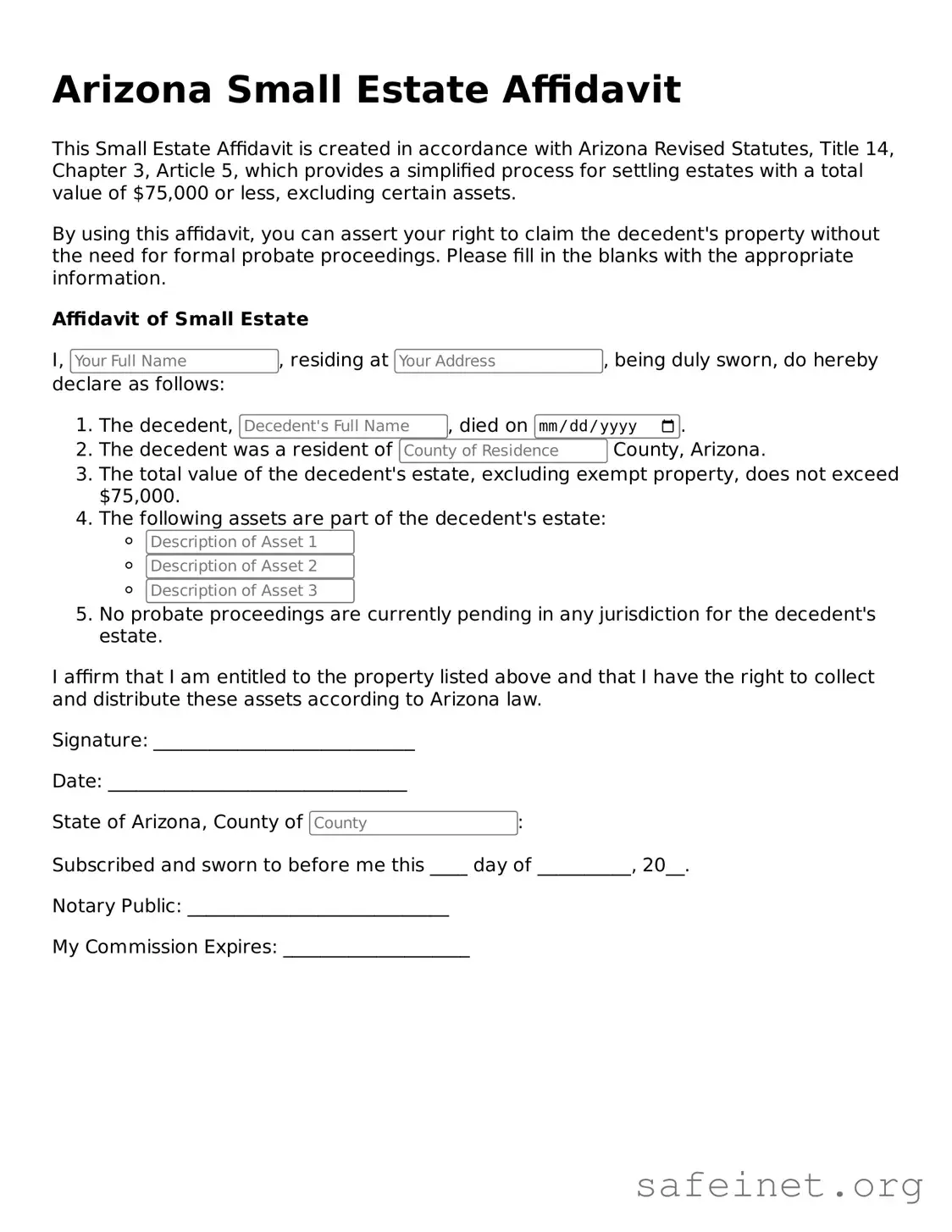
In Arizona, the Small Estate Affidavit serves as a streamlined option for settling the estates of deceased individuals whose total assets do not exceed a specified value. This form simplifies the process for heirs and beneficiaries, allowing them to bypass the lengthy and often costly probate process. To qualify, the estate must meet certain criteria, including limits on the total value of assets and specific types of property. The affidavit must be completed and signed by the rightful heirs, affirming their relationship to the deceased and their entitlement to the assets. Once filed, this legal document enables heirs to claim property, bank accounts, and other assets without court intervention, making it an invaluable tool for those navigating the complexities of estate management in Arizona. Understanding the requirements and procedures associated with the Small Estate Affidavit can save time and reduce stress during an already challenging period.
Arizona Small Estate Affidavit
This Small Estate Affidavit is created in accordance with Arizona Revised Statutes, Title 14, Chapter 3, Article 5, which provides a simplified process for settling estates with a total value of $75,000 or less, excluding certain assets.
By using this affidavit, you can assert your right to claim the decedent's property without the need for formal probate proceedings. Please fill in the blanks with the appropriate information.
Affidavit of Small Estate
I, , residing at , being duly sworn, do hereby declare as follows:
I affirm that I am entitled to the property listed above and that I have the right to collect and distribute these assets according to Arizona law.
Signature: ____________________________
Date: ________________________________
State of Arizona, County of :
Subscribed and sworn to before me this ____ day of __________, 20__.
Notary Public: ____________________________
My Commission Expires: ____________________
| Fact Name | Description |
|---|---|
| Purpose | The Arizona Small Estate Affidavit allows individuals to claim assets of a deceased person without going through formal probate, provided the estate meets certain criteria. |
| Eligibility | To qualify, the total value of the estate must not exceed $100,000, excluding certain exempt assets. |
| Governing Law | The use of the Small Estate Affidavit is governed by Arizona Revised Statutes, specifically A.R.S. § 14-3971. |
| Required Information | The affidavit must include details such as the deceased's name, date of death, and a list of assets being claimed. |
| Signature Requirement | The affidavit must be signed by the person claiming the assets, affirming that the information provided is true and correct. |
| Filing Process | The completed affidavit is typically submitted to the financial institution or entity holding the deceased's assets. |
| Limitations | This process cannot be used if the deceased had a will that specifically directs the distribution of assets. |
After gathering the necessary information and documents, you are ready to fill out the Arizona Small Estate Affidavit form. Completing this form accurately is crucial for the next steps in managing the estate. Follow the steps below to ensure you fill out the form correctly.
What is the Arizona Small Estate Affidavit?
The Arizona Small Estate Affidavit is a legal document that allows individuals to claim the assets of a deceased person without going through the formal probate process. This affidavit can simplify the transfer of property and is typically used when the total value of the estate is below a certain threshold, which is currently set at $100,000 for personal property and $75,000 for real property.
Who can use the Small Estate Affidavit?
Any person who is entitled to inherit from the deceased individual can use the Small Estate Affidavit. This includes heirs, beneficiaries named in a will, or individuals designated by law to inherit. It is important that the person filing the affidavit is at least 18 years old and has a legal claim to the deceased's assets.
What assets are eligible for the Small Estate Affidavit?
The Small Estate Affidavit can be used for various types of assets, including bank accounts, vehicles, and personal property. However, it cannot be used for real estate or assets that require a different legal process. The total value of the eligible assets must not exceed the specified limits to qualify for this process.
How do I complete the Small Estate Affidavit?
To complete the Small Estate Affidavit, you will need to fill out the form accurately, providing information about the deceased, the heirs, and the assets being claimed. It is essential to include a description of the assets and their estimated values. You must also sign the affidavit in front of a notary public to validate the document.
Do I need to file the Small Estate Affidavit with the court?
No, the Small Estate Affidavit does not need to be filed with the court. Instead, you will present the completed affidavit to the institutions or entities holding the deceased's assets, such as banks or car dealerships. They will use the affidavit to release the assets to you.
Are there any fees associated with the Small Estate Affidavit?
While there are generally no court fees for using the Small Estate Affidavit, you may incur costs related to notarization or obtaining copies of the death certificate. Additionally, some financial institutions may have their own fees for processing the affidavit.
What happens if the estate exceeds the Small Estate limits?
If the total value of the estate exceeds the limits set for the Small Estate Affidavit, you will need to initiate formal probate proceedings. This process is more complex and may require the assistance of an attorney. It is advisable to evaluate the estate's value carefully before deciding on the appropriate course of action.
Can I use the Small Estate Affidavit if there is a will?
Yes, you can use the Small Estate Affidavit even if there is a will. However, the will must not name an executor or require probate to be effective. If the will names an executor, that person must go through the probate process to administer the estate. If the will is valid and the estate qualifies, the affidavit can still facilitate the transfer of assets to the beneficiaries.
Not providing accurate information about the decedent.
Individuals often forget to include the full legal name of the deceased, along with the date of death. This information is crucial for the affidavit's validity.
Failing to list all assets and liabilities.
People sometimes overlook certain assets or debts, which can lead to complications. It is essential to account for all property, including bank accounts, real estate, and personal belongings.
Inaccurate valuation of the estate.
Some individuals underestimate or overestimate the value of the estate. Accurate valuations are necessary to ensure compliance with Arizona law regarding small estates.
Not obtaining the required signatures.
Affidavits must be signed by the appropriate parties. Failing to gather all necessary signatures can result in delays or rejection of the affidavit.
Ignoring the notarization requirement.
Many people forget that the affidavit must be notarized. Without a notary's acknowledgment, the document may not be accepted by financial institutions or courts.
The Arizona Small Estate Affidavit is a useful tool for individuals seeking to settle the estate of a deceased person without going through the formal probate process. Alongside this affidavit, several other forms and documents may be required to ensure a smooth transition of assets. Below is a list of commonly used documents that complement the Small Estate Affidavit.
Understanding these additional forms and documents can help streamline the estate settlement process. Proper preparation and organization of these materials can lead to a more efficient resolution of the estate's affairs.
The Arizona Small Estate Affidavit is similar to the Affidavit of Heirship, which is often used in cases where a deceased person did not leave a will. This document allows heirs to claim ownership of property without going through formal probate. It requires an affidavit to be signed by individuals who can attest to the relationship between the deceased and the heirs, providing a simplified process for transferring property to rightful heirs.
Another document comparable to the Small Estate Affidavit is the Petition for Summary Administration. This legal tool is utilized in various states to expedite the probate process for small estates. It allows heirs to bypass lengthy probate proceedings, enabling them to access the deceased's assets more quickly. The petition must demonstrate that the estate meets specific criteria, similar to the requirements of the Small Estate Affidavit.
The Small Estate Affidavit also shares similarities with the Will and Testament. While a will outlines how a person's assets should be distributed after death, it requires probate to be executed. The Small Estate Affidavit can serve as an alternative for smaller estates, allowing heirs to claim assets without formal probate, thus simplifying the process for those who may not have a will.
In some respects, the Small Estate Affidavit resembles the Transfer on Death Deed (TODD). A TODD allows individuals to transfer real property directly to beneficiaries upon death without going through probate. While the Small Estate Affidavit is used after death, the TODD is executed prior to death, making both documents tools for simplifying asset transfer.
The Affidavit for Collection of Personal Property is another document akin to the Small Estate Affidavit. This affidavit allows individuals to collect personal property of a deceased person without formal probate. It is particularly useful for accessing bank accounts or personal belongings, similar to how the Small Estate Affidavit facilitates the transfer of various assets.
The Small Estate Affidavit is also similar to the Spousal Property Petition, which allows a surviving spouse to claim property without going through the full probate process. This document streamlines the transfer of assets specifically for spouses, paralleling the Small Estate Affidavit's goal of simplifying asset distribution for smaller estates.
Another comparable document is the Affidavit of Support, often used in immigration cases. While its primary purpose is to ensure that immigrants have adequate financial support, it shares the concept of using an affidavit to affirm certain facts. Both documents rely on sworn statements to facilitate legal processes, though they serve different legal contexts.
The Small Estate Affidavit can also be likened to the Certificate of Trust. This document certifies the existence of a trust and outlines its terms, allowing trustees to manage and distribute trust assets without going through probate. Both documents aim to simplify the transfer of assets, though the Certificate of Trust is specific to trust law.
Lastly, the Durable Power of Attorney has similarities with the Small Estate Affidavit in terms of granting authority. A Durable Power of Attorney allows an individual to designate someone to manage their affairs if they become incapacitated. While the Small Estate Affidavit is used after death, both documents facilitate the management and transfer of assets in a streamlined manner.
When completing the Arizona Small Estate Affidavit form, it is important to follow certain guidelines to ensure accuracy and compliance. Here are some essential do's and don'ts:
Following these guidelines can help streamline the process and avoid potential issues. Always consider seeking legal advice if you have questions about the affidavit or the estate process.
Understanding the Arizona Small Estate Affidavit form is crucial for those dealing with the estates of deceased individuals. However, several misconceptions often arise about this legal document. Below are six common misconceptions, along with clarifications for each.
This is incorrect. The Small Estate Affidavit is specifically designed for estates that do not exceed a certain value, which is currently set at $100,000 in Arizona. Estates exceeding this limit must go through formal probate.
While heirs are typically the ones who file this affidavit, it is not limited to them. Any person who is entitled to the property can file the affidavit, including personal representatives or other interested parties.
This is misleading. Although the Small Estate Affidavit simplifies the process, it still requires the filing of the affidavit with the appropriate court and may involve notifying creditors or other interested parties.
While the basic structure of the Small Estate Affidavit is consistent, specific requirements and procedures can vary by county. It is essential to check local rules to ensure compliance.
This is not entirely accurate. The Small Estate Affidavit can be used to transfer personal property but does not apply to real estate unless additional steps are taken, such as a separate affidavit for real property.
While it can be faster than formal probate, the timeline can vary. Factors such as court processing times and the need for creditor notifications can affect how quickly the process is completed.
Filling out and using the Arizona Small Estate Affidavit form can simplify the process of transferring assets after someone has passed away. Here are some key takeaways to consider: