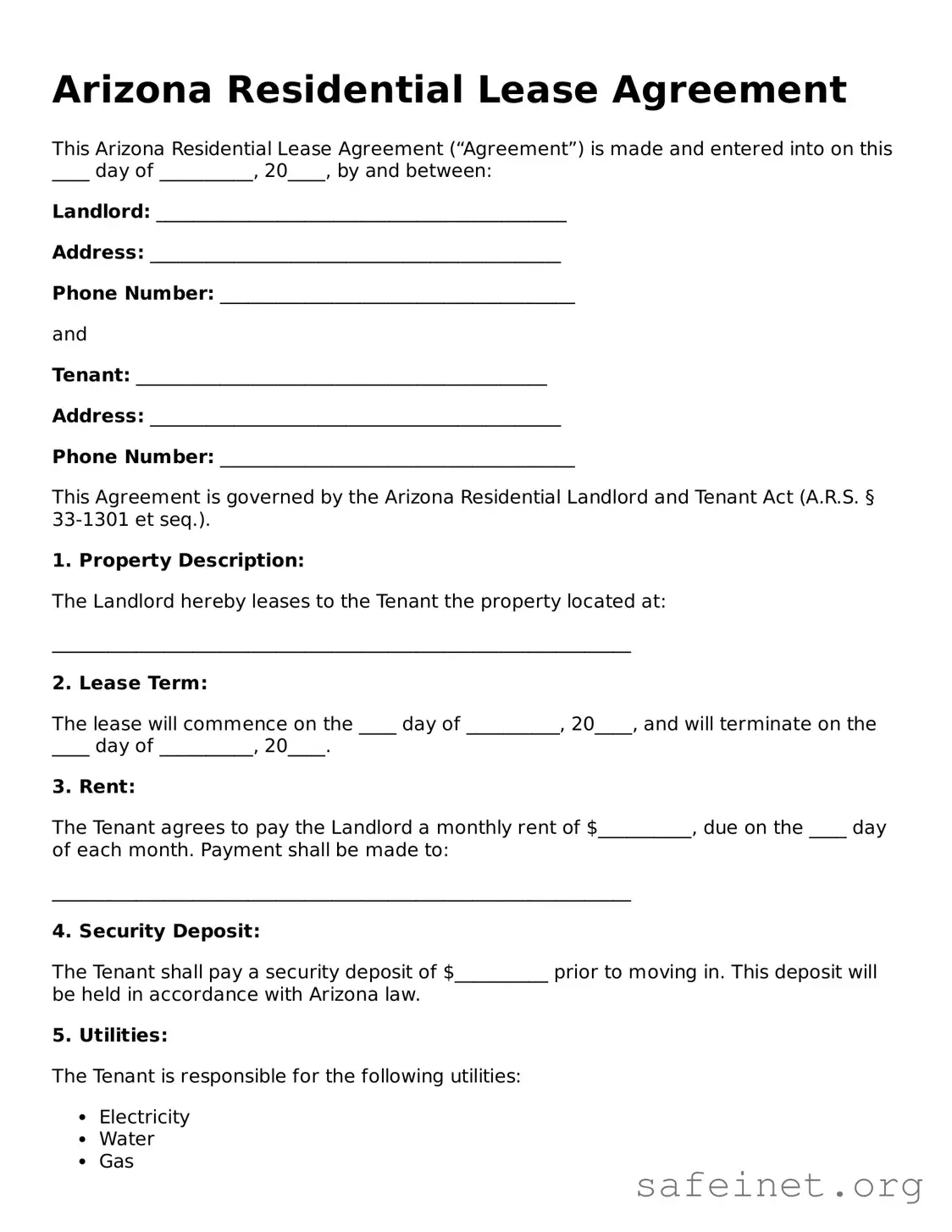
The Arizona Residential Lease Agreement is an essential document for both landlords and tenants, outlining the terms and conditions of renting a residential property. This agreement typically includes important details such as the names of the parties involved, the property address, and the duration of the lease. Rent amount and payment due dates are clearly specified, ensuring that both sides understand their financial obligations. Additionally, the agreement covers security deposits, maintenance responsibilities, and rules regarding pets or alterations to the property. By addressing these key aspects, the lease helps prevent misunderstandings and establishes a clear framework for the rental relationship. Understanding the specifics of this form can empower both landlords and tenants to navigate their rights and responsibilities effectively.
Arizona Residential Lease Agreement
This Arizona Residential Lease Agreement (“Agreement”) is made and entered into on this ____ day of __________, 20____, by and between:
Landlord: ____________________________________________
Address: ____________________________________________
Phone Number: ______________________________________
and
Tenant: ____________________________________________
Address: ____________________________________________
Phone Number: ______________________________________
This Agreement is governed by the Arizona Residential Landlord and Tenant Act (A.R.S. § 33-1301 et seq.).
1. Property Description:
The Landlord hereby leases to the Tenant the property located at:
______________________________________________________________
2. Lease Term:
The lease will commence on the ____ day of __________, 20____, and will terminate on the ____ day of __________, 20____.
3. Rent:
The Tenant agrees to pay the Landlord a monthly rent of $__________, due on the ____ day of each month. Payment shall be made to:
______________________________________________________________
4. Security Deposit:
The Tenant shall pay a security deposit of $__________ prior to moving in. This deposit will be held in accordance with Arizona law.
5. Utilities:
The Tenant is responsible for the following utilities:
6. Maintenance and Repairs:
The Tenant agrees to maintain the property in a clean and sanitary condition. Any repairs needed must be reported to the Landlord promptly.
7. Pets:
Pets are allowed / not allowed (circle one). If allowed, a pet deposit of $__________ is required.
8. Termination:
Either party may terminate this Agreement by providing written notice at least ____ days prior to the intended termination date.
9. Governing Law:
This Agreement shall be governed by the laws of the State of Arizona.
10. Signatures:
By signing below, both parties agree to the terms of this lease:
Landlord Signature: ___________________________ Date: ____________
Tenant Signature: ___________________________ Date: ____________
| Fact Name | Description |
|---|---|
| Governing Law | The Arizona Residential Lease Agreement is governed by Arizona Revised Statutes, Title 33, Chapter 10. |
| Parties Involved | The agreement typically includes a landlord and a tenant, both of whom must sign the document. |
| Lease Term | The lease can be for a fixed term, usually one year, or on a month-to-month basis. |
| Security Deposit | Arizona law allows landlords to collect a security deposit, which cannot exceed one and a half times the monthly rent. |
| Rent Payment | The lease must specify the amount of rent due, the due date, and acceptable payment methods. |
| Maintenance Responsibilities | Landlords are required to maintain the property in a habitable condition, while tenants must keep the premises clean and undamaged. |
| Termination Notice | For month-to-month leases, either party must provide a written notice of at least 30 days to terminate the agreement. |
| Dispute Resolution | The lease may include clauses for resolving disputes, such as mediation or arbitration, to avoid court proceedings. |
Filling out the Arizona Residential Lease Agreement form is a straightforward process. Once completed, this form will serve as a binding contract between the landlord and tenant, outlining the terms of the rental arrangement. Follow the steps below to ensure that you fill out the form correctly.
What is an Arizona Residential Lease Agreement?
The Arizona Residential Lease Agreement is a legal document used between a landlord and a tenant to outline the terms of renting a residential property. This agreement details essential aspects such as the rental amount, lease duration, security deposit, and responsibilities of both parties. It serves to protect the rights of both the landlord and the tenant throughout the rental period.
What key terms should be included in the agreement?
Several critical terms should be included in the Arizona Residential Lease Agreement. These typically cover the names of the parties involved, property address, lease term (start and end dates), rental payment amount and due date, security deposit details, maintenance responsibilities, and rules regarding pets or smoking. Clear definitions of each party's obligations help prevent misunderstandings.
How long is a typical lease term in Arizona?
Lease terms in Arizona can vary widely. They may be short-term (such as month-to-month agreements) or long-term (typically ranging from six months to one year). The duration should be specified in the lease agreement, allowing both parties to understand the commitment involved.
Can a landlord increase rent during the lease term?
Generally, a landlord cannot increase rent during the lease term unless the lease agreement specifically allows for such increases. If the lease is month-to-month, the landlord may provide proper notice before raising the rent. Arizona law requires landlords to give tenants at least 30 days' notice for rent increases in month-to-month agreements.
What happens if a tenant wants to terminate the lease early?
If a tenant wishes to terminate the lease early, they must review the lease agreement for any specific clauses regarding early termination. Often, the tenant may be required to provide written notice and may incur penalties, such as losing their security deposit or paying rent until a new tenant is found. Open communication with the landlord can sometimes lead to a mutually agreeable solution.
Is a security deposit required in Arizona?
Yes, landlords in Arizona often require a security deposit. This deposit serves as protection for the landlord against potential damages or unpaid rent. Arizona law does not set a maximum amount for security deposits, but it is common for landlords to charge one and a half times the monthly rent. The terms regarding the security deposit should be clearly outlined in the lease agreement.
What are the tenant's rights under Arizona law?
Tenants in Arizona have several rights, including the right to a habitable living environment, the right to privacy, and the right to be free from retaliation for exercising their rights. If issues arise, tenants can seek remedies through the Arizona Department of Housing or local legal aid organizations. Understanding these rights helps tenants advocate for themselves effectively.
Incomplete Information: Many people forget to fill out all required sections of the lease agreement. This includes not only names and addresses but also specific details about the rental property. Leaving out important information can lead to misunderstandings later.
Incorrect Dates: Another common mistake is entering the wrong lease start and end dates. It’s crucial to ensure these dates are accurate to avoid confusion about when the lease begins and ends.
Ignoring Terms and Conditions: Some individuals overlook the terms and conditions section. It is important to read and understand these terms fully. Misunderstanding rules about pets, maintenance, or rent increases can create issues down the line.
Not Initialing Changes: If any changes are made to the lease agreement, such as alterations to the rental amount or additional clauses, both parties should initial next to those changes. Failing to do this can make it unclear what was agreed upon.
Missing Signatures: Lastly, some people forget to sign the lease. Without signatures from both the landlord and tenant, the lease is not legally binding. This oversight can lead to disputes about the terms of the rental agreement.
When entering into a rental agreement in Arizona, it is essential to consider several additional forms and documents that can help clarify responsibilities and protect the rights of both landlords and tenants. These documents complement the Arizona Residential Lease Agreement and provide a comprehensive framework for the rental relationship.
Utilizing these documents alongside the Arizona Residential Lease Agreement not only fosters a clear understanding between landlords and tenants but also helps mitigate potential conflicts. By ensuring that all parties are informed and in agreement, a smoother rental experience can be achieved.
The Arizona Commercial Lease Agreement is similar to the Residential Lease Agreement in that both documents outline the terms and conditions of renting a property. While the Residential Lease focuses on residential properties, the Commercial Lease pertains to business spaces. Each agreement typically includes details about rent, duration, and responsibilities of both the landlord and tenant, ensuring clarity in the landlord-tenant relationship.
The Arizona Rental Application serves as a preliminary document that potential tenants fill out before signing a lease. It collects personal information, rental history, and references. Like the Residential Lease Agreement, it aims to protect the interests of the landlord by ensuring that tenants meet specific criteria before entering into a binding contract.
The Arizona Lease Termination Notice is another related document. It allows either party to formally communicate their intent to end the lease. This notice must adhere to specific timelines and conditions, similar to how the Residential Lease Agreement outlines the process for lease termination and the obligations of each party upon ending the lease.
The Arizona Security Deposit Agreement outlines the terms regarding the security deposit required from tenants. This document is closely related to the Residential Lease Agreement, as it specifies the amount of the deposit, the conditions for its return, and any deductions that may be made, ensuring both parties understand their rights and obligations concerning the deposit.
The Arizona Move-In/Move-Out Checklist is a document that helps both landlords and tenants assess the condition of the rental property. It is similar to the Residential Lease Agreement in that it provides a record of the property's state at the beginning and end of the tenancy, which can prevent disputes regarding damages and security deposits.
The Arizona Sublease Agreement allows a tenant to rent out their leased property to another person. This document is similar to the Residential Lease Agreement as it outlines the terms of the sublease, including rent and responsibilities, ensuring that the original landlord's conditions are upheld even when the tenant is not occupying the property.
The Arizona Lease Renewal Agreement provides a framework for extending the terms of an existing lease. Like the Residential Lease Agreement, it details the new terms, including any changes in rent or conditions, ensuring that both parties agree to the continuation of the lease under specified terms.
The Arizona Pet Agreement is an addendum to the Residential Lease Agreement that specifically addresses pet ownership in rental properties. It outlines rules, fees, and responsibilities related to having pets, similar to how the main lease agreement sets forth rules and responsibilities for the tenant and landlord.
The Arizona Roommate Agreement is a document that can be used when multiple tenants share a rental property. This agreement is similar to the Residential Lease Agreement, as it defines the rights and responsibilities of each roommate, including rent payment, shared expenses, and property upkeep, ensuring that all parties are on the same page.
The Arizona Lease Addendum is a document that modifies or adds to the existing lease agreement. It is similar to the Residential Lease Agreement in that it can clarify specific terms or conditions, such as maintenance responsibilities or modifications to the rental terms, ensuring that both parties have a clear understanding of their obligations.
When filling out the Arizona Residential Lease Agreement form, it's important to be careful and thorough. Here’s a list of things you should and shouldn't do:
Understanding the Arizona Residential Lease Agreement form is crucial for both landlords and tenants. However, several misconceptions can lead to confusion and potential disputes. Here are nine common misconceptions:
Many people believe that lease agreements are standardized across the board. In reality, each lease can vary significantly based on the specific terms negotiated between the landlord and tenant.
Some assume that a verbal agreement is enough to establish a lease. However, without a written document, it can be challenging to enforce any terms or conditions.
It is a common misconception that security deposits cannot be refunded. In fact, tenants may receive their deposit back, minus any legitimate deductions for damages or unpaid rent.
Many believe landlords have unrestricted access to their rental properties. However, landlords must provide reasonable notice and have valid reasons for entering, as stipulated in the lease agreement.
Some tenants think that once a lease is signed, the terms are set in stone. Modifications can be made, but both parties must agree and document any changes in writing.
There is a belief that rent remains fixed for the entire duration of the lease. While this is often true, some leases include clauses that allow for rent increases under certain conditions.
Many tenants assume that rent covers all utilities. In reality, the lease should specify which utilities are included and which are the tenant's responsibility.
Some think that signing the lease waives all tenant rights. However, tenants retain rights regarding habitability, privacy, and other protections under state law.
Finally, many believe that breaking a lease is a simple process without repercussions. In truth, breaking a lease can lead to financial penalties and legal issues, depending on the lease terms.
Being aware of these misconceptions can help both landlords and tenants navigate their agreements more effectively and avoid potential conflicts.
When filling out and using the Arizona Residential Lease Agreement form, keep these key points in mind:
By paying attention to these details, you can create a clear and effective lease agreement that protects both parties involved.