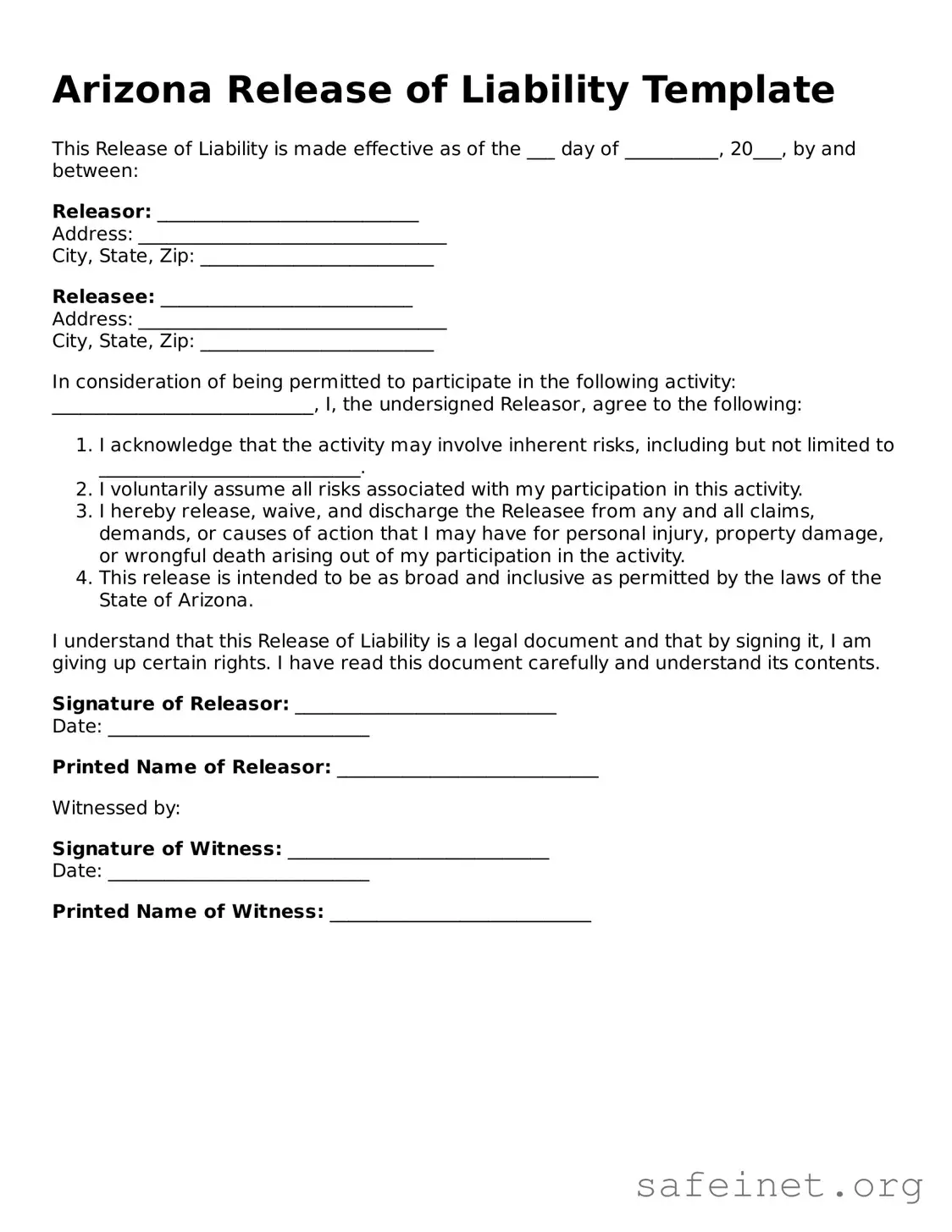
The Arizona Release of Liability form serves an important purpose in various activities and events where there is a potential risk of injury. This form is commonly used by organizations, businesses, and individuals to protect themselves from legal claims that may arise due to accidents or injuries that occur during participation in certain activities. By signing this document, participants acknowledge the inherent risks involved and agree not to hold the organizers or facilitators responsible for any injuries or damages. The form typically outlines the specific activities involved, the risks associated with those activities, and the rights being waived by the participant. Additionally, it often includes spaces for signatures, dates, and contact information, ensuring that all parties are aware of their responsibilities and the implications of their agreement. Understanding the key components and implications of the Arizona Release of Liability form is essential for anyone looking to engage in activities that carry potential risks, as it fosters transparency and mutual understanding between participants and organizers.
Arizona Release of Liability Template
This Release of Liability is made effective as of the ___ day of __________, 20___, by and between:
Releasor: ____________________________
Address: _________________________________
City, State, Zip: _________________________
Releasee: ___________________________
Address: _________________________________
City, State, Zip: _________________________
In consideration of being permitted to participate in the following activity: ____________________________, I, the undersigned Releasor, agree to the following:
I understand that this Release of Liability is a legal document and that by signing it, I am giving up certain rights. I have read this document carefully and understand its contents.
Signature of Releasor: ____________________________
Date: ____________________________
Printed Name of Releasor: ____________________________
Witnessed by:
Signature of Witness: ____________________________
Date: ____________________________
Printed Name of Witness: ____________________________
| Fact Name | Description |
|---|---|
| Purpose | The Arizona Release of Liability form is used to protect individuals and organizations from legal claims related to injuries or damages that may occur during an activity. |
| Governing Law | This form is governed by Arizona state law, specifically under the principles of contract law and liability waivers. |
| Parties Involved | The form typically involves two parties: the releasor (the person giving up the right to sue) and the releasee (the person or organization being released from liability). |
| Voluntary Agreement | Signing the form indicates that the releasor voluntarily agrees to assume the risks associated with the activity. |
| Legal Enforceability | For the release to be enforceable, it must be clear, specific, and signed by the releasor. Courts generally uphold well-drafted releases. |
| Limitations | The form may not protect against gross negligence or intentional misconduct. Certain exceptions apply under Arizona law. |
After obtaining the Arizona Release of Liability form, you will need to complete it accurately. Follow these steps to ensure you fill out the form correctly.
Once you have completed the form, review it for any errors or missing information. After confirming that everything is accurate, you can submit it as required.
What is an Arizona Release of Liability form?
An Arizona Release of Liability form is a legal document that individuals use to waive their right to hold another party responsible for injuries or damages that may occur during an activity. This form is commonly used in recreational activities, sports events, and other situations where there is a risk of injury. By signing the form, participants acknowledge the risks involved and agree not to pursue legal action against the organizer or facility.
Who should use a Release of Liability form?
This form is beneficial for businesses, organizations, and individuals who conduct activities that carry inherent risks. Examples include sports leagues, fitness centers, adventure companies, and event organizers. Participants in these activities should also be encouraged to sign the form to protect the entity from potential lawsuits.
Is a Release of Liability form legally binding in Arizona?
In general, a Release of Liability form can be legally binding in Arizona, provided it meets certain criteria. The form must be clear, unambiguous, and voluntarily signed by the participant. Courts may enforce the release unless it is found to be unconscionable or if the liability is related to gross negligence or willful misconduct.
Can a minor sign a Release of Liability form?
Minors cannot legally enter into contracts, including a Release of Liability form, on their own. However, a parent or legal guardian can sign the form on behalf of a minor. This signature provides consent and acknowledges the risks associated with the activity.
What should be included in an Arizona Release of Liability form?
An effective Release of Liability form should include several key elements. These typically consist of a clear statement of the risks involved, a description of the activity, the participant's acknowledgment of these risks, and a waiver of liability. Additionally, it should include spaces for signatures and dates, as well as contact information for both parties.
Can a Release of Liability form be revoked after signing?
Generally, once a Release of Liability form is signed, it cannot be revoked unilaterally. However, if the participant can demonstrate that they were coerced into signing or did not understand the document's implications, a court may consider allowing a revocation. It is advisable for participants to read and comprehend the form before signing.
What are the limitations of a Release of Liability form?
While a Release of Liability form can provide significant protection, it does not eliminate all legal responsibilities. It typically does not protect against claims arising from gross negligence or intentional harm. Additionally, if the form is poorly drafted or lacks clarity, a court may not enforce it. Participants should be aware of these limitations when engaging in activities that require such a release.
Incomplete Information: Many individuals fail to fill out all required fields. Leaving sections blank can lead to the form being considered invalid.
Incorrect Dates: Some people mistakenly enter the wrong date. This can create confusion about the timeline of the event or activity.
Not Reading the Terms: A common error is not fully understanding the terms of the release. Failing to read the document can result in unintended waivers of rights.
Signature Issues: Individuals sometimes forget to sign the form or use a signature that does not match their legal name. This can invalidate the agreement.
Failure to Date the Signature: Another frequent mistake is neglecting to date the signature. This oversight can create ambiguity regarding when the release was executed.
The Arizona Release of Liability form is a crucial document used to protect individuals and organizations from legal claims related to injuries or damages that may occur during an activity or event. However, it is often accompanied by other forms and documents that help clarify responsibilities, outline expectations, and ensure safety. Below are four commonly used documents that complement the Release of Liability form.
These documents play a vital role in establishing clear communication and expectations between participants and organizers. By using these forms alongside the Arizona Release of Liability, individuals can better protect themselves and ensure a safer experience for everyone involved.
The Arizona Release of Liability form shares similarities with the General Release form. Both documents are designed to protect one party from legal claims that may arise from an activity or event. In a General Release, an individual waives their right to sue for any injuries or damages that may occur, much like the Arizona form. The intent is to ensure that the party providing the service or activity is not held responsible for unforeseen incidents.
Another document that resembles the Arizona Release of Liability is the Waiver of Liability. This waiver is often used in recreational activities, such as sports or adventure outings. Participants agree not to hold the organizers responsible for any injuries sustained during the activity. Both forms emphasize voluntary participation and the understanding of risks involved, providing a similar level of protection for the organizers.
The Consent to Participate form is also comparable to the Arizona Release of Liability. This document is commonly used in educational or recreational settings. It informs participants about the risks associated with an activity and seeks their consent to engage. While it may not explicitly release liability, it serves to acknowledge the participant's understanding of potential dangers, similar to the Arizona form's purpose.
The Indemnity Agreement shares features with the Arizona Release of Liability. This agreement involves one party agreeing to compensate another for any losses or damages incurred. While the Arizona form primarily focuses on releasing liability, an Indemnity Agreement goes a step further by ensuring that one party will cover any claims made against the other. Both documents aim to manage risk and clarify responsibilities.
The Participant Agreement is another document that aligns with the Arizona Release of Liability. Often used in organized events or activities, this agreement outlines the expectations and responsibilities of participants. It may include a clause that releases the organizers from liability, similar to the Arizona form. Both documents emphasize the importance of understanding the terms before engaging in the activity.
The Hold Harmless Agreement is similar in nature to the Arizona Release of Liability. This document protects one party from legal claims by requiring the other party to assume responsibility for any injuries or damages. Like the Arizona form, it aims to limit liability and clarify the risks involved. Both documents serve to ensure that individuals understand their responsibilities while participating in certain activities.
The Liability Waiver is another document that resembles the Arizona Release of Liability. This waiver is often used in various contexts, including fitness classes and recreational events. Participants sign to acknowledge the risks and agree not to hold the organizers liable for any injuries. Both documents focus on risk management and the voluntary assumption of those risks by the participant.
The Medical Release form also shares similarities with the Arizona Release of Liability. This document allows medical personnel to treat an individual in case of an emergency, often used in sports or camps. While its primary purpose is to grant permission for medical treatment, it may also include a liability waiver, protecting the organizers from claims related to medical decisions made during the activity. Both forms emphasize informed consent and the acceptance of risks.
Lastly, the Event Liability Release is comparable to the Arizona Release of Liability. This document is typically used for events, such as concerts or festivals, where attendees agree not to hold the organizers liable for any injuries or damages. Like the Arizona form, it aims to manage risk and ensure that participants understand the potential hazards associated with the event.
When filling out the Arizona Release of Liability form, it is important to approach the process carefully. Here are some key things to do and avoid:
Following these guidelines can help ensure that the form is filled out correctly and that you understand what you are agreeing to. Taking these steps can protect your interests and clarify your rights.
Understanding the Arizona Release of Liability form can be challenging. Here are five common misconceptions that people often have about this legal document:
It completely absolves all responsibility. Many believe that signing a Release of Liability means the other party is entirely free from any responsibility, regardless of the circumstances. In reality, while it can limit liability, it does not protect against gross negligence or willful misconduct.
It is only for extreme activities. Some think that a Release of Liability is only necessary for high-risk activities, like skydiving or rock climbing. However, these forms can be used in various situations, including sports events, recreational activities, and even certain business transactions.
Signing it means you cannot sue at all. A common belief is that once you sign this document, you lose all rights to pursue legal action. While it does limit your ability to sue for certain claims, it does not eliminate your right to seek compensation for damages caused by negligence or illegal acts.
All Release of Liability forms are the same. Many assume that all liability waivers are interchangeable. In truth, the language and enforceability can vary significantly based on the specific wording and the context in which they are used. It is crucial to have a form tailored to your specific situation.
Minors cannot sign a Release of Liability. Some people think that minors are unable to sign these forms. While minors typically cannot enter into binding contracts, a parent or guardian can often sign on their behalf, providing a layer of protection for the organization or business involved.
Understanding these misconceptions can help individuals make informed decisions when considering the use of a Release of Liability form in Arizona.
When dealing with the Arizona Release of Liability form, it’s essential to understand its purpose and how to fill it out correctly. Here are some key takeaways:
By following these guidelines, you can help ensure that the Arizona Release of Liability form serves its intended purpose effectively.