In the vibrant landscape of Arizona’s family law, the prenuptial agreement form stands as a vital tool for couples contemplating marriage. This legal document serves to outline the financial and property rights of each partner, ensuring clarity and protection before entering into matrimony. It typically addresses the division of assets, debts, and any potential spousal support in the event of a divorce. By establishing these terms in advance, couples can foster open communication and mitigate future disputes. The form requires specific information, including the full names of both parties, a detailed list of assets and liabilities, and the signatures of both individuals, often necessitating the involvement of legal counsel to ensure that the agreement is enforceable under Arizona law. Understanding the nuances of this form not only empowers couples to make informed decisions but also lays a solid foundation for their future together.
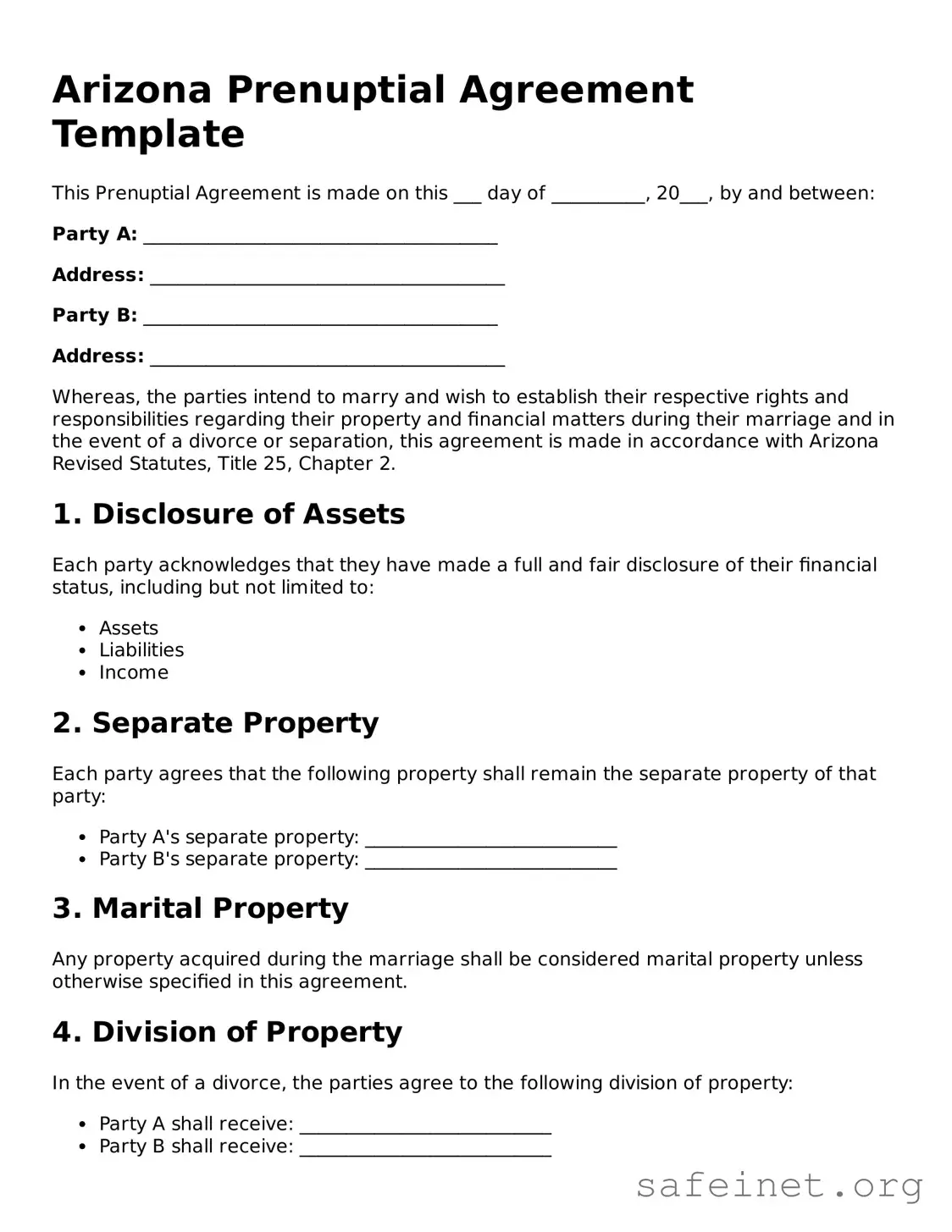
Arizona Prenuptial Agreement Template
This Prenuptial Agreement is made on this ___ day of __________, 20___, by and between:
Party A: ______________________________________
Address: ______________________________________
Party B: ______________________________________
Address: ______________________________________
Whereas, the parties intend to marry and wish to establish their respective rights and responsibilities regarding their property and financial matters during their marriage and in the event of a divorce or separation, this agreement is made in accordance with Arizona Revised Statutes, Title 25, Chapter 2.
1. Disclosure of Assets
Each party acknowledges that they have made a full and fair disclosure of their financial status, including but not limited to:
2. Separate Property
Each party agrees that the following property shall remain the separate property of that party:
3. Marital Property
Any property acquired during the marriage shall be considered marital property unless otherwise specified in this agreement.
4. Division of Property
In the event of a divorce, the parties agree to the following division of property:
5. Spousal Support
The parties agree that in the event of a divorce:
6. Amendments
This agreement may be amended only by a written document signed by both parties.
7. Governing Law
This agreement shall be governed by the laws of the State of Arizona.
8. Signatures
By signing below, both parties agree to the terms and conditions outlined in this Prenuptial Agreement.
______________________________
Party A Signature
______________________________
Party B Signature
______________________________
Date
| Fact Name | Details |
|---|---|
| Governing Law | Arizona Revised Statutes, Title 25, Chapter 2 governs prenuptial agreements. |
| Definition | A prenuptial agreement is a contract between two individuals before marriage, outlining the distribution of assets and responsibilities. |
| Enforceability | For a prenuptial agreement to be enforceable, it must be in writing and signed by both parties. |
| Disclosure Requirement | Full and fair disclosure of assets and liabilities is required for the agreement to be valid. |
| Legal Representation | While not mandatory, it is advisable for both parties to seek independent legal counsel before signing. |
| Modification | Prenuptial agreements can be modified or revoked after marriage, but this must be done in writing. |
| Judicial Review | A court may review the agreement for fairness and unconscionability if disputes arise. |
| Timeframe | It is best to finalize the agreement well before the wedding to avoid claims of coercion. |
| Common Misconception | Many believe prenuptial agreements are only for the wealthy; however, they can benefit anyone. |
| Postnuptial Agreement | A postnuptial agreement serves a similar purpose but is created after marriage. |
Preparing a prenuptial agreement in Arizona is a thoughtful step for couples entering marriage. This process involves carefully considering individual assets and financial responsibilities. Once the form is filled out, you can move forward with the necessary discussions and legal considerations that accompany this important document.
What is a prenuptial agreement in Arizona?
A prenuptial agreement, often called a "prenup," is a legal contract between two people who are planning to get married. This agreement outlines how assets and debts will be divided in the event of a divorce or separation. In Arizona, prenups can also address issues like spousal support and property rights, making them a valuable tool for couples to protect their interests before tying the knot.
Why should I consider a prenuptial agreement?
Considering a prenuptial agreement can provide peace of mind. It helps clarify financial expectations and responsibilities, which can reduce potential conflicts in the future. For those entering a marriage with significant assets, business interests, or children from previous relationships, a prenup can ensure that their wishes are respected and that their loved ones are protected.
How do I create a prenuptial agreement in Arizona?
Creating a prenuptial agreement typically involves several steps. First, both parties should discuss their financial situations openly. Next, it's advisable to consult with separate attorneys to ensure that both individuals understand their rights and obligations. Once both parties agree on the terms, the prenup must be written, signed, and notarized to be enforceable in Arizona.
Can I modify a prenuptial agreement after marriage?
Yes, a prenuptial agreement can be modified after marriage. Both parties must agree to the changes, and it is recommended to put any modifications in writing and have them notarized. This ensures clarity and legal enforceability in the future.
What happens if my spouse and I don’t sign a prenup?
If you and your spouse do not sign a prenuptial agreement, Arizona law will govern the division of assets and debts in the event of a divorce. This means that property acquired during the marriage may be considered community property, which is typically split evenly. Without a prenup, you may have less control over how your assets are divided.
Are there any requirements for a prenuptial agreement to be valid in Arizona?
Yes, for a prenuptial agreement to be valid in Arizona, it must be in writing and signed by both parties. Each individual should enter the agreement voluntarily and should fully disclose their financial information. Additionally, the terms of the agreement should be fair and not unconscionable at the time of enforcement.
Can a prenuptial agreement cover child custody and support?
While a prenuptial agreement can address many financial aspects, it cannot dictate child custody or support arrangements. Arizona courts prioritize the best interests of the child, and these matters are typically determined during divorce proceedings based on current circumstances rather than pre-existing agreements.
What if my prenuptial agreement is challenged in court?
If a prenuptial agreement is challenged in court, the judge will evaluate its validity based on several factors, including whether both parties entered into the agreement voluntarily and whether there was full financial disclosure. If the prenup is deemed valid, it will likely be upheld. However, if it was signed under duress or contains unfair terms, it may be set aside.
How much does it cost to create a prenuptial agreement in Arizona?
The cost of creating a prenuptial agreement can vary widely depending on the complexity of the agreement and the attorneys involved. Basic agreements may cost a few hundred dollars, while more complex arrangements could run into the thousands. Investing in a well-drafted prenup can save both parties time and money in the long run.
Is a prenuptial agreement only for the wealthy?
No, prenuptial agreements are not just for the wealthy. They can benefit anyone who wants to clarify financial expectations and protect their interests. Whether you have significant assets, debts, or simply want to avoid potential conflicts in the future, a prenup can be a wise decision for couples of all financial backgrounds.
Failing to fully disclose assets and debts. Transparency is crucial. Not listing everything can lead to complications later.
Not having the agreement reviewed by an attorney. Professional guidance can help avoid pitfalls and ensure the document is enforceable.
Using vague language. Clear and specific terms help prevent misunderstandings in the future.
Not considering future changes. Life circumstances can change, so it’s important to include provisions for adjustments.
Ignoring state laws. Each state has different requirements. Familiarity with Arizona’s laws is essential for a valid agreement.
Not allowing enough time for review. Rushing through the process can lead to mistakes. Give both parties time to consider the terms.
Forgetting to sign the document in front of a notary. Notarization adds a layer of legitimacy and can be crucial for enforcement.
Overlooking the importance of having separate legal representation. Each party should have their own attorney to ensure fairness.
Neglecting to update the agreement after significant life events. Changes such as the birth of a child or a major financial shift should prompt a review.
When preparing a prenuptial agreement in Arizona, several other forms and documents may be beneficial to consider. These documents can provide additional clarity and legal protection for both parties entering into marriage. Below is a list of common forms that often accompany a prenuptial agreement.
Considering these additional documents can help create a comprehensive approach to financial and legal matters in a marriage. Each form serves a unique purpose and can provide essential protections and guidelines for both parties involved.
A cohabitation agreement is similar to a prenuptial agreement in that it outlines the financial and personal rights of two individuals living together without being married. This document can address issues such as property ownership, financial responsibilities, and how assets will be divided if the relationship ends. Like a prenuptial agreement, it helps to clarify expectations and protect both parties, reducing potential conflicts in the future.
A postnuptial agreement, often confused with a prenuptial agreement, is created after a couple is married. This document serves a similar purpose by outlining how assets and debts will be managed during the marriage and what will happen in the event of a divorce. Both agreements aim to provide clarity and security regarding financial matters, although the timing of their creation differs.
A separation agreement is another document that bears resemblance to a prenuptial agreement. It is typically used when a couple decides to separate but not yet divorce. This agreement outlines the terms of the separation, including asset division, child custody, and support obligations. Like a prenuptial agreement, it seeks to minimize disputes and provide a clear framework for both parties moving forward.
A marital settlement agreement is closely related to a prenuptial agreement as it is often used during divorce proceedings. This document details how the couple will divide their assets, debts, and responsibilities after the marriage ends. Both agreements serve to protect individual interests and provide a clear understanding of financial matters, though a marital settlement agreement is typically more focused on dissolution rather than prevention.
An estate plan is somewhat similar to a prenuptial agreement in that it addresses the distribution of assets. While a prenuptial agreement focuses on asset division during a marriage or divorce, an estate plan outlines how those assets will be distributed upon death. Both documents require careful consideration of financial matters and can help prevent disputes among heirs or beneficiaries.
A trust agreement shares similarities with a prenuptial agreement as both involve the management of assets. A trust agreement allows an individual to place their assets into a trust for the benefit of another party, which can help protect those assets from creditors or during divorce proceedings. Both documents require careful planning and consideration of how assets will be handled and distributed.
A business partnership agreement can resemble a prenuptial agreement, especially if one or both partners are bringing significant assets into the partnership. This document outlines each partner's contributions, responsibilities, and how profits and losses will be shared. Like a prenuptial agreement, it helps to establish clear expectations and protect individual interests in the event of a dispute.
A financial power of attorney is another document that has similarities with a prenuptial agreement. While a prenuptial agreement addresses asset division and rights within a marriage, a financial power of attorney allows an individual to designate someone to make financial decisions on their behalf. Both documents require trust and clarity regarding financial matters, although their purposes differ significantly.
An insurance policy, particularly a life insurance policy, can also be compared to a prenuptial agreement. Both documents can provide financial protection and security for loved ones. A prenuptial agreement protects assets during marriage or divorce, while a life insurance policy ensures that beneficiaries receive financial support upon the policyholder's death. Both require careful consideration of financial planning and potential future outcomes.
A will is a fundamental legal document that shares some characteristics with a prenuptial agreement. While a prenuptial agreement addresses asset division during marriage or divorce, a will specifies how a person's assets will be distributed after their death. Both documents are essential for ensuring that an individual's wishes are honored and can help prevent disputes among family members or beneficiaries.
When preparing to fill out the Arizona Prenuptial Agreement form, it's important to approach the task thoughtfully. Here are some essential dos and don'ts to keep in mind:
By following these guidelines, you can create a solid foundation for your future together. A well-prepared prenuptial agreement can help protect both parties and foster a sense of security as you embark on your new life together.
When considering a prenuptial agreement in Arizona, several misconceptions can cloud judgment. Understanding these can help couples make informed decisions.
By dispelling these misconceptions, couples can approach the idea of a prenuptial agreement with clarity and confidence.
When considering a prenuptial agreement in Arizona, it’s essential to understand the process and implications. Here are some key takeaways to keep in mind:
By keeping these points in mind, couples can navigate the process of creating a prenuptial agreement more effectively and ensure that their interests are protected.