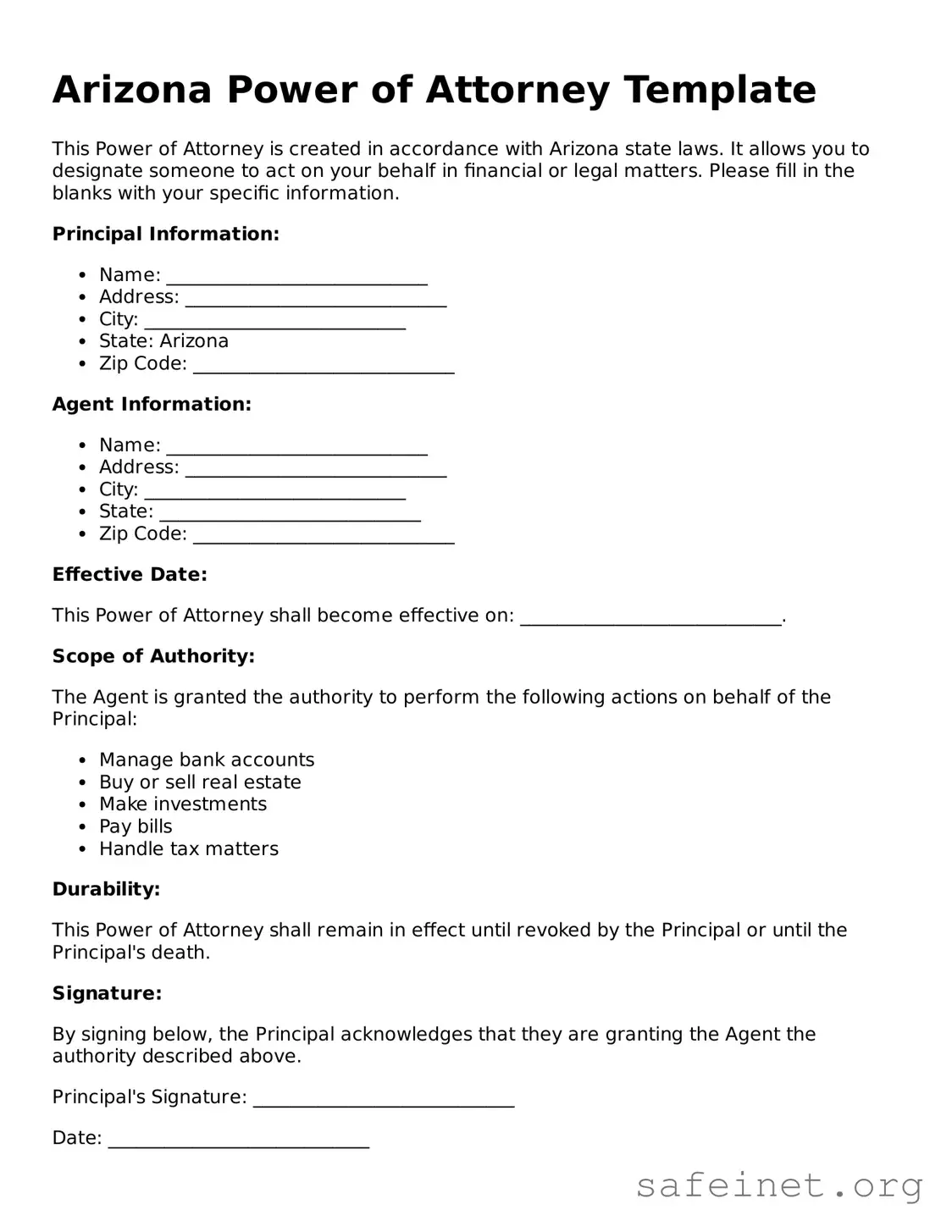
The Arizona Power of Attorney form is a vital legal document that grants someone the authority to make decisions on your behalf. This can include managing your financial affairs, making healthcare decisions, or handling real estate transactions. It is essential for individuals who want to ensure that their wishes are respected, especially in situations where they may be unable to communicate or make decisions for themselves. The form allows you to designate a trusted person, known as an agent or attorney-in-fact, who will act according to your preferences. Additionally, the Arizona Power of Attorney can be tailored to meet specific needs, whether it is durable, which remains effective even if you become incapacitated, or limited, which restricts the agent's authority to particular tasks. Understanding how to properly complete and execute this form is crucial, as it ensures that your intentions are clear and legally binding. This article will guide you through the key components of the Arizona Power of Attorney form, helping you navigate the process with confidence.
Arizona Power of Attorney Template
This Power of Attorney is created in accordance with Arizona state laws. It allows you to designate someone to act on your behalf in financial or legal matters. Please fill in the blanks with your specific information.
Principal Information:
Agent Information:
Effective Date:
This Power of Attorney shall become effective on: ____________________________.
Scope of Authority:
The Agent is granted the authority to perform the following actions on behalf of the Principal:
Durability:
This Power of Attorney shall remain in effect until revoked by the Principal or until the Principal's death.
Signature:
By signing below, the Principal acknowledges that they are granting the Agent the authority described above.
Principal's Signature: ____________________________
Date: ____________________________
Witnesses:
Two witnesses are required to sign below:
Notary Public:
This document must be notarized to be valid.
Notary Signature: ____________________________
Date: ____________________________
| Fact Name | Description |
|---|---|
| Definition | The Arizona Power of Attorney form allows an individual to designate another person to make decisions on their behalf. |
| Governing Law | The form is governed by Arizona Revised Statutes, Title 14, Chapter 5. |
| Types | There are several types of Power of Attorney, including General, Durable, and Limited. |
| Durability | A Durable Power of Attorney remains effective even if the principal becomes incapacitated. |
| Agent Responsibilities | The appointed agent must act in the best interest of the principal and adhere to their wishes. |
| Revocation | The principal can revoke the Power of Attorney at any time, as long as they are competent. |
| Signature Requirements | The form must be signed by the principal and witnessed by at least one individual or notarized. |
| Limitations | Some decisions, such as those regarding health care, may require a separate form in Arizona. |
| Effective Date | The Power of Attorney can be effective immediately or upon a specified event, such as incapacitation. |
| Accessibility | The Arizona Power of Attorney form is available online and can be customized to meet individual needs. |
After obtaining the Arizona Power of Attorney form, it is essential to fill it out accurately to ensure that it serves its intended purpose. The following steps will guide you through the process of completing the form correctly.
Once the form is filled out and notarized, it is ready for use. Ensure that all parties involved are aware of the arrangement and understand their roles.
What is a Power of Attorney in Arizona?
A Power of Attorney (POA) in Arizona is a legal document that allows one person, known as the principal, to appoint another person, called the agent or attorney-in-fact, to make decisions on their behalf. This can include financial matters, healthcare decisions, or other specific tasks. The authority granted can be broad or limited, depending on the principal's wishes.
What types of Power of Attorney are available in Arizona?
Arizona recognizes several types of Power of Attorney. The most common are the General Power of Attorney, which grants broad authority to the agent, and the Limited Power of Attorney, which restricts the agent's authority to specific tasks or time periods. Additionally, there is a Durable Power of Attorney, which remains effective even if the principal becomes incapacitated, and a Healthcare Power of Attorney, which specifically addresses medical decisions.
Do I need to notarize my Power of Attorney in Arizona?
Yes, in Arizona, a Power of Attorney must be notarized to be valid. This means that the principal must sign the document in the presence of a notary public. Notarization helps ensure that the document is authentic and that the principal is acting voluntarily and understands the implications of granting authority to the agent.
Can I revoke a Power of Attorney in Arizona?
Absolutely. A principal can revoke a Power of Attorney at any time, as long as they are mentally competent. To revoke the POA, the principal should create a written notice of revocation and provide it to the agent and any relevant third parties, such as banks or healthcare providers, to ensure that the revocation is recognized.
What happens if I become incapacitated and have a Power of Attorney?
If you become incapacitated and have a Durable Power of Attorney in place, your agent can continue to make decisions on your behalf. This is one of the key benefits of a Durable Power of Attorney. If you do not have a Durable Power of Attorney, your loved ones may need to go through a court process to obtain guardianship or conservatorship to make decisions for you.
Can I choose anyone to be my agent?
Yes, you can choose anyone to be your agent, but it is advisable to select someone you trust completely. This could be a family member, friend, or professional advisor. It’s important to consider the person’s ability to handle the responsibilities and make decisions in your best interest.
Is there a specific form I need to use for a Power of Attorney in Arizona?
While there is no official state form required for a Power of Attorney in Arizona, it is recommended to use a form that meets state laws and clearly outlines the powers granted. Many resources are available online, or you may wish to consult with a legal professional to ensure that your document is valid and comprehensive.
Not Specifying the Powers Granted: One common mistake is failing to clearly outline the specific powers being granted to the agent. It's essential to define whether the agent can make financial decisions, medical decisions, or both.
Inadequate Agent Selection: Choosing an agent without considering their reliability and ability to act in your best interest can lead to complications. It’s crucial to select someone trustworthy and responsible.
Neglecting to Sign and Date the Document: A Power of Attorney form must be signed and dated by the principal. Omitting this step renders the document invalid.
Failing to Have Witnesses or Notarization: In Arizona, certain types of Power of Attorney require either a witness or notarization. Not following this requirement can invalidate the form.
Not Updating the Document: Life circumstances change. Failing to update the Power of Attorney after significant life events—like marriage, divorce, or the death of a previously appointed agent—can lead to confusion.
Overlooking Revocation Procedures: People often forget to specify how the Power of Attorney can be revoked. It’s important to include clear instructions for revocation to avoid potential conflicts.
When creating a Power of Attorney in Arizona, several other documents may be beneficial to ensure comprehensive legal planning. Each of these documents serves a specific purpose and can complement the Power of Attorney form.
These documents, when used in conjunction with the Arizona Power of Attorney form, can help individuals ensure that their legal, financial, and medical wishes are clearly communicated and legally binding.
The Arizona Power of Attorney form shares similarities with a Living Will. A Living Will outlines an individual's preferences regarding medical treatment in the event they become incapacitated. Both documents allow individuals to express their wishes and ensure that their decisions are respected. While the Power of Attorney designates someone to make decisions on behalf of the individual, a Living Will focuses specifically on healthcare choices, providing clarity during critical moments.
Another document akin to the Power of Attorney is the Healthcare Proxy. This form allows individuals to appoint someone to make medical decisions for them if they cannot do so themselves. Like the Power of Attorney, it empowers a designated person to act on behalf of another, ensuring that their healthcare preferences are honored. The key difference lies in the specific focus on health-related decisions in the Healthcare Proxy, while the Power of Attorney can cover a broader range of financial and legal matters.
The Durable Power of Attorney is a close relative of the standard Power of Attorney. The primary distinction is that the Durable Power of Attorney remains effective even if the individual becomes incapacitated. This ensures that the appointed agent can continue to make decisions on behalf of the individual without interruption. Both documents serve the purpose of delegating authority, but the Durable version provides added security during times of vulnerability.
A Financial Power of Attorney is another document that mirrors the Arizona Power of Attorney. This form specifically grants authority to manage financial matters, such as banking, investments, and property transactions. While the general Power of Attorney can encompass various responsibilities, the Financial Power of Attorney hones in on fiscal issues. This specialization can be particularly useful for individuals who want to ensure their financial affairs are handled by a trusted person.
The Revocable Trust is also similar to the Power of Attorney in that it allows individuals to designate someone to manage their assets. In a Revocable Trust, the creator can transfer ownership of their assets into the trust while retaining control during their lifetime. Upon their passing, the designated trustee manages the assets according to the terms outlined in the trust. Both documents facilitate the management of one’s affairs, but a Revocable Trust often provides additional benefits related to estate planning.
A Guardianship document shares some similarities with the Power of Attorney as well. This legal arrangement is established when a court appoints someone to make decisions for an individual who cannot care for themselves. While the Power of Attorney is a voluntary arrangement made by the individual, Guardianship is a court-mandated decision. Both serve to protect individuals, but the process and authority differ significantly.
The Advance Directive is another document that aligns with the Power of Attorney. This term encompasses both the Living Will and the Healthcare Proxy, allowing individuals to outline their healthcare preferences and appoint someone to make decisions on their behalf. Like the Power of Attorney, an Advance Directive ensures that a person’s wishes are known and respected, particularly in critical healthcare situations.
The Declaration of Guardian is similar to the Power of Attorney in that it allows individuals to specify who they would like to serve as their guardian if they become incapacitated. This document provides peace of mind, knowing that a trusted individual will be appointed to make decisions. While the Power of Attorney focuses on delegation of authority, the Declaration of Guardian emphasizes the choice of a guardian, often for personal and care-related decisions.
The Minor Child Power of Attorney is another variant that resembles the general Power of Attorney. This document allows parents to designate someone to make decisions on behalf of their minor children. It can cover various aspects, including education and healthcare. While the Power of Attorney is typically used for adults, this specific form addresses the unique needs of children, ensuring their welfare is managed by a trusted individual when parents are unavailable.
Lastly, the Special Power of Attorney is a specific type of Power of Attorney that grants limited authority for particular tasks. Unlike the general Power of Attorney, which provides broad powers, the Special Power of Attorney is tailored to specific situations, such as selling a property or handling a single financial transaction. This document allows individuals to maintain control over their affairs while still delegating certain responsibilities to a trusted agent.
When filling out the Arizona Power of Attorney form, it is essential to follow specific guidelines to ensure that the document is valid and serves its intended purpose. Below is a list of things you should and shouldn't do.
Understanding the Arizona Power of Attorney form is crucial for anyone considering its use. However, several misconceptions often cloud its true purpose and function. Here are five common misunderstandings about this important legal document:
This is not entirely accurate. While many people associate Power of Attorney with financial decisions, it can also cover medical and legal matters. Individuals can specify what powers they wish to grant, including the authority to make healthcare decisions on their behalf.
This is misleading. A Power of Attorney can be revoked at any time, as long as the person who created it is mentally competent. It is essential to communicate this revocation to the agent and any relevant institutions to ensure clarity.
This misconception overlooks the fact that anyone can benefit from having a Power of Attorney. Unexpected events, such as accidents or sudden illnesses, can happen to anyone, regardless of age. It is wise for all adults to consider establishing this document.
This is a common concern, but it is important to understand that the agent must act in the best interest of the principal. The authority granted is meant to reflect the principal's wishes, and the agent is legally bound to follow those wishes.
While consulting a lawyer can provide valuable guidance, it is not strictly necessary. In Arizona, individuals can create a Power of Attorney using forms available online or through various resources. However, ensuring that the form meets all legal requirements is essential for it to be valid.
By dispelling these misconceptions, individuals can better appreciate the significance of the Arizona Power of Attorney form and make informed decisions regarding their personal and financial affairs.
Here are some key takeaways about filling out and using the Arizona Power of Attorney form: