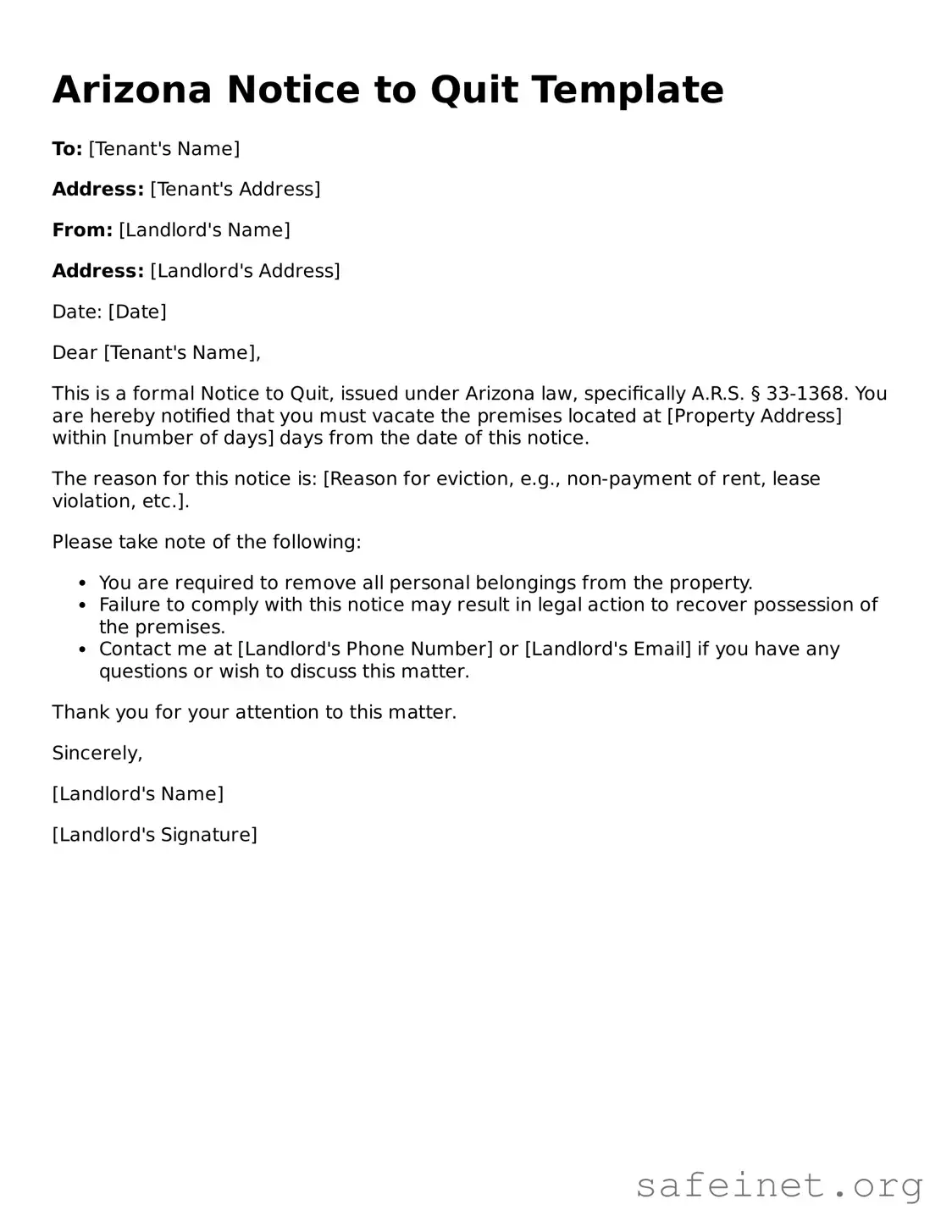
The Arizona Notice to Quit form serves as a crucial legal document in the landlord-tenant relationship, particularly when a landlord seeks to terminate a tenancy. This form is typically used when a tenant has violated lease terms or failed to pay rent, signaling the need for the tenant to vacate the premises. It outlines the specific reasons for the eviction and provides a timeline for the tenant to respond or remedy the situation. The Notice to Quit must be delivered in accordance with Arizona law, ensuring that tenants receive proper notification of their obligations. Understanding the nuances of this form is essential for both landlords and tenants, as it helps prevent misunderstandings and potential legal disputes. By adhering to the guidelines set forth in the Notice to Quit, landlords can take the necessary steps to reclaim their property while tenants can understand their rights and responsibilities in this process.
Arizona Notice to Quit Template
To: [Tenant's Name]
Address: [Tenant's Address]
From: [Landlord's Name]
Address: [Landlord's Address]
Date: [Date]
Dear [Tenant's Name],
This is a formal Notice to Quit, issued under Arizona law, specifically A.R.S. § 33-1368. You are hereby notified that you must vacate the premises located at [Property Address] within [number of days] days from the date of this notice.
The reason for this notice is: [Reason for eviction, e.g., non-payment of rent, lease violation, etc.].
Please take note of the following:
Thank you for your attention to this matter.
Sincerely,
[Landlord's Name]
[Landlord's Signature]
| Fact Name | Description |
|---|---|
| Purpose | The Arizona Notice to Quit form is used by landlords to inform tenants of their intention to terminate a lease agreement. |
| Governing Law | This form is governed by Arizona Revised Statutes, Title 33, Chapter 10. |
| Notice Period | Typically, a landlord must provide a 5-day notice for non-payment of rent and a 10-day notice for lease violations. |
| Delivery Methods | The notice can be delivered in person, by mail, or posted on the tenant's door. |
| Contents | The form must include the reason for termination, the date by which the tenant must vacate, and the landlord's contact information. |
| Tenant Rights | Tenants have the right to contest the notice in court if they believe it is unjustified. |
| Legal Consequences | If a tenant does not comply with the notice, the landlord may initiate eviction proceedings. |
| Form Availability | The Arizona Notice to Quit form is available through various legal aid organizations and online resources. |
After you have gathered all necessary information, you are ready to fill out the Arizona Notice to Quit form. This document is important for initiating the process of terminating a lease agreement. Ensure that you complete each section accurately to avoid any delays in the process.
Once you have completed the form, ensure you keep a copy for your records. After serving the notice, be prepared to follow up based on the tenant's response or lack thereof.
What is an Arizona Notice to Quit form?
The Arizona Notice to Quit form is a legal document used by landlords to inform tenants that they must vacate the rental property. This notice typically arises when a tenant has violated the terms of the lease agreement or has not paid rent. The form outlines the reasons for the eviction and provides a specific timeframe in which the tenant must leave the premises.
How much notice must be given to a tenant?
In Arizona, the notice period can vary depending on the reason for the eviction. For non-payment of rent, landlords must provide a 5-day notice. If the tenant has violated a lease term, a 10-day notice may be required. For month-to-month leases, a 30-day notice is typically necessary. It’s important for landlords to follow these timelines to ensure compliance with state laws.
Can a tenant contest a Notice to Quit?
Yes, tenants have the right to contest a Notice to Quit. If they believe the notice is unjust or that they have rectified the issue (such as paying overdue rent), they can respond accordingly. It is advisable for tenants to document their communications and gather any evidence that supports their case. If necessary, they may also seek legal assistance to navigate the eviction process.
What happens if a tenant does not comply with the Notice to Quit?
If a tenant does not vacate the property by the deadline specified in the Notice to Quit, the landlord may proceed with filing an eviction lawsuit, known as a forcible entry and detainer action. This legal process can lead to a court hearing where both parties can present their case. If the court rules in favor of the landlord, a judgment may be issued, allowing for the tenant’s removal from the property.
Is it necessary to use a specific form for the Notice to Quit?
While there is no specific state-mandated form for the Notice to Quit in Arizona, it is essential that the notice includes certain key information. This includes the tenant's name, the address of the rental property, the reason for the eviction, and the date by which the tenant must vacate. Using a well-structured form can help ensure that all necessary details are included and that the notice is legally valid.
Failing to provide the correct tenant's name. Ensure that the name matches the one on the lease agreement.
Omitting the address of the rental property. This detail is crucial for identifying the location involved in the notice.
Not specifying the reason for the notice. Clearly state the grounds for eviction to avoid confusion.
Incorrectly calculating the notice period. Make sure to follow Arizona's laws regarding the required time frame for the notice.
Neglecting to sign and date the form. A signature is necessary to validate the notice and indicate that it was properly executed.
Not keeping a copy of the completed form. Retaining a copy is important for your records and future reference.
When dealing with rental agreements and tenant issues in Arizona, various forms and documents often accompany the Notice to Quit. Understanding these documents can help ensure that both landlords and tenants are well-informed about their rights and responsibilities. Here’s a list of common forms that you might encounter.
Each of these documents plays a crucial role in the rental process. Familiarity with them can empower both landlords and tenants, ensuring smoother interactions and clearer communication. Always consider seeking guidance from a legal professional if you have questions about these forms and their implications.
The Arizona Notice to Quit form is similar to the Eviction Notice, which landlords use to inform tenants that they must vacate the property. This document outlines the reasons for the eviction, such as failure to pay rent or violation of lease terms. Both forms serve as a formal communication to tenants, indicating that they need to leave the premises by a specified date to avoid further legal action.
Another document that resembles the Notice to Quit is the Pay or Quit Notice. This notice is typically issued when a tenant has not paid their rent on time. It demands that the tenant either pay the overdue rent or vacate the property within a certain timeframe. Like the Notice to Quit, it aims to prompt action from the tenant to resolve the issue before legal proceedings are initiated.
The Cure or Quit Notice is also similar, as it is used when a tenant has violated a lease agreement but has the opportunity to fix the issue. This document specifies the violation and gives the tenant a set period to correct it. If the tenant fails to comply, they must vacate the premises, similar to the Notice to Quit's requirements.
A 3-Day Notice to Pay Rent or Quit is another related document. This notice is specifically for situations where rent is overdue. It informs the tenant that they have three days to either pay the rent owed or vacate the property. This notice is a straightforward way for landlords to address non-payment issues, paralleling the purpose of the Notice to Quit.
The Notice of Lease Termination is also akin to the Notice to Quit. This document is used to inform a tenant that their lease will not be renewed and they must vacate the property. It typically includes the date by which the tenant must leave. Both notices serve to communicate the end of a tenant's right to occupy the property.
The Notice of Non-Renewal is similar as well. It is issued when a landlord decides not to extend a tenant's lease agreement. This notice provides the tenant with a clear timeframe to vacate the premises, ensuring they are aware of their obligations. Like the Notice to Quit, it marks the end of the tenancy.
The Notice to Vacate is another comparable document. It is used by landlords to request that tenants leave the property, often for reasons unrelated to lease violations. This notice may be issued for personal reasons or property sales. Both the Notice to Vacate and the Notice to Quit serve as formal requests for tenants to leave.
Lastly, the Conditional Quit Notice shares similarities with the Notice to Quit. This document is issued when a tenant has committed a lease violation but may be allowed to stay if they remedy the situation within a specified time frame. If they do not comply, they must vacate. Both documents aim to inform tenants of their responsibilities and the consequences of failing to meet them.
When dealing with a Notice to Quit form in Arizona, it's essential to approach the task with care and attention to detail. Here’s a list of things to do and avoid to ensure the process goes smoothly.
By adhering to these guidelines, you can navigate the complexities of the Notice to Quit form with greater confidence and clarity.
Many people have misunderstandings about the Arizona Notice to Quit form. Here are eight common misconceptions:
The Notice to Quit is specifically for terminating a lease agreement. It is not applicable for all eviction situations.
While personal service is one option, the Notice to Quit can also be mailed or posted on the property, depending on the circumstances.
Receiving a Notice to Quit does not mean tenants cannot defend themselves. They still have the right to respond and contest the eviction.
The Notice to Quit is a preliminary step. It informs tenants of the intention to terminate the lease but does not constitute a formal eviction.
Landlords must have a legitimate reason for issuing a Notice to Quit, such as non-payment of rent or lease violations.
While there is a standard format, landlords can customize the Notice to Quit as long as it meets legal requirements.
Ignoring a Notice to Quit can lead to further legal action. Tenants should take it seriously and respond appropriately.
A Notice to Quit does not guarantee that a tenant will be evicted. The landlord must still follow legal procedures to complete the eviction process.
Filling out and using the Arizona Notice to Quit form can be a straightforward process if you keep a few key points in mind. Here are some essential takeaways to help you navigate this important document:
By keeping these points in mind, you can ensure that you handle the Notice to Quit form effectively and in accordance with Arizona law.