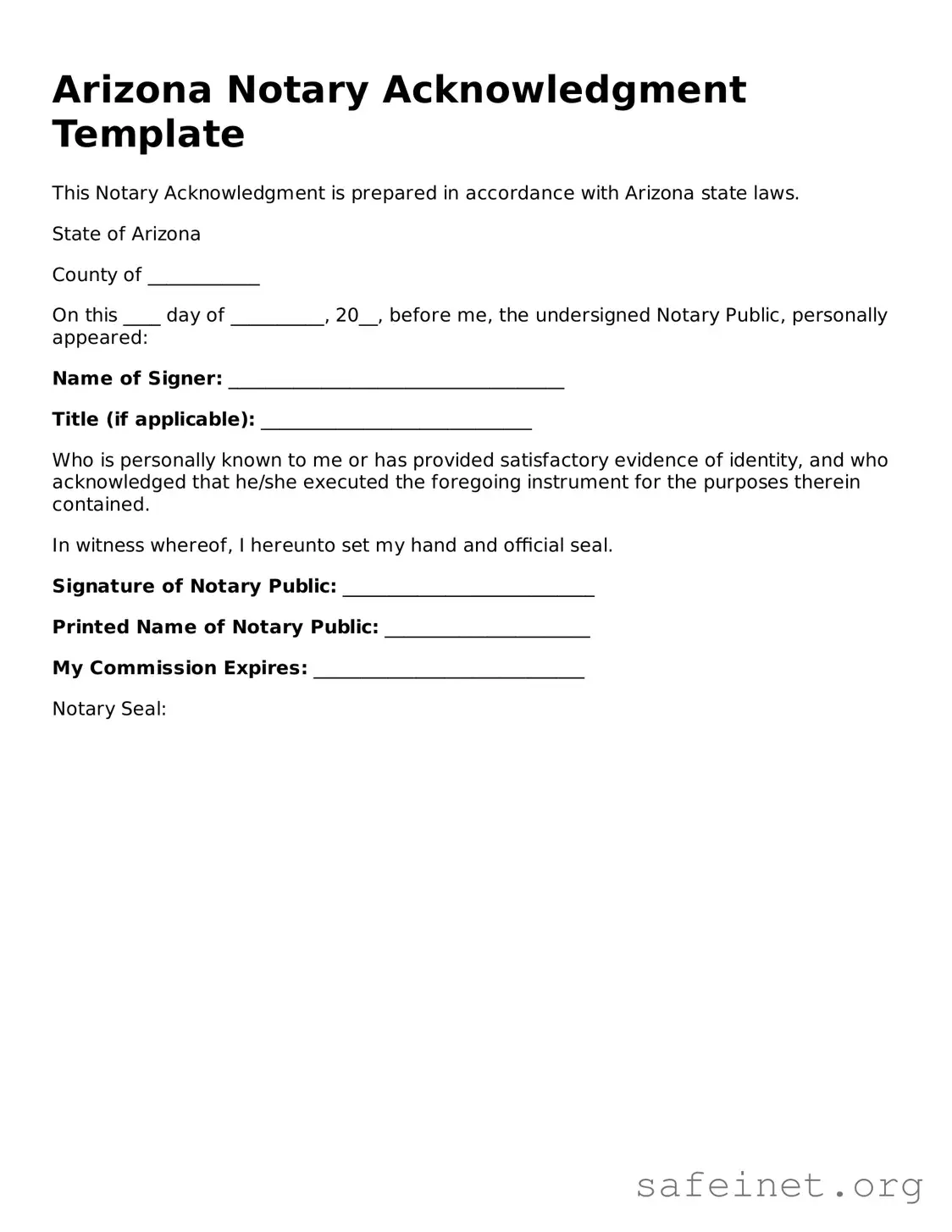
The Arizona Notary Acknowledgment form plays a crucial role in the notarization process, serving as a vital tool for verifying the identity of individuals signing important documents. This form ensures that the signer is doing so willingly and is aware of the contents of the document. It typically includes essential information such as the name of the signer, the type of document being acknowledged, and the date of the acknowledgment. The notary public, who acts as an impartial witness, will complete the form by adding their signature and seal, thereby affirming that they have properly identified the signer and confirmed their understanding of the document. Understanding how to properly fill out and utilize this form can help individuals navigate legal requirements with confidence, ensuring that their documents hold up in court and are recognized by various institutions. Whether you are involved in real estate transactions, legal agreements, or other formal processes, knowing the ins and outs of the Arizona Notary Acknowledgment form is essential for safeguarding your interests and ensuring the integrity of your documents.
Arizona Notary Acknowledgment Template
This Notary Acknowledgment is prepared in accordance with Arizona state laws.
State of Arizona
County of ____________
On this ____ day of __________, 20__, before me, the undersigned Notary Public, personally appeared:
Name of Signer: ____________________________________
Title (if applicable): _____________________________
Who is personally known to me or has provided satisfactory evidence of identity, and who acknowledged that he/she executed the foregoing instrument for the purposes therein contained.
In witness whereof, I hereunto set my hand and official seal.
Signature of Notary Public: ___________________________
Printed Name of Notary Public: ______________________
My Commission Expires: _____________________________
Notary Seal:
| Fact Name | Description |
|---|---|
| Purpose | The Arizona Notary Acknowledgement form is used to confirm that a person has willingly signed a document in the presence of a notary public. |
| Governing Law | This form is governed by Arizona Revised Statutes, Title 41, Chapter 2, which outlines the powers and duties of notaries public. |
| Signature Requirement | The individual signing the document must do so in front of the notary, who will then complete the acknowledgment process. |
| Identification | The signer must provide valid identification to the notary, ensuring that their identity is verified before the acknowledgment is completed. |
| Record Keeping | Notaries are required to keep a record of each acknowledgment in their journal, documenting the details of the transaction. |
| Usage | This form is commonly used for various legal documents, including contracts, deeds, and powers of attorney. |
After obtaining the Arizona Notary Acknowledgment form, you will need to fill it out accurately to ensure it meets legal requirements. Once completed, the form will be ready for submission or use as needed.
What is the Arizona Notary Acknowledgement form?
The Arizona Notary Acknowledgement form is a legal document used to verify that a signature on a document was made in the presence of a notary public. This form confirms the identity of the signer and ensures that they acted voluntarily and with an understanding of the document's content.
Who can serve as a notary public in Arizona?
In Arizona, any individual who is at least 18 years old, a resident of the state, and has no felony convictions can apply to become a notary public. Additionally, applicants must complete a training course and pass an exam to ensure they understand their responsibilities.
What documents require a Notary Acknowledgement?
Many legal documents may require a Notary Acknowledgement, including deeds, mortgages, powers of attorney, and contracts. It is essential to check the specific requirements for each document to determine if notarization is necessary.
How do I complete the Arizona Notary Acknowledgement form?
To complete the form, the signer must appear before the notary public. The notary will verify the signer's identity, witness the signature, and then fill out the form, including details such as the date, location, and the notary's official seal.
Is there a fee for notarization in Arizona?
Yes, Arizona law allows notaries to charge a fee for their services. The maximum fee for a standard acknowledgment is $10 per signature. However, fees may vary, so it’s advisable to confirm with the notary beforehand.
What should I bring when getting a document notarized?
When visiting a notary, bring a valid form of identification, such as a driver's license or passport. Ensure that the document you need notarized is complete and ready for signing, as the notary cannot provide legal advice or assist in filling out the document.
Can a notary refuse to notarize a document?
Yes, a notary can refuse to notarize a document if they believe the signer is not acting voluntarily, if the document is incomplete, or if the signer cannot provide adequate identification. Notaries must adhere to ethical standards and ensure the integrity of the notarization process.
How long is a Notary Acknowledgement valid in Arizona?
A Notary Acknowledgement does not have a specific expiration date. However, the validity of the underlying document may vary. It’s essential to check the requirements for the specific document to ensure it remains valid for its intended purpose.
Incorrect Date: One common mistake is failing to enter the correct date of the acknowledgment. This date should reflect when the notary performed the acknowledgment, not when the document was signed.
Missing Signatures: Often, individuals forget to sign the document before presenting it for notarization. All parties involved must sign in the presence of the notary.
Wrong Notary Section: Some people mistakenly fill out the wrong section of the form. It is essential to ensure that the acknowledgment section is completed, as it is specifically designed for this purpose.
Inaccurate Personal Information: Providing incorrect personal information, such as the name or address of the signer, can lead to issues. This information must be accurate and match the identification provided.
Failure to Identify Signers: Notaries must verify the identity of all signers. Failing to do so can invalidate the acknowledgment. Always present valid identification.
Not Using a Notary Seal: A notary’s seal is a crucial part of the acknowledgment process. Some individuals neglect to ensure that the notary has applied their seal to the document, which can render it ineffective.
Omitting the Notary's Signature: Finally, a common error is the omission of the notary's signature. This signature is essential to authenticate the acknowledgment and must be included.
When engaging in legal transactions in Arizona, various forms and documents often accompany the Notary Acknowledgement form. These documents serve to provide clarity and ensure that all parties involved are protected and informed. Below is a list of common forms that you may encounter.
Each of these documents plays a vital role in the legal landscape of Arizona. Understanding their purpose can help you navigate legal processes more effectively and ensure that all necessary protections are in place.
The Arizona Notary Acknowledgment form shares similarities with the Affidavit. An affidavit is a written statement confirmed by oath or affirmation, used as evidence in court. Like the notary acknowledgment, it requires a signature and a notary's verification. Both documents serve to authenticate the identity of the signer and affirm that the content is true to the best of their knowledge, providing a legal basis for the statements made within them.
Another document that resembles the Arizona Notary Acknowledgment form is the Power of Attorney. This legal document allows one person to act on behalf of another in legal or financial matters. The signing process for a Power of Attorney often requires notarization to confirm the identity of the principal and ensure that the document is executed willingly. Both documents involve a notary's role in validating the identities and intentions of the parties involved.
The Certificate of Acknowledgment is also similar to the Arizona Notary Acknowledgment. This certificate is often attached to various legal documents, confirming that the signer appeared before the notary and acknowledged their signature. Like the notary acknowledgment, it serves to provide evidence that the signer understood the document they were signing and did so voluntarily, reinforcing the authenticity of the transaction.
A Deed is another document that bears resemblance to the Arizona Notary Acknowledgment form. When transferring property, a deed must be signed and often notarized. The notary’s role is to verify the identities of the parties involved and confirm that the signing was done voluntarily. Both documents play crucial roles in ensuring the legality and enforceability of property transactions.
Lastly, the Mortgage Agreement shares characteristics with the Arizona Notary Acknowledgment. This document outlines the terms of a loan secured by real estate. Notarization is typically required to ensure that all parties have agreed to the terms and that the signatures are legitimate. Both the mortgage agreement and the notary acknowledgment serve to protect the interests of the parties involved, ensuring that the agreements are binding and enforceable.
When filling out the Arizona Notary Acknowledgment form, it is essential to follow specific guidelines to ensure the document is valid and properly executed. Here are five important things to do and avoid:
Understanding the Arizona Notary Acknowledgement form is crucial for anyone involved in legal documents. However, several misconceptions can lead to confusion. Below are six common misconceptions about this form, along with clarifications.
Not every signature on a document requires notarization. Only those that need to be acknowledged as genuine must go through this process.
This is not a requirement. The notary must verify the signer's identity, but prior personal acquaintance is not necessary.
While notaries have discretion, they cannot refuse without a valid reason, such as lack of proper identification or signs of coercion.
Notarization does not ensure the legality of the document itself; it only confirms that the signer appeared before the notary and acknowledged their signature.
Notaries are not authorized to provide legal advice. Their role is strictly to verify identities and witness signatures.
A notarized document can be amended, but any changes made after notarization may require re-notarization to maintain validity.
By addressing these misconceptions, individuals can better navigate the requirements and processes associated with the Arizona Notary Acknowledgement form.
When filling out and using the Arizona Notary Acknowledgement form, it is essential to understand its purpose and requirements. Here are key takeaways to consider: