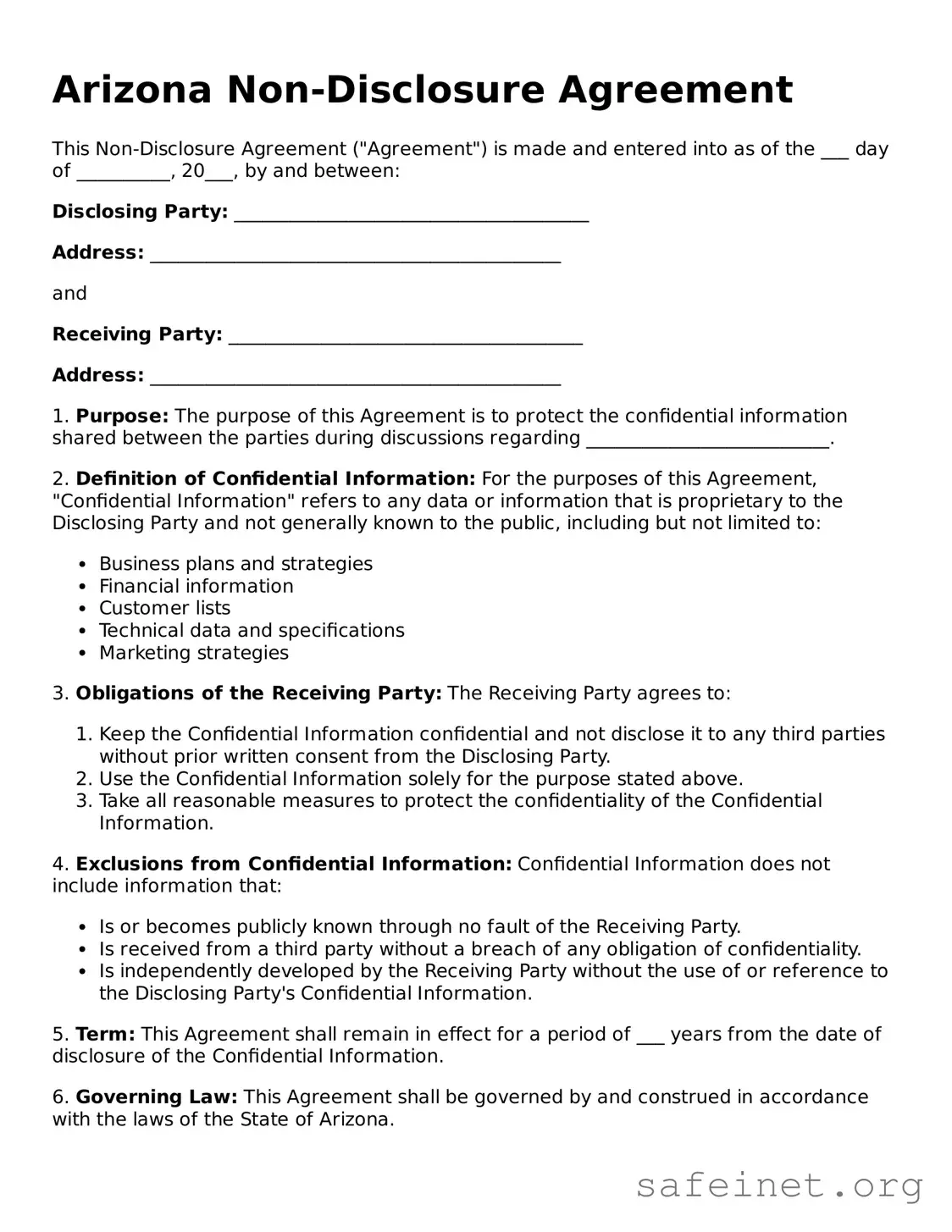
The Arizona Non-disclosure Agreement (NDA) form serves as a crucial legal document for individuals and businesses seeking to protect sensitive information from unauthorized disclosure. This agreement outlines the obligations of the parties involved, ensuring that confidential information remains secure. Key elements typically included in the NDA encompass the definition of what constitutes confidential information, the duration of the agreement, and the specific responsibilities of each party. Additionally, the form may specify any exceptions to confidentiality, such as information that is already public or independently developed. By clearly delineating the terms of confidentiality, the Arizona NDA helps foster trust and collaboration between parties while safeguarding proprietary information. Understanding the nuances of this form is essential for anyone looking to engage in business dealings that involve sensitive data.
Arizona Non-Disclosure Agreement
This Non-Disclosure Agreement ("Agreement") is made and entered into as of the ___ day of __________, 20___, by and between:
Disclosing Party: ______________________________________
Address: ____________________________________________
and
Receiving Party: ______________________________________
Address: ____________________________________________
1. Purpose: The purpose of this Agreement is to protect the confidential information shared between the parties during discussions regarding __________________________.
2. Definition of Confidential Information: For the purposes of this Agreement, "Confidential Information" refers to any data or information that is proprietary to the Disclosing Party and not generally known to the public, including but not limited to:
3. Obligations of the Receiving Party: The Receiving Party agrees to:
4. Exclusions from Confidential Information: Confidential Information does not include information that:
5. Term: This Agreement shall remain in effect for a period of ___ years from the date of disclosure of the Confidential Information.
6. Governing Law: This Agreement shall be governed by and construed in accordance with the laws of the State of Arizona.
7. Entire Agreement: This Agreement constitutes the entire understanding between the parties regarding the subject matter herein and supersedes all prior agreements, whether written or oral.
IN WITNESS WHEREOF, the parties hereto have executed this Non-Disclosure Agreement as of the date first above written.
Disclosing Party:
______________________________
Signature
______________________________
Date
Receiving Party:
______________________________
Signature
______________________________
Date
| Fact Name | Details |
|---|---|
| Definition | An Arizona Non-disclosure Agreement (NDA) is a legal contract that protects confidential information shared between parties. |
| Purpose | The primary purpose of an NDA is to prevent the unauthorized disclosure of sensitive information. |
| Governing Law | NDAs in Arizona are governed by the Arizona Revised Statutes, specifically Title 44, which covers trade secrets. |
| Types of NDAs | There are two main types: unilateral (one party discloses information) and mutual (both parties share information). |
| Duration | NDAs typically specify a duration for which the confidentiality obligation lasts, often ranging from 1 to 5 years. |
| Enforceability | For an NDA to be enforceable, it must be reasonable in scope and duration, and not overly broad. |
| Exceptions | NDAs usually have exceptions, such as information that is publicly available or independently developed. |
| Consequences of Breach | If a party breaches the NDA, they may face legal action, including injunctions and monetary damages. |
| Signing Requirements | While notarization is not required, both parties should sign the NDA to demonstrate agreement and intent. |
| Common Uses | NDAs are commonly used in business relationships, employment agreements, and during negotiations for mergers or acquisitions. |
After obtaining the Arizona Non-disclosure Agreement form, you will need to complete it accurately to ensure that all parties involved understand their obligations. Follow these steps carefully to fill out the form correctly.
What is a Non-disclosure Agreement (NDA) in Arizona?
A Non-disclosure Agreement, commonly known as an NDA, is a legal contract designed to protect confidential information shared between parties. In Arizona, this agreement ensures that sensitive information, such as business secrets or proprietary data, remains private. It creates a legal obligation for the receiving party to keep the information confidential and outlines the consequences of any breach.
When should I use an NDA in Arizona?
You should consider using an NDA whenever you plan to share sensitive information with another party, whether it's for business negotiations, partnerships, or employment. For instance, if you are discussing a new product with a potential partner or hiring someone who will have access to your company’s trade secrets, an NDA can help safeguard your interests.
What should be included in an Arizona NDA?
An effective NDA should clearly define the confidential information being protected, specify the obligations of the receiving party, and outline the duration of the confidentiality obligation. Additionally, it may include clauses about the permitted use of the information, the consequences of unauthorized disclosure, and any exceptions to the confidentiality requirement.
Is an NDA enforceable in Arizona?
Yes, NDAs are generally enforceable in Arizona as long as they meet certain legal criteria. The agreement must be clear and specific about what constitutes confidential information. It should also be reasonable in its terms and not overly broad, which could lead to challenges in court. Always consult with a legal professional to ensure your NDA is compliant with Arizona law.
How long does the confidentiality obligation last?
The duration of the confidentiality obligation can vary depending on the terms of the NDA. Typically, it lasts for a specified period, often ranging from two to five years. However, some information may remain confidential indefinitely, especially if it pertains to trade secrets. It's essential to define this duration clearly in the agreement.
Can I modify an NDA after it has been signed?
Yes, you can modify an NDA after it has been signed, but both parties must agree to the changes. Modifications should be documented in writing and signed by both parties to ensure that the new terms are enforceable. It's always a good idea to consult with a legal expert when making changes to any legal agreement.
What happens if someone breaches the NDA?
If a party breaches the NDA, the injured party may seek legal remedies. This could include monetary damages for any losses incurred due to the breach or an injunction to prevent further disclosure of the confidential information. The specific consequences should be outlined in the NDA itself, providing clarity on the actions that can be taken in the event of a breach.
Not reading the entire agreement thoroughly. Many individuals overlook important clauses that could affect their rights and obligations.
Failing to identify all parties involved. It is crucial to list all individuals or entities that will be bound by the agreement.
Using vague language. Specificity is key. Ambiguous terms can lead to misunderstandings and disputes later on.
Neglecting to define confidential information. Without clear definitions, it can be difficult to determine what information is protected under the agreement.
Overlooking the duration of confidentiality. The time frame for which the information must remain confidential should be clearly stated.
Not including the consequences of breach. It is important to outline the potential repercussions for violating the terms of the agreement.
Failing to consult legal advice. Many individuals attempt to fill out the form without professional guidance, which can lead to significant errors.
Not keeping a copy of the signed agreement. Retaining a copy is essential for reference and enforcement of the agreement in the future.
When entering into a Non-disclosure Agreement (NDA) in Arizona, it’s often beneficial to have additional documents prepared. These documents can support the NDA and clarify the terms of the agreement. Below is a list of forms and documents frequently used alongside an NDA.
Having these documents ready can streamline the process of entering into an NDA and ensure all parties are clear on their responsibilities. It’s important to tailor each document to fit the specific needs of your situation to provide the best protection possible.
A Confidentiality Agreement is similar to a Non-disclosure Agreement (NDA) in that both documents aim to protect sensitive information. While an NDA typically focuses on preventing the disclosure of proprietary information between parties, a Confidentiality Agreement can also cover oral or written information shared in various contexts. Both agreements establish a legal framework for maintaining confidentiality, but a Confidentiality Agreement may be more flexible in terms of the types of information it protects.
A Non-compete Agreement often accompanies NDAs in business relationships. This document restricts an individual from engaging in similar business activities that could compete with the interests of their employer or business partner. While an NDA focuses on information sharing, a Non-compete Agreement emphasizes limiting competitive behavior. Together, they help safeguard both intellectual property and market position.
An Employment Agreement may include confidentiality clauses akin to those found in NDAs. This document outlines the terms of employment, including job responsibilities, compensation, and any obligations related to confidential information. By integrating confidentiality provisions, employers can ensure that employees understand their duty to protect sensitive company information throughout their employment and even after leaving the company.
A Partnership Agreement is another document that often contains confidentiality provisions similar to those in an NDA. This agreement outlines the terms of a partnership, including profit sharing, responsibilities, and the handling of confidential information. By including confidentiality clauses, partners can protect sensitive business strategies and trade secrets from being disclosed to outside parties.
A Service Agreement can include confidentiality provisions that echo those found in NDAs. This document outlines the terms under which one party provides services to another. When sensitive information is exchanged during the service relationship, confidentiality clauses help protect that information from being disclosed or misused, ensuring both parties feel secure in their dealings.
A Technology Transfer Agreement may share similarities with NDAs, particularly in protecting proprietary technology and trade secrets. This document governs the transfer of technology from one party to another, often including confidentiality provisions to safeguard sensitive information. The goal is to ensure that the receiving party does not disclose or exploit the transferred technology without permission.
A Settlement Agreement, often used in legal disputes, can include confidentiality clauses akin to those in NDAs. This document outlines the terms of a settlement between parties, which may involve the exchange of confidential information. By including confidentiality provisions, the parties can agree to keep the terms of the settlement private, thus protecting their reputations and interests.
A Memorandum of Understanding (MOU) may also contain confidentiality clauses similar to those in NDAs. An MOU outlines the intentions and agreements between parties before a formal contract is established. If sensitive information is shared during negotiations, confidentiality provisions can help ensure that such information remains protected until a formal agreement is reached.
Finally, a Disclosure Agreement, while often seen as a precursor to an NDA, serves a similar purpose in protecting sensitive information. This document allows one party to disclose information to another while establishing terms for confidentiality. It ensures that the receiving party understands their obligation to keep the information confidential, similar to the protections offered by a Non-disclosure Agreement.
When filling out the Arizona Non-disclosure Agreement form, it is crucial to approach the task with care. Here are five things you should and shouldn't do:
When it comes to Non-disclosure Agreements (NDAs) in Arizona, several misconceptions can lead to confusion. Understanding these myths can help individuals and businesses navigate their legal obligations more effectively. Here are four common misconceptions:
By addressing these misconceptions, individuals and businesses can approach NDAs with a clearer understanding of their purpose and limitations.
When filling out and utilizing the Arizona Non-disclosure Agreement (NDA) form, it is crucial to understand its implications and requirements. Here are six key takeaways to keep in mind:
By following these key takeaways, you can effectively navigate the process of filling out and using the Arizona Non-disclosure Agreement form, safeguarding your confidential information.