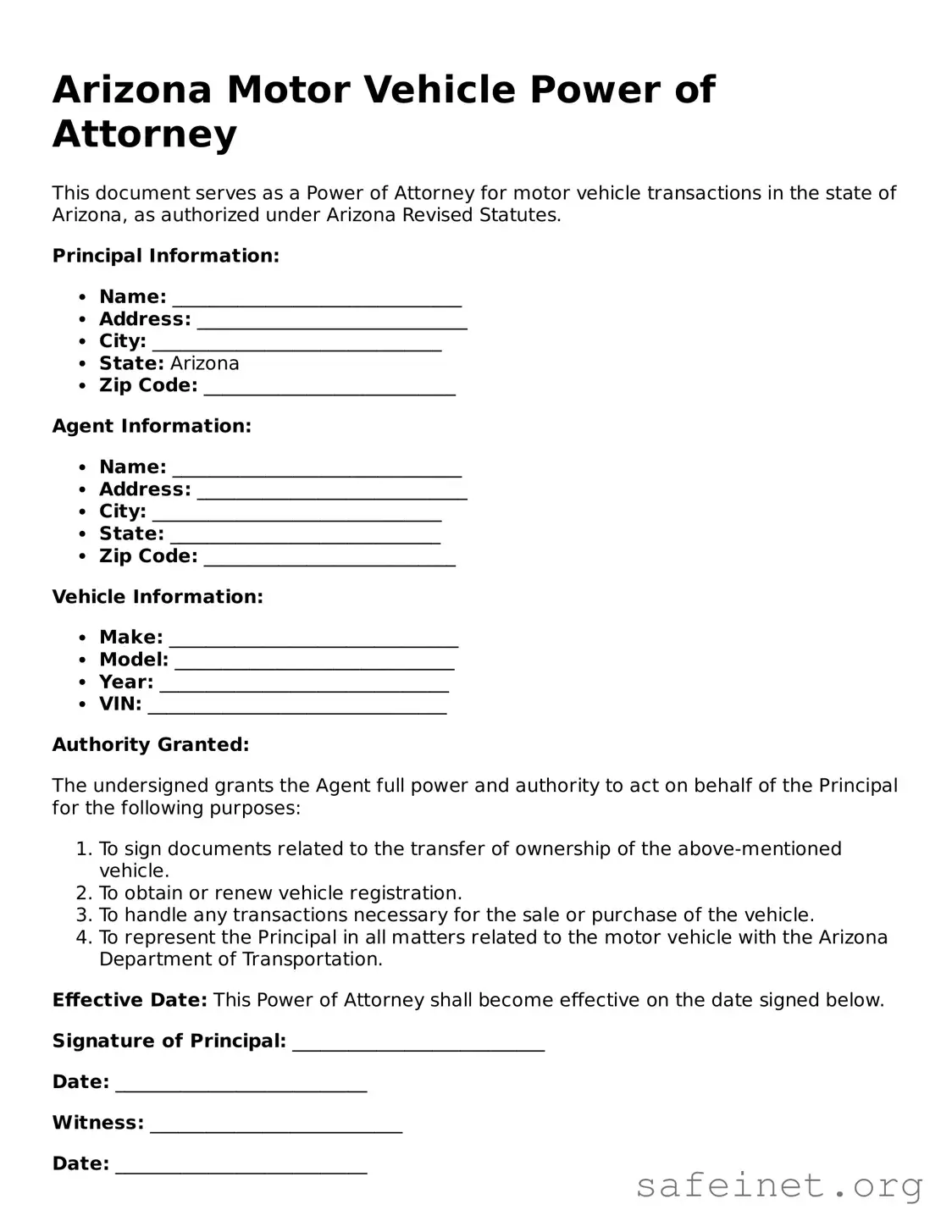
The Arizona Motor Vehicle Power of Attorney form serves as a crucial legal document that enables an individual, known as the principal, to designate another person, referred to as the agent, to act on their behalf in matters related to motor vehicle transactions. This form is particularly significant when the principal is unable to be present for the completion of tasks such as registering a vehicle, transferring ownership, or obtaining a title. It outlines the specific powers granted to the agent, ensuring clarity and preventing misunderstandings. The form must be signed by the principal and often requires notarization to verify authenticity. Additionally, it is important for both parties to understand the responsibilities and limitations of the authority being granted. By utilizing this form, individuals can ensure that their motor vehicle affairs are managed effectively, even in their absence, thereby providing peace of mind in a variety of circumstances.
Arizona Motor Vehicle Power of Attorney
This document serves as a Power of Attorney for motor vehicle transactions in the state of Arizona, as authorized under Arizona Revised Statutes.
Principal Information:
Agent Information:
Vehicle Information:
Authority Granted:
The undersigned grants the Agent full power and authority to act on behalf of the Principal for the following purposes:
Effective Date: This Power of Attorney shall become effective on the date signed below.
Signature of Principal: ___________________________
Date: ___________________________
Witness: ___________________________
Date: ___________________________
Notary Public: ___________________________
Date: ___________________________
| Fact Name | Description |
|---|---|
| Purpose | The Arizona Motor Vehicle Power of Attorney form allows an individual to designate another person to handle motor vehicle-related transactions on their behalf. |
| Governing Law | This form is governed by Arizona Revised Statutes § 14-5501 and § 28-2001. |
| Signature Requirement | The form must be signed by the principal (the person granting authority) in the presence of a notary public. |
| Agent Authority | The designated agent can perform tasks such as registering a vehicle, transferring ownership, and obtaining title documents. |
| Revocation | The principal can revoke the power of attorney at any time, as long as they provide notice to the agent. |
| Validity | This power of attorney remains valid until revoked or until the principal becomes incapacitated, unless otherwise specified. |
| Use Cases | Common scenarios include when the principal is unable to attend DMV appointments or needs assistance with vehicle transactions. |
| Form Availability | The form can typically be obtained from the Arizona Department of Transportation or online legal resources. |
| Notarization | Notarization is crucial for the form's acceptance by state authorities and ensures the authenticity of the principal's signature. |
Filling out the Arizona Motor Vehicle Power of Attorney form is a straightforward process that allows you to designate someone to handle specific tasks related to your vehicle. After completing the form, you will need to ensure it is properly signed and may need to submit it to the appropriate agency or party involved.
What is a Motor Vehicle Power of Attorney in Arizona?
A Motor Vehicle Power of Attorney (POA) in Arizona is a legal document that allows an individual, known as the principal, to designate another person, referred to as the agent, to act on their behalf regarding matters related to motor vehicles. This can include tasks such as transferring ownership, registering a vehicle, or obtaining title documents. The agent is granted the authority to perform these actions as if they were the principal, making it easier for individuals who may be unable to handle these tasks themselves due to various reasons, such as health issues or being out of state.
Who can serve as an agent in a Motor Vehicle Power of Attorney?
In Arizona, any competent adult can serve as an agent in a Motor Vehicle Power of Attorney. This means that the person you choose should be at least 18 years old and capable of understanding the responsibilities that come with the role. Many people select trusted family members or friends, but it is essential to choose someone who will act in your best interest and handle your vehicle-related matters responsibly.
How do I complete the Motor Vehicle Power of Attorney form?
Completing the Motor Vehicle Power of Attorney form involves filling out specific information about both the principal and the agent. This includes names, addresses, and signatures. It is crucial to ensure that all information is accurate and clearly written. After completing the form, it should be signed in front of a notary public to ensure its validity. Notarization adds an extra layer of authenticity, which may be required by certain institutions when the agent uses the power granted to them.
Can I revoke a Motor Vehicle Power of Attorney once it is established?
Yes, a Motor Vehicle Power of Attorney can be revoked at any time by the principal, as long as they are mentally competent. To revoke the POA, the principal should create a written notice stating their intent to revoke the document. It is advisable to inform the agent and any institutions that may have relied on the original POA, such as the Department of Motor Vehicles, to prevent any confusion or misuse of the authority previously granted.
Is a Motor Vehicle Power of Attorney necessary for all vehicle transactions?
No, a Motor Vehicle Power of Attorney is not necessary for every vehicle transaction. However, it can be very helpful in specific situations, such as when the principal is unable to be present for a transaction or when they are transferring ownership to another party. In cases where the principal can manage their vehicle-related matters without assistance, a POA may not be needed. It is important to assess each situation individually to determine whether a POA would facilitate the process.
Incomplete Information: Failing to provide all necessary details, such as the full name, address, and contact information of both the principal and the agent, can lead to issues. Every section must be filled out completely to avoid delays or rejections.
Incorrect Signatures: The form must be signed by the principal. Sometimes, individuals mistakenly believe that the agent can sign on behalf of the principal. This error can invalidate the document.
Not Notarizing the Document: In Arizona, the Motor Vehicle Power of Attorney form often requires notarization. Skipping this step may result in the form being considered invalid.
Using Outdated Forms: Laws and regulations can change. Using an outdated version of the form can lead to complications. Always ensure that the most current version is being utilized.
Overlooking Specific Powers Granted: The form allows the principal to specify certain powers. Failing to clearly outline these powers can lead to misunderstandings about what the agent is authorized to do.
Not Understanding the Scope: Some individuals may not fully grasp the implications of granting power of attorney. It’s important to understand the responsibilities and authority being given to the agent.
Failing to Provide a Copy: After completing the form, not providing a copy to the agent can create confusion. Both parties should have a copy for reference.
Ignoring State-Specific Requirements: Each state may have unique requirements for the Power of Attorney. Ignoring these specifics can lead to invalidation of the form.
When dealing with vehicle transactions in Arizona, several forms and documents may accompany the Motor Vehicle Power of Attorney. These documents help ensure that the necessary legal authority and information are in place for the transaction to proceed smoothly. Below are some commonly used forms that you might encounter.
Having these documents prepared and organized can facilitate the vehicle transaction process in Arizona. Always ensure that you have the appropriate paperwork ready to avoid any delays or complications.
The Arizona Motor Vehicle Power of Attorney form shares similarities with the General Power of Attorney. Both documents allow an individual to appoint someone else to act on their behalf in various matters. However, while the General Power of Attorney can cover a wide range of financial and legal decisions, the Motor Vehicle Power of Attorney is specifically tailored for matters related to vehicle ownership, registration, and transactions. This focused scope makes it easier for individuals to handle automotive issues without needing to grant broader authority.
Another document akin to the Motor Vehicle Power of Attorney is the Limited Power of Attorney. This form is used when a person wants to grant specific powers for a particular task or time period. Like the Motor Vehicle Power of Attorney, it restricts the authority given to the agent, making it clear that the agent can only act in designated areas. This specificity helps to protect the principal’s interests while allowing for necessary actions to be taken in a controlled manner.
The Durable Power of Attorney is also similar, but with a crucial difference. This document remains effective even if the principal becomes incapacitated. While the Motor Vehicle Power of Attorney is generally effective only during the principal's competency, the Durable Power of Attorney ensures that the agent can continue to manage the principal's affairs, including vehicle-related matters, in times of need. This can provide peace of mind for individuals who want their affairs managed seamlessly, regardless of their health status.
The Vehicle Title Transfer form is another related document, often used when ownership of a vehicle changes hands. This form is essential for legally transferring the title from one owner to another. While the Motor Vehicle Power of Attorney allows someone to act on behalf of the owner in these transactions, the Vehicle Title Transfer form is the actual document that finalizes the ownership change. Both documents work together to facilitate smooth vehicle transactions, ensuring all legal requirements are met.
Similar to the Motor Vehicle Power of Attorney is the Consent to Release Information form. This document allows individuals to authorize the release of specific information to third parties, such as insurance companies or repair shops. While the Motor Vehicle Power of Attorney grants broader authority to act on behalf of the owner, the Consent to Release Information form is focused on sharing information. This distinction is important for individuals who want to maintain control over their information while still allowing necessary disclosures.
Lastly, the Affidavit of Heirship is comparable in that it deals with the transfer of property, including vehicles, after a person's death. This document serves to establish the rightful heirs of a deceased person's estate. While the Motor Vehicle Power of Attorney is used during a person's lifetime to delegate authority, the Affidavit of Heirship comes into play after death to ensure that vehicle ownership is correctly passed on to heirs. Both documents address the transfer of ownership but at different stages of life.
When filling out the Arizona Motor Vehicle Power of Attorney form, it's important to follow certain guidelines to ensure the document is valid and effective. Here’s a list of things to do and avoid:
By following these guidelines, you can help ensure that your Motor Vehicle Power of Attorney form is completed correctly and serves its intended purpose.
Misconception 1: The Motor Vehicle Power of Attorney can only be used for selling a vehicle.
This form is not limited to just selling a vehicle. It can also grant someone the authority to register a vehicle, obtain a duplicate title, or handle other motor vehicle-related tasks.
Misconception 2: A Power of Attorney must be notarized to be valid.
While notarization is often recommended for added legitimacy, Arizona law does not require it for the Motor Vehicle Power of Attorney to be valid. However, having it notarized can help prevent disputes.
Misconception 3: Only a lawyer can create a Motor Vehicle Power of Attorney.
Anyone can create this document without a lawyer. However, it is wise to ensure that all required information is included to avoid complications.
Misconception 4: The person granting the Power of Attorney loses all rights to their vehicle.
The vehicle owner retains their rights even after granting Power of Attorney. The appointed individual acts on behalf of the owner, but ownership remains unchanged.
Misconception 5: The Power of Attorney is permanent and cannot be revoked.
This is incorrect. The vehicle owner can revoke the Power of Attorney at any time, as long as they provide proper notice to the appointed individual.
When filling out and using the Arizona Motor Vehicle Power of Attorney form, consider the following key takeaways: