In Arizona, the Medical Power of Attorney form plays a crucial role in ensuring that your healthcare wishes are respected when you are unable to communicate them yourself. This legal document allows you to appoint someone you trust, known as your agent, to make medical decisions on your behalf. It's essential to choose an individual who understands your values and preferences regarding medical treatment. The form outlines the specific powers granted to your agent, which can range from consenting to or refusing medical procedures to making decisions about end-of-life care. Additionally, the Arizona Medical Power of Attorney can include provisions for mental health treatment, ensuring comprehensive coverage of your healthcare needs. By completing this form, you gain peace of mind knowing that your healthcare decisions will be made according to your wishes, even in challenging circumstances. Understanding the nuances of this document is vital for anyone looking to safeguard their medical preferences and ensure their voice is heard when it matters most.
Arizona Medical Power of Attorney
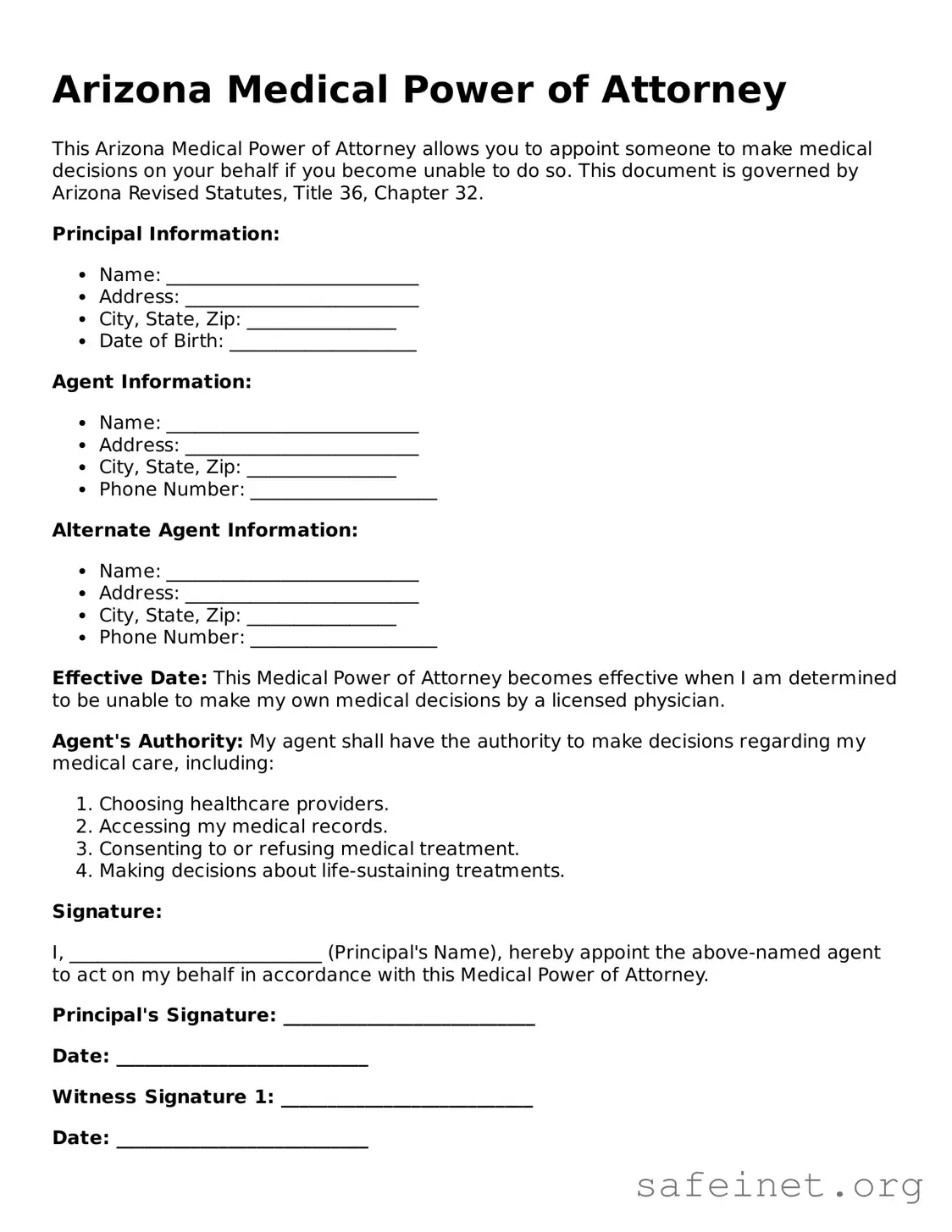
This Arizona Medical Power of Attorney allows you to appoint someone to make medical decisions on your behalf if you become unable to do so. This document is governed by Arizona Revised Statutes, Title 36, Chapter 32.
Principal Information:
Agent Information:
Alternate Agent Information:
Effective Date: This Medical Power of Attorney becomes effective when I am determined to be unable to make my own medical decisions by a licensed physician.
Agent's Authority: My agent shall have the authority to make decisions regarding my medical care, including:
Signature:
I, ___________________________ (Principal's Name), hereby appoint the above-named agent to act on my behalf in accordance with this Medical Power of Attorney.
Principal's Signature: ___________________________
Date: ___________________________
Witness Signature 1: ___________________________
Date: ___________________________
Witness Signature 2: ___________________________
Date: ___________________________
Notary Public:
State of Arizona
County of ___________________________
Subscribed and sworn before me on this _____ day of ____________, 20__.
Notary Public Signature: ___________________________
My Commission Expires: ___________________________
| Fact Name | Description |
|---|---|
| Definition | The Arizona Medical Power of Attorney form allows individuals to designate someone to make healthcare decisions on their behalf if they become unable to do so. |
| Governing Law | This form is governed by Arizona Revised Statutes, specifically Title 36, Chapter 32, which outlines the laws regarding healthcare directives. |
| Eligibility | Any adult resident of Arizona can create a Medical Power of Attorney, provided they are of sound mind when completing the document. |
| Agent Selection | The individual can choose any competent adult as their agent, but it is advisable to select someone who understands their healthcare preferences. |
| Durability | This power of attorney remains effective even if the individual becomes incapacitated, ensuring that their healthcare wishes are honored. |
| Revocation | The document can be revoked at any time by the individual, as long as they are still competent to do so. A written notice is recommended for clarity. |
| Witness Requirements | The form must be signed in the presence of at least one witness who is not related to the individual or named as an agent, ensuring impartiality. |
Filling out the Arizona Medical Power of Attorney form is an important step in ensuring your healthcare wishes are respected. Once you have completed the form, you will need to sign it in front of a notary or witnesses, depending on your preferences. This ensures that your document is valid and can be used when needed.
What is a Medical Power of Attorney in Arizona?
A Medical Power of Attorney (MPOA) is a legal document that allows you to designate someone you trust to make healthcare decisions on your behalf if you become unable to do so. This person, often referred to as your agent or proxy, will have the authority to make medical decisions based on your wishes and best interests. It's important to choose someone who understands your values and preferences regarding medical treatment.
How do I create a Medical Power of Attorney in Arizona?
Creating a Medical Power of Attorney in Arizona involves a few straightforward steps. First, you need to obtain the appropriate form, which can often be found online or through legal resources. After filling it out, ensure that you sign the document in the presence of a notary public or two witnesses, as required by Arizona law. Once completed, provide copies to your agent, healthcare providers, and keep one for your records. Remember, it’s crucial to review this document periodically, especially if your circumstances or wishes change.
Can I revoke my Medical Power of Attorney in Arizona?
Yes, you can revoke your Medical Power of Attorney at any time as long as you are mentally competent. To do this, you should create a written revocation statement and notify your agent and any healthcare providers who have a copy of your MPOA. It’s also a good idea to destroy any copies of the original document to avoid confusion. This ensures that your current wishes are clear and respected.
What happens if I don’t have a Medical Power of Attorney?
If you do not have a Medical Power of Attorney in place and become unable to make your own healthcare decisions, the state will determine who can make those decisions for you. Typically, this would be a close family member, but the process can be complicated and may lead to disagreements among family members. Having an MPOA allows you to avoid potential conflicts and ensures that your healthcare preferences are honored.
Is there a specific age requirement to create a Medical Power of Attorney in Arizona?
In Arizona, you must be at least 18 years old to create a Medical Power of Attorney. This age requirement ensures that you have the legal capacity to make informed decisions about your healthcare. If you are under 18, a parent or legal guardian typically handles healthcare decisions on your behalf. Once you reach adulthood, it’s wise to establish your own MPOA to ensure your wishes are respected.
Failing to designate a clear and specific agent. Ensure that you name someone you trust to make medical decisions on your behalf.
Not providing alternate agents. If your primary agent is unavailable, having a backup can prevent delays in decision-making.
Overlooking the need for signatures. Both the principal and the agent must sign the form for it to be valid.
Neglecting to date the document. A date is crucial for determining the form’s validity and the timing of decisions.
Using outdated forms. Always use the most current version of the Arizona Medical Power of Attorney to ensure compliance with state laws.
Not discussing your wishes with your agent. Clear communication about your healthcare preferences is essential for your agent to act in your best interest.
Failing to review and update the document regularly. Life changes, and so may your preferences or your chosen agent.
The Arizona Medical Power of Attorney form is an important document that allows individuals to designate someone to make medical decisions on their behalf if they become unable to do so. It is often used in conjunction with other documents to ensure comprehensive planning for healthcare and end-of-life decisions. Below is a list of other forms and documents commonly associated with the Arizona Medical Power of Attorney.
Having these documents in place can provide peace of mind, knowing that healthcare decisions will align with personal wishes. It is advisable to review and update these forms regularly to reflect any changes in preferences or circumstances.
The Arizona Medical Power of Attorney form shares similarities with the Durable Power of Attorney. Both documents allow an individual to appoint someone to make decisions on their behalf. The key difference lies in the scope of authority. While a Durable Power of Attorney can cover financial and legal matters, the Medical Power of Attorney is specifically focused on healthcare decisions. This specialization ensures that the appointed agent has the authority to make medical choices when the principal is unable to do so.
Another document that resembles the Arizona Medical Power of Attorney is the Living Will. A Living Will outlines an individual’s preferences regarding medical treatment in specific situations, particularly at the end of life. While the Medical Power of Attorney designates an agent to make decisions, the Living Will serves as a guide for that agent. Together, they provide a comprehensive approach to managing healthcare wishes.
The Advance Healthcare Directive also parallels the Arizona Medical Power of Attorney. This document combines elements of both the Medical Power of Attorney and the Living Will. It allows individuals to appoint a healthcare agent while also specifying their treatment preferences. The dual function of this directive ensures clarity in medical decision-making and helps prevent conflicts among family members during critical times.
The Healthcare Proxy is another similar document. Like the Medical Power of Attorney, it designates someone to make healthcare decisions on behalf of another person. The main distinction lies in the terminology and specific state laws. While the Medical Power of Attorney is commonly used in Arizona, the Healthcare Proxy is more prevalent in other states, yet both serve the fundamental purpose of ensuring that an individual’s medical wishes are honored.
The Do Not Resuscitate (DNR) order is also relevant. Although it primarily focuses on emergency medical situations, it complements the Medical Power of Attorney by providing specific instructions about resuscitation efforts. A DNR order can be included in a broader medical plan, which may be informed by the decisions made by the agent designated in the Medical Power of Attorney.
Similarly, the Physician Orders for Life-Sustaining Treatment (POLST) form bears resemblance to the Arizona Medical Power of Attorney. POLST is a medical order that outlines a patient's preferences regarding life-sustaining treatments. While the Medical Power of Attorney appoints an agent to make decisions, POLST provides explicit instructions for healthcare providers, ensuring that the patient’s wishes are respected in medical emergencies.
Lastly, the Mental Health Power of Attorney is akin to the Arizona Medical Power of Attorney but focuses specifically on mental health decisions. This document empowers an agent to make decisions about mental health treatment when the principal is unable to do so. It highlights the importance of addressing both physical and mental health needs through appropriate legal mechanisms.
When filling out the Arizona Medical Power of Attorney form, it is important to follow certain guidelines to ensure the document is valid and effective. Below is a list of things you should and shouldn't do.
Things You Should Do:
Things You Shouldn't Do:
When it comes to the Arizona Medical Power of Attorney form, several misconceptions can lead to confusion. Understanding these misconceptions can help ensure that individuals make informed decisions regarding their healthcare preferences.
This is not true. A Medical Power of Attorney allows someone to make healthcare decisions on your behalf if you are unable to do so. In contrast, a Living Will outlines your preferences for medical treatment in specific situations, such as end-of-life care.
This is incorrect. Individuals have the right to revoke or modify their Medical Power of Attorney at any time, as long as they are mentally competent to do so. It's important to communicate any changes to the designated agent and healthcare providers.
This is a common misunderstanding. Anyone, regardless of age, can benefit from having a Medical Power of Attorney. Unexpected medical situations can arise at any time, making it essential for all adults to consider their healthcare preferences.
This is not accurate. A Medical Power of Attorney specifically pertains to healthcare decisions. For financial matters, a separate document, such as a Durable Power of Attorney, is necessary to designate someone to handle financial affairs.
Filling out and using the Arizona Medical Power of Attorney form is an important step in ensuring that your healthcare preferences are respected in the event that you are unable to communicate them yourself. Here are five key takeaways to consider: