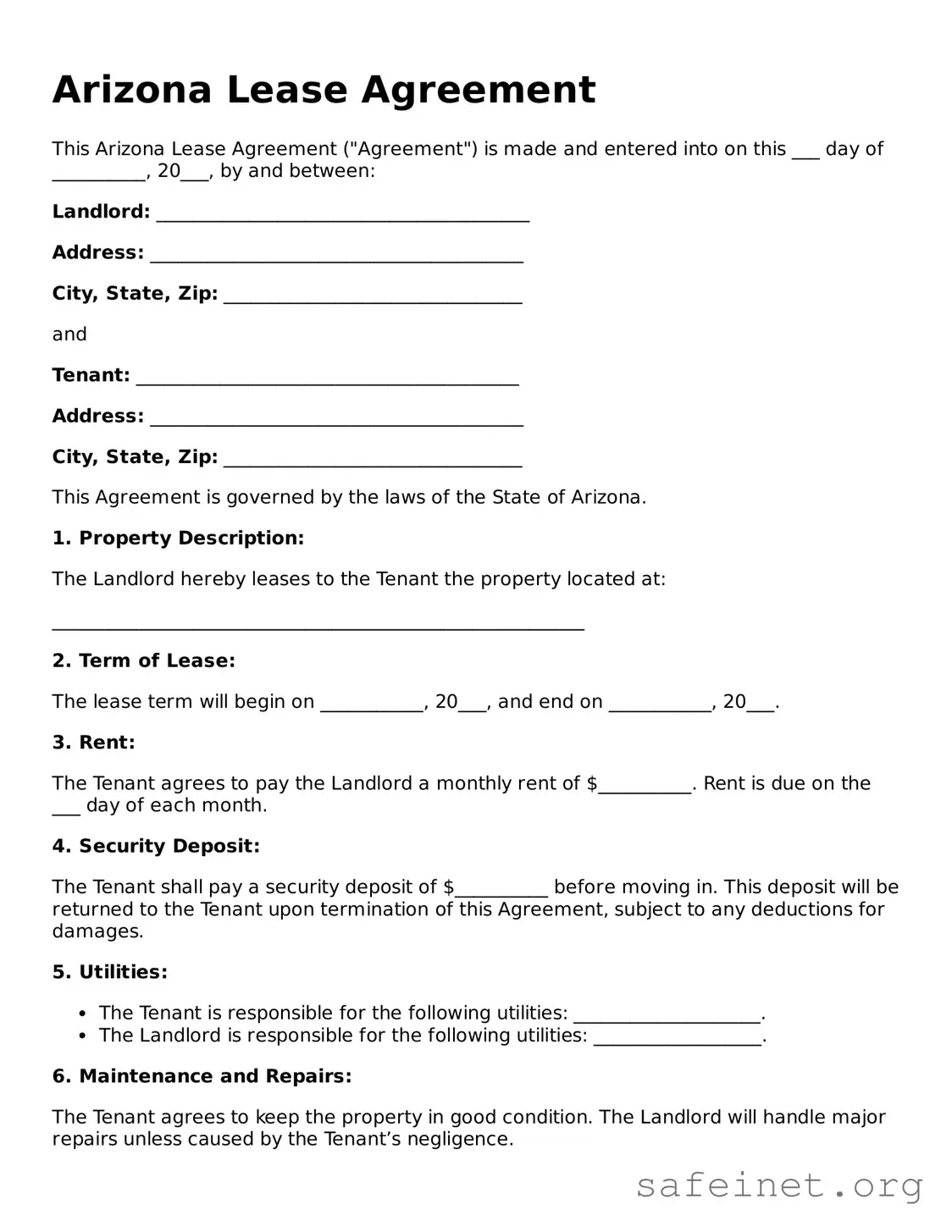
When entering into a rental agreement in Arizona, understanding the Arizona Lease Agreement form is essential for both landlords and tenants. This document outlines the rights and responsibilities of each party, helping to ensure a smooth and clear rental experience. Key components of the lease include details about the property, the duration of the lease, and the amount of rent due. It also specifies the security deposit requirements, maintenance responsibilities, and rules regarding pets. Additionally, the form addresses termination conditions and the process for renewing the lease. By familiarizing yourself with these aspects, you can navigate the leasing process with confidence and clarity.
Arizona Lease Agreement
This Arizona Lease Agreement ("Agreement") is made and entered into on this ___ day of __________, 20___, by and between:
Landlord: ________________________________________
Address: ________________________________________
City, State, Zip: ________________________________
and
Tenant: _________________________________________
Address: ________________________________________
City, State, Zip: ________________________________
This Agreement is governed by the laws of the State of Arizona.
1. Property Description:
The Landlord hereby leases to the Tenant the property located at:
_________________________________________________________
2. Term of Lease:
The lease term will begin on ___________, 20___, and end on ___________, 20___.
3. Rent:
The Tenant agrees to pay the Landlord a monthly rent of $__________. Rent is due on the ___ day of each month.
4. Security Deposit:
The Tenant shall pay a security deposit of $__________ before moving in. This deposit will be returned to the Tenant upon termination of this Agreement, subject to any deductions for damages.
5. Utilities:
6. Maintenance and Repairs:
The Tenant agrees to keep the property in good condition. The Landlord will handle major repairs unless caused by the Tenant’s negligence.
7. Termination:
Either party may terminate this Agreement by providing a written notice of ___ days before the end of the lease term.
8. Governing Law:
This Agreement shall be governed by and construed in accordance with the laws of the State of Arizona.
IN WITNESS WHEREOF, the parties hereto have executed this Lease Agreement as of the day and year first above written.
Landlord Signature: ___________________________
Date: ________________
Tenant Signature: ____________________________
Date: ________________
| Fact Name | Details |
|---|---|
| Governing Law | Arizona Revised Statutes, Title 33 - Property |
| Parties Involved | The lease agreement involves a landlord and a tenant. |
| Lease Duration | Leases can be for a fixed term or month-to-month. |
| Security Deposit | The maximum security deposit is one and a half months' rent. |
| Rent Payment | Rent is typically due on the first day of each month. |
| Notice Requirements | Landlords must provide a 30-day notice for lease termination. |
| Maintenance Responsibilities | Landlords are responsible for maintaining habitable premises. |
| Dispute Resolution | Disputes may be resolved through mediation or court action. |
Filling out the Arizona Lease Agreement form is an important step in establishing a rental arrangement. This document outlines the terms and conditions between the landlord and tenant, ensuring that both parties understand their rights and responsibilities. Follow these steps to complete the form accurately.
Once the form is completed, ensure that both parties retain a copy for their records. This will help avoid misunderstandings in the future and provide a clear reference to the agreed-upon terms.
What is an Arizona Lease Agreement form?
An Arizona Lease Agreement form is a legal document that outlines the terms and conditions between a landlord and a tenant for renting residential or commercial property in Arizona. This form details the rights and responsibilities of both parties, including rent amount, lease duration, and maintenance obligations.
What should be included in the Lease Agreement?
The Lease Agreement should include the names of the landlord and tenant, property address, lease term, rental amount, payment due dates, security deposit details, and any rules or restrictions regarding the property. It’s also important to include provisions for repairs, maintenance, and termination of the lease.
How long does a typical lease last in Arizona?
In Arizona, lease agreements can vary in duration. Most residential leases are typically for one year, but they can also be month-to-month or for a shorter term, depending on the agreement between the landlord and tenant. Always ensure that the lease duration is clearly stated in the agreement.
Is a security deposit required in Arizona?
Yes, landlords in Arizona often require a security deposit. This deposit serves as protection against potential damages or unpaid rent. The law limits the amount a landlord can charge for a security deposit, which is typically equal to one and a half times the monthly rent for residential properties.
Can a lease be terminated early in Arizona?
Yes, a lease can be terminated early, but it usually requires mutual consent from both the landlord and tenant. If one party wishes to break the lease, they may need to provide notice and possibly pay a fee, depending on the terms outlined in the lease agreement.
What happens if a tenant does not pay rent?
If a tenant fails to pay rent, the landlord has the right to issue a notice to pay or quit, which gives the tenant a specific time to pay the overdue rent or vacate the property. If the tenant does not comply, the landlord may initiate eviction proceedings in accordance with Arizona law.
Are there any specific laws governing lease agreements in Arizona?
Yes, Arizona has specific laws that govern lease agreements, including the Arizona Residential Landlord and Tenant Act. This law outlines the rights and responsibilities of both landlords and tenants, ensuring fair treatment and clear guidelines for rental agreements.
Can lease agreements be modified?
Lease agreements can be modified, but any changes must be agreed upon by both the landlord and tenant. It’s important to document any modifications in writing and have both parties sign the updated agreement to ensure clarity and avoid disputes.
Incomplete Information: Many individuals fail to provide all required information. This includes not listing all tenants or omitting contact details. Each tenant's full name and contact information should be clearly stated to avoid confusion.
Incorrect Dates: Entering the wrong lease start and end dates is a common mistake. Ensure that the dates are accurate to prevent disputes regarding the lease term.
Neglecting Signatures: Some people overlook the necessity of signatures. All parties involved must sign the lease agreement. Without signatures, the document may not be legally binding.
Failure to Review Terms: Not reading the terms and conditions thoroughly can lead to misunderstandings. It is crucial to understand the obligations and rights outlined in the agreement.
When entering into a rental agreement in Arizona, several additional documents may be necessary to ensure clarity and compliance. These documents help define the terms of the lease and protect the rights of both the landlord and tenant.
Using these documents in conjunction with the Arizona Lease Agreement helps create a clear framework for the rental relationship. Each document serves a specific purpose, fostering transparency and understanding between landlords and tenants.
The Arizona Rental Application is a document that property owners use to screen potential tenants. Similar to the Lease Agreement, it collects essential information about the applicant, such as employment history, rental history, and personal references. This application serves as a preliminary step before entering into a lease, allowing landlords to assess whether a prospective tenant is a good fit for their property. Both documents aim to establish a clear understanding between the landlord and tenant, ensuring that the rental process is smooth and informed.
The Arizona Security Deposit Receipt is another important document in the rental process. It is closely related to the Lease Agreement as it outlines the amount of security deposit collected from the tenant and the conditions under which it may be retained or returned. Just as the Lease Agreement lays out the terms of occupancy, this receipt provides a formal acknowledgment of the deposit, protecting both parties by ensuring transparency regarding financial transactions related to the rental property.
The Arizona Move-In Checklist complements the Lease Agreement by documenting the condition of the rental unit at the time of move-in. This checklist allows both the landlord and tenant to agree on the state of the property before occupancy begins. By detailing any existing damages or issues, it helps prevent disputes over security deposits when the tenant eventually moves out, making it an essential tool for maintaining clarity and accountability in the landlord-tenant relationship.
The Arizona Notice to Quit serves as a formal communication from the landlord to the tenant, indicating the need to vacate the premises. While the Lease Agreement outlines the terms of tenancy, the Notice to Quit is a critical document that may be issued in response to a lease violation or failure to pay rent. This notice is essential for landlords to initiate the eviction process, ensuring that tenants are informed of their obligations and the consequences of non-compliance.
The Arizona Lease Renewal Agreement is a document that allows both parties to extend the terms of the original Lease Agreement. This renewal form is similar in nature to the original lease, as it reiterates the conditions of tenancy while allowing for any necessary adjustments. It provides a structured way for landlords and tenants to continue their relationship without interruption, maintaining the continuity of the rental arrangement while ensuring that both parties are on the same page regarding expectations.
The Arizona Sublease Agreement is a variation of the Lease Agreement that allows a tenant to rent out their leased space to another individual, known as the subtenant. This document is similar in that it outlines the terms of occupancy, responsibilities, and rights of the subtenant, mirroring the original lease's structure. It is important for tenants who wish to temporarily vacate their rental unit while still retaining their lease obligations, thus offering flexibility within the framework of the original agreement.
The Arizona Rent Receipt is a straightforward document that landlords provide to tenants upon receiving rent payments. While the Lease Agreement establishes the payment terms, the Rent Receipt serves as proof of payment. This document is vital for record-keeping purposes for both parties, ensuring that financial transactions are documented and acknowledged, which can be useful in case of disputes or for tax purposes.
The Arizona Tenant's Rights and Responsibilities document outlines the legal rights and obligations of tenants living in Arizona. This document complements the Lease Agreement by providing tenants with a comprehensive overview of their rights, such as the right to a habitable living environment and protection against unlawful eviction. Understanding these rights is crucial for tenants, as it empowers them to advocate for themselves and ensures that they are aware of the legal framework governing their tenancy.
The Arizona Eviction Notice is a critical document that landlords may issue to inform tenants of their failure to comply with lease terms. This notice, similar to the Lease Agreement, serves to communicate specific issues, such as non-payment of rent or lease violations. It is a necessary step in the eviction process, allowing landlords to formally notify tenants of their obligations and the potential consequences of failing to rectify the situation.
When filling out the Arizona Lease Agreement form, it is important to be careful and thorough. Here are some guidelines to help you navigate the process.
Understanding lease agreements can be challenging, and misconceptions often arise. Below is a list of common misunderstandings regarding the Arizona Lease Agreement form, along with explanations to clarify each point.
This is not true. In Arizona, a lease agreement does not need to be notarized to be valid. However, having a notary can provide additional assurance of the parties' identities.
Every lease agreement can differ significantly based on the specific terms negotiated between the landlord and tenant. It is essential to read and understand the unique terms of each lease.
While verbal agreements can be legally binding, they are difficult to enforce. A written lease agreement provides clear documentation of the terms and conditions agreed upon.
This misconception is misleading. In Arizona, security deposits can be refundable, provided that the tenant meets the conditions outlined in the lease agreement and returns the property in good condition.
Landlords must provide reasonable notice before entering a rental property, typically 48 hours, unless there is an emergency. This protects the tenant's right to privacy.
Lease agreements can be for any duration, including month-to-month or multi-year terms. The length of the lease is negotiable between the landlord and tenant.
While tenants generally need permission from the landlord to make changes, some lease agreements may allow for minor alterations. Always check the lease for specific terms regarding modifications.
Late fees must be explicitly stated in the lease agreement. If not mentioned, landlords may not charge a late fee, even if rent is paid late.
This is not always the case. The lease agreement should specify which utilities are included and which are the tenant's responsibility. Always clarify this before signing.
While a lease is a binding contract, amendments can be made if both parties agree. It is important to document any changes in writing to avoid future disputes.
By addressing these misconceptions, individuals can better navigate the leasing process and ensure they are fully informed about their rights and responsibilities under the Arizona Lease Agreement form.
Filling out and using the Arizona Lease Agreement form requires attention to detail and understanding of the terms involved. Here are some key takeaways to consider:
By following these guidelines, both landlords and tenants can create a clear and effective lease agreement that protects their rights and responsibilities.