Creating a Last Will and Testament is an essential step for anyone looking to ensure their wishes are honored after their passing. In Arizona, this legal document serves as a roadmap for distributing your assets, appointing guardians for minor children, and designating an executor to manage your estate. The Arizona Last Will and Testament form allows individuals to express their final wishes clearly and legally, providing peace of mind to both the testator and their loved ones. Key components of this form include the identification of beneficiaries, the specification of property distribution, and the inclusion of any specific bequests. Additionally, the form must meet certain requirements, such as being signed in the presence of witnesses, to ensure its validity. Understanding these aspects can help simplify the process and ensure that your intentions are respected, making it crucial for Arizona residents to familiarize themselves with this important legal tool.
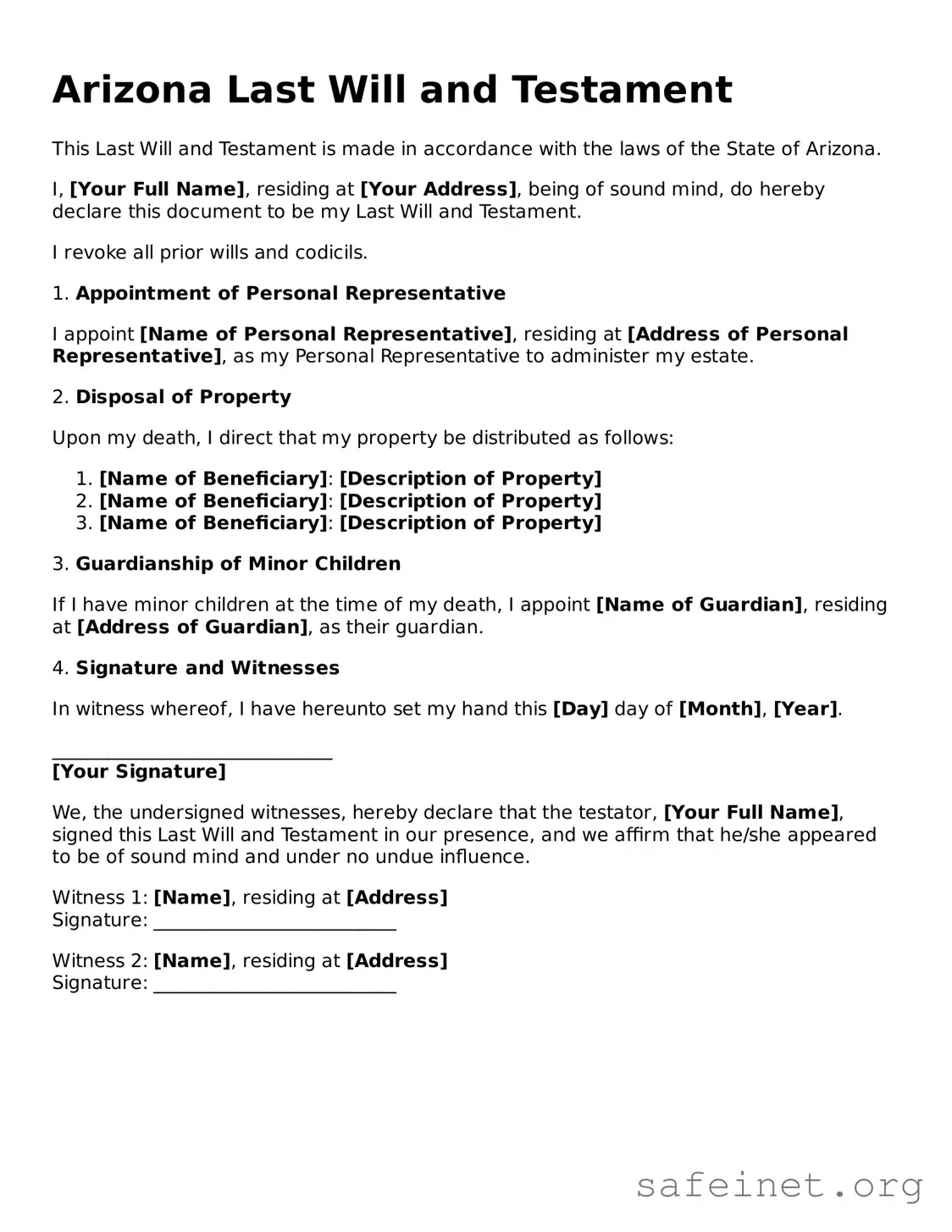
Arizona Last Will and Testament
This Last Will and Testament is made in accordance with the laws of the State of Arizona.
I, [Your Full Name], residing at [Your Address], being of sound mind, do hereby declare this document to be my Last Will and Testament.
I revoke all prior wills and codicils.
1. Appointment of Personal Representative
I appoint [Name of Personal Representative], residing at [Address of Personal Representative], as my Personal Representative to administer my estate.
2. Disposal of Property
Upon my death, I direct that my property be distributed as follows:
3. Guardianship of Minor Children
If I have minor children at the time of my death, I appoint [Name of Guardian], residing at [Address of Guardian], as their guardian.
4. Signature and Witnesses
In witness whereof, I have hereunto set my hand this [Day] day of [Month], [Year].
______________________________
[Your Signature]
We, the undersigned witnesses, hereby declare that the testator, [Your Full Name], signed this Last Will and Testament in our presence, and we affirm that he/she appeared to be of sound mind and under no undue influence.
Witness 1: [Name], residing at [Address]
Signature: __________________________
Witness 2: [Name], residing at [Address]
Signature: __________________________
| Fact Name | Detail |
|---|---|
| Governing Law | The Arizona Last Will and Testament is governed by Arizona Revised Statutes Title 14, Chapter 2. |
| Minimum Age | Individuals must be at least 18 years old to create a valid will in Arizona. |
| Signature Requirement | The testator must sign the will, or someone else may sign on their behalf in their presence. |
| Witnesses | At least two witnesses are required to sign the will for it to be valid. |
| Holographic Wills | Arizona recognizes holographic wills, which are handwritten and do not require witnesses if signed by the testator. |
| Revocation | A will can be revoked by creating a new will or by destroying the existing will with the intent to revoke. |
| Self-Proving Wills | A self-proving will includes a notarized affidavit from the witnesses, simplifying the probate process. |
| Probate Process | After death, the will must be filed with the probate court to initiate the distribution of the estate. |
Once you have the Arizona Last Will and Testament form in hand, you’re ready to start filling it out. This form allows you to express your wishes regarding your assets and beneficiaries. Follow these steps to ensure that you complete the document correctly.
After completing the form, keep it in a safe place. Inform your executor and trusted family members about its location. Regularly review and update your will as necessary to reflect any changes in your life circumstances.
What is a Last Will and Testament in Arizona?
A Last Will and Testament is a legal document that outlines how a person's assets and property should be distributed after their death. In Arizona, this document allows individuals to specify their wishes regarding the distribution of their estate, appoint guardians for minor children, and designate an executor to manage the estate. It ensures that a person's intentions are honored and provides clarity to family members during a difficult time.
Who can create a Last Will and Testament in Arizona?
Any individual who is at least 18 years old and of sound mind can create a Last Will and Testament in Arizona. It is important that the person understands the nature of their assets and the implications of their decisions. This document can be created by residents of Arizona or individuals who own property in the state, regardless of their primary residence.
What are the requirements for a valid Last Will and Testament in Arizona?
For a Last Will and Testament to be valid in Arizona, it must be in writing and signed by the person making the will (the testator). Additionally, it must be witnessed by at least two individuals who are present at the same time. These witnesses must also sign the will, affirming that they witnessed the testator's signature. There are specific rules regarding holographic wills (handwritten wills) in Arizona, which may not require witnesses but must be signed by the testator.
Can I change or revoke my Last Will and Testament in Arizona?
Yes, you can change or revoke your Last Will and Testament in Arizona at any time, as long as you are of sound mind. To make changes, you can create a new will that explicitly revokes the previous one, or you can add a codicil, which is an amendment to the existing will. If you wish to revoke the will entirely, you can do so by destroying it or by stating your intention to revoke it in writing.
What happens if I die without a Last Will and Testament in Arizona?
If you pass away without a Last Will and Testament in Arizona, your estate will be distributed according to the state's intestacy laws. This means that your assets will be divided among your surviving relatives, which may not align with your wishes. The process can also lead to complications, delays, and potential disputes among family members. To ensure that your assets are distributed according to your desires, it is advisable to have a valid will in place.
Not Clearly Identifying the Testator: One common mistake individuals make is failing to clearly state their name and address at the beginning of the will. This information is crucial for establishing the identity of the person making the will, known as the testator.
Omitting Witness Signatures: In Arizona, a valid will must be signed by at least two witnesses. Many people forget this step, which can lead to complications during the probate process. Without the required signatures, the will may be deemed invalid.
Neglecting to Update the Will: Life changes such as marriage, divorce, or the birth of a child necessitate updates to the will. Failing to revise the document can result in outdated provisions that do not reflect the testator's current wishes.
Being Vague About Bequests: It is essential to be specific when detailing gifts or bequests. Ambiguities can lead to disputes among heirs. Clearly describing each item and the intended recipient helps prevent confusion and potential conflict.
Not Including a Residual Clause: A residual clause addresses any assets not specifically mentioned in the will. Omitting this clause can lead to unintended consequences, such as those assets being distributed according to state law rather than the testator's wishes.
When preparing a Last Will and Testament in Arizona, several other documents may be necessary to ensure that your wishes are carried out effectively. Each of these documents serves a specific purpose and can help clarify your intentions regarding your estate and personal affairs. Below is a list of commonly used forms that complement the Last Will and Testament.
By considering these additional documents, you can create a more comprehensive plan for your estate. Each form plays a crucial role in ensuring that your wishes are honored and that your loved ones are taken care of. Take the time to assess which documents best suit your needs and consult with a professional if necessary to ensure everything is in order.
The Arizona Living Will is a document that outlines an individual's wishes regarding medical treatment in the event they become unable to communicate. Like a Last Will and Testament, it serves to express personal preferences, but it focuses specifically on healthcare decisions rather than the distribution of assets. Both documents require clear language and must be signed and witnessed to ensure they are legally binding. This ensures that a person’s wishes are respected during critical moments when they cannot voice them themselves.
The Arizona Durable Power of Attorney is another important document that shares similarities with a Last Will and Testament. This document allows an individual to designate someone else to make financial or legal decisions on their behalf if they become incapacitated. While a will takes effect after death, a durable power of attorney is effective during the individual's lifetime. Both documents require careful consideration of who is entrusted with these responsibilities, emphasizing the importance of choosing someone who understands the individual’s wishes and values.
The Arizona Healthcare Power of Attorney is also akin to a Last Will and Testament in that it designates someone to make medical decisions for an individual if they are unable to do so. This document specifically addresses health-related matters, ensuring that the appointed agent can make informed choices about treatment options. Like a will, it reflects personal values and preferences, and it must be executed according to state laws to be valid. Both documents are essential for ensuring that an individual’s choices are honored when they cannot advocate for themselves.
When filling out the Arizona Last Will and Testament form, it's important to follow certain guidelines to ensure your wishes are clearly expressed and legally valid. Here’s a list of things you should and shouldn't do:
Following these guidelines can help ensure that your will is effective and reflects your wishes accurately.
Understanding the nuances of a Last Will and Testament in Arizona can be challenging. Here are some common misconceptions that people often have:
Addressing these misconceptions can help individuals make informed decisions about their estate planning in Arizona.
Filling out and using the Arizona Last Will and Testament form is a crucial step in ensuring that your wishes are honored after your passing. Here are some key takeaways to consider:
These considerations will help ensure that your Last Will and Testament accurately reflects your wishes and provides for your loved ones in the future.