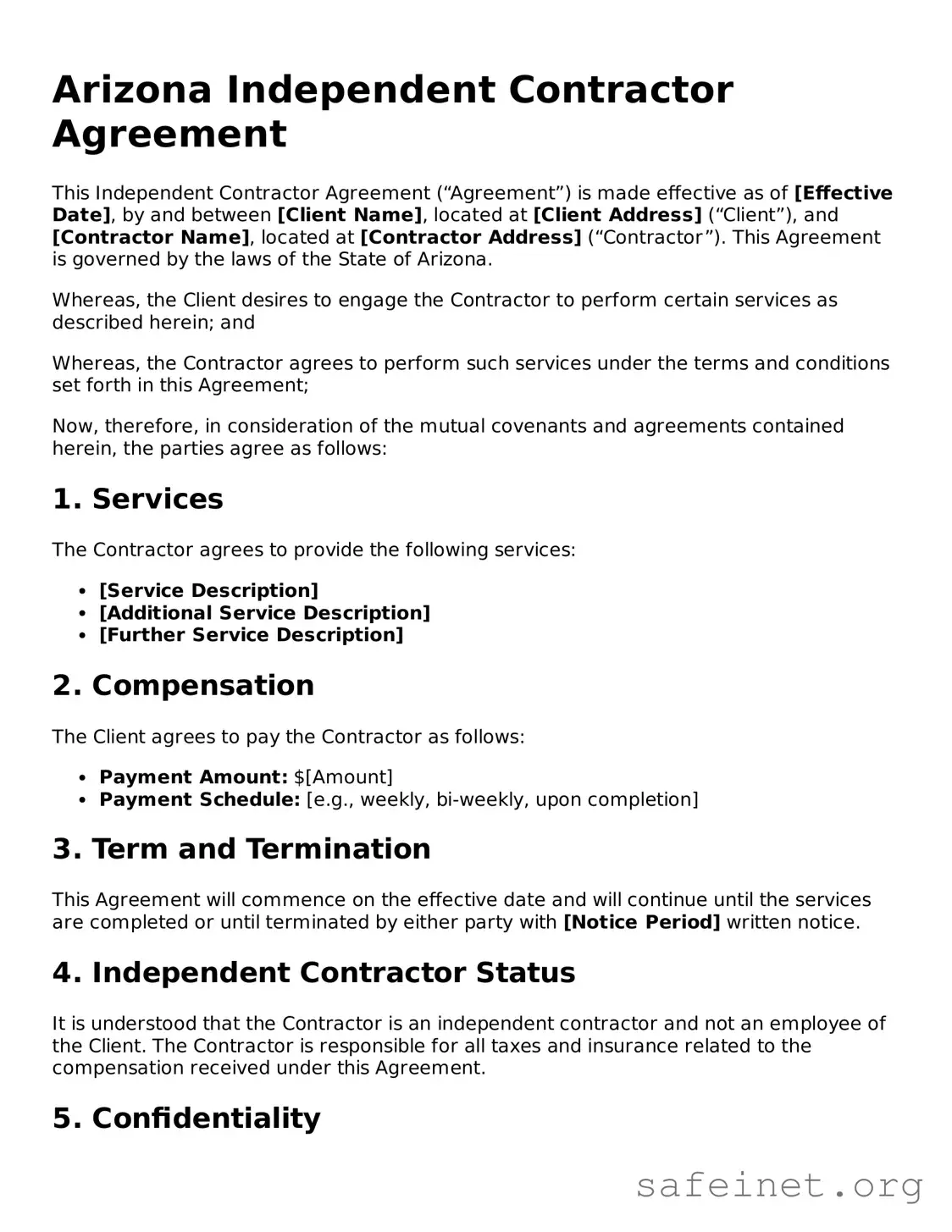
In Arizona, the Independent Contractor Agreement form serves as a crucial document for establishing the terms of a working relationship between a business and an independent contractor. This form outlines key elements such as the scope of work, payment terms, and duration of the contract. It also specifies the responsibilities and rights of both parties, ensuring clarity and mutual understanding. Additionally, the agreement addresses issues related to confidentiality, intellectual property, and termination conditions. By clearly defining these aspects, the form helps to prevent misunderstandings and disputes that may arise during the course of the contract. It is essential for both businesses and contractors to understand the importance of this agreement, as it lays the foundation for a professional and legally compliant working relationship.
Arizona Independent Contractor Agreement
This Independent Contractor Agreement (“Agreement”) is made effective as of [Effective Date], by and between [Client Name], located at [Client Address] (“Client”), and [Contractor Name], located at [Contractor Address] (“Contractor”). This Agreement is governed by the laws of the State of Arizona.
Whereas, the Client desires to engage the Contractor to perform certain services as described herein; and
Whereas, the Contractor agrees to perform such services under the terms and conditions set forth in this Agreement;
Now, therefore, in consideration of the mutual covenants and agreements contained herein, the parties agree as follows:
1. Services
The Contractor agrees to provide the following services:
2. Compensation
The Client agrees to pay the Contractor as follows:
3. Term and Termination
This Agreement will commence on the effective date and will continue until the services are completed or until terminated by either party with [Notice Period] written notice.
4. Independent Contractor Status
It is understood that the Contractor is an independent contractor and not an employee of the Client. The Contractor is responsible for all taxes and insurance related to the compensation received under this Agreement.
5. Confidentiality
The Contractor agrees to keep all proprietary information and trade secrets of the Client confidential. This obligation will continue even after the termination of this Agreement.
6. Governing Law
This Agreement shall be governed by and construed in accordance with the laws of the State of Arizona.
7. Entire Agreement
This Agreement constitutes the entire understanding between the parties regarding the subject matter hereof and supersedes all prior discussions, agreements, or understandings.
IN WITNESS WHEREOF, the parties hereto have executed this Independent Contractor Agreement as of the date first above written.
Client Signature: ___________________________ Date: _______________
Contractor Signature: _______________________ Date: _______________
| Fact Name | Description |
|---|---|
| Definition | The Arizona Independent Contractor Agreement outlines the terms and conditions between a business and an independent contractor. |
| Purpose | This agreement clarifies the relationship, ensuring both parties understand their rights and responsibilities. |
| Governing Law | The agreement is governed by the laws of the State of Arizona. |
| Payment Terms | It typically specifies payment details, including rates, payment schedules, and any applicable expenses. |
| Duration | The contract may outline the duration of the agreement, whether it is for a specific project or an ongoing arrangement. |
| Termination Clause | A termination clause is often included, detailing how either party can end the agreement. |
| Liability and Insurance | The agreement may address liability issues and whether the contractor must carry insurance. |
Filling out the Arizona Independent Contractor Agreement form is straightforward. This form outlines the terms of the working relationship between a contractor and a client. Follow these steps carefully to ensure all necessary information is included.
What is an Arizona Independent Contractor Agreement?
An Arizona Independent Contractor Agreement is a legal document that outlines the terms and conditions between a business and an independent contractor. This agreement specifies the nature of the work, payment terms, and the responsibilities of both parties. It serves to clarify the relationship and protect the interests of both the contractor and the hiring entity.
Who needs an Independent Contractor Agreement in Arizona?
Any business or individual hiring an independent contractor in Arizona should consider using this agreement. It is particularly important for freelancers, consultants, and service providers who will be working on a project basis. Having a formal agreement helps prevent misunderstandings and establishes clear expectations.
What are the key components of the agreement?
The key components typically include the scope of work, payment terms, duration of the agreement, confidentiality clauses, and termination conditions. Additionally, it may address intellectual property rights and any other specific requirements related to the project.
Is the Independent Contractor Agreement legally binding?
Yes, once both parties sign the agreement, it becomes legally binding. This means that both the business and the contractor are obligated to adhere to the terms laid out in the document. However, it is essential that the agreement complies with Arizona laws to ensure enforceability.
Can the agreement be modified after it is signed?
Yes, the agreement can be modified after it is signed, but any changes must be documented in writing and agreed upon by both parties. This helps maintain clarity and ensures that both parties are aware of any adjustments to the terms.
What happens if a dispute arises?
If a dispute arises, the agreement may outline specific procedures for resolution. This can include mediation or arbitration clauses. If the agreement does not specify a resolution process, the parties may need to seek legal advice or pursue litigation, depending on the situation.
Are there any tax implications for independent contractors?
Yes, independent contractors are responsible for their own taxes. Unlike employees, contractors do not have taxes withheld from their paychecks. They must report their income and pay self-employment taxes. It's advisable for contractors to consult with a tax professional to understand their obligations.
How long does the agreement last?
The duration of the agreement can vary based on the project and the terms set by both parties. Some agreements are for a specific project, while others may be ongoing until terminated by either party. It’s important to clearly define the duration in the agreement.
What should I do if I need to terminate the agreement?
If termination is necessary, the agreement should outline the process for doing so. This may include providing written notice within a specific timeframe. Following the agreed-upon procedure helps ensure a smooth termination and minimizes potential conflicts.
Where can I find a template for the Arizona Independent Contractor Agreement?
Templates for the Arizona Independent Contractor Agreement can often be found online through legal websites or document services. However, it is crucial to ensure that any template used complies with Arizona laws and is tailored to the specific needs of the parties involved.
Incomplete Information: Many individuals fail to fill out all required fields. This includes missing names, addresses, or contact information. Leaving any section blank can delay the processing of the agreement.
Incorrect Dates: Entering the wrong start or end dates for the contract can lead to confusion about the duration of the agreement. Double-checking these dates ensures clarity for both parties.
Misunderstanding Independent Contractor Status: Some people mistakenly classify themselves or others as independent contractors when they do not meet the criteria. Understanding the definition and implications of this status is crucial.
Failure to Specify Payment Terms: Not clearly outlining payment terms, such as rates and due dates, can lead to disputes later. It’s important to detail how and when payments will be made.
Omitting Signatures: Some individuals forget to sign the agreement or have the other party sign. Without signatures, the agreement is not legally binding. Ensure both parties sign and date the document.
When working with independent contractors in Arizona, several forms and documents can complement the Independent Contractor Agreement. These documents help clarify roles, protect both parties, and ensure compliance with regulations. Below is a list of commonly used forms that can be beneficial in these situations.
Using these documents alongside the Arizona Independent Contractor Agreement can help ensure a smooth working relationship. They provide clarity, protect both parties, and help manage expectations throughout the contract period.
The Arizona Independent Contractor Agreement shares similarities with the Employment Agreement. Both documents outline the terms of a working relationship, detailing the responsibilities and expectations of the parties involved. However, while an Employment Agreement typically establishes an employer-employee relationship with benefits and job security, the Independent Contractor Agreement emphasizes a contractor's autonomy and the lack of benefits. This distinction is crucial, as it defines how taxes are handled and the level of control each party has over the work performed.
Another related document is the Non-Disclosure Agreement (NDA). Both agreements aim to protect sensitive information, but they serve different purposes. An NDA focuses on confidentiality, ensuring that proprietary information shared during the working relationship remains secure. In contrast, the Independent Contractor Agreement primarily governs the working relationship itself, including payment terms and project deliverables. Nevertheless, both documents may include clauses that address confidentiality to safeguard business interests.
The Service Agreement is also comparable to the Independent Contractor Agreement. Both documents outline the scope of work to be performed and the compensation structure. However, a Service Agreement can apply to various service providers, including businesses, while the Independent Contractor Agreement specifically pertains to individuals or companies contracted for specific tasks. This distinction helps clarify the nature of the relationship and the expectations of both parties.
Lastly, the Consulting Agreement bears resemblance to the Independent Contractor Agreement. Both agreements are used when hiring individuals to provide expertise or services on a contractual basis. A Consulting Agreement often includes specific deliverables, timelines, and payment terms, similar to the Independent Contractor Agreement. However, it typically emphasizes the consultant's role as an expert providing advice or strategic direction, whereas the Independent Contractor Agreement may cover a broader range of tasks. This nuance helps define the level of involvement and the nature of the work being performed.
When filling out the Arizona Independent Contractor Agreement form, it is essential to follow certain guidelines to ensure accuracy and compliance. Here is a list of things you should and shouldn't do:
Following these guidelines can help prevent misunderstandings and ensure that the agreement is valid and enforceable.
When considering an Arizona Independent Contractor Agreement, it's essential to understand the common misconceptions that can lead to confusion. Below are four prevalent misunderstandings about this important document.
Many people believe that only large companies need an Independent Contractor Agreement. In reality, any business or individual hiring a contractor, regardless of size, should have a written agreement to clarify the terms of the working relationship.
Some assume that a verbal agreement is enough to establish a working relationship. However, without a written contract, misunderstandings can easily arise. A written agreement provides clear documentation of the terms and expectations, which can protect both parties.
It is a common belief that independent contractors do not receive any benefits. While it is true that they typically do not receive employee benefits, they may negotiate certain perks, such as flexible hours or project bonuses, within the agreement.
Many confuse an Independent Contractor Agreement with an employment contract. These documents serve different purposes. An Independent Contractor Agreement outlines the terms of a contractor's work, while an employment contract includes terms related to an employee's job, benefits, and obligations.
When filling out and using the Arizona Independent Contractor Agreement form, keep the following key takeaways in mind:
These points will help ensure a smooth process when using the Arizona Independent Contractor Agreement form.