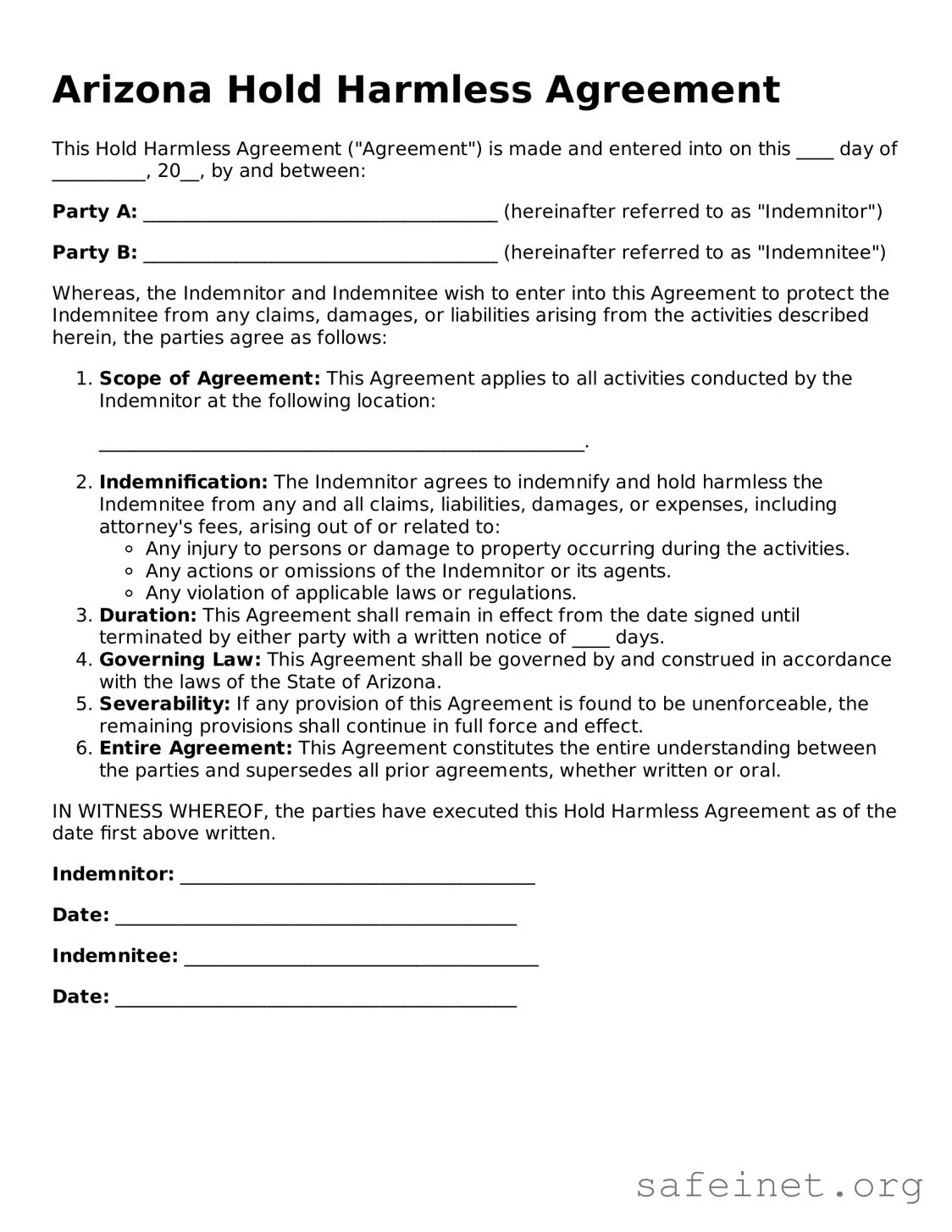
The Arizona Hold Harmless Agreement form serves as a vital tool for individuals and organizations looking to mitigate liability risks associated with various activities. This form establishes a clear understanding between parties, typically outlining that one party agrees to assume the risk of certain liabilities while protecting the other from legal claims. It is commonly used in contexts such as recreational activities, construction projects, and events where potential injuries or damages may occur. By signing this agreement, participants acknowledge the inherent risks involved and waive their right to hold the other party accountable for accidents or injuries that may arise. The document often includes specific details about the activities covered, the duration of the agreement, and any limitations on liability. Ultimately, the Hold Harmless Agreement is designed to foster transparency and trust, allowing parties to engage in activities with a clearer understanding of their responsibilities and risks.
Arizona Hold Harmless Agreement
This Hold Harmless Agreement ("Agreement") is made and entered into on this ____ day of __________, 20__, by and between:
Party A: ______________________________________ (hereinafter referred to as "Indemnitor")
Party B: ______________________________________ (hereinafter referred to as "Indemnitee")
Whereas, the Indemnitor and Indemnitee wish to enter into this Agreement to protect the Indemnitee from any claims, damages, or liabilities arising from the activities described herein, the parties agree as follows:
____________________________________________________.
IN WITNESS WHEREOF, the parties have executed this Hold Harmless Agreement as of the date first above written.
Indemnitor: ______________________________________
Date: ___________________________________________
Indemnitee: ______________________________________
Date: ___________________________________________
| Fact Name | Description |
|---|---|
| Definition | The Arizona Hold Harmless Agreement is a legal document that protects one party from liability for certain actions or events. |
| Purpose | This agreement is often used to mitigate risk in various activities, including events, property use, and services. |
| Governing Law | Arizona state law governs the Hold Harmless Agreement, specifically under Arizona Revised Statutes. |
| Parties Involved | Typically, two parties are involved: the indemnitor (the party assuming the risk) and the indemnitee (the party being protected). |
| Key Components | Essential elements include the scope of indemnification, limitations of liability, and any specific conditions or exclusions. |
| Enforceability | For the agreement to be enforceable, it must be clear, specific, and voluntarily signed by both parties. |
| Common Uses | Commonly used in situations such as rental agreements, sports events, and construction projects. |
| Legal Advice | It is advisable to seek legal counsel before signing or drafting a Hold Harmless Agreement to ensure it meets legal standards. |
Completing the Arizona Hold Harmless Agreement form requires careful attention to detail. After filling out the form, it will be ready for submission to the relevant parties involved in the agreement. Follow these steps to ensure accuracy and completeness.
What is a Hold Harmless Agreement?
A Hold Harmless Agreement is a legal document that protects one party from liability for any injuries or damages that may occur during a specific activity or event. This agreement typically involves two parties: one that agrees to assume the risk and another that seeks protection from claims arising from that risk. In Arizona, these agreements are often used in various contexts, such as events, construction projects, and recreational activities.
Why is a Hold Harmless Agreement important in Arizona?
In Arizona, a Hold Harmless Agreement can provide significant legal protection. It helps clarify the responsibilities and liabilities of each party involved. By signing this agreement, individuals and organizations can minimize their exposure to lawsuits and financial loss. This is particularly important in activities where risks are inherent, such as sports events or construction work.
Who typically needs a Hold Harmless Agreement?
Individuals and organizations that host events, provide services, or engage in activities that carry potential risks often require a Hold Harmless Agreement. This includes event organizers, property owners, contractors, and recreational facilities. Anyone who wants to protect themselves from claims related to injuries or damages should consider using this type of agreement.
What should be included in a Hold Harmless Agreement?
A comprehensive Hold Harmless Agreement should include several key elements. These typically consist of a clear description of the activity or event, the parties involved, and the specific risks being assumed. It should also outline the extent of liability being waived and any limitations or exclusions. Clear language is essential to ensure that all parties understand their rights and responsibilities.
Is a Hold Harmless Agreement enforceable in Arizona?
Yes, Hold Harmless Agreements can be enforceable in Arizona, provided they meet certain legal standards. The agreement must be clear, specific, and voluntarily signed by both parties. However, courts may not enforce these agreements if they are deemed unconscionable or if they attempt to waive liability for gross negligence or willful misconduct.
Can a Hold Harmless Agreement be modified or revoked?
Yes, a Hold Harmless Agreement can be modified or revoked, but this typically requires the consent of all parties involved. Changes should be documented in writing to avoid any misunderstandings. It is advisable to consult with legal counsel before making any modifications to ensure that the agreement remains valid and enforceable.
What happens if someone is injured despite the Hold Harmless Agreement?
If an injury occurs despite the existence of a Hold Harmless Agreement, the injured party may still have the right to pursue a claim, depending on the circumstances. The enforceability of the agreement will be evaluated based on the specific terms and the nature of the incident. If the injury resulted from gross negligence or intentional misconduct, the agreement may not provide protection.
How can I create a Hold Harmless Agreement?
Creating a Hold Harmless Agreement can be straightforward. It is recommended to consult with a legal professional to ensure the agreement complies with Arizona law and adequately protects your interests. Many templates are available online, but customizing the agreement to fit the specific circumstances and risks involved is essential for effective protection.
Incomplete Information: Many individuals forget to fill out all required fields. Missing names, addresses, or dates can lead to the form being rejected.
Not Understanding the Terms: Some people do not fully grasp what they are agreeing to. It’s crucial to read the entire document to understand the implications of the agreement.
Incorrect Signatures: Failing to sign the form correctly can cause issues. Ensure that all parties involved sign where indicated, and check if witnesses are required.
Using Outdated Versions: Using an old version of the Hold Harmless Agreement can lead to problems. Always obtain the most current form to ensure compliance with any recent changes in law.
Not Keeping Copies: After submitting the form, some forget to keep a copy for their records. Having a copy is important for future reference and to prove that the agreement was made.
A Hold Harmless Agreement is a crucial document that protects one party from liability for damages or injuries that may occur during a specific activity or event. In Arizona, this agreement is often used in conjunction with several other forms and documents to ensure comprehensive legal protection. Below is a list of related documents that are commonly associated with the Hold Harmless Agreement.
Using these documents alongside the Hold Harmless Agreement can help mitigate risks and clarify the responsibilities of all parties involved. It is advisable to review each document carefully to ensure they meet specific needs and legal requirements.
The Indemnity Agreement shares a close relationship with the Hold Harmless Agreement. Both documents serve to protect one party from the financial consequences of another party's actions or negligence. In an Indemnity Agreement, one party agrees to compensate the other for any losses or damages that may arise from specific activities or situations. This can often include legal fees, medical expenses, or property damage. The essence of both agreements lies in their mutual goal of risk management, ensuring that one party does not suffer undue financial burden due to the actions of another.
Another document that resembles the Hold Harmless Agreement is the Liability Waiver. Typically used in recreational activities, a Liability Waiver allows participants to acknowledge the risks involved and agree not to hold the organization or individual responsible for injuries or damages. While both documents aim to limit liability, a Liability Waiver is often signed before participation in an event, whereas a Hold Harmless Agreement may be used in various contexts, including contracts for services or property use. The focus remains on protecting one party from claims arising from the other’s actions.
The Release of Liability form also bears similarities to the Hold Harmless Agreement. This document is commonly utilized when an individual agrees to relinquish their right to pursue legal action against another party. By signing a Release of Liability, individuals acknowledge the risks involved in a particular activity and agree not to hold the other party responsible for any resulting injuries or damages. Both documents emphasize the importance of understanding risks and accepting responsibility, although the Release of Liability often serves as a more formal acknowledgment of those risks.
The Consent to Treat form, often used in medical settings, shares a conceptual link with the Hold Harmless Agreement. In this case, a patient gives permission for medical treatment while acknowledging potential risks involved. By signing this document, the patient typically agrees not to hold the healthcare provider liable for any adverse outcomes that may occur. While the focus is on medical treatment rather than general liability, both documents aim to clarify responsibilities and protect one party from claims arising from the other’s choices.
Lastly, the Service Agreement can be seen as a document that parallels the Hold Harmless Agreement. A Service Agreement outlines the terms and conditions under which services will be provided, often including clauses that limit liability for one party. These clauses may stipulate that the service provider is not responsible for certain types of damages or losses. Like the Hold Harmless Agreement, the Service Agreement aims to establish clear boundaries regarding liability and responsibilities, helping to prevent disputes between the involved parties.
When filling out the Arizona Hold Harmless Agreement form, it is important to follow certain guidelines to ensure accuracy and compliance. Below is a list of things to do and things to avoid.
Things to Do:
Things to Avoid:
When it comes to the Arizona Hold Harmless Agreement form, there are several misconceptions that people often have. Understanding these can help you navigate the legal landscape more effectively.
This is not true. A Hold Harmless Agreement can protect both parties involved in a transaction or activity. It outlines the responsibilities and liabilities of each party, ensuring that both sides are aware of their obligations.
Many believe that signing this agreement means that one party is completely free from any liability. However, this is not the case. While it can limit liability in certain situations, it does not absolve a party from all legal responsibilities, especially in cases of gross negligence or willful misconduct.
Some people think that Hold Harmless Agreements are only relevant for activities like extreme sports or construction work. In reality, these agreements can be beneficial in a variety of situations, including rental agreements, events, and even simple social gatherings.
There is a belief that Hold Harmless Agreements lack legal weight. In Arizona, however, these agreements can be enforceable if they are properly drafted and meet legal standards. It's important to ensure that the language used is clear and that both parties fully understand the terms.
When considering the Arizona Hold Harmless Agreement form, it is important to understand its purpose and implications. This document serves as a tool to protect one party from liability for certain actions or events. Here are some key takeaways to keep in mind:
Understanding these key points can help individuals and businesses effectively use the Arizona Hold Harmless Agreement form to manage risk and liability.