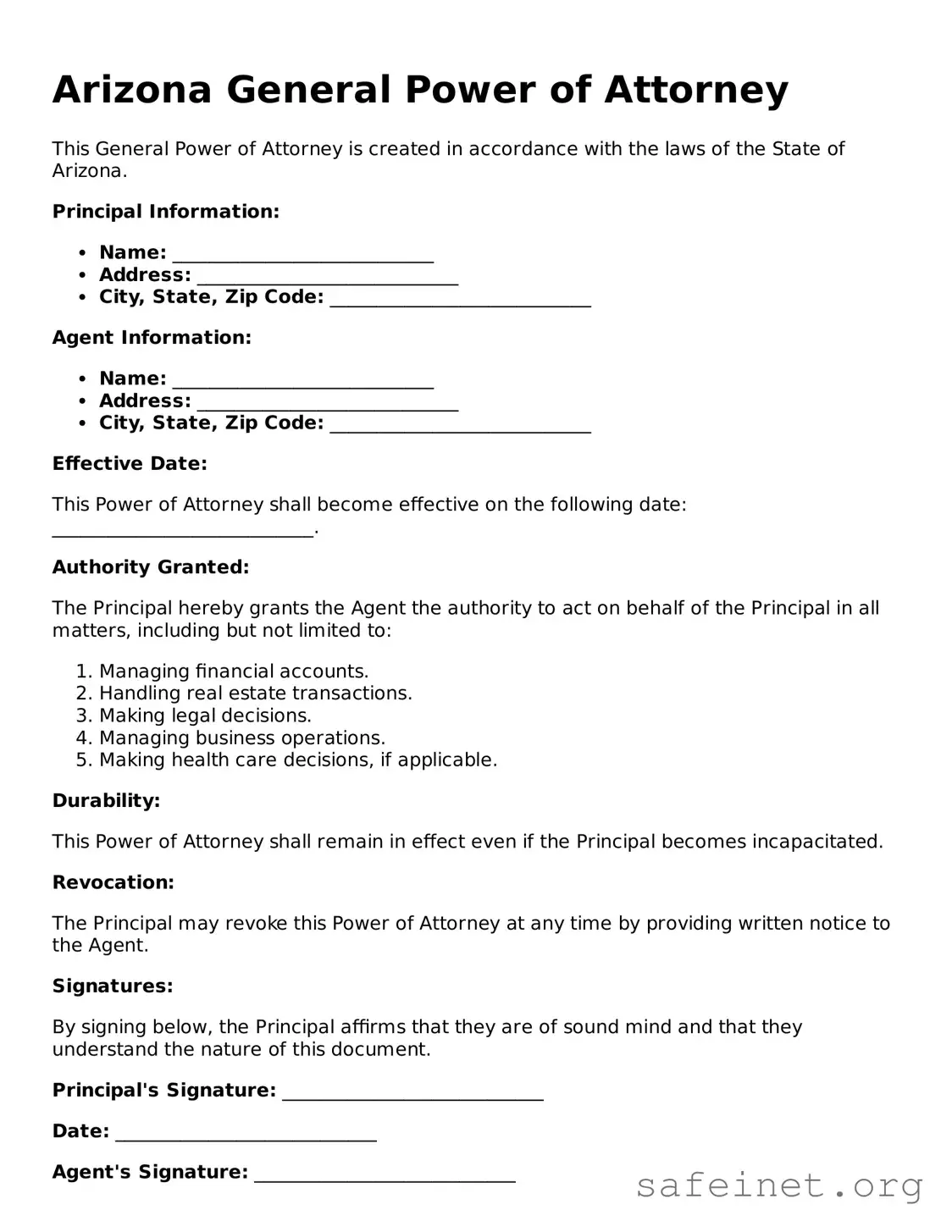
The Arizona General Power of Attorney form serves as a crucial legal document that allows individuals to designate another person to act on their behalf in a variety of financial and legal matters. This form can empower an agent to manage tasks such as handling bank transactions, signing contracts, and making investment decisions. Importantly, the authority granted through this document can be broad or limited, depending on the specific needs and preferences of the principal, the person granting the power. Additionally, the form must be signed in the presence of a notary public to ensure its validity. It is also essential to note that the powers can be effective immediately or can be set to activate only under certain conditions, such as the principal's incapacitation. Understanding the nuances of this form is vital for individuals looking to make informed decisions about their financial affairs and personal representation in Arizona.
Arizona General Power of Attorney
This General Power of Attorney is created in accordance with the laws of the State of Arizona.
Principal Information:
Agent Information:
Effective Date:
This Power of Attorney shall become effective on the following date: ____________________________.
Authority Granted:
The Principal hereby grants the Agent the authority to act on behalf of the Principal in all matters, including but not limited to:
Durability:
This Power of Attorney shall remain in effect even if the Principal becomes incapacitated.
Revocation:
The Principal may revoke this Power of Attorney at any time by providing written notice to the Agent.
Signatures:
By signing below, the Principal affirms that they are of sound mind and that they understand the nature of this document.
Principal's Signature: ____________________________
Date: ____________________________
Agent's Signature: ____________________________
Date: ____________________________
Witness Information:
Notary Public:
State of Arizona
County of ____________________________
Subscribed and sworn before me on this _____ day of _______________, 20__.
Notary Signature: ____________________________
My Commission Expires: ____________________________
| Fact Name | Description |
|---|---|
| Definition | The Arizona General Power of Attorney form allows an individual (the principal) to designate another person (the agent) to manage financial and legal matters on their behalf. |
| Governing Law | This form is governed by Arizona Revised Statutes, Title 14, Chapter 5. |
| Durability | The General Power of Attorney can be made durable, meaning it remains effective even if the principal becomes incapacitated. |
| Agent's Authority | The agent can perform various tasks, including managing bank accounts, signing checks, and handling real estate transactions, as specified in the document. |
| Revocation | The principal can revoke the General Power of Attorney at any time, provided they are mentally competent. |
| Witness and Notary Requirements | The form must be signed in the presence of a notary public and may also require witnesses to be valid. |
| Limitations | While the agent has broad powers, certain actions, such as making healthcare decisions, may require a separate document. |
Filling out the Arizona General Power of Attorney form requires careful attention to detail. Once completed, this form allows you to designate someone to act on your behalf in various matters. Follow these steps to ensure the form is filled out correctly.
Once you have completed these steps, the form is ready to be used. Ensure that your agent has access to the document, as they will need it to act on your behalf when necessary.
What is a General Power of Attorney in Arizona?
A General Power of Attorney in Arizona is a legal document that allows one person (the principal) to appoint another person (the agent) to make decisions on their behalf. This authority can cover a wide range of matters, including financial transactions, real estate decisions, and other legal actions. The agent acts in the best interest of the principal and is expected to manage affairs according to the principal's wishes.
How do I create a General Power of Attorney in Arizona?
To create a General Power of Attorney in Arizona, you must complete a specific form that outlines the powers granted to your agent. The document should be signed by the principal in the presence of a notary public. It is advisable to include details about the powers being granted and any limitations. Once executed, the form should be kept in a safe place and copies provided to the agent and relevant institutions.
Can I revoke a General Power of Attorney in Arizona?
Yes, a General Power of Attorney can be revoked at any time by the principal, as long as they are mentally competent. To revoke the document, the principal should create a written notice of revocation and notify the agent and any institutions that may have relied on the original power of attorney. It is important to destroy any copies of the original document to prevent confusion.
What happens if the principal becomes incapacitated?
If the principal becomes incapacitated, the General Power of Attorney remains in effect unless it specifically states otherwise. However, if a durable power of attorney is desired, it must be indicated in the document. A durable power of attorney continues to be effective even if the principal loses the ability to make decisions. It is crucial to clarify this in the document to ensure the agent can act when needed.
Is a General Power of Attorney valid in other states?
A General Power of Attorney created in Arizona may not automatically be recognized in other states. Each state has its own laws regarding powers of attorney. Therefore, if the principal plans to use the document outside of Arizona, it is advisable to check the specific requirements of that state. In some cases, a new power of attorney may need to be drafted to comply with local laws.
What are the risks associated with granting a General Power of Attorney?
Granting a General Power of Attorney involves risks, as it gives significant authority to the agent. If the agent acts irresponsibly or against the principal's wishes, it can lead to financial loss or other negative consequences. It is essential to choose a trustworthy agent and consider including specific limitations in the document. Regularly reviewing the arrangement can help mitigate risks and ensure that the agent continues to act in the principal's best interest.
Not clearly identifying the principal. The person granting the power must be clearly named, including their full legal name and address.
Failing to specify the powers granted. It is important to outline exactly what authority is being given to the agent. Vague language can lead to confusion.
Not signing the document in the presence of a notary. Arizona law requires that the General Power of Attorney form be notarized to be valid.
Overlooking the need for witnesses. Depending on the specific powers granted, having witnesses may be necessary in addition to notarization.
Using outdated forms. Legal documents can change over time. Ensure that you are using the most current version of the Arizona General Power of Attorney form.
Not considering the agent's qualifications. Choose someone trustworthy and capable of handling the responsibilities that come with the power of attorney.
Neglecting to review the document after completion. Double-checking for errors or omissions is crucial to ensure the document reflects your intentions.
Failing to communicate with the agent. Discussing the powers and expectations with the chosen agent can prevent misunderstandings in the future.
Not keeping copies of the signed document. It is important to have multiple copies of the General Power of Attorney for both the principal and the agent, as well as any relevant institutions.
When creating a General Power of Attorney in Arizona, it's important to consider additional forms and documents that may complement this legal instrument. These documents can help ensure that your wishes are clearly communicated and legally upheld. Below is a list of commonly used forms that work well alongside a General Power of Attorney.
Utilizing these forms in conjunction with your General Power of Attorney can provide clarity and security in managing your affairs. Always consider consulting with a legal professional to ensure that your documents align with your personal needs and legal requirements.
The Arizona General Power of Attorney form shares similarities with the Durable Power of Attorney. Both documents allow an individual to designate someone else to manage their financial and legal affairs. However, the key difference lies in durability. While a General Power of Attorney becomes ineffective if the principal becomes incapacitated, a Durable Power of Attorney remains valid even if the principal loses the ability to make decisions. This ensures continuity in managing affairs during critical times.
Another document that resembles the Arizona General Power of Attorney is the Healthcare Power of Attorney. This form specifically allows an individual to appoint someone to make medical decisions on their behalf if they are unable to do so. Like the General Power of Attorney, it empowers an agent to act on behalf of the principal, but it is focused solely on healthcare matters, illustrating the importance of having a separate document for medical decisions.
The Financial Power of Attorney is also similar to the Arizona General Power of Attorney. This document grants authority specifically for financial matters, allowing the agent to handle banking, investments, and property transactions. While both documents empower an agent to act on behalf of the principal, the Financial Power of Attorney is more narrowly tailored to financial issues, making it a useful tool for those who want to limit their agent's authority to financial matters only.
The Limited Power of Attorney bears resemblance to the Arizona General Power of Attorney as well. This form allows the principal to grant authority for specific tasks or for a limited time. Unlike the General Power of Attorney, which provides broad powers, the Limited Power of Attorney restricts the agent’s authority to defined actions. This can be particularly useful when the principal needs assistance with a specific transaction or event.
Another related document is the Springing Power of Attorney. This type of power of attorney only becomes effective under certain conditions, typically when the principal becomes incapacitated. Like the General Power of Attorney, it allows an agent to act on behalf of the principal, but the springing nature ensures that the principal retains control until they are unable to manage their affairs.
The Revocation of Power of Attorney form is also relevant. While it does not grant authority, it serves as a means to cancel any existing power of attorney, including a General Power of Attorney. This document is important for individuals who wish to change their designated agent or revoke previously granted powers, ensuring that their current wishes are accurately reflected.
Next, the Advance Healthcare Directive is akin to the Healthcare Power of Attorney but includes additional instructions regarding medical treatment preferences. This document outlines the principal’s wishes regarding healthcare and designates an agent to make decisions. Both documents work together to ensure that an individual's healthcare preferences are honored when they cannot speak for themselves.
The Living Will is another document that aligns with the Arizona General Power of Attorney in terms of healthcare decisions. A Living Will specifies the types of medical treatment an individual wishes to receive or decline in certain situations, particularly at the end of life. While it does not appoint an agent, it complements the Healthcare Power of Attorney by providing clear guidance on the principal's wishes.
The Trust Agreement is also similar in that it allows for the management of assets, but it operates differently. A Trust Agreement creates a legal entity that holds assets for the benefit of the beneficiaries. While the General Power of Attorney grants authority to an agent to manage assets, a Trust Agreement establishes a framework for asset management and distribution, often providing more control over how assets are handled.
Lastly, the Business Power of Attorney is comparable to the Arizona General Power of Attorney, especially for individuals involved in business activities. This document allows someone to act on behalf of a business owner in business transactions. Like the General Power of Attorney, it provides the agent with the authority to make decisions, but it is specifically tailored to the context of business operations, ensuring that the business interests are adequately represented.
When filling out the Arizona General Power of Attorney form, it is essential to approach the task with care and attention to detail. Below is a list of things you should and shouldn't do to ensure the document is valid and serves its intended purpose.
By adhering to these guidelines, you can help ensure that your General Power of Attorney form is completed correctly and effectively. This document plays a crucial role in managing your affairs, so taking the time to do it right is essential.
Understanding the Arizona General Power of Attorney form is crucial for anyone considering its use. However, several misconceptions can lead to confusion. Here are ten common misconceptions, along with clarifications to help you navigate this important legal document.
Many believe that a General Power of Attorney only pertains to financial matters. In reality, it can cover a wide range of decisions, including health care and legal matters, depending on how it is drafted.
A General Power of Attorney ceases to be effective upon the principal's death. At that point, the authority transfers to the executor of the estate.
This is not true. The principal can revoke a General Power of Attorney at any time, as long as they are mentally competent.
While legal assistance can be beneficial, individuals can create a General Power of Attorney without a lawyer, using state-provided forms and guidelines.
Not all powers are automatically included. The principal must specify the powers they wish to grant to the agent.
People of all ages can benefit from a General Power of Attorney. Unexpected events can happen at any time, making this document useful for anyone.
While agents are generally expected to act in the principal's best interest, they have a fiduciary duty to do so, and failure to comply can lead to legal consequences.
A General Power of Attorney is not the same as a Durable Power of Attorney. The latter remains effective even if the principal becomes incapacitated, while the former does not.
Each state has its own laws regarding powers of attorney. An Arizona General Power of Attorney may not be valid in another state without proper modifications.
Every General Power of Attorney should be tailored to fit the specific needs of the principal. A generic form may not adequately address individual circumstances.
Being informed about these misconceptions can empower you to make better decisions regarding the Arizona General Power of Attorney. It is always wise to seek advice tailored to your specific situation when considering such important documents.
Filling out and using the Arizona General Power of Attorney form can be straightforward if you keep a few key points in mind. Here are some important takeaways to help guide you through the process:
By following these guidelines, you can effectively utilize the Arizona General Power of Attorney form to ensure your affairs are managed according to your wishes.