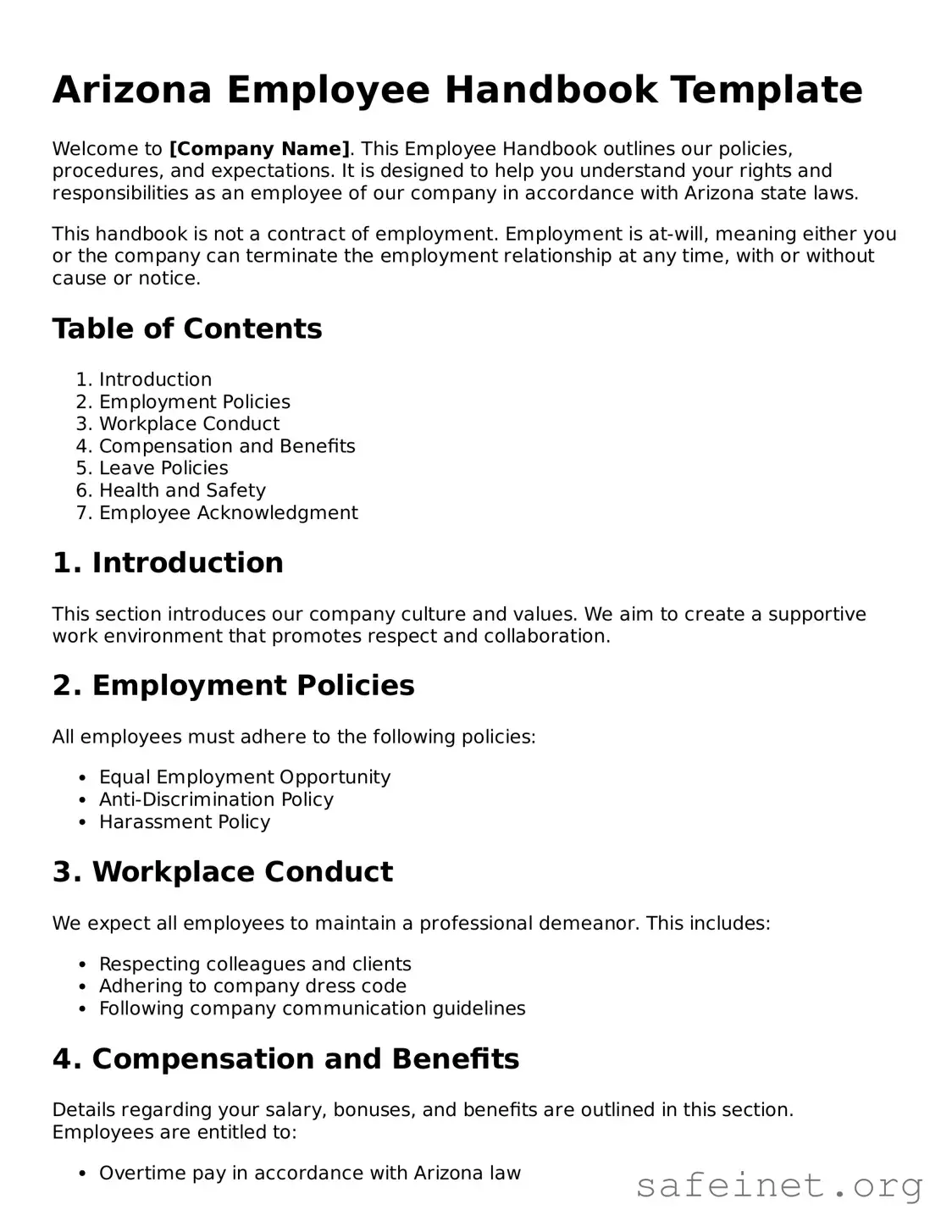
Creating a comprehensive employee handbook is a crucial step for any business operating in Arizona. This document serves as a vital resource for both employers and employees, outlining workplace policies, procedures, and expectations. The Arizona Employee Handbook form typically includes sections on company culture, code of conduct, anti-discrimination policies, and employee benefits. Additionally, it addresses workplace safety, attendance requirements, and disciplinary procedures, ensuring that all employees understand their rights and responsibilities. By providing clarity on these key aspects, the handbook helps foster a positive work environment and minimizes potential legal disputes. A well-crafted handbook not only protects the employer but also empowers employees with the information they need to thrive in their roles.
Arizona Employee Handbook Template
Welcome to [Company Name]. This Employee Handbook outlines our policies, procedures, and expectations. It is designed to help you understand your rights and responsibilities as an employee of our company in accordance with Arizona state laws.
This handbook is not a contract of employment. Employment is at-will, meaning either you or the company can terminate the employment relationship at any time, with or without cause or notice.
Table of Contents
1. Introduction
This section introduces our company culture and values. We aim to create a supportive work environment that promotes respect and collaboration.
2. Employment Policies
All employees must adhere to the following policies:
3. Workplace Conduct
We expect all employees to maintain a professional demeanor. This includes:
4. Compensation and Benefits
Details regarding your salary, bonuses, and benefits are outlined in this section. Employees are entitled to:
5. Leave Policies
Employees are eligible for various types of leave, including:
6. Health and Safety
We prioritize the health and safety of our employees. All employees must:
7. Employee Acknowledgment
By signing below, you acknowledge that you have received and read this Employee Handbook.
Employee Name: [Employee Name]
Signature: [Signature]
Date: [Date]
| Fact Name | Description |
|---|---|
| Purpose | The Arizona Employee Handbook serves as a guide for employees regarding company policies and procedures. |
| Legal Requirement | While not legally required, providing an employee handbook is considered best practice in Arizona. |
| Governing Laws | The handbook should comply with Arizona labor laws, including the Arizona Revised Statutes (ARS) Title 23. |
| Content Recommendations | It is advisable to include sections on workplace conduct, benefits, and disciplinary procedures. |
| Employee Acknowledgment | Employees should sign an acknowledgment form to confirm they have received and understood the handbook. |
| Updates | The handbook should be reviewed and updated regularly to reflect changes in laws or company policies. |
| Non-Discrimination Policy | A clear non-discrimination policy should be included to promote a fair workplace environment. |
| At-Will Employment | Arizona is an at-will employment state, meaning either the employer or employee can terminate employment at any time. |
Completing the Arizona Employee Handbook form is an essential step in ensuring that you understand your rights and responsibilities as an employee. This guide will walk you through the process, making it straightforward and manageable.
Once you have submitted the form, your employer will review it and keep it on file. You may also want to schedule a time to discuss any questions or clarifications regarding the handbook with your supervisor.
What is the Arizona Employee Handbook form?
The Arizona Employee Handbook form is a document designed to outline the policies, procedures, and expectations of an organization regarding its employees. It serves as a guide for employees, helping them understand their rights and responsibilities within the workplace. This handbook can include information on topics such as workplace conduct, benefits, and disciplinary procedures, ensuring that everyone is on the same page regarding company standards.
Why is it important to have an Employee Handbook?
An Employee Handbook is crucial for several reasons. First, it helps establish clear communication between the employer and employees. By outlining company policies, it minimizes misunderstandings and sets expectations. Furthermore, having a well-documented handbook can protect the organization from legal issues by demonstrating that it has communicated its policies effectively. It can also foster a positive work environment by promoting transparency and consistency.
Who should create the Employee Handbook?
What should be included in the Arizona Employee Handbook?
The handbook should cover a range of topics to be comprehensive. Common sections include an introduction to the company, employment policies, workplace conduct, anti-discrimination policies, benefits and compensation, leave policies, and procedures for reporting grievances. Additionally, it may address safety protocols and procedures for handling workplace emergencies. Tailoring the content to reflect the organization's culture and values is also essential.
How often should the Employee Handbook be updated?
How should the Employee Handbook be distributed to employees?
Distribution of the Employee Handbook can be done in several ways. Many organizations opt for a digital format, allowing employees to access it via the company intranet or email. Others may provide printed copies during onboarding. Regardless of the method, it is essential to ensure that all employees receive a copy and acknowledge that they have read and understood the handbook.
What should employees do if they have questions about the handbook?
If employees have questions regarding the Employee Handbook, they should feel encouraged to reach out to their supervisor or the human resources department. Open communication is key. Employees should not hesitate to seek clarification on any policy or procedure they do not fully understand. This proactive approach can prevent potential issues from arising in the future.
Can an Employee Handbook be legally binding?
What are the consequences of not having an Employee Handbook?
Not having an Employee Handbook can lead to confusion and inconsistency in how policies are applied. Without clear guidelines, employees may not understand their rights or responsibilities, which can result in conflicts and grievances. Additionally, organizations without a handbook may expose themselves to legal risks, as they may not have documented policies to refer to in case of disputes. Overall, the absence of a handbook can undermine workplace harmony and compliance.
Failing to read the entire handbook before signing. Understanding the policies is crucial.
Not providing accurate personal information. Incorrect details can lead to issues with payroll and benefits.
Overlooking the acknowledgment section. This section confirms that the employee has read and understood the policies.
Neglecting to ask questions about unclear policies. Seeking clarification can prevent misunderstandings later.
Forgetting to update the form if personal circumstances change. Changes in address or marital status should be reported.
Ignoring the consequences of not following the handbook. Policies are in place for a reason, and violations can lead to disciplinary actions.
Assuming that verbal agreements override written policies. The handbook is the official reference for company policies.
Not keeping a copy of the signed form for personal records. Having a copy can be helpful for future reference.
Rushing through the form without thorough review. Taking time to check for errors is essential.
Failing to understand the importance of confidentiality clauses. These clauses protect both the employee and the employer.
In Arizona, an Employee Handbook serves as a vital resource for both employers and employees, outlining workplace policies, procedures, and expectations. However, it is often accompanied by several other important forms and documents that help ensure a clear understanding of the employment relationship. Here are some common documents that are frequently used alongside the Employee Handbook:
These documents play a crucial role in establishing a transparent and effective workplace. By utilizing them alongside the Employee Handbook, employers can create a well-structured environment that benefits both parties involved in the employment relationship.
The Arizona Employee Handbook is similar to a company policy manual. Both documents serve as essential resources for employees, outlining the expectations and guidelines within the workplace. A policy manual provides detailed descriptions of company policies, procedures, and rules that govern employee behavior. This ensures that employees understand their rights and responsibilities while fostering a consistent work environment. Just as the Employee Handbook helps employees navigate their roles, the policy manual reinforces the company’s values and operational standards.
Another document that resembles the Arizona Employee Handbook is the employee orientation guide. This guide is often provided to new hires during their onboarding process. It typically includes information about the company's mission, vision, and culture, along with practical details such as benefits, payroll procedures, and workplace safety. Like the Employee Handbook, the orientation guide aims to help employees acclimate to their new environment, ensuring they feel informed and supported from day one.
Similar to the Employee Handbook is the workplace safety manual. This document focuses specifically on health and safety protocols within the workplace. It outlines procedures for reporting accidents, emergency protocols, and safety training requirements. While the Employee Handbook covers a broader range of topics, both documents prioritize employee well-being and aim to create a safe working environment. Understanding safety procedures is crucial for minimizing risks and ensuring that employees know how to protect themselves and their colleagues.
The Arizona Employee Handbook also shares similarities with the code of conduct. This document establishes the ethical standards and behavioral expectations for employees. It often includes guidelines on professionalism, harassment, and conflict resolution. Both the Employee Handbook and the code of conduct work together to promote a respectful and inclusive workplace culture. They serve as reminders of the importance of maintaining integrity and accountability in professional interactions.
Lastly, the employee benefits guide is another document that parallels the Arizona Employee Handbook. This guide provides detailed information about the benefits offered by the employer, such as health insurance, retirement plans, and paid time off. While the Employee Handbook may touch on benefits briefly, the employee benefits guide delves deeper into eligibility, enrollment procedures, and coverage options. Both documents aim to empower employees by ensuring they are aware of the resources available to them, enhancing their overall job satisfaction and well-being.
When filling out the Arizona Employee Handbook form, it's essential to approach the task with care and attention. The details you provide can have significant implications for your employment experience. Here’s a guide to help you navigate this process effectively.
Do's:
Don'ts:
By following these guidelines, you can ensure that your completion of the Arizona Employee Handbook form is smooth and effective. Remember, this is not just a formality; it’s a vital step in your employment journey.
When it comes to the Arizona Employee Handbook form, several misconceptions can lead to confusion. Here are five common misunderstandings:
Understanding these misconceptions can help employers create a more effective and realistic employee handbook that serves both the business and its employees.
When filling out and utilizing the Arizona Employee Handbook form, there are several important points to consider. These key takeaways will help ensure that the handbook is effective and compliant with state regulations.
By following these takeaways, organizations can create an effective Arizona Employee Handbook that supports both employees and management.