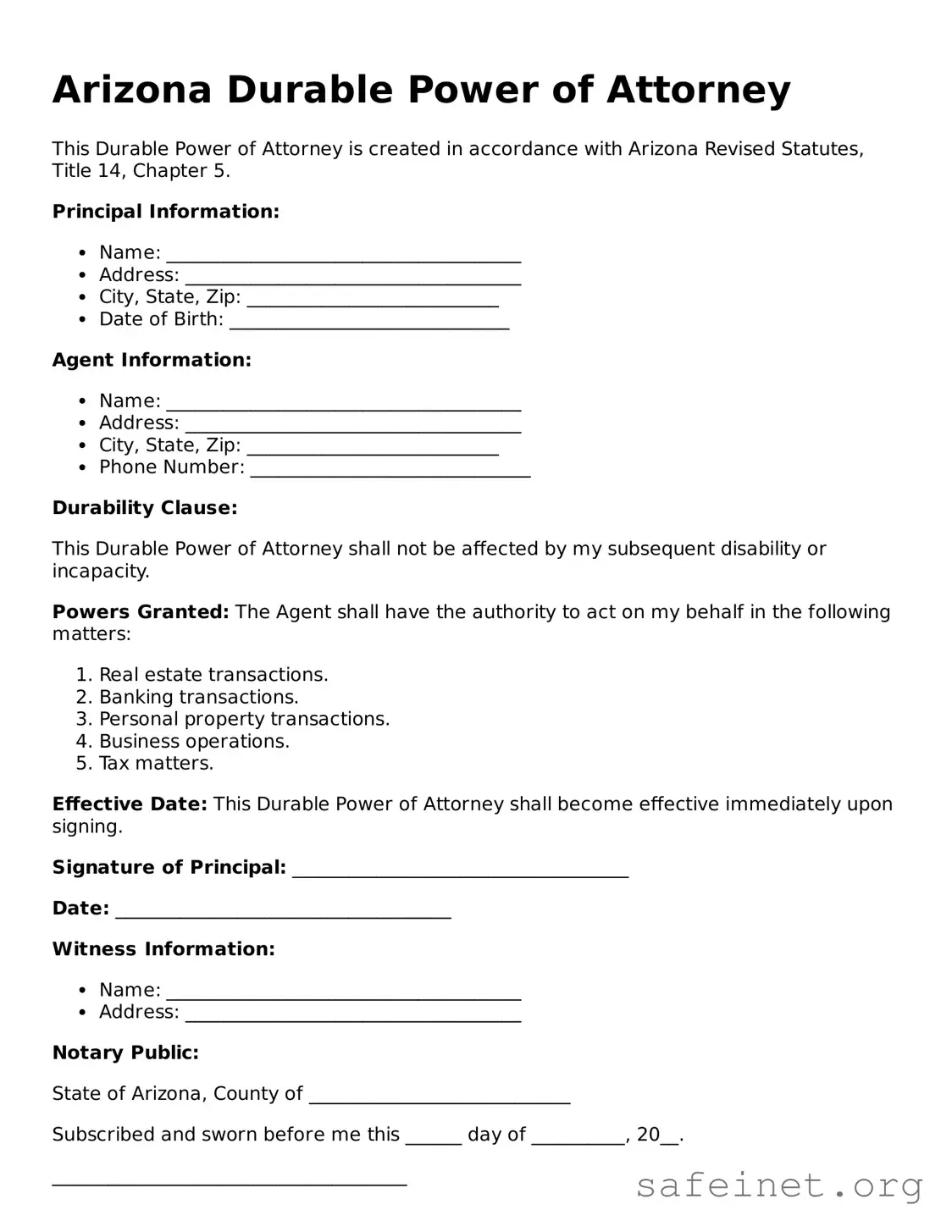
The Arizona Durable Power of Attorney form is a vital legal document that empowers individuals to designate someone they trust to make decisions on their behalf, particularly in financial or healthcare matters, should they become incapacitated. This form remains effective even if the person who created it loses the ability to make decisions, ensuring that their wishes are honored. Key elements include the appointment of an agent, who is responsible for acting in the best interest of the principal, and the specific powers granted to that agent, which can range from managing bank accounts to making medical decisions. Additionally, the form allows for flexibility; individuals can tailor the authority granted to their agent based on personal needs and preferences. Understanding the implications of this document is crucial for anyone looking to safeguard their future and ensure that their affairs are managed according to their wishes.
Arizona Durable Power of Attorney
This Durable Power of Attorney is created in accordance with Arizona Revised Statutes, Title 14, Chapter 5.
Principal Information:
Agent Information:
Durability Clause:
This Durable Power of Attorney shall not be affected by my subsequent disability or incapacity.
Powers Granted: The Agent shall have the authority to act on my behalf in the following matters:
Effective Date: This Durable Power of Attorney shall become effective immediately upon signing.
Signature of Principal: ____________________________________
Date: ____________________________________
Witness Information:
Notary Public:
State of Arizona, County of ____________________________
Subscribed and sworn before me this ______ day of __________, 20__.
______________________________________
Notary Public Signature
My Commission Expires: ____________________
| Fact Name | Description |
|---|---|
| Definition | A Durable Power of Attorney in Arizona allows an individual to designate someone to make financial and legal decisions on their behalf, even if they become incapacitated. |
| Governing Law | The Arizona Durable Power of Attorney is governed by Arizona Revised Statutes, Title 14, Chapter 5. |
| Durability | This form remains effective even if the principal becomes incapacitated, which distinguishes it from a regular Power of Attorney. |
| Revocation | The principal can revoke the Durable Power of Attorney at any time, as long as they are mentally competent. |
| Execution Requirements | In Arizona, the form must be signed by the principal and acknowledged by a notary public to be valid. |
Completing the Arizona Durable Power of Attorney form is a straightforward process that allows individuals to designate someone to make financial or legal decisions on their behalf. Following the steps below will help ensure that the form is filled out correctly and meets the necessary requirements.
Once the form is filled out and signed, it is essential to provide a copy to your agent and any relevant financial institutions or healthcare providers, if applicable. This will facilitate the agent's ability to act on your behalf when needed.
What is a Durable Power of Attorney in Arizona?
A Durable Power of Attorney (DPOA) in Arizona is a legal document that allows you to appoint someone you trust to make decisions on your behalf if you become unable to do so. This can include financial matters, medical decisions, or other important issues. The term "durable" means that the power remains in effect even if you become incapacitated. It's a way to ensure your wishes are followed when you cannot communicate them yourself.
Who can be appointed as an agent under a Durable Power of Attorney?
You can choose anyone to be your agent, as long as they are at least 18 years old and mentally competent. This could be a family member, a close friend, or even a professional, like an attorney. It’s important to select someone who understands your values and wishes. Trust is key, as this person will have significant authority over your financial and personal affairs.
Do I need to have a lawyer to create a Durable Power of Attorney in Arizona?
No, you do not necessarily need a lawyer to create a Durable Power of Attorney in Arizona. You can use a template or form that meets state requirements. However, consulting with a lawyer can provide peace of mind and ensure that your document is properly drafted and executed. A legal expert can help you understand the implications of the choices you make and tailor the document to fit your specific needs.
How do I revoke a Durable Power of Attorney in Arizona?
If you decide to revoke your Durable Power of Attorney, you must do so in writing. You should notify your agent and any institutions or individuals who had a copy of the original document. Once you revoke it, the previous agent no longer has authority to act on your behalf. It’s a good idea to keep a record of the revocation for your own files, just in case there are any questions later on.
Not specifying the powers granted. It's crucial to clearly outline what authority is being given to the agent.
Failing to date the form. A date is essential for validating the document and establishing when it becomes effective.
Overlooking the need for signatures. Both the principal and the agent must sign the document for it to be valid.
Not having the form notarized or witnessed. Arizona law requires that the Durable Power of Attorney be either notarized or signed by two witnesses.
Using outdated forms. Always ensure the form is the most current version to avoid legal complications.
Failing to review state-specific requirements. Each state has its own rules regarding Durable Power of Attorney forms, and Arizona is no exception.
Leaving sections blank. Every section should be filled out completely to prevent misunderstandings or disputes.
Not discussing the document with the agent. It’s important for the agent to understand their responsibilities and the powers being granted.
Ignoring the need for updates. Life changes, and so should the Durable Power of Attorney. Regular reviews are necessary.
Assuming all powers are automatically granted. Some powers may need to be explicitly stated to ensure clarity and intent.
When creating a Durable Power of Attorney in Arizona, several other documents may be useful to ensure comprehensive planning for future needs. Below is a list of commonly used forms that complement the Durable Power of Attorney.
Each of these documents plays a vital role in effective planning and decision-making. Together, they provide a comprehensive approach to managing personal, medical, and financial affairs, ensuring that your wishes are honored and your loved ones are protected.
The Arizona Durable Power of Attorney (DPOA) is similar to a General Power of Attorney (GPOA). Both documents grant an agent the authority to make decisions on behalf of the principal. However, the key distinction lies in the durability aspect; the DPOA remains effective even if the principal becomes incapacitated, while the GPOA typically ceases to be valid under such circumstances. This durability feature makes the DPOA particularly useful for long-term planning.
A Healthcare Power of Attorney (HPOA) shares similarities with the DPOA in that it allows an individual to designate someone to make healthcare decisions on their behalf. While the DPOA can cover financial matters, the HPOA specifically focuses on medical decisions. Both documents empower an agent to act in the best interests of the principal, but the HPOA is tailored to healthcare-related issues, emphasizing the importance of medical preferences.
A Living Will, while not a power of attorney, is often mentioned alongside the DPOA. This document outlines an individual's wishes regarding medical treatment in the event of terminal illness or incapacity. Unlike the DPOA, which appoints an agent to make decisions, a Living Will provides direct instructions to healthcare providers. Both documents serve to ensure that an individual’s preferences are respected when they are unable to communicate them.
The Revocable Trust is similar to the DPOA in that it allows for the management of assets during the grantor's lifetime and can dictate how assets are handled after death. While the DPOA grants authority to an agent to manage financial matters, a Revocable Trust allows the grantor to retain control over their assets until they choose to transfer them to beneficiaries. Both documents can be used for estate planning and can help avoid probate.
A Special Needs Trust is another document that aligns with the principles of the DPOA. This trust is designed to benefit individuals with disabilities without jeopardizing their eligibility for government assistance. While the DPOA allows an agent to manage finances, a Special Needs Trust specifically allocates funds for the care of a disabled individual, ensuring that their needs are met without affecting their benefits.
The Advance Healthcare Directive combines elements of both a DPOA and a Living Will. It allows individuals to appoint an agent to make healthcare decisions while also providing specific instructions about their medical treatment preferences. This document ensures that both the wishes of the principal and the authority of the appointed agent are clearly articulated, similar to the DPOA’s purpose of empowering an agent.
The Guardian Nomination form is comparable to the DPOA in that it allows individuals to designate someone to make decisions on their behalf, particularly concerning minors or dependents. While the DPOA is focused on financial and healthcare decisions for the principal, the Guardian Nomination form specifically addresses the care and custody of children. Both documents emphasize the importance of having a trusted individual in place to make critical decisions.
A Bill of Rights for Residents of Long-Term Care Facilities shares a conceptual similarity with the DPOA in terms of empowering individuals. This document outlines the rights of residents, ensuring that they are treated with dignity and respect. While it does not appoint an agent, it serves to protect the interests of individuals in long-term care, similar to how a DPOA protects the interests of the principal through appointed authority.
Finally, a Declaration of Living Trust is similar to the DPOA in its function of managing assets and ensuring that an individual’s wishes are honored. This document allows for the management of assets during the grantor's lifetime and specifies how those assets should be distributed after death. While the DPOA focuses on granting authority to an agent, a Declaration of Living Trust centers on the management and distribution of the grantor's assets, both serving important roles in estate planning.
When filling out the Arizona Durable Power of Attorney form, it is essential to be careful and thorough. Here are some important dos and don'ts to keep in mind:
Following these guidelines will help ensure that your Durable Power of Attorney is valid and effective. Take the time to review your form carefully before submission.
There are several misconceptions about the Arizona Durable Power of Attorney form that can lead to confusion. Understanding these can help ensure that individuals make informed decisions.
Understanding these misconceptions can help individuals make better choices regarding their Durable Power of Attorney in Arizona.
Filling out and using the Arizona Durable Power of Attorney form is an important step in planning for your future. Here are some key takeaways to consider:
By following these guidelines, you can ensure that your Durable Power of Attorney is filled out correctly and serves its intended purpose effectively.