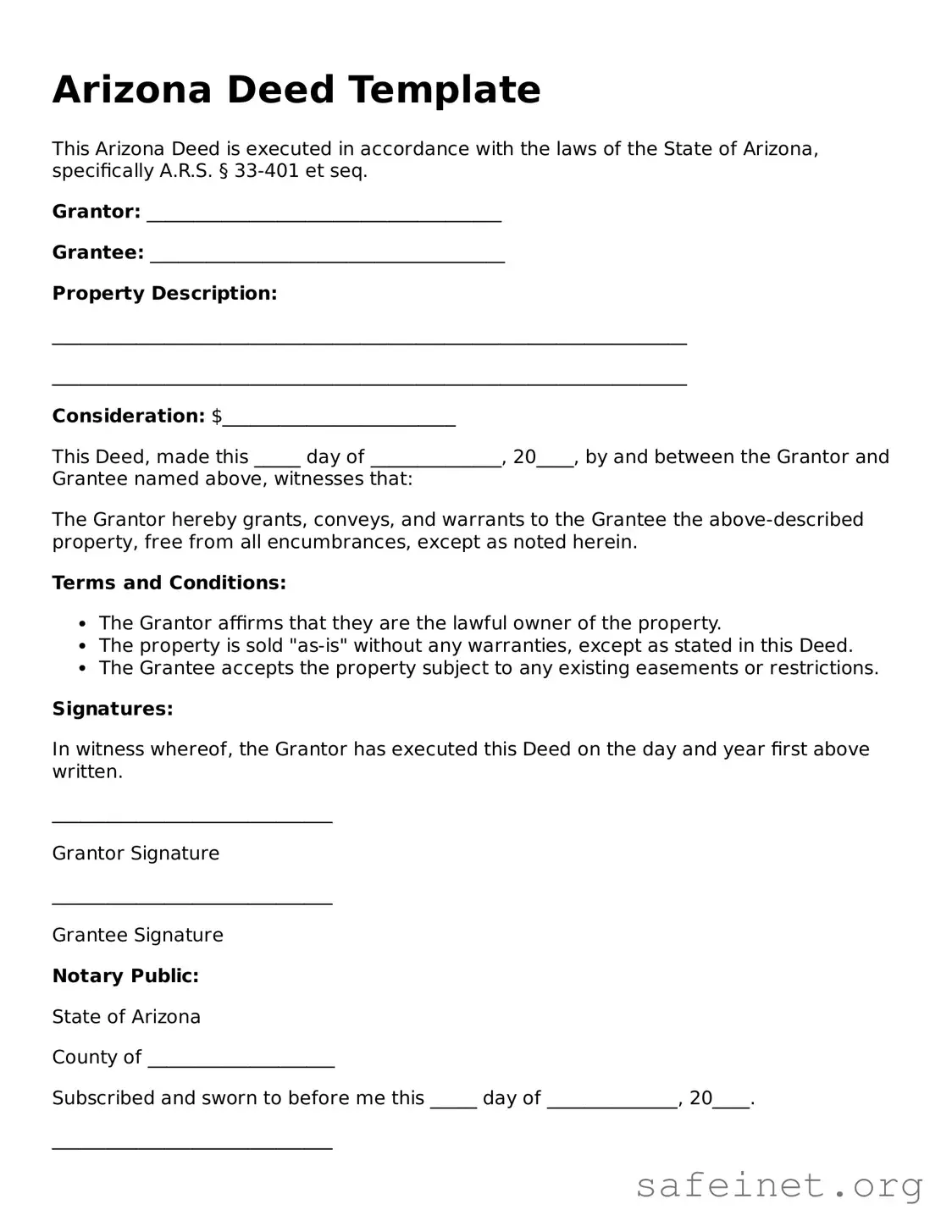
The Arizona Deed form serves as a critical instrument in the transfer of real property ownership within the state. This legal document outlines the specifics of the transaction, including the names of the parties involved, the description of the property being transferred, and the terms under which the transfer occurs. Essential elements such as the signature of the grantor and the acknowledgment by a notary public are required to validate the deed. Various types of deeds, including warranty deeds and quitclaim deeds, cater to different circumstances and provide varying levels of protection to the grantee. Additionally, the form must be recorded with the county recorder’s office to ensure public notice of the change in ownership. Understanding the intricacies of the Arizona Deed form is vital for both buyers and sellers, as it not only facilitates the legal transfer of property but also helps in safeguarding the rights of all parties involved in the transaction.
Arizona Deed Template
This Arizona Deed is executed in accordance with the laws of the State of Arizona, specifically A.R.S. § 33-401 et seq.
Grantor: ______________________________________
Grantee: ______________________________________
Property Description:
____________________________________________________________________
____________________________________________________________________
Consideration: $_________________________
This Deed, made this _____ day of ______________, 20____, by and between the Grantor and Grantee named above, witnesses that:
The Grantor hereby grants, conveys, and warrants to the Grantee the above-described property, free from all encumbrances, except as noted herein.
Terms and Conditions:
Signatures:
In witness whereof, the Grantor has executed this Deed on the day and year first above written.
______________________________
Grantor Signature
______________________________
Grantee Signature
Notary Public:
State of Arizona
County of ____________________
Subscribed and sworn to before me this _____ day of ______________, 20____.
______________________________
Notary Public Signature
My Commission Expires: _______________
| Fact Name | Description |
|---|---|
| Governing Law | The Arizona Deed form is governed by Arizona state law, specifically under Title 33 of the Arizona Revised Statutes. |
| Types of Deeds | Arizona recognizes several types of deeds, including warranty deeds, quitclaim deeds, and special warranty deeds. |
| Notarization Requirement | All Arizona Deed forms must be notarized to be legally valid and enforceable. |
| Recording | To provide public notice, the deed must be recorded with the County Recorder's Office in the county where the property is located. |
| Property Description | A legal description of the property must be included in the deed to clearly identify the parcel being transferred. |
| Transfer Tax | Arizona imposes a transfer tax on the sale of real property, which may need to be paid at the time of recording the deed. |
Once you have the Arizona Deed form ready, it’s time to fill it out carefully. Completing this form accurately is essential for ensuring that the transfer of property is legally recognized. Follow the steps below to fill out the form correctly.
After completing these steps, the deed will need to be filed with the appropriate county recorder’s office in Arizona. This ensures that the transfer is officially recorded and recognized by local authorities.
What is an Arizona Deed form?
An Arizona Deed form is a legal document used to transfer ownership of real property in the state of Arizona. This form outlines the details of the transaction, including the names of the parties involved, a description of the property, and any conditions or restrictions related to the transfer. The deed must be signed and notarized to be legally valid.
What types of Deeds are available in Arizona?
In Arizona, several types of deeds can be used, including Warranty Deeds, Quitclaim Deeds, and Special Warranty Deeds. A Warranty Deed provides a guarantee that the seller holds clear title to the property and has the right to sell it. A Quitclaim Deed transfers whatever interest the seller has in the property without any warranties. A Special Warranty Deed offers limited warranties, covering only the period during which the seller owned the property.
How do I complete an Arizona Deed form?
To complete an Arizona Deed form, you need to provide specific information. This includes the names of the grantor (seller) and grantee (buyer), a legal description of the property, and the date of the transaction. The form must be signed by the grantor in front of a notary public. It is advisable to check with local regulations or consult a legal professional to ensure compliance with all requirements.
Do I need to record the Deed after it is signed?
Yes, it is important to record the Deed with the county recorder's office in the county where the property is located. Recording the Deed provides public notice of the transfer and protects the rights of the new owner. Failure to record may result in complications regarding ownership and title in the future.
Are there any fees associated with filing an Arizona Deed?
Yes, there are typically fees associated with filing a Deed in Arizona. These fees vary by county and may include recording fees and any applicable transfer taxes. It is advisable to check with the local county recorder's office for the exact fees and payment methods accepted.
Incorrect Property Description: One of the most common mistakes is providing an inaccurate or incomplete description of the property. Ensure that the legal description is precise and matches public records.
Not Including All Grantors and Grantees: If multiple parties are involved, all grantors (sellers) and grantees (buyers) must be listed. Omitting a name can lead to legal complications later.
Failing to Sign the Deed: A deed must be signed by the grantor. Without a signature, the document is not valid. Ensure that all required parties have signed before submission.
Improper Notarization: The deed must be notarized correctly. If the notary fails to follow proper procedures, the deed may be rejected by the county recorder’s office.
Leaving Out the Date: Not dating the deed can create confusion about when the transfer occurred. Always include the date of signing to ensure clarity.
Using the Wrong Form: Different types of deeds serve different purposes. Using a quitclaim deed when a warranty deed is required can lead to issues with title insurance.
Neglecting to Record the Deed: After completing the deed, it must be recorded with the appropriate county office. Failing to do so can leave the property transfer unprotected against future claims.
When completing a property transaction in Arizona, various forms and documents may be necessary alongside the Arizona Deed form. Each of these documents serves a specific purpose, ensuring that the transfer of property is legal and properly recorded.
Each of these documents plays a crucial role in ensuring a smooth property transaction in Arizona. Understanding their purpose can help streamline the process and avoid potential issues.
The Arizona Deed form shares similarities with a Quitclaim Deed. Both documents transfer ownership of real property from one party to another. However, a Quitclaim Deed does not guarantee that the title is clear or free of liens. It simply conveys whatever interest the grantor has in the property. This makes it a popular choice for transfers between family members or in situations where the parties know each other well and trust the title's status.
An Affidavit of Title is another document that resembles the Arizona Deed form. This affidavit is a sworn statement by the seller affirming their ownership of the property and the absence of any undisclosed liens or claims. While the Arizona Deed officially transfers ownership, the Affidavit of Title provides additional assurance to the buyer about the property’s legal status. It is often used in conjunction with the deed to enhance the buyer's confidence in the transaction.
A Bill of Sale is another document that bears resemblance to the Arizona Deed form, particularly when it comes to transferring ownership. While a Bill of Sale is typically used for personal property rather than real estate, both documents serve the same purpose: they formalize the transfer of ownership. The Bill of Sale outlines the terms of the sale and provides proof of ownership, much like the Arizona Deed does for real property.
Lastly, a Real Estate Purchase Agreement is similar to the Arizona Deed form in that it outlines the terms of a real estate transaction. This agreement details the buyer's and seller's obligations and includes important information such as the sale price and closing date. While the Arizona Deed is the final document that completes the transfer of ownership, the Purchase Agreement lays the groundwork for the entire transaction, ensuring that both parties are on the same page before the deed is executed.
When filling out the Arizona Deed form, there are important guidelines to follow. Here is a list of things you should and shouldn't do:
Following these guidelines can help ensure that the deed is completed correctly and efficiently.
Understanding the Arizona Deed form can be challenging due to various misconceptions. Here are six common misunderstandings:
All deeds are the same. Many people believe that all deeds serve the same purpose. In reality, different types of deeds, such as warranty deeds and quitclaim deeds, have distinct functions and levels of protection for the buyer.
Only a lawyer can prepare a deed. While legal assistance can be beneficial, individuals can prepare a deed themselves if they understand the requirements. However, it's essential to ensure that all necessary information is included to avoid future issues.
A deed must be notarized to be valid. Although notarization is a common practice, it is not always required for a deed to be legally binding in Arizona. However, having a notarized deed can help prevent disputes.
Once a deed is signed, it cannot be changed. People often think that a deed is final once signed. In fact, deeds can be amended or revoked, but the process must follow legal guidelines to ensure validity.
Deeds do not need to be recorded. Some believe that recording a deed is optional. In Arizona, recording a deed is crucial for establishing public notice of ownership and protecting rights against third parties.
All property transfers require a deed. While most property transfers do involve a deed, some transactions, such as those involving certain trusts or government properties, may not require a traditional deed.
Clarifying these misconceptions can help individuals navigate the process of property ownership and transfer in Arizona more effectively.
When filling out and using the Arizona Deed form, it is essential to keep several key points in mind to ensure a smooth process. Below are important takeaways to consider: