In Arizona, homeowners facing financial difficulties may consider a Deed in Lieu of Foreclosure as a viable alternative to the lengthy and often stressful foreclosure process. This legal document allows a homeowner to voluntarily transfer the title of their property back to the lender, effectively relinquishing ownership and resolving the mortgage debt. By doing so, the homeowner can avoid the damaging effects of foreclosure on their credit score and may even qualify for a more favorable resolution. The Deed in Lieu of Foreclosure process typically involves several key steps, including communication with the lender, submission of necessary documentation, and potentially negotiating terms that could benefit both parties. Additionally, it is important for homeowners to understand the implications of this transfer, including the potential for tax consequences and the need for a thorough review of the mortgage agreement. Overall, this option can provide a more dignified exit from homeownership while offering a path toward financial recovery.
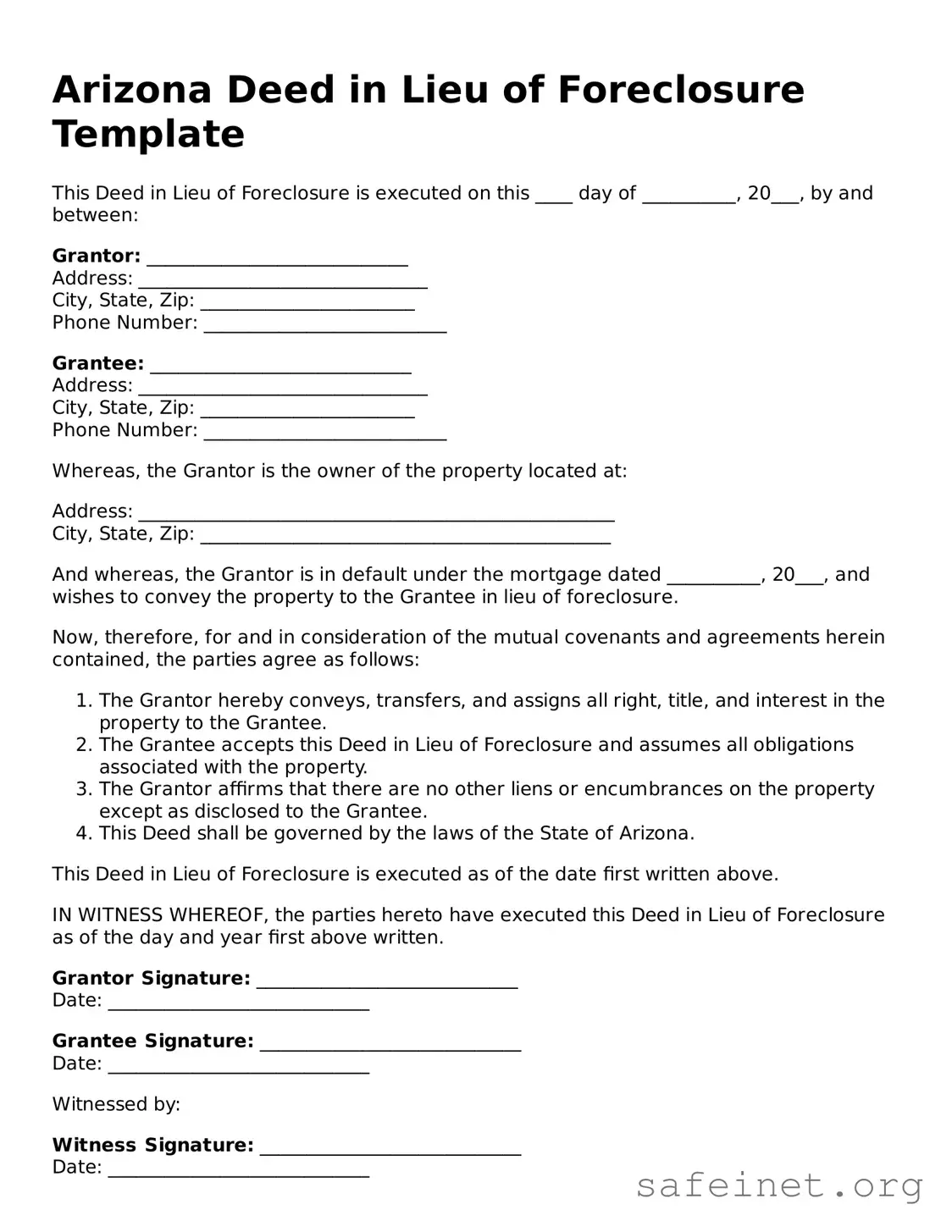
Arizona Deed in Lieu of Foreclosure Template
This Deed in Lieu of Foreclosure is executed on this ____ day of __________, 20___, by and between:
Grantor: ____________________________
Address: _______________________________
City, State, Zip: _______________________
Phone Number: __________________________
Grantee: ____________________________
Address: _______________________________
City, State, Zip: _______________________
Phone Number: __________________________
Whereas, the Grantor is the owner of the property located at:
Address: ___________________________________________________
City, State, Zip: ____________________________________________
And whereas, the Grantor is in default under the mortgage dated __________, 20___, and wishes to convey the property to the Grantee in lieu of foreclosure.
Now, therefore, for and in consideration of the mutual covenants and agreements herein contained, the parties agree as follows:
This Deed in Lieu of Foreclosure is executed as of the date first written above.
IN WITNESS WHEREOF, the parties hereto have executed this Deed in Lieu of Foreclosure as of the day and year first above written.
Grantor Signature: ____________________________
Date: ____________________________
Grantee Signature: ____________________________
Date: ____________________________
Witnessed by:
Witness Signature: ____________________________
Date: ____________________________
Witness Signature: ____________________________
Date: ____________________________
Notarization:
State of Arizona
County of ______________________
On this ____ day of __________, 20___, before me, a Notary Public in and for said County and State, personally appeared ____________________________ and ____________________________, known to me to be the persons whose names are subscribed to the within instrument, and acknowledged to me that they executed the same for the purposes therein contained.
Given under my hand and official seal.
Notary Public Signature: ____________________________
My Commission Expires: ____________________________
| Fact Name | Details |
|---|---|
| Definition | A deed in lieu of foreclosure allows a borrower to transfer property ownership to the lender to avoid foreclosure. |
| Purpose | This form is used to settle a mortgage default and prevent the lengthy foreclosure process. |
| Governing Law | The deed in lieu of foreclosure in Arizona is governed by state property laws, specifically Arizona Revised Statutes Title 33. |
| Eligibility | Borrowers facing financial hardship and unable to keep up with mortgage payments may qualify for this option. |
| Property Condition | The property must typically be in good condition, as lenders may require it to be free of significant damage. |
| Impact on Credit | A deed in lieu of foreclosure can negatively impact a borrower’s credit score, but often less than a foreclosure. |
| Tax Implications | Borrowers may face potential tax consequences on forgiven debt, as it could be considered taxable income. |
| Process Duration | The process can be quicker than foreclosure, often taking a few weeks to finalize once both parties agree. |
| Legal Advice | Consulting with a legal professional is advisable to understand all implications before proceeding. |
| Alternative Options | Borrowers should also consider alternatives such as loan modifications or short sales before opting for a deed in lieu. |
Once you have the Arizona Deed in Lieu of Foreclosure form ready, it's time to complete it accurately. This process involves several steps that ensure all necessary information is properly documented. After filling out the form, you will be moving forward with the next steps in the process, which may include submitting the form to the appropriate parties and potentially finalizing the transfer of property ownership.
What is a Deed in Lieu of Foreclosure?
A Deed in Lieu of Foreclosure is a legal document where a homeowner voluntarily transfers ownership of their property to the lender to avoid foreclosure. This option can help the homeowner avoid the lengthy and costly foreclosure process.
Who is eligible for a Deed in Lieu of Foreclosure in Arizona?
Homeowners facing financial difficulties and unable to keep up with mortgage payments may be eligible. Lenders typically require that the homeowner has tried to sell the property and that the mortgage is in default or at risk of default.
What are the benefits of choosing a Deed in Lieu of Foreclosure?
One major benefit is that it can significantly reduce the impact on the homeowner's credit score compared to a foreclosure. Additionally, it allows for a quicker resolution, often resulting in less stress and financial burden.
What are the drawbacks of a Deed in Lieu of Foreclosure?
While it can be beneficial, a Deed in Lieu of Foreclosure may still affect your credit score. Furthermore, the lender may pursue a deficiency judgment if the property's value is less than the mortgage balance, which could lead to further financial obligations for the homeowner.
How does the process work?
The homeowner must contact their lender to discuss the option. If approved, the homeowner will complete the necessary paperwork, including the Deed in Lieu of Foreclosure form. After signing, the lender will take ownership of the property, and the homeowner will be released from the mortgage obligation.
Can I negotiate the terms of a Deed in Lieu of Foreclosure?
Yes, homeowners can negotiate terms with their lender. This may include discussing the possibility of a cash incentive, the timeline for vacating the property, or even potential forgiveness of any remaining mortgage debt.
Do I need a lawyer to complete a Deed in Lieu of Foreclosure?
While it is not legally required to have a lawyer, it is advisable to seek legal assistance. A lawyer can help ensure that all documents are completed correctly and that your rights are protected throughout the process.
How can I find the necessary forms for a Deed in Lieu of Foreclosure?
Forms can typically be obtained from your lender or online through legal document preparation websites. Ensure that you use the most current and state-specific forms to avoid any issues.
Incorrect Property Description: Failing to provide a clear and accurate description of the property can lead to confusion and delays. Always double-check the legal description of the property.
Missing Signatures: Not signing the document can render it invalid. Ensure that all required parties sign the form where indicated.
Not Notarizing the Document: Many forms require notarization to be legally binding. Skipping this step can cause issues during the process.
Inaccurate Debtor Information: Providing incorrect names or details for the debtor can complicate the transaction. Verify all information before submission.
Failing to Include Necessary Attachments: Some situations may require additional documentation, such as a financial hardship statement. Ensure all relevant documents are included.
Not Understanding Tax Implications: Ignoring the potential tax consequences of a deed in lieu of foreclosure can lead to unexpected financial burdens. Consult a tax professional if unsure.
When navigating the process of a deed in lieu of foreclosure in Arizona, several other forms and documents may be necessary. Each of these documents serves a specific purpose and helps ensure that all legal requirements are met. Below is a list of commonly used forms associated with this process.
Understanding these documents can help streamline the deed in lieu of foreclosure process. Each form plays a crucial role in protecting the interests of both the borrower and the lender, ensuring a smooth transition away from foreclosure.
The Arizona Deed in Lieu of Foreclosure form is similar to a Quitclaim Deed. A Quitclaim Deed transfers ownership of property from one party to another without any guarantees or warranties regarding the title. This document is often used in situations where a property owner wants to quickly transfer their interest in a property, such as in a divorce or when dealing with family property. Like the Deed in Lieu of Foreclosure, it allows for a straightforward transfer, but it does not address the underlying debt associated with the property.
Another document that bears resemblance to the Deed in Lieu of Foreclosure is the Warranty Deed. A Warranty Deed provides a guarantee that the grantor holds clear title to the property and has the right to transfer it. This document is more protective for the buyer than a Quitclaim Deed. While both documents facilitate the transfer of property, the Warranty Deed assures the buyer that they will not face claims against the title, unlike the Deed in Lieu of Foreclosure, which focuses on resolving a mortgage default.
The Assignment of Mortgage is also similar, as it involves transferring rights related to a mortgage. In this case, the lender assigns their rights to another party, which can happen when a loan is sold or transferred. While the Deed in Lieu of Foreclosure resolves the borrower’s obligation by transferring the property back to the lender, the Assignment of Mortgage merely shifts the lender’s rights without affecting the ownership of the property.
A Short Sale Agreement shares some characteristics with the Deed in Lieu of Foreclosure. In a short sale, the lender agrees to accept less than the full amount owed on the mortgage when the property is sold. Both options are ways for homeowners to avoid foreclosure. However, a short sale involves selling the property to a third party, while a Deed in Lieu of Foreclosure involves directly transferring the property back to the lender.
The Release of Lien document is another related form. This document indicates that a lien on a property has been removed, often after the debt has been satisfied. In the context of a Deed in Lieu of Foreclosure, the lien associated with the mortgage is effectively released when the property is transferred back to the lender, allowing the borrower to walk away from the debt without further obligation.
Similar to the Deed in Lieu of Foreclosure is a Foreclosure Notice. This document is issued when a borrower is in default and the lender begins the foreclosure process. While a Foreclosure Notice signals the start of legal proceedings to take possession of the property, the Deed in Lieu of Foreclosure is a proactive step taken by the homeowner to avoid the lengthy and costly foreclosure process.
The Power of Attorney can also be seen as a related document. This legal document allows one person to act on behalf of another in legal matters, including property transactions. In some cases, a homeowner may grant Power of Attorney to someone else to execute a Deed in Lieu of Foreclosure on their behalf, simplifying the process when the homeowner is unable to do so themselves.
The Mortgage Modification Agreement is another document that can be compared to the Deed in Lieu of Foreclosure. This agreement modifies the terms of an existing mortgage to make it more affordable for the borrower. While a Deed in Lieu of Foreclosure involves giving up the property, a Mortgage Modification Agreement aims to help the borrower keep their home by adjusting the payment terms.
Lastly, the Forbearance Agreement is similar in that it provides temporary relief to a borrower facing financial difficulties. This document allows the borrower to pause or reduce their mortgage payments for a specified period. While a Deed in Lieu of Foreclosure is a permanent solution to avoid foreclosure, a Forbearance Agreement is often a temporary fix to help homeowners regain their financial footing.
When filling out the Arizona Deed in Lieu of Foreclosure form, it is essential to follow specific guidelines to ensure the process goes smoothly. Here are ten important do's and don'ts:
When considering a deed in lieu of foreclosure in Arizona, many people hold misconceptions that can lead to confusion and poor decision-making. Here are six common misunderstandings:
Many believe that signing a deed in lieu of foreclosure wipes out all mortgage debt. However, this is not always the case. Depending on the lender's policies and the specific circumstances, you may still owe money, particularly if the property is worth less than the outstanding loan balance.
While a deed in lieu can be faster than a foreclosure, it is not without its complexities. The process requires negotiation with the lender, and they must agree to accept the deed. This can take time and may involve legal and financial considerations.
Many individuals think that a deed in lieu of foreclosure will not affect their credit. In reality, it can have a significant negative impact, similar to a foreclosure. This can hinder your ability to secure future loans or credit.
Not every lender is willing to accept a deed in lieu of foreclosure. Some may prefer to go through the foreclosure process instead. It's crucial to check with your lender to see if they offer this option.
Signing over the property does not automatically absolve you of all liabilities. You may still be responsible for any unpaid property taxes or homeowners association fees. These obligations can linger even after the deed is signed.
Many confuse a deed in lieu with selling a home. However, a deed in lieu is a voluntary transfer of property to the lender to avoid foreclosure, while selling involves transferring ownership to a buyer, often for a profit. The outcomes and implications are quite different.
Understanding these misconceptions can help you make informed decisions regarding your financial future and property ownership in Arizona.
When dealing with the Arizona Deed in Lieu of Foreclosure form, consider these key takeaways: