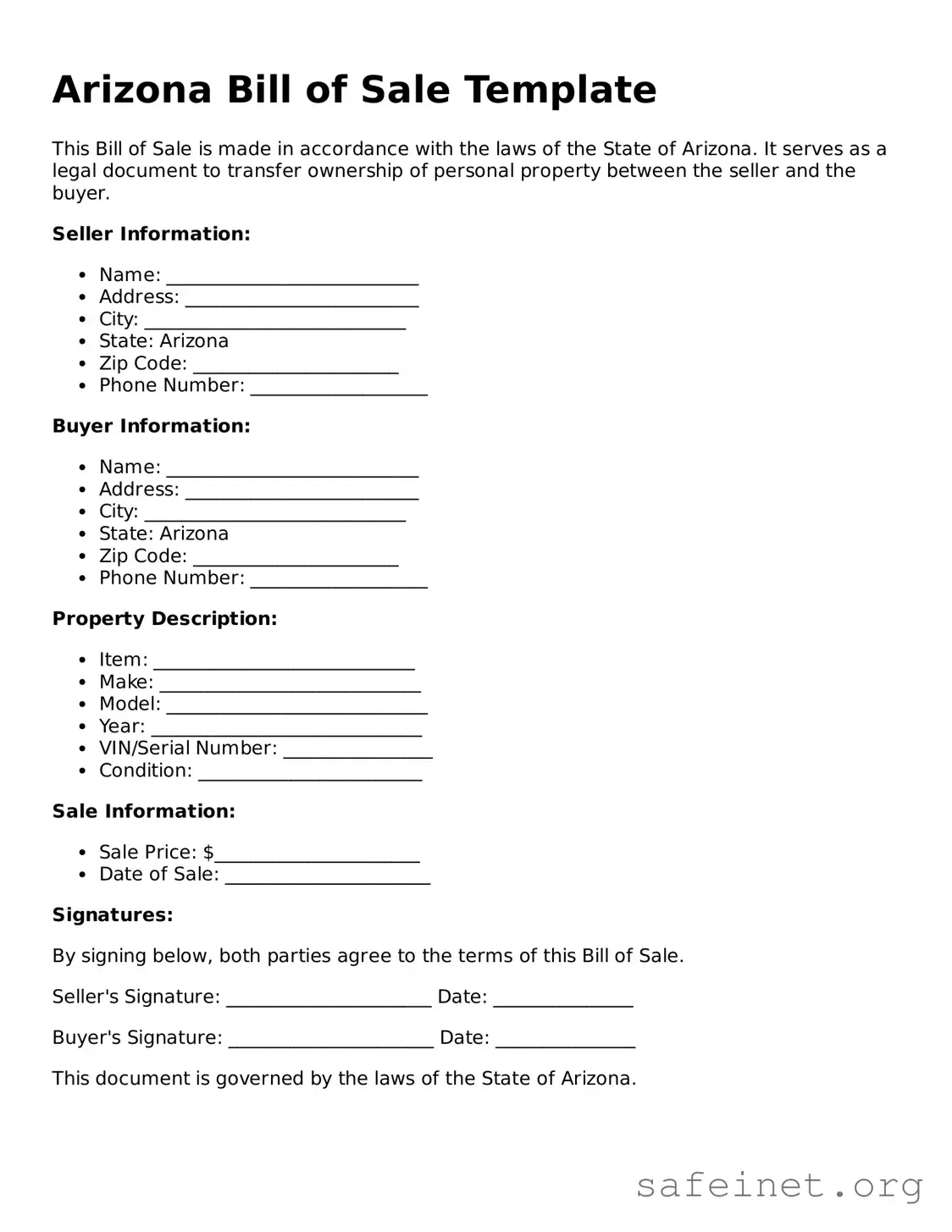
The Arizona Bill of Sale form serves as a crucial document in the transfer of ownership for personal property, whether it be a vehicle, boat, or other items of value. This form outlines essential details such as the names and addresses of both the buyer and the seller, a description of the item being sold, and the purchase price. It also provides space for the date of the transaction, ensuring that all parties have a clear record of when the transfer occurred. In Arizona, while a Bill of Sale is not always required for every transaction, having one can protect both parties by documenting the agreement and the condition of the item at the time of sale. Additionally, the form may include warranties or disclaimers, which can further clarify the responsibilities of each party. As a simple yet effective tool, the Arizona Bill of Sale enhances transparency and can help prevent disputes in the future.
Arizona Bill of Sale Template
This Bill of Sale is made in accordance with the laws of the State of Arizona. It serves as a legal document to transfer ownership of personal property between the seller and the buyer.
Seller Information:
Buyer Information:
Property Description:
Sale Information:
Signatures:
By signing below, both parties agree to the terms of this Bill of Sale.
Seller's Signature: ______________________ Date: _______________
Buyer's Signature: ______________________ Date: _______________
This document is governed by the laws of the State of Arizona.
| Fact Name | Description |
|---|---|
| Purpose | The Arizona Bill of Sale form is used to document the transfer of ownership of personal property from one party to another. |
| Governing Laws | This form is governed by Arizona Revised Statutes, specifically Title 44, Chapter 2. |
| Required Information | The form typically requires details such as the names of the buyer and seller, a description of the item, and the sale price. |
| Notarization | While notarization is not always required, it is recommended for added legal protection during the transfer. |
Filling out the Arizona Bill of Sale form is a straightforward process that helps document the sale of personal property. Once completed, this form serves as a record for both the buyer and seller, ensuring that the transaction is clear and legally recognized. Here’s how to fill it out step by step.
After completing the form, make copies for both the buyer and seller. This ensures that both parties have a record of the transaction. Store the original in a safe place, as it may be needed for future reference or legal purposes.
What is an Arizona Bill of Sale?
An Arizona Bill of Sale is a legal document that records the transfer of ownership of personal property from one party to another. This form provides proof of the transaction and can be used for various types of property, including vehicles, boats, and equipment. It outlines details such as the buyer and seller's names, the description of the item, and the sale price.
Do I need a Bill of Sale for every transaction in Arizona?
What information should be included in an Arizona Bill of Sale?
An Arizona Bill of Sale should include the following information: the full names and addresses of both the buyer and seller, a detailed description of the item being sold (including make, model, and VIN for vehicles), the sale price, and the date of the transaction. Both parties should sign the document to make it valid.
Can I create my own Bill of Sale in Arizona?
Yes, you can create your own Bill of Sale in Arizona. There are no specific state forms required, but it must include all necessary information to be legally binding. Templates are available online, or you can draft one from scratch. Ensure that it meets the requirements for the specific type of property being sold.
Is a Bill of Sale required for a gift in Arizona?
A Bill of Sale is not legally required for a gift. However, having one can provide clarity and proof of the transfer, especially for valuable items. It can help avoid disputes in the future regarding ownership. If you choose to create a Bill of Sale for a gift, include a statement indicating that the item is being given without payment.
What happens if I lose my Bill of Sale?
If you lose your Bill of Sale, it can create challenges, especially if disputes arise regarding ownership. While it is not impossible to resolve the situation, having a copy of the document is beneficial. If you need a replacement, you may be able to contact the other party involved to recreate the document or use any other proof of the transaction, such as receipts or emails.
Not including all required information. Ensure that the names, addresses, and contact details of both the buyer and seller are clearly stated.
Failing to accurately describe the item being sold. Provide a detailed description, including make, model, year, and any identifying numbers.
Omitting the purchase price. Clearly state the amount agreed upon for the transaction to avoid future disputes.
Not signing the document. Both parties should sign the Bill of Sale to validate the agreement.
Forgetting to date the form. Including the date of the transaction is crucial for record-keeping and legal purposes.
Neglecting to check for typos. Simple errors can lead to confusion or legal issues, so review the form carefully.
Using outdated forms. Always ensure you are using the most current version of the Arizona Bill of Sale to comply with state laws.
Not providing a copy to the buyer. Both parties should retain a copy of the signed Bill of Sale for their records.
Ignoring state-specific requirements. Be aware of any additional stipulations that may apply in Arizona, such as notarization.
Assuming verbal agreements are sufficient. Always document the sale in writing to protect both parties involved.
When completing a transaction in Arizona, especially for vehicles or personal property, you may need additional documents alongside the Bill of Sale. These forms help ensure that the sale is legal and that both parties are protected. Here’s a list of common documents you might encounter.
Having the right documents in place not only simplifies the transaction but also provides peace of mind for both the buyer and seller. Always check local requirements to ensure you have everything you need for a smooth sale.
The Arizona Bill of Sale form shares similarities with the Vehicle Title Transfer form. Both documents serve as proof of ownership transfer for vehicles. When a seller and buyer agree on a vehicle sale, the Vehicle Title Transfer form is typically completed to officially record the change in ownership. This ensures that the new owner can register the vehicle in their name, while the seller is released from any liability associated with the vehicle. Like the Bill of Sale, this form includes essential details such as the vehicle identification number (VIN), the names of both parties, and the date of the transaction.
Another document comparable to the Arizona Bill of Sale is the Lease Agreement. While a Bill of Sale signifies a transfer of ownership, a Lease Agreement outlines the terms under which one party rents property from another. Both documents require clear identification of the parties involved and a description of the item or property in question. They serve to protect the interests of both parties by establishing the terms of the transaction, whether it be a sale or a rental arrangement. Each document provides a legal framework that helps prevent disputes down the line.
The Purchase Agreement is also similar to the Arizona Bill of Sale. This document is often used in real estate transactions, outlining the terms of a property sale. Like the Bill of Sale, it includes vital information such as the purchase price, the parties involved, and any conditions that must be met before the sale is finalized. Both documents serve as a formal acknowledgment of the agreement between buyer and seller, ensuring that both parties understand their rights and responsibilities throughout the transaction process.
A fourth document that resembles the Arizona Bill of Sale is the Receipt. While a Bill of Sale is more comprehensive, a receipt serves as proof of payment for goods or services. Both documents confirm that a transaction has occurred, providing a record that can be referenced later. Receipts often include the date, amount paid, and a description of the item purchased, similar to how a Bill of Sale records the details of the sale. This shared purpose of documenting transactions helps protect both parties involved.
Lastly, the Affidavit of Sale is akin to the Arizona Bill of Sale in that it serves as a sworn statement regarding the sale of an item. This document is often used when the seller cannot provide a title or when the item sold is not typically titled. Both the Affidavit of Sale and the Bill of Sale serve to provide legal evidence of the transaction, protecting the buyer's rights and ensuring that the seller has disclosed any relevant information. The affidavit can enhance the buyer's confidence in the legitimacy of the purchase.
When filling out the Arizona Bill of Sale form, it's important to follow certain guidelines to ensure accuracy and compliance. Here’s a list of things you should and shouldn't do:
Understanding the Arizona Bill of Sale form can be challenging due to various misconceptions. Here are eight common misunderstandings:
Many people believe a Bill of Sale is only required for large purchases. However, it is beneficial for any transaction involving the sale of personal property, regardless of the item's value.
Some assume that notarization is mandatory for a Bill of Sale to be valid. In Arizona, notarization is not required, but it can provide an additional layer of authenticity.
While often associated with vehicle sales, the Bill of Sale can be used for various items, including furniture, electronics, and other personal property.
Many think that a Bill of Sale only benefits the buyer. In reality, it also protects the seller by documenting the transaction and providing proof of the sale.
Some people mistakenly believe that a Bill of Sale is a contract. While it serves as a record of the transaction, it does not typically include the same legal obligations as a formal contract.
Not all Bill of Sale forms are identical. Different types of transactions may require specific information, so using the appropriate form is crucial.
Some individuals think that once the transaction is complete, they can discard the Bill of Sale. Keeping a copy is important for both parties for future reference and proof of ownership.
Another misconception is that the buyer's information is optional. Including full details of both the buyer and seller is essential for the document's validity and clarity.
When dealing with the Arizona Bill of Sale form, it's essential to understand its importance and proper usage. Here are key takeaways to keep in mind:
Understanding these key points can help ensure a smooth transaction and protect the interests of both parties involved in the sale.