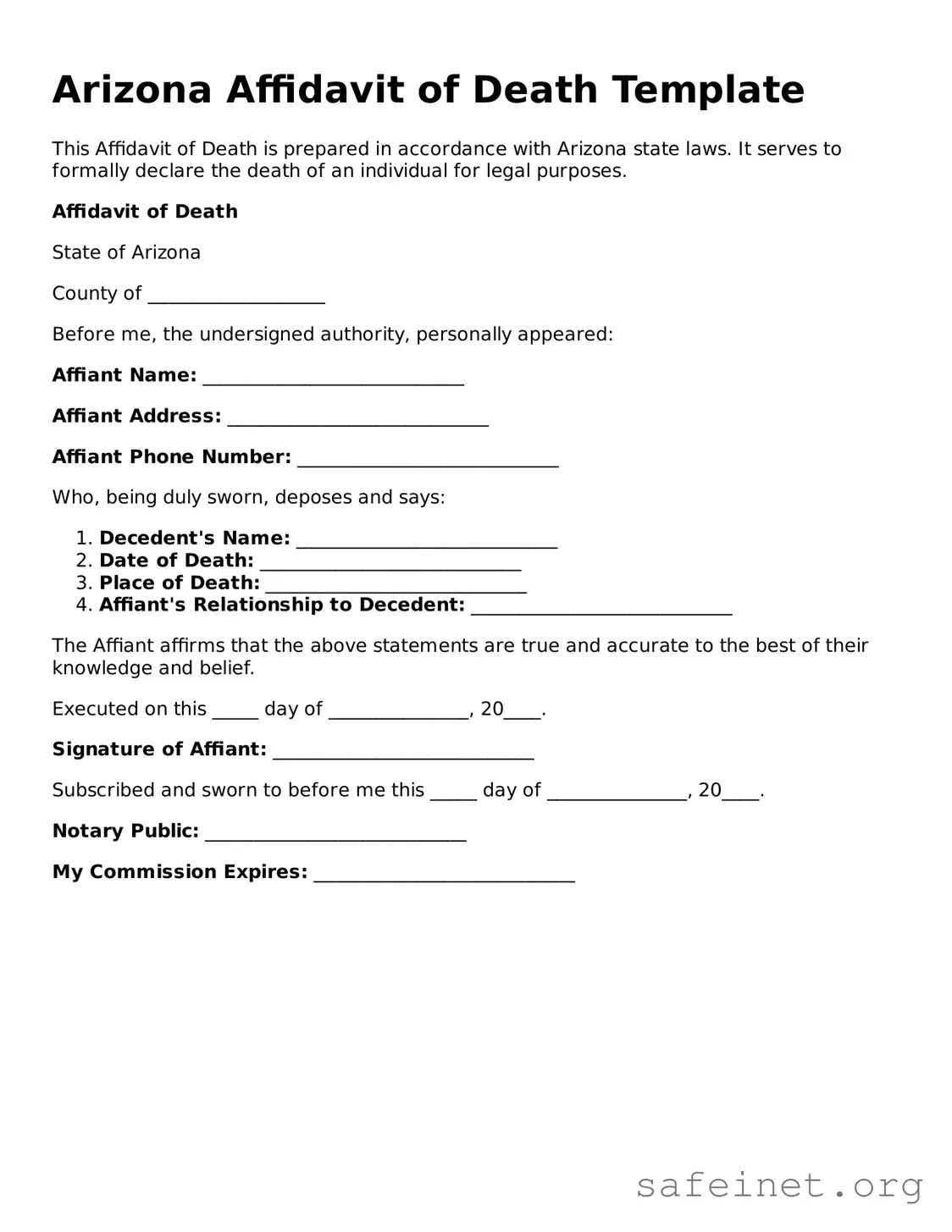
The Arizona Affidavit of Death form serves as an essential legal document in the aftermath of a loved one’s passing. This form is primarily used to officially declare an individual's death, which is crucial for settling their estate and transferring property ownership. It typically includes vital information such as the deceased person's full name, date of birth, date of death, and other pertinent details. By providing a sworn statement, the affiant—often a family member or close associate—attests to the accuracy of the information presented. This document not only helps facilitate the probate process but also serves as a means to clear any legal uncertainties regarding the deceased’s assets. Understanding the requirements and implications of the Arizona Affidavit of Death form is vital for those navigating the complexities of estate management during a challenging time.
Arizona Affidavit of Death Template
This Affidavit of Death is prepared in accordance with Arizona state laws. It serves to formally declare the death of an individual for legal purposes.
Affidavit of Death
State of Arizona
County of ___________________
Before me, the undersigned authority, personally appeared:
Affiant Name: ____________________________
Affiant Address: ____________________________
Affiant Phone Number: ____________________________
Who, being duly sworn, deposes and says:
The Affiant affirms that the above statements are true and accurate to the best of their knowledge and belief.
Executed on this _____ day of _______________, 20____.
Signature of Affiant: ____________________________
Subscribed and sworn to before me this _____ day of _______________, 20____.
Notary Public: ____________________________
My Commission Expires: ____________________________
| Fact Name | Details |
|---|---|
| Purpose | The Arizona Affidavit of Death is used to formally declare the death of an individual, often for the purpose of settling estates or transferring property. |
| Governing Law | This form is governed by Arizona Revised Statutes, specifically Title 14, which pertains to probate, trusts, and fiduciaries. |
| Who Can Use It | Any interested party, such as a family member or executor of the estate, can complete and file the affidavit. |
| Required Information | The form typically requires the deceased's full name, date of death, and details about the affiant (the person completing the form). |
| Filing Location | The affidavit must be filed with the county recorder’s office in the county where the deceased resided at the time of death. |
| Signature Requirement | The form must be signed by the affiant in the presence of a notary public to ensure its validity. |
| Legal Effect | Once filed, the affidavit serves as legal proof of death and can facilitate the transfer of assets without the need for probate. |
| Additional Documentation | It may be necessary to attach a certified copy of the death certificate when submitting the affidavit. |
After obtaining the Arizona Affidavit of Death form, the next step involves accurately filling it out to ensure proper processing. This document requires specific information about the deceased and the individual completing the affidavit. Following the steps below will help streamline the process.
Once the form is completed, it may need to be filed with the appropriate local government office or presented to other relevant parties, depending on the specific circumstances surrounding the death.
What is an Arizona Affidavit of Death form?
The Arizona Affidavit of Death form is a legal document used to officially declare the death of an individual. This form is typically utilized when a person passes away and their estate needs to be settled. It provides necessary information about the deceased, such as their full name, date of death, and other relevant details. This document can help facilitate the transfer of property and the settling of financial affairs without the need for a lengthy probate process.
Who can file an Affidavit of Death in Arizona?
In Arizona, any interested party can file an Affidavit of Death. This may include family members, heirs, or individuals who have a legal interest in the deceased's estate. It is important that the person filing the affidavit has knowledge of the facts surrounding the death and is able to provide accurate information.
What information is required on the Affidavit of Death form?
The Affidavit of Death form typically requires several key pieces of information. This includes the full name of the deceased, their date of birth, date of death, and the county where the death occurred. Additionally, the form may ask for the name and address of the person filing the affidavit, as well as any relevant details about the deceased’s estate or property.
Is the Affidavit of Death form filed with a court?
No, the Affidavit of Death form is not filed with a court. Instead, it is usually recorded with the county recorder's office where the deceased owned property. This recording serves as public notice of the individual’s death and helps to establish the legal status of the estate.
What is the purpose of the Affidavit of Death?
The primary purpose of the Affidavit of Death is to provide a legal declaration of an individual’s death, which can simplify the process of transferring assets and settling the estate. By recording this affidavit, interested parties can avoid the complexities of probate in many cases, especially when dealing with real estate or other significant assets.
Do I need a lawyer to complete the Affidavit of Death?
While it is not strictly necessary to hire a lawyer to complete the Affidavit of Death, it can be beneficial to consult with one. A lawyer can provide guidance on the process, ensure that the form is filled out correctly, and help navigate any potential issues that may arise during the estate settlement process.
What happens after the Affidavit of Death is filed?
Once the Affidavit of Death is filed with the county recorder's office, it becomes part of the public record. This allows other interested parties to verify the death and assists in the transfer of the deceased's assets. The estate can then proceed with settling debts and distributing property according to the deceased's wishes or state law.
Can the Affidavit of Death be contested?
Generally, an Affidavit of Death itself is not subject to contestation. However, disputes may arise regarding the deceased's estate or the validity of the will. If there are disagreements among heirs or beneficiaries, those issues would typically be addressed in probate court rather than through the affidavit itself.
Missing Signature: One common mistake is forgetting to sign the affidavit. This document requires a signature to be legally valid. Without it, the affidavit cannot be processed.
Incorrect Information: Providing inaccurate details about the deceased, such as the full name or date of death, can lead to delays or rejection of the affidavit. Always double-check the information before submission.
Not Including Required Attachments: Some individuals overlook the need to attach necessary documents, such as a death certificate. These attachments are often crucial for validating the affidavit.
Improper Notarization: Failing to have the affidavit properly notarized can invalidate it. A notary public must witness the signing of the document to ensure its authenticity.
Using Outdated Forms: People sometimes use outdated versions of the Affidavit of Death form. Always ensure you have the most current version to avoid complications.
Neglecting to Review State Requirements: Each state may have specific requirements for the affidavit. Not being aware of Arizona's unique regulations can lead to errors in the submission process.
When dealing with the passing of a loved one, various forms and documents may be required to ensure that their estate is settled properly. The Arizona Affidavit of Death form is a key document in this process, but it is often accompanied by other important paperwork. Below is a list of forms that may be used alongside the Affidavit of Death in Arizona.
Each of these forms plays a vital role in ensuring that the affairs of the deceased are handled appropriately. Understanding the purpose of each document can help simplify the process during a difficult time.
The Arizona Affidavit of Death form is similar to the Last Will and Testament. Both documents deal with the distribution of a deceased person's assets. A Last Will outlines how a person wishes their property to be divided after death, while the Affidavit of Death serves to officially confirm the death and facilitate the transfer of property without the need for probate. Both documents are crucial in ensuring that the deceased's wishes are respected and legally recognized.
Another related document is the Death Certificate. This official record is issued by a government authority and provides proof of death. While the Affidavit of Death may be used to transfer assets, the Death Certificate is often required to initiate that process. Both documents serve as essential legal proof of a person's passing, but the Death Certificate is more focused on the factual aspect of the death itself.
The Probate Petition also shares similarities with the Affidavit of Death. A Probate Petition is filed to begin the legal process of distributing a deceased person's estate. While the Affidavit of Death can help bypass some of the probate process for smaller estates, both documents are used in the context of settling an estate and ensuring that the deceased's affairs are properly managed.
The Affidavit of Heirship is another document that parallels the Affidavit of Death. This affidavit is used to establish the heirs of a deceased person when there is no will. It serves a similar purpose in identifying who has the right to inherit property. Both documents help clarify ownership and facilitate the transfer of assets to rightful heirs.
Additionally, the Certificate of Trust is comparable to the Affidavit of Death. A Certificate of Trust provides evidence of a trust's existence and outlines the authority of the trustee. In cases where a trust is involved, the Affidavit of Death may be used alongside the Certificate of Trust to ensure that assets held in the trust are properly managed and distributed after death.
The Living Will, while primarily focused on medical decisions, shares a thematic connection with the Affidavit of Death. Both documents reflect a person's wishes regarding their end-of-life circumstances. While the Living Will addresses healthcare preferences, the Affidavit of Death confirms the outcome of those preferences, marking the conclusion of life and the beginning of the legal processes that follow.
The Power of Attorney document is also relevant. This document allows an individual to designate someone else to make decisions on their behalf. While it is effective during a person's lifetime, it becomes void upon death. The Affidavit of Death then serves as a necessary document to transition from the authority granted by the Power of Attorney to the legal processes surrounding the deceased's estate.
Lastly, the Trust Distribution Request can be compared to the Affidavit of Death. This document is used when a trustee seeks to distribute assets from a trust after the death of the trustor. The Affidavit of Death serves as a prerequisite to this request, confirming that the trustor has passed away and allowing for the legal distribution of trust assets according to the terms established in the trust agreement.
When filling out the Arizona Affidavit of Death form, it is essential to approach the task with care and attention to detail. This document is crucial for the legal acknowledgment of a person's passing and can affect various aspects of estate management. Here are some important dos and don'ts to consider:
By following these guidelines, you can help ensure that the Affidavit of Death is filled out correctly and efficiently, allowing for a smoother transition during a challenging time.
When dealing with the Arizona Affidavit of Death form, it's common to encounter several misconceptions. Understanding the truth behind these can help ensure that the process goes smoothly and that you are well-informed. Here are seven common misconceptions:
By clarifying these misconceptions, individuals can navigate the process of using the Arizona Affidavit of Death more effectively and with greater confidence.
Here are some key takeaways regarding the Arizona Affidavit of Death form: