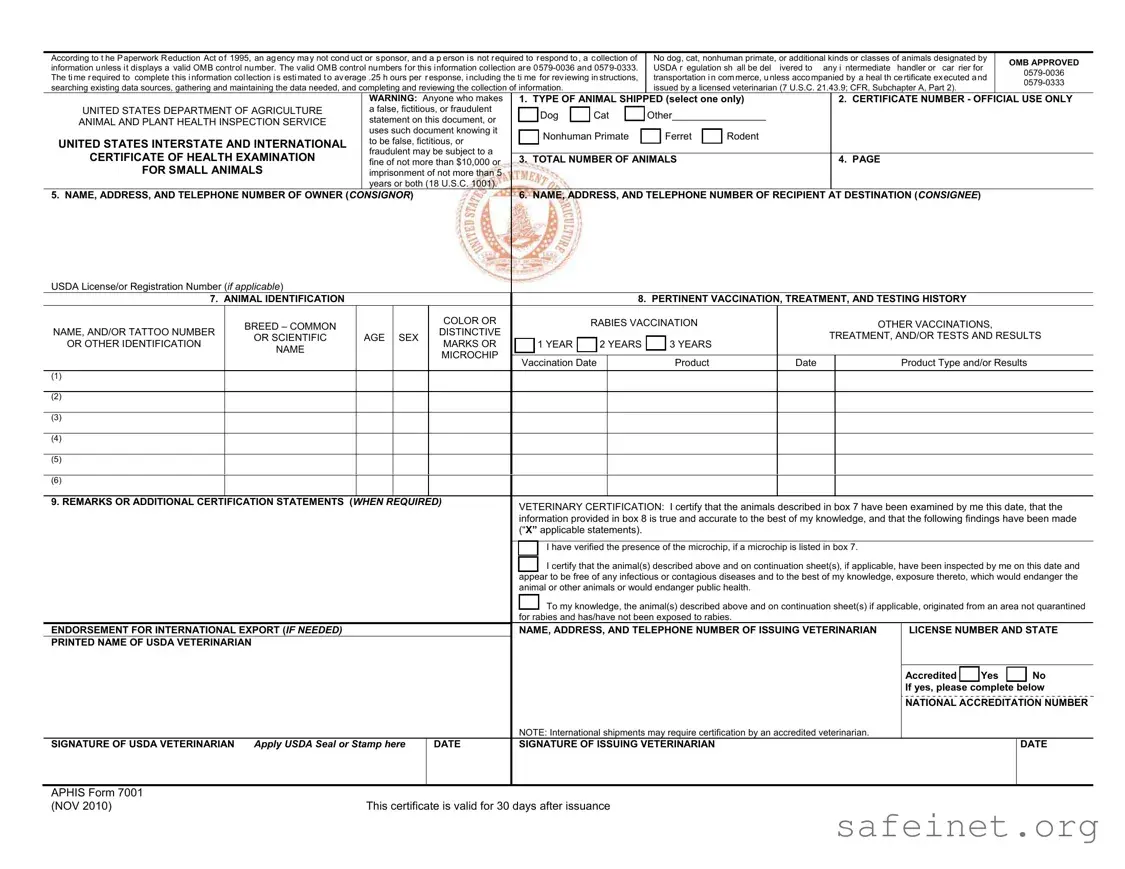
The Aphis 7001 form plays a crucial role in the transportation of certain animals across state lines and internationally. This certificate ensures that animals such as dogs, cats, and nonhuman primates are healthy and free from infectious diseases before they embark on their journey. It is important to note that this form must be accompanied by a health certificate issued by a licensed veterinarian, which outlines the animal's vaccination history and any treatments received. The form requires specific details, including the type of animal being shipped, the number of animals, and the contact information of both the owner and the recipient. Additionally, it includes sections for veterinary certification, ensuring that the information provided is accurate and that the animals have been properly examined. The Aphis 7001 form is not just a bureaucratic requirement; it is a safeguard for animal health and public safety. Completing this form takes an estimated 15 minutes, but the implications of accurate information are significant. Misrepresentation on the form can lead to severe penalties, including fines and imprisonment. Understanding the Aphis 7001 form is essential for anyone involved in the interstate or international transport of animals.
| Fact Name | Details |
|---|---|
| OMB Control Numbers | The valid OMB control numbers for the Aphis 7001 form are 0579-0036 and 0579-0333. |
| Completion Time | It is estimated that completing this information collection will take an average of 0.25 hours per response. |
| Legal Consequences | Providing false information on this form may lead to a fine of up to $10,000 or imprisonment for up to 5 years under 18 U.S.C. 1001. |
| Governing Law | This form is governed by 7 U.S.C. 21.43.9 and regulations in CFR, Subchapter A, Part 2. |
Filling out the APHIS 7001 form is a straightforward process, but accuracy is crucial. This form is essential for the transportation of certain animals, and it must be completed correctly to ensure compliance with regulations. Follow these steps to fill out the form properly.
Once you have completed the form, review it carefully for any errors or omissions. Ensure that all necessary signatures are in place before submitting it. This will help facilitate a smooth transportation process for the animals involved.
What is the purpose of the APHIS 7001 form?
The APHIS 7001 form serves as a health certificate for the interstate and international transportation of certain animals. This document is essential to ensure that animals being transported are free from infectious diseases and meet the health standards set by the USDA. It includes vital information about the animals, such as their species, identification, and vaccination history, and is typically required by both the sender and recipient of the animals.
Who is required to complete the APHIS 7001 form?
The form must be completed by a licensed veterinarian who has examined the animals being transported. This veterinarian is responsible for certifying that the animals are healthy and free from any contagious diseases. The owner or consignor of the animals also plays a role in providing accurate information about the animals on the form.
How long does it take to complete the APHIS 7001 form?
On average, it takes about 15 minutes, or 0.25 hours, to complete the APHIS 7001 form. This estimate includes time spent reviewing instructions, gathering necessary data, and filling out the form. It’s important to ensure that all information is accurate and complete to avoid any delays in the transportation process.
What happens if false information is provided on the APHIS 7001 form?
Providing false, fictitious, or fraudulent information on the APHIS 7001 form can lead to serious consequences. Individuals found guilty of such actions may face fines of up to $10,000 or imprisonment for up to five years, or both. This emphasizes the importance of honesty and accuracy when completing the form.
How long is the APHIS 7001 form valid?
The APHIS 7001 form is valid for 30 days from the date of issuance. If the transportation of the animals is not completed within this timeframe, a new form will need to be obtained to ensure compliance with health regulations.
Are there any specific animals that require the APHIS 7001 form?
The APHIS 7001 form is specifically required for the transport of certain animals, including dogs, cats, nonhuman primates, and other species as designated by the USDA. It’s crucial to check the current regulations to determine if your specific animal requires this form for transportation.
Failing to select the correct type of animal shipped. It’s crucial to choose only one option from the list provided.
Leaving the certificate number blank. This field is essential for official use and must be filled out accurately.
Not providing the total number of animals being shipped. This information is necessary for tracking and compliance.
Inaccurately filling out the owner's and recipient's information. Ensure that names, addresses, and phone numbers are correct.
Overlooking the animal identification details. Include breed, age, sex, and any distinctive marks or microchip numbers.
Neglecting to document the pertinent vaccination and treatment history. This information is vital for health compliance.
Failing to sign and date the veterinary certification. This signature confirms that the information provided is accurate.
Not including any necessary remarks or additional certification statements. If required, these must be clearly stated.
Ignoring the need for an endorsement for international export if applicable. This may be necessary for shipments outside the U.S.
Submitting the form without verifying the OMB control number. Ensure that it displays a valid number to avoid delays.
The APHIS Form 7001 is a critical document used for the interstate and international transport of certain animals. However, it is often accompanied by other forms and documents to ensure compliance with regulations and to facilitate the movement of animals. Below is a list of additional documents that are commonly used alongside the APHIS Form 7001.
Each of these documents plays a vital role in the safe and legal transport of animals. Ensuring that all necessary paperwork is completed accurately can help prevent delays and potential legal issues during the transportation process.
The APHIS 7001 form is similar to the USDA Health Certificate, which is required for the interstate transport of animals. This document serves to verify that the animal has been examined by a licensed veterinarian and is free from diseases. Both forms require detailed information about the animal, including its identification, vaccination history, and the contact details of the owner and recipient. The USDA Health Certificate also emphasizes compliance with regulations to ensure the health and safety of animals during transport.
Another document comparable to the APHIS 7001 is the Veterinary Health Certificate. This certificate is often needed for international travel with pets and serves a similar purpose. Like the APHIS 7001, it requires a veterinarian's endorsement to confirm the animal's health status and vaccination records. The Veterinary Health Certificate is crucial for ensuring that animals meet the health standards of the destination country, just as the APHIS 7001 ensures compliance within the U.S.
The Certificate of Veterinary Inspection (CVI) is also akin to the APHIS 7001. This document is often required for livestock and other animals moving between states. It provides a comprehensive health assessment and includes details about vaccinations and treatments. Both the CVI and the APHIS 7001 are designed to prevent the spread of disease and ensure that animals are healthy before they are transported.
The International Animal Health Certificate (IAHC) is another document that shares similarities with the APHIS 7001. This certificate is specifically used for animals being exported to other countries. It requires a thorough examination by a veterinarian, similar to the APHIS 7001. Both documents aim to certify the health status of animals and ensure compliance with international health regulations.
The Animal Movement Permit can also be compared to the APHIS 7001 form. This permit is often required for the movement of animals across state lines and may involve health inspections. Like the APHIS 7001, it serves to document the health status of the animals and prevent the spread of disease. Both forms facilitate safe and regulated animal transport.
Lastly, the Import Permit for Animals is similar to the APHIS 7001 in that it is necessary for bringing animals into the U.S. This permit outlines health requirements that must be met before an animal can enter the country. Both documents require detailed health information and aim to protect public health and animal welfare during transportation.
When filling out the APHIS 7001 form, attention to detail is crucial. Here are five things you should and shouldn't do to ensure the process goes smoothly.
By following these guidelines, you can help ensure that your submission is processed efficiently and correctly. Remember, attention to detail can save you time and potential issues down the road.
Understanding the Aphis 7001 form is essential for anyone involved in the transportation of certain animals. However, several misconceptions can lead to confusion. Here are ten common misconceptions about the Aphis 7001 form, along with clarifications for each:
The Aphis 7001 form is specifically required for the interstate and international shipment of certain animals, such as dogs, cats, and nonhuman primates. Not all animals need this form.
While a licensed veterinarian must certify the health of the animals, the form can be filled out by the owner or an authorized representative. It is crucial to ensure all information is accurate.
The Aphis 7001 form is valid for 30 days from the date of issuance. This means it can be used for multiple shipments within that timeframe, as long as the animals meet health requirements.
A health certificate, executed by a licensed veterinarian, is mandatory for the shipment of animals. This certificate ensures that the animals are free from infectious diseases.
Providing false information on the Aphis 7001 form can result in severe penalties, including fines up to $10,000 or imprisonment for up to five years.
The form allows for the shipment of multiple animals, as long as their details are accurately provided in the designated sections.
If a microchip is listed for an animal, it must be verified by the veterinarian. This helps in identifying the animal and ensuring its health records are accurate.
While the Aphis 7001 form is a federal requirement, individual states may have additional regulations or requirements for animal shipments. Always check state-specific rules.
After submission, it is essential to keep a copy of the form and any related documents for your records. This can be useful in case of any inquiries or issues during transportation.
This form is required for both interstate and international shipments of certain animals. It is not limited to international transport.
Being aware of these misconceptions can help ensure compliance with regulations and facilitate smoother animal shipments.
Here are key takeaways for filling out and using the APHIS 7001 form: