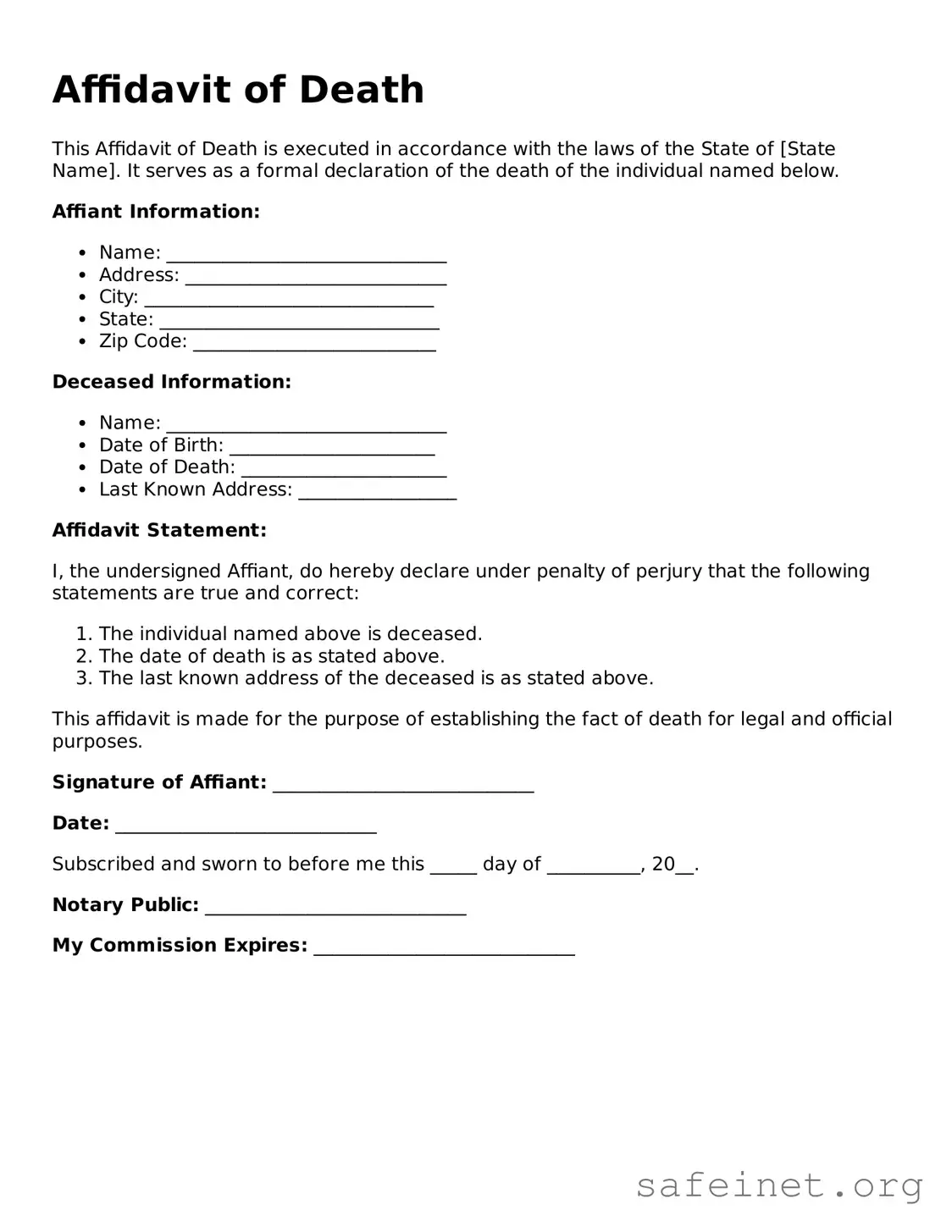
When a loved one passes away, navigating the legal landscape can feel overwhelming, especially when it comes to handling their estate. One important document that often comes into play is the Affidavit of Death form. This form serves as a sworn statement that confirms an individual's death, providing essential information such as the deceased's name, date of death, and other identifying details. It is typically used to facilitate the transfer of assets and settle affairs, particularly when a will is not present or when the estate is small. By filing this affidavit, heirs and beneficiaries can assert their rights to inherit property and access financial accounts without the need for lengthy probate proceedings. Understanding how to properly complete and submit this form can ease the burden during a difficult time, ensuring that the deceased's wishes are honored and their estate is managed efficiently.
Affidavit of Death
This Affidavit of Death is executed in accordance with the laws of the State of [State Name]. It serves as a formal declaration of the death of the individual named below.
Affiant Information:
Deceased Information:
Affidavit Statement:
I, the undersigned Affiant, do hereby declare under penalty of perjury that the following statements are true and correct:
This affidavit is made for the purpose of establishing the fact of death for legal and official purposes.
Signature of Affiant: ____________________________
Date: ____________________________
Subscribed and sworn to before me this _____ day of __________, 20__.
Notary Public: ____________________________
My Commission Expires: ____________________________
| Fact Name | Description |
|---|---|
| Definition | An Affidavit of Death is a legal document that confirms an individual's death, often used to settle estates or transfer property. |
| Purpose | This form is typically used to provide evidence of death for financial institutions, government agencies, and courts. |
| State-Specific Forms | Each state may have its own version of the Affidavit of Death. For example, California's form is governed by the California Probate Code. |
| Signature Requirement | The affidavit must be signed by a person with knowledge of the death, often a family member or executor of the estate. |
| Notarization | Most states require the affidavit to be notarized to ensure its authenticity. |
| Legal Implications | Filing a false affidavit can lead to legal consequences, including potential criminal charges. |
After gathering the necessary information, the next step involves completing the Affidavit of Death form accurately. This document requires specific details about the deceased individual, as well as the affiant, who is the person completing the form. Ensure all information is correct to avoid any delays in processing.
What is an Affidavit of Death?
An Affidavit of Death is a legal document that confirms the death of an individual. It is typically used to settle the affairs of the deceased, such as transferring property or settling debts. This document serves as official proof of death for various legal and administrative purposes.
Who can complete an Affidavit of Death?
The Affidavit of Death can be completed by an individual who has personal knowledge of the deceased’s death. This is often a family member, close friend, or an executor of the deceased's estate. It is important that the person completing the affidavit is able to provide accurate information and attest to the facts surrounding the death.
What information is required in the Affidavit of Death?
Typically, the Affidavit of Death will require the full name of the deceased, the date of death, and the place of death. Additional details may include the deceased's Social Security number, date of birth, and information about the affiant, such as their relationship to the deceased and contact information.
Is the Affidavit of Death a public document?
Yes, once filed with the appropriate authority, the Affidavit of Death becomes a public record. This means that it can be accessed by anyone who requests it, subject to local laws and regulations regarding public records.
Where do I file the Affidavit of Death?
The Affidavit of Death should be filed with the appropriate court or governmental agency in the jurisdiction where the deceased lived or where the death occurred. This may include probate court, county clerk's office, or other relevant authorities. It is advisable to check local requirements to ensure proper filing.
Do I need to have the Affidavit of Death notarized?
Yes, most jurisdictions require the Affidavit of Death to be notarized. This means that the affiant must sign the document in the presence of a notary public, who will then verify the identity of the signer and affix their seal. Notarization adds an extra layer of authenticity to the document.
What happens after I file the Affidavit of Death?
After filing, the Affidavit of Death will be processed by the relevant authority. It may be used to update property titles, settle bank accounts, and address other legal matters related to the deceased's estate. It is important to keep copies of the filed affidavit for personal records and future reference.
Can I contest an Affidavit of Death?
Yes, if there are grounds to contest the validity of the Affidavit of Death, interested parties may do so. This could involve proving that the information in the affidavit is incorrect or that the affiant did not have the authority to make the statement. Legal advice may be necessary to navigate this process effectively.
Incomplete Information: Many individuals fail to provide all the required details, such as the deceased's full name, date of birth, and date of death. This can lead to delays or rejections.
Incorrect Dates: Entering the wrong dates can create confusion. Ensure that the dates of birth and death are accurate and formatted correctly.
Not Signing the Document: A common oversight is neglecting to sign the affidavit. Without a signature, the form is invalid.
Missing Witnesses: In some jurisdictions, affidavits must be witnessed. Failing to have the required number of witnesses can invalidate the document.
Improper Notarization: If notarization is required, ensure that the notary public follows the proper procedures. An improperly notarized document may not be accepted.
Using Outdated Forms: Laws and forms can change. Using an outdated version of the affidavit may lead to complications. Always check for the latest version.
Providing Incorrect Identification: When submitting the affidavit, you may need to provide identification. Make sure the ID is valid and matches the information on the form.
Neglecting to Review: Failing to double-check the form for errors before submission can result in mistakes going unnoticed, which may cause delays.
Not Keeping Copies: After submitting the affidavit, it’s wise to keep a copy for your records. This can be crucial for future reference or disputes.
When navigating the process of handling a deceased person's affairs, several important documents are often required alongside the Affidavit of Death form. Each of these documents serves a specific purpose and can help facilitate the necessary legal and administrative actions that follow the passing of an individual.
Understanding these documents can ease the burden during a difficult time. Each plays a crucial role in ensuring that the deceased's affairs are handled respectfully and according to their wishes.
The Affidavit of Death is similar to a Death Certificate. A Death Certificate is an official document issued by a government authority that confirms the date, location, and cause of a person's death. Both documents serve to provide legal proof of a person's passing, which can be necessary for settling estates, claiming life insurance, or addressing other legal matters. While a Death Certificate is typically required for formal processes, the Affidavit of Death can be used in situations where a sworn statement is acceptable.
An Affidavit of Heirship shares similarities with the Affidavit of Death. This document is used to establish the legal heirs of a deceased person, particularly when there is no will. Like the Affidavit of Death, it is a sworn statement and can help clarify inheritance issues. Both documents are often used in probate proceedings to facilitate the distribution of a deceased person's assets.
The Statement of Death is another document that resembles the Affidavit of Death. This statement is often used in insurance claims and financial matters to notify institutions of an individual's death. While it may not carry the same legal weight as an affidavit, it serves a similar purpose by providing information regarding the deceased's passing, allowing for the processing of claims and other related actions.
A Will can also be compared to the Affidavit of Death. While a Will outlines how a person's assets should be distributed after their death, the Affidavit of Death serves to confirm that the individual has indeed passed away. Both documents are crucial in the estate planning process and can play significant roles in probate court, although they serve different functions.
The Certificate of Death Registration is akin to the Affidavit of Death in that it is a formal record of death. This document is typically filed with a state or local government agency and serves as an official acknowledgment of a person's death. Like the Affidavit, it is necessary for various legal and administrative purposes, including settling estates and claiming benefits.
A Power of Attorney can also be compared to the Affidavit of Death, though in a different context. While a Power of Attorney grants someone the authority to act on behalf of another person, it becomes void upon the death of the individual. The Affidavit of Death is then used to formally declare that the individual has passed away, effectively terminating the authority granted by the Power of Attorney.
Lastly, a Probate Petition is another document that has similarities with the Affidavit of Death. A Probate Petition is filed with the court to initiate the probate process for a deceased person's estate. The Affidavit of Death may be included as part of the documentation to establish that the individual has died, thus allowing the court to proceed with the distribution of assets according to the Will or state law.
Filling out the Affidavit of Death form can seem daunting, but knowing what to do and what to avoid can make the process smoother. Here’s a handy list to guide you through it:
By following these guidelines, you can confidently navigate the Affidavit of Death form. Remember, attention to detail is key!
The Affidavit of Death form is often misunderstood, leading to confusion for those who need to use it. Here are five common misconceptions:
Many believe the affidavit is only necessary in the context of probate proceedings. However, it can also be used for various purposes, such as transferring property or closing bank accounts.
While it may seem straightforward, the affidavit must typically be completed by someone with personal knowledge of the deceased's death. This often means a family member or close friend.
This form does not replace an official death certificate. Instead, it serves as a supplementary document that may be used alongside the death certificate for certain legal processes.
In most cases, filing the affidavit is a relatively quick process. Once completed, it can often be submitted directly to the relevant institution or agency without extensive delays.
While the format and requirements may vary, the concept of an affidavit of death exists in many states. It is important to check local laws to ensure compliance.
When dealing with the Affidavit of Death form, it's important to understand its purpose and how to fill it out correctly. Here are some key takeaways to keep in mind:
Understanding these points can help streamline the process of using the Affidavit of Death form and ensure that it meets all legal requirements.