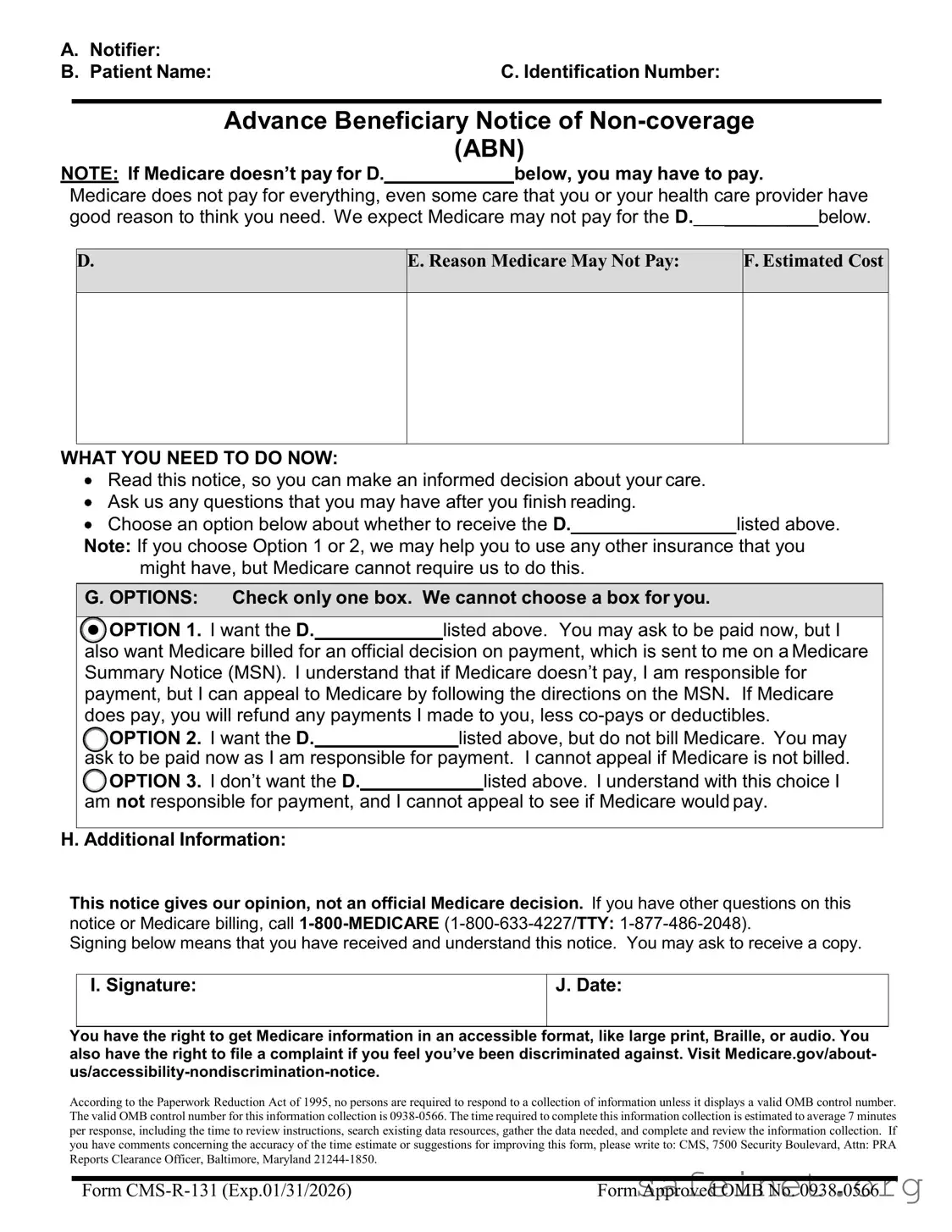
The Advance Beneficiary Notice of Non-coverage, commonly referred to as the ABN, serves as a crucial communication tool between healthcare providers and Medicare beneficiaries. This form is particularly important in situations where a provider believes that a specific service or item may not be covered by Medicare. By issuing an ABN, the provider informs the beneficiary of the potential for non-coverage, thereby allowing the patient to make informed decisions regarding their healthcare options. The form outlines the reasons for the anticipated denial, offers the patient the choice to proceed with the service or forgo it, and clarifies the financial implications should Medicare deny coverage. Importantly, the ABN must be filled out correctly and provided in a timely manner to ensure that beneficiaries understand their rights and responsibilities. This proactive approach not only fosters transparency in the healthcare process but also empowers patients to engage actively in their own care, potentially avoiding unexpected medical bills. As such, the ABN is not merely a bureaucratic requirement; it is a vital component of patient-centered care that underscores the importance of informed consent and financial awareness in the realm of healthcare services.
| Fact Name | Description |
|---|---|
| Purpose | The Advance Beneficiary Notice of Non-coverage (ABN) informs Medicare beneficiaries that a service may not be covered. |
| When to Use | Providers must issue an ABN when they believe a service will not be reimbursed by Medicare. |
| Beneficiary Rights | Beneficiaries have the right to receive the ABN before the service is provided, allowing them to make informed decisions. |
| State-Specific Forms | Some states may have their own versions of the ABN, governed by local laws. Always check state regulations. |
| Signature Requirement | Beneficiaries must sign the ABN to acknowledge understanding of the potential non-coverage. |
| Documentation | Providers should keep a copy of the signed ABN in the beneficiary's medical record for compliance purposes. |
| Impact on Payment | If a beneficiary receives a service after signing an ABN, they may be responsible for payment if Medicare denies coverage. |
After you have the Advance Beneficiary Notice of Non-coverage form in front of you, it's time to fill it out accurately. This form is crucial for your healthcare process, and completing it correctly will help ensure that you understand your coverage options.
Once you have filled out the form, submit it to your healthcare provider or the appropriate Medicare office. Keep an eye on any correspondence you receive regarding your submission.
What is the Advance Beneficiary Notice of Non-coverage (ABN)?
The Advance Beneficiary Notice of Non-coverage, commonly known as the ABN, is a form used by healthcare providers to inform Medicare beneficiaries that a specific service or item may not be covered by Medicare. This notice allows patients to understand their potential financial responsibility before receiving the service.
When should an ABN be provided?
An ABN should be provided when a healthcare provider believes that Medicare may not cover a service or item. This typically occurs when the provider has reason to think that the service is not medically necessary, is not covered under Medicare rules, or is deemed experimental. It is crucial for beneficiaries to receive this notice before the service is rendered.
What should I do if I receive an ABN?
If you receive an ABN, carefully review the information provided. The form will outline the service in question, the reason for the non-coverage, and your options. You can choose to either accept responsibility for payment if the service is not covered or decline the service. Make sure to ask your provider any questions you may have to clarify your options.
Will I be charged for services if I sign the ABN?
Signing the ABN does not guarantee that you will be charged for the service. It indicates that you understand that Medicare may not cover the service. If you choose to proceed with the service, you may be billed for it if Medicare denies coverage. Always confirm with your provider about the potential costs involved.
Can I appeal a decision if Medicare denies coverage after I received an ABN?
Yes, you can appeal a Medicare coverage denial even after signing an ABN. If you believe that the service should be covered, you have the right to request a review of the decision. Follow the instructions on the denial notice for the appeals process, and gather any necessary documentation to support your case.
Is there a time limit for using the ABN?
There is no specific time limit for using the ABN itself; however, it is essential to act promptly if you decide to appeal a Medicare denial. Generally, you must submit your appeal within 120 days of receiving the denial notice. Keep in mind that the ABN is only valid for the specific service or item it addresses.
Incomplete Information: One common mistake is not providing all the required information. Ensure that every section is filled out completely. Missing details can lead to delays or denials of coverage.
Incorrect Dates: Entering the wrong dates can create confusion. Make sure to double-check the dates you provide, especially the service dates and the date you sign the form.
Not Understanding the Notice: Some individuals fail to read the notice carefully. It’s important to understand what services are not covered and why. This knowledge can help in making informed decisions regarding your healthcare.
Ignoring Signature Requirements: Failing to sign the form is a frequent oversight. Always remember to sign and date the form where indicated. A missing signature can render the form invalid.
The Advance Beneficiary Notice of Non-coverage (ABN) is an important document that notifies Medicare beneficiaries when a service may not be covered. However, several other forms and documents are often used in conjunction with the ABN to ensure clarity and compliance. Below is a list of these forms and a brief description of each.
Understanding these documents is essential for both healthcare providers and beneficiaries. They help navigate the complexities of Medicare coverage and ensure that patients are well-informed about their rights and responsibilities.
The Advance Beneficiary Notice of Non-coverage (ABN) form is similar to the Medicare Outpatient Observation Notice (MOON). Both documents serve to inform beneficiaries about their coverage status. The MOON specifically addresses situations where a patient is under observation status in a hospital, which may not be covered by Medicare. Like the ABN, the MOON provides patients with essential information about their rights and the potential financial responsibilities they may face if services are not covered. This transparency helps patients make informed decisions about their care.
The Notice of Exclusion from Medicare Benefits (NEMB) is another document akin to the ABN. This notice is issued when a service or item is not covered by Medicare. It clearly outlines the reasons for the exclusion, helping beneficiaries understand why they may be responsible for costs. Similar to the ABN, the NEMB emphasizes the importance of patient awareness regarding their healthcare expenses, ensuring they are not caught off guard by unexpected bills.
The Medicare Summary Notice (MSN) also shares similarities with the ABN. The MSN is a quarterly statement that summarizes the services received by a beneficiary, detailing what Medicare paid and what the beneficiary owes. While the ABN is proactive, informing patients before services are rendered, the MSN is retrospective. Both documents aim to keep beneficiaries informed about their coverage and any potential costs associated with their care.
The Important Message from Medicare (IM) is another relevant document. This notice is provided to patients upon admission to a hospital and explains their rights regarding Medicare coverage. It informs beneficiaries about their right to appeal if they believe they should receive coverage for their hospital stay. Like the ABN, the IM emphasizes the importance of understanding one's rights and the financial implications of healthcare decisions.
The Skilled Nursing Facility (SNF) Advance Beneficiary Notice is closely related to the ABN as well. This notice is used when a patient is in a skilled nursing facility and there is uncertainty about coverage for continued care. It informs beneficiaries that Medicare may not pay for certain services, allowing them to make informed choices about their treatment options. Both notices aim to clarify coverage issues and promote transparency in healthcare billing.
Lastly, the Home Health Agency (HHA) Notice of Non-coverage is similar to the ABN in its purpose. This notice is given to patients receiving home health services when those services may not be covered by Medicare. It informs patients about their rights and the potential costs they may incur. Like the ABN, the HHA notice is crucial for ensuring that patients understand their coverage and can make informed decisions regarding their healthcare.
When filling out the Advance Beneficiary Notice of Non-coverage (ABN) form, it's essential to ensure accuracy and clarity. Here are some key points to consider:
The Advance Beneficiary Notice of Non-coverage (ABN) form is an important document in the Medicare system, yet several misconceptions surround it. Here are nine common misunderstandings:
Many people believe that ABNs apply solely to those enrolled in Medicare. In reality, while ABNs are primarily used in Medicare, they can also be relevant in certain situations involving other insurance plans.
Some think that signing an ABN automatically means they will have to pay for the service. However, signing the form indicates that you have been informed about potential non-coverage, but it does not guarantee that you will be billed.
It is a common belief that ABNs are only necessary for costly procedures. In fact, an ABN can be issued for any service that may not be covered, regardless of the cost.
Some assume that healthcare providers can choose whether or not to issue an ABN. In truth, providers are required to issue an ABN when they believe that a service may not be covered by Medicare.
Many people think ABNs are only relevant when a claim is denied. However, they are also used proactively to inform patients about potential non-coverage before services are rendered.
There is a misconception that ABNs serve the same purpose as a waiver of liability. While both documents inform patients about potential costs, an ABN specifically addresses Medicare coverage issues.
Some believe that signing an ABN waives their right to appeal a payment decision. This is incorrect; patients can still appeal if they feel the service should have been covered.
It is a common misconception that ABNs are limited to specific medical services. In reality, they can be issued for a wide range of services that may not be covered by Medicare.
While some find ABNs complicated, they serve an important purpose. They help ensure that patients are informed about their coverage options and potential costs, allowing for better financial planning.
Understanding these misconceptions can help beneficiaries navigate their healthcare options more effectively. Always feel free to ask your healthcare provider for clarification if you have questions about the ABN process.
The Advance Beneficiary Notice of Non-coverage (ABN) form is an important document for Medicare beneficiaries. Here are some key takeaways regarding its use: