Homepage > Blank Ada Dental Claim Template
Article Structure

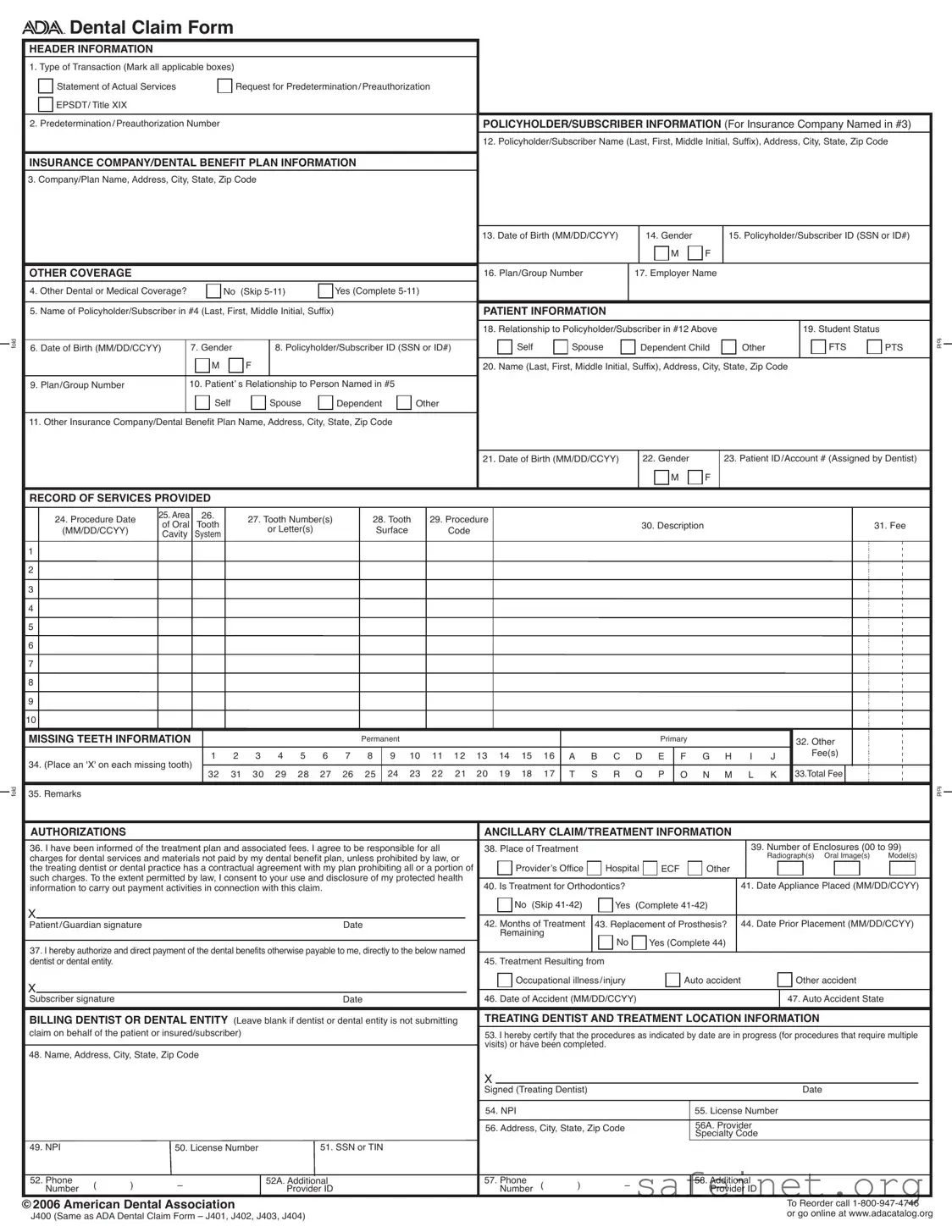
The ADA Dental Claim Form serves as a vital document in the process of submitting dental claims to insurance companies and dental benefit plans. It encompasses several key sections that gather essential information about the transaction type, policyholder, patient, and the services rendered. The form begins with header information, where individuals indicate the type of transaction, such as a statement of actual services or a request for predetermination. Following this, the policyholder's details are captured, including their name, address, and insurance information. Additional sections address other coverage that may exist, alongside patient-specific information like their relationship to the policyholder and their demographic details. The record of services provided is a crucial part of the form, detailing the procedures performed, associated fees, and any missing teeth information. The ADA Dental Claim Form also includes authorizations and ancillary treatment information, ensuring that all necessary consents are obtained for the processing of claims. Proper completion of this form is essential, as it streamlines the claims process and facilitates timely reimbursement for dental services rendered.
Form Sample

Dental Claim Form
1. Type of Transaction (Mark all applicable boxes)
EPSDT/ Title XIX
HEADER INFORMATION
OTHER COVERAGE
Statement of Actual Services Request for Predetermination / Preauthorization
© 2006 American Dental Association
MISSING TEETH INFORMATION
34. (Place an 'X' on each missing tooth)
35. Remarks
J400 (Same as ADA Dental Claim Form – J401, J402, J403, J404)
To Reorder call 1-800-947-4746
or go online at www.adacatalog.org
1 2 3 4 5 6 7 8
32 31 30 29 28 27 26 25
24 23 22 2 1 20 19 18 17
9 10 11 12 13 14 15 16
A B C D E F G H I J
T S R Q P
O N M L K
Permanent
Primary
32. Other
Fee(s)
33.Total Fee
24. Procedure Date
(MM/DD/CCYY)
25. Area
of Oral
Cavity
26.
Tooth
System
27. Tooth Number(s)
or Letter(s)
28. Tooth
Surface
29. Procedure
Code
30. Description 31. Fee
fold
RECORD OF SERVICES PROVIDED
TREATING DENTIST AND TREATMENT LOCATION INFORMATION
BILLING DENTIST OR DENTAL ENTITY
(Leave blank if dentist or dental entity is not submitting
claim on behalf of the patient or insured/subscriber)
PATIENT INFORMATION
18. Relationship to Policyholder/Subscriber in #12 Above 19. Student Status
Self Spouse
Dependent Child Other
20. Name (Last, First, Middle Initial, Suffix), Address, City, State, Zip Code
21. Date of Birth (MM/DD/CCYY)
23. Patient ID/Account # (Assigned by Dentist)
22. Gender
M
F
INSURANCE COMPANY/DENTAL BENEFIT PLAN INFORMATION
3. Company/Plan Name, Address, City, State, Zip Code
5. Name of Policyholder/Subscriber in #4 (Last, First, Middle Initial, Suffix)
11. Other Insurance Company/Dental Benefit Plan Name, Address, City, State, Zip Code
4. Other Dental or Medical Coverage?
48. Name, Address, City, State, Zip Code
56. Address, City, State, Zip Code
54. NPI 55. License Number
49. NPI
( ) –
( ) –
50. License Number
51. SSN or TIN
Yes (Complete 5-11)
No (Skip 5-11)
53. I hereby certify that the procedures as indicated by date are in progress (for procedures that require multiple
visits) or have been completed.
Signed (Treating Dentist)
Date
X
fold
fold
fold
2. Predetermination / Preauthorization Number
ANCILLARY CLAIM/ TREATMENT INFORMATION
41. Date Appliance Placed (MM/DD/CCYY)
44. Date Prior Placement (MM/DD/CCYY)
42. Months of Treatment
Remaining
No
Yes (Complete 44)
38. Place of Treatment
43. Replacement of Prosthesis?
39. Number of Enclosures (00 to 99)
Radiograph(s)
Oral Image(s) Model(s)
Yes (Complete 41-42)
No (Skip 41-42)
40. Is Treatment for Orthodontics?
Provider’s Office
Hospital
ECF Other
45. Treatment Resulting from
47. Auto Accident State
46. Date of Accident (MM/DD/CCYY)
Occupational illness/ injury
Auto accident
Other accident
AUTHORIZATIONS
36. I have been informed of the treatment plan and associated fees. I agree to be responsible for all
charges for dental services and materials not paid by my dental benefit plan, unless prohibited by law, or
the treating dentist or dental practice has a contractual agreement with my plan prohibiting all or a portion of
such charges. To the extent permitted by law, I consent to your use and disclosure of my protected health
information to carry out payment activities in connection with this claim.
Date
Patient /Guardian signature
X
37.
I hereby authorize and direct payment of the dental benefits otherwise payable to me, directly to the below named
dentist or dental entity.
Date
Subscriber signature
X
58. Additional
Provider ID
FTS
PTS
1
2
3
4
5
6
7
8
9
10
6. Date of Birth (MM/DD/CCYY)
8. Policyholder/Subscriber ID (SSN or ID#)
7. Gender
M
F
9. Plan/Group Number
10. Patient’ s Relationship to Person Named in #5
Self Spouse
Dependent Other
POLICYHOLDER/SUBSCRIBER INFORMATION (For Insurance Company Named in #3)
12. Policyholder/Subscriber Name (Last, First, Middle Initial, Suffix), Address, City, State, Zip Code
13. Date of Birth (MM/DD/CCYY)
15. Policyholder/Subscriber ID (SSN or ID#)
14. Gender
M
F
16. Plan/Group Number 17. Employer Name
52A. Additional
Provider ID
56A. Provider
Specialty Code
52. Phone
Number
57. Phone
Number
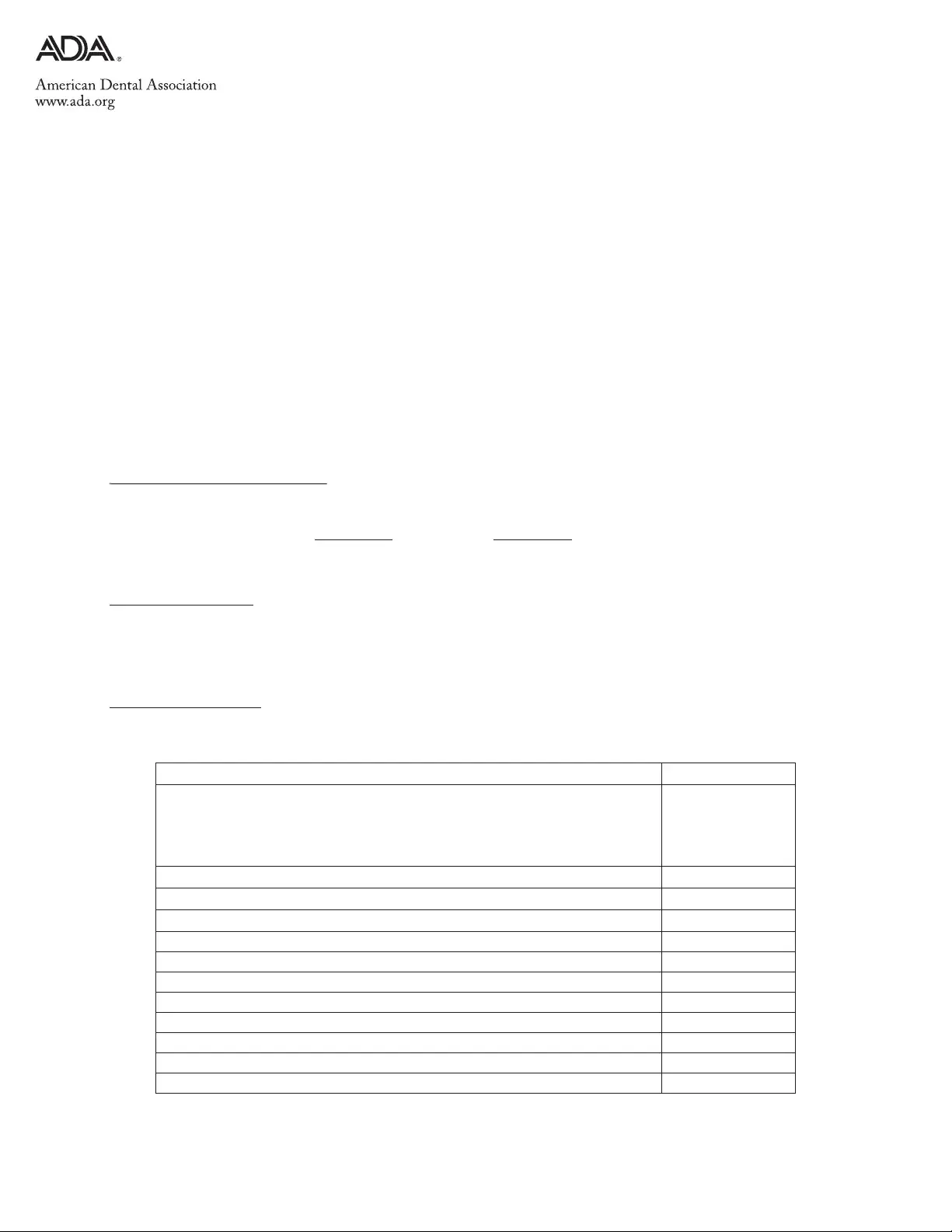
Comprehensive completion instructions for the ADA Dental Claim Form are found in Section 4 of the ADA Publication titled CDT-2007/2008.
Five relevant extracts from that section follow:
GENERAL INSTRUCTIONS
A. The form is designed so that the name and address (Item 3) of the third-party payer receiving the claim (insurance company/dental 
benefit plan) is visible in a standard #10 window envelope. Please fold the form using the ‘tick-marks’ printed in the margin.
B.  In the upper-right of the form, a blank space is provided for the convenience of the payer or insurance company, to allow the 
assignment of a claim or control number.
C. 
All Items in the form must be completed unless it is noted on the form or in the following instructions that completion is not required.
D. 
When a name and address field is required, the full name of an individual or a full business name, address and zip code must be entered.
E.  All dates must include the four-digit year.
F.  If the number of procedures reported exceeds the number of lines available on one claim form, the remaining procedures must be 
listed on a separate, fully completed claim form.
COORDINATION OF BENEFITS (COB)
When a claim is being submitted to the secondary payer, complete the form in its entirety and attach the primary payers Explanation of Benefits
(EOB) showing the amount paid by the primary payer. You may indicate the amount the primary carrier paid in the “Remarks” field (Item # 35).
NATIONAL PROVIDER IDENTIFIER (NPI)
49 and 54 NPI (National Provider Indentifier): This is an identifier assigned by the Federal government to all providers considered to be
HIPAA covered entities. Dentists who are not covered entities may elect to obtain an NPI at their discretion, or may be
enumerated if required by a participating provider agreement with a third-party payer or applicable state law/regulation. An NPI
is unique to an individual dentist (Type 1 NPI) or dental entity (Type 2 NPI), and has no intrinsic meaning. Additional information
on NPI and enumeration can be obtained from the ADAs Internet Web Site: www.ada.org/goto/npi
ADDITIONAL PROVIDER IDENTIFIER
52A and 58
Additional Provider ID: This is an identifier assigned to the billing dentist or dental entity other than a Social Security
Number (SSN) or Tax Identification Number (TIN). It is not the providers NPI. The additional identifier is sometimes referred
to as a Legacy Identifier (LID). LIDs may not be unique as they are assigned by different entities (e.g., third-party payer; Federal
government). Some Legacy IDs have an intrinsic meaning.
PROVIDER SPECIALTY CODES
56A Provider Specialty Code: Enter the code that indicates the type of dental professional who delivered the treatment. Available
codes describing treating dentists are listed below. The general code listed as ‘Dentist’ may be used instead of any other dental
practitioner code.
Category / Description Code Code
A dentist is a person qualified by a doctorate in dental surgery (D.D.S)
or dental medicine (D.M.D.) licensed by the state to practice dentistry,
and practicing within the scope of that license.
Dentist
122300000X
General Practice
1223G0001X
Dental Specialty (see following list)
Dental Public Health
Endodontics
Orthodontics
Pediatric Dentistry
Periodontics
Prosthodontics
Oral & Maxillofacial Pathology
Oral & Maxillofacial Radiology
Oral & Maxillofacial Surgery
Various
1223D0001X
1223E0200X
1223X0400X
1223P0221X
1223P0300X
1223P0700X
1223P0106X
1223D0008X
1223S0112X
Should there be any updates to ADA Dental Claim Form completion instructions, the updates will be posted on the ADAs web site at:
www.ada.org/goto/dentalcode
Dental provider taxonomy codes listed above are a subset of the full code set that is posted at:
www.wpc-edi.com/codes/taxonomy

Document Specifications

Fact Name Details
Form Purpose The ADA Dental Claim Form is used to submit claims for dental services to insurance companies or dental benefit plans.
Transaction Types Users can indicate multiple transaction types, including Statement of Actual Services and Request for Predetermination/Preauthorization.
Policyholder Information Details such as the policyholder's name, address, and subscriber ID must be provided for insurance processing.
Patient Information Information about the patient, including their relationship to the policyholder and date of birth, is required.
Record of Services The form includes sections to detail the services provided, including procedure dates and associated fees.
Missing Teeth Information Claimants must indicate any missing teeth on the form by marking the appropriate boxes.
Coordination of Benefits If applicable, the form must be completed in full when submitting to a secondary payer, along with the primary payer's Explanation of Benefits.
National Provider Identifier (NPI) Dentists must include their NPI, which is a unique identifier assigned by the federal government.
Provider Specialty Codes Specialty codes indicate the type of dental professional who provided treatment, such as orthodontics or pediatric dentistry.
State-Specific Requirements Some states may have additional laws or regulations that govern the use of the ADA Dental Claim Form. It is essential to check local laws.

Steps to Filling Out Ada Dental Claim

Filling out the ADA Dental Claim form is an important step in ensuring your dental services are covered by your insurance. Follow these steps carefully to complete the form accurately.

  1. Type of Transaction: Mark all applicable boxes for the type of transaction at the top of the form.
  2. Predetermination/Preauthorization Number: If applicable, enter the number in the designated space.
  3. Policyholder/Subscriber Information: Fill in the policyholder's name, address, city, state, and zip code.
  4. Insurance Company/Dental Benefit Plan Information: Provide the company/plan name, address, city, state, and zip code.
  5. Date of Birth: Enter the policyholder’s date of birth in MM/DD/CCYY format.
  6. Gender: Indicate the policyholder’s gender by checking the appropriate box.
  7. Policyholder/Subscriber ID: Enter the Social Security Number or ID number.
  8. Other Coverage: If there is other dental or medical coverage, answer yes or no. If yes, complete the additional fields.
  9. Patient Information: Fill in the patient's relationship to the policyholder, date of birth, gender, and address.
  10. Record of Services Provided: List the procedure date, area, tooth number(s), procedure description, and fee.
  11. Missing Teeth Information: Mark each missing tooth and total the fees.
  12. Authorizations: Read and sign the authorization statement regarding treatment and payment responsibilities.
  13. Treating Dentist Information: Fill in the treating dentist's name, address, and contact information.
  14. Billing Dentist or Dental Entity: If applicable, provide the billing dentist's information.
  15. Final Review: Double-check all entries for accuracy before submitting the form.

More About Ada Dental Claim

What is the purpose of the ADA Dental Claim Form?

The ADA Dental Claim Form is primarily used to submit claims for dental services provided to patients. It allows dental professionals to request payment from insurance companies or dental benefit plans. The form collects essential information about the patient, the policyholder, and the services rendered. By using this standardized form, dental practices can ensure that claims are processed efficiently and accurately, reducing the likelihood of delays in payment.

What information is required on the ADA Dental Claim Form?

Completing the ADA Dental Claim Form requires several pieces of information. Key sections include header information about the type of transaction, policyholder and subscriber details, and patient information. Additionally, the form asks for specifics regarding the services provided, such as procedure dates, tooth numbers, and associated fees. It is important to fill out all applicable sections to prevent any issues with claim processing.

How should the ADA Dental Claim Form be submitted?

The form should be folded according to the tick-marks provided in the margin to ensure that the insurance company’s name and address are visible in a standard #10 envelope. After completing the form, it can be mailed directly to the dental benefit plan or insurance company. If the claim is being submitted to a secondary payer, it is necessary to include the primary payer’s Explanation of Benefits (EOB) along with the completed form.

What should I do if there are multiple procedures to report?

If the number of procedures exceeds the lines available on a single ADA Dental Claim Form, it is important to complete an additional form for the remaining procedures. Each form must be fully completed to ensure that all services are documented and can be reviewed by the insurance company. This helps in maintaining clarity and accuracy in the claims process.

What is the National Provider Identifier (NPI) and why is it important?

The National Provider Identifier (NPI) is a unique identifier assigned to healthcare providers, including dentists, by the federal government. It is essential for billing and claims processing, as it helps to identify providers in a standardized manner. Dentists are required to include their NPI on the ADA Dental Claim Form if they are considered HIPAA covered entities. This helps streamline communication between dental practices and insurance companies, facilitating quicker and more efficient processing of claims.

Common mistakes

  1. Incomplete Header Information: Failing to mark all applicable transaction types can lead to processing delays. Ensure that you select all that apply, including Statement of Actual Services and Request for Predetermination.

  2. Missing Policyholder Information: Omitting the full name and address of the policyholder can cause issues. Always provide the last name, first name, middle initial, and suffix, along with the complete address.

  3. Incorrect Date Formats: Dates must be entered in the MM/DD/CCYY format. Using an incorrect format can result in rejections or delays.

  4. Not Indicating Other Coverage: If there is other dental or medical coverage, it's crucial to indicate this and complete the relevant sections. Failing to do so may affect claim processing.

  5. Missing Patient Information: Ensure that all patient details, such as name, relationship to the policyholder, and date of birth, are fully completed. Incomplete patient information can lead to claim denials.

  6. Neglecting to List Multiple Procedures: If the number of procedures exceeds the lines available on the form, additional procedures must be documented on a separate claim form. Skipping this step can complicate the claim process.

  7. Ignoring the Remarks Section: Use the remarks field to provide any necessary explanations or additional information, especially when submitting to a secondary payer. This can facilitate smoother processing.

  8. Forgetting Signatures: Claims must be signed by both the patient or guardian and the treating dentist. Missing signatures can halt the claim process.

  9. Not Using the Correct Provider Identifier: Make sure to include the correct National Provider Identifier (NPI) and any additional provider identifiers. Incorrect identifiers can lead to claim rejections.

Documents used along the form

The ADA Dental Claim Form is an essential document for submitting dental insurance claims. However, it is often accompanied by other forms and documents that help streamline the claims process. Below are five commonly used documents that may be needed alongside the ADA Dental Claim Form.

  • Explanation of Benefits (EOB): This document is provided by the insurance company after a claim has been processed. It outlines what services were covered, the amount paid by the insurer, and any remaining balance that the patient is responsible for. The EOB is crucial for coordinating benefits when multiple insurance plans are involved.
  • Patient Registration Form: This form collects essential information about the patient, including personal details, insurance information, and medical history. It ensures that the dental office has accurate data on file, which is important for billing and treatment purposes.
  • Authorization for Release of Information: This document allows the dental practice to share the patient's health information with the insurance company. It is typically required to comply with privacy laws and to facilitate the claims process.
  • Dental Treatment Plan: This plan outlines the recommended dental procedures and associated costs. It serves as a guide for both the patient and the insurance company, ensuring that everyone is on the same page regarding the expected treatments.
  • Coordination of Benefits Form: When a patient has multiple insurance policies, this form helps determine which insurer is responsible for payment. It collects information about all insurance plans the patient is enrolled in, which is essential for processing claims accurately.

These documents play a vital role in ensuring that dental claims are processed smoothly and efficiently. Having them ready can help avoid delays and misunderstandings, making the experience easier for both patients and dental providers.

Similar forms

The ADA Dental Claim Form shares similarities with the CMS-1500 form, which is used for medical claims in the United States. Both forms require detailed patient and provider information, including names, addresses, and identification numbers. They serve as essential tools for healthcare providers to submit claims to insurance companies for reimbursement. Each form also includes sections for documenting the services provided, ensuring that the payer has a clear understanding of the treatment rendered and the associated costs. The structured layout of both forms aids in efficient processing by insurers, facilitating quicker payment for services rendered.

Another document comparable to the ADA Dental Claim Form is the UB-04 form, primarily used for institutional healthcare claims. Like the ADA form, the UB-04 captures vital information about the patient, provider, and services rendered. Both documents require comprehensive details about the treatment and associated costs. However, while the ADA form is tailored for dental services, the UB-04 addresses a broader range of healthcare services, including inpatient and outpatient hospital care. This distinction highlights the specific focus of each form while maintaining a similar purpose in facilitating claims processing.

The Dental Treatment Plan is another document that aligns closely with the ADA Dental Claim Form. This plan outlines the recommended dental services for a patient, detailing procedures, costs, and timelines. While the ADA form is used to claim reimbursement for completed services, the treatment plan serves as a proactive measure to inform both the patient and the insurer of expected procedures and associated fees. Both documents emphasize clear communication and transparency between dental providers and insurance companies, ensuring that all parties are aware of the treatment process and financial responsibilities.

The Health Insurance Claim Form (HICF) is also similar to the ADA Dental Claim Form, as it is utilized across various healthcare settings to submit claims for reimbursement. Both forms require essential information about the patient, provider, and services provided. The HICF encompasses a wider range of medical services, while the ADA form is specifically designed for dental care. Despite this difference, both forms streamline the claims process, ensuring that insurers have the necessary details to evaluate and process claims efficiently.

Lastly, the Explanation of Benefits (EOB) document complements the ADA Dental Claim Form. While the ADA form is used to submit claims, the EOB provides a breakdown of the insurance company’s response to those claims. It outlines the services covered, the amount paid, and any remaining patient responsibilities. Both documents work together to ensure clarity in the claims process, allowing patients and providers to understand the financial aspects of dental care. The EOB serves as a crucial communication tool that follows the submission of the ADA form, ensuring all parties are informed of the outcomes related to the claim.

Dos and Don'ts

When filling out the ADA Dental Claim Form, attention to detail is crucial. Here are ten important things to keep in mind:

  • Do ensure that all required fields are completed. Missing information can delay processing.
  • Don’t forget to include the full name and address of the policyholder. This is essential for identification.
  • Do write dates in the MM/DD/CCYY format. Using the correct format prevents confusion.
  • Don’t leave any sections blank unless specified. Every applicable item should be filled out.
  • Do use the tick-marks on the form for proper folding. This ensures that the claim is visible in a standard envelope.
  • Don’t submit multiple procedures on a single form if they exceed the available lines. Use a separate form for additional procedures.
  • Do include the National Provider Identifier (NPI) where required. This is necessary for identification of the dental provider.
  • Don’t forget to sign and date the form. An unsigned form may be rejected.
  • Do attach any necessary documents, such as the primary payer’s Explanation of Benefits, when submitting to a secondary payer.
  • Don’t overlook the remarks section. This is a good place to clarify any special circumstances regarding the claim.

By following these guidelines, the chances of a smooth claims process increase significantly. Careful attention to detail will help ensure that the claim is processed efficiently and accurately.

Misconceptions

Misconceptions about the ADA Dental Claim Form can lead to confusion and errors in submissions. Here are four common misunderstandings:

  • All fields must be completed, regardless of relevance. Many believe that every section of the form needs to be filled out. However, certain fields can be skipped if they do not apply to the patient or the situation.
  • Only dentists can submit the form. Some think that only licensed dentists can file claims. In reality, the form can also be submitted by dental entities on behalf of patients or insured individuals.
  • Missing teeth do not need to be reported. A common assumption is that if a tooth is missing, it doesn't need to be documented. In fact, the form requires clear indications of any missing teeth to ensure accurate processing of claims.
  • The form is the same for all insurance companies. Many people believe that the ADA Dental Claim Form is universally accepted by all insurance providers. However, different companies may have specific requirements or additional forms that need to be submitted along with the ADA form.

Key takeaways

  • Ensure you fill out all required fields on the ADA Dental Claim Form. Missing information can delay processing.

  • Clearly indicate the type of transaction by marking the appropriate boxes. This helps the insurance company understand the purpose of the claim.

  • Provide complete and accurate patient and policyholder information, including names, addresses, and identification numbers. This is crucial for proper identification.

  • If there is other dental or medical coverage, make sure to complete the relevant sections. This ensures coordination of benefits and proper payment.

  • Use the Remarks section to include any additional information, such as the amount paid by a primary insurer if submitting to a secondary payer.

  • Familiarize yourself with the National Provider Identifier (NPI) requirements. This identifier is essential for claims submitted by dental professionals.