Homepage > Blank Acord 130 Template
Article Structure

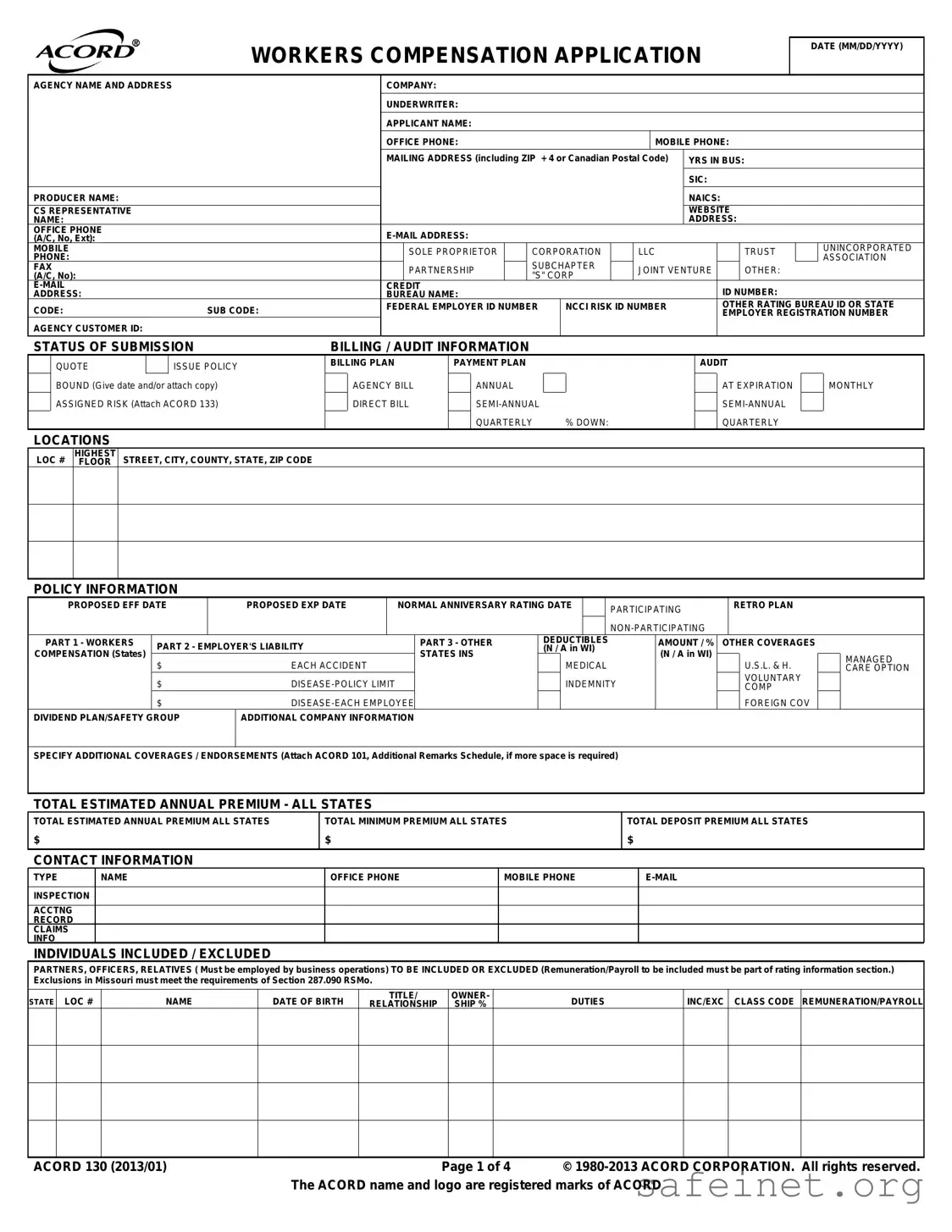
The Acord 130 form serves as a vital tool in the workers' compensation insurance application process, capturing essential information about a business seeking coverage. This form requires details such as the applicant's name, agency information, and contact details. It also collects data on the type of business entity, years in operation, and relevant classification codes. Furthermore, the Acord 130 includes sections for providing information on estimated annual premiums, prior insurance history, and any loss history over the past five years. The form prompts applicants to disclose specific operational details, including the nature of their business, employee classifications, and any unique risks associated with their operations. Additionally, it addresses billing preferences and coverage options, ensuring that applicants are aware of their choices regarding payment plans and policy terms. By thoroughly completing the Acord 130, businesses can facilitate a smoother application process, ultimately leading to the appropriate workers' compensation coverage tailored to their needs.
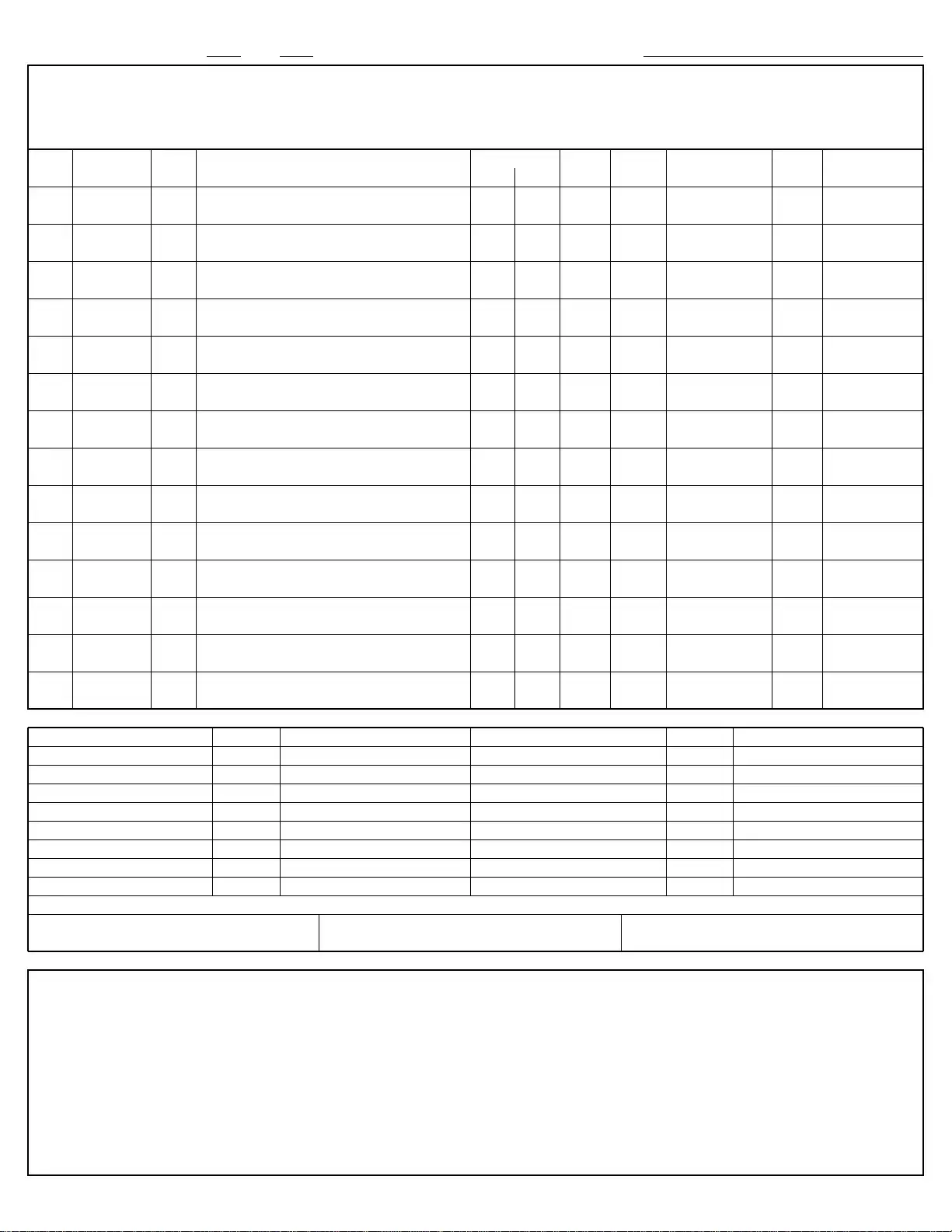
Form Sample

PRODUCER NAME:
CS REPRESENTATIVE
NAME:
OFFICE PHONE
(A/C, No, Ext):
AGENCY CUSTOMER ID:
CODE: SUB CODE:
ADDRESS:
E-MAIL
FAX
(A/C, No):
MOBILE
PHONE:
AGENCY NAME AND ADDRESS
ASSOCIATION
OTHER:
"S" CORP
UNINCORPORATED
ADDRESS:
WEBSITE
JOINT VENTURE
TRUST
E-MAIL ADDRESS:
MOBILE PHONE:OFFICE PHONE:
APPLICANT NAME:
ID NUMBER:
UNDERWRITER:
COMPANY:
SIC:
FEDERAL EMPLOYER ID NUMBER NCCI RISK ID NUMBER
OTHER RATING BUREAU ID OR STATE
EMPLOYER REGISTRATION NUMBER
CREDIT
BUREAU NAME:
LLC
SUBCHAPTER
CORPORATION
PARTNERSHIP
SOLE PROPRIETOR
MAILING ADDRESS (including ZIP + 4 or Canadian Postal Code)
NAICS:
YRS IN BUS:
DATE (MM/DD/YYYY)
WORKERS COMPENSATION APPLICATION
PARTNERS, OFFICERS, RELATIVES ( Must be employed by business operations) TO BE INCLUDED OR EXCLUDED (Remuneration/Payroll to be included must be part of rating information section.)
Exclusions in Missouri must meet the requirements of Section 287.090 RSMo.
NAME DATE OF BIRTH
TITLE/
RELATIONSHIP
OWNER-
SHIP %
DUTIES INC/EXC CLASS CODE REMUNERATION/PAYROLL
LOC #STATE
INDIVIDUALS INCLUDED / EXCLUDED
$
TOTAL DEPOSIT PREMIUM ALL STATES
$
TOTAL MINIMUM PREMIUM ALL STATES
$
TOTAL ESTIMATED ANNUAL PREMIUM ALL STATES
TOTAL ESTIMATED ANNUAL PREMIUM - ALL STATES
OFFICE PHONE
INFO
CLAIMS
RECORD
TYPE
ACCTNG
INSPECTION
CONTACT INFORMATION
E-MAILMOBILE PHONENAME
The ACORD name and logo are registered marks of ACORD
SPECIFY ADDITIONAL COVERAGES / ENDORSEMENTS (Attach ACORD 101, Additional Remarks Schedule, if more space is required)
PART 3 - OTHER
STATES INS
DISEASE-EACH EMPLOYEE
DISEASE-POLICY LIMIT
EACH ACCIDENT
$
$
$
PART 2 - EMPLOYER'S LIABILITY
PART 1 - WORKERS
COMPENSATION (States)
PROPOSED EXP DATEPROPOSED EFF DATE
POLICY INFORMATION
RETRO PLAN
PARTICIPATING
NON-PARTICIPATING
NORMAL ANNIVERSARY RATING DATE
AMOUNT / %
(N / A in WI)
(N / A in WI)
DEDUCTIBLES
MEDICAL
INDEMNITY
ADDITIONAL COMPANY INFORMATIONDIVIDEND PLAN/SAFETY GROUP
U.S.L. & H.
CARE OPTION
MANAGED
FOREIGN COV
COMP
VOLUNTARY
OTHER COVERAGES
LOCATIONS
FLOOR
HIGHEST
STREET, CITY, COUNTY, STATE, ZIP CODE
LOC #
BILLING PLAN
AGENCY BILL
DIRECT BILLASSIGNED RISK (Attach ACORD 133)
BOUND (Give date and/or attach copy)
ISSUE POLICYQUOTE
BILLING / AUDIT INFORMATIONSTATUS OF SUBMISSION
PAYMENT PLAN
ANNUAL
SEMI-ANNUAL
QUARTERLY % DOWN:
AUDIT
AT EXPIRATION
SEMI-ANNUAL
QUARTERLY
MONTHLY
ACORD 130 (2013/01) Page 1 of 4 © 1980-2013 ACORD CORPORATION. All rights reserved.
ACORD 130 (2013/01)
REMARKS (ACORD 101, Additional Remarks Schedule, may be attached if more space is required)
AGENCY CUSTOMER ID:
OF SHEETSSTATE RATING SHEET #
RATING INFORMATION - STATE:
Page 2 of 4
FOR MULTIPLE STATES, ATTACH AN ADDITIONAL PAGE 2 OF THIS FORM
STATE RATING WORKSHEET
* N / A in Wisconsin
N / A
N / A
N / A
MODIFICATION
TAXES / ASSESSMENTS *
FACTORED PREMIUM
EXPERIENCE OR MERIT
FACTOR
$ $ $
DEPOSIT PREMIUMMINIMUM PREMIUMTOTAL ESTIMATED ANNUAL PREMIUM
STANDARD PREMIUM $
$
SCHEDULE RATING *
$
CCPAP
FACTORED PREMIUM
FACTOR
STATE:
$TOTAL
$INCREASED LIMITS
DEDUCTIBLE * $
$
$
$
$ASSIGNED RISK SURCHARGE *
$ARAP *
$
$PREMIUM DISCOUNT
$EXPENSE CONSTANT
$
$
PREMIUM
DESCR
CODE
ESTIMATED
ANNUAL MANUAL
PREMIUM
ESTIMATED ANNUAL
REMUNERATION/
PAYROLL
SIC NAICSLOC # CLASS CODE CATEGORIES, DUTIES, CLASSIFICATIONS
# EMPLOYEES
RATE
FULL
TIME
PART
TIME
15. ARE ATHLETIC TEAMS SPONSORED?
13. ANY EMPLOYEES WITH PHYSICAL HANDICAPS?
14. DO EMPLOYEES TRAVEL OUT OF STATE? (If "YES", indicate state(s) of travel and frequency)
ACORD 130 (2013/01)
Y / N
AGENCY CUSTOMER ID:
6. ARE SUB-CONTRACTORS USED? (If "YES", give % of work subcontracted)
7. ANY WORK SUBLET WITHOUT CERTIFICATES OF INSURANCE? (If "YES", payroll for this work must be included in the State Rating Worksheet on Page 2)
9. ANY GROUP TRANSPORTATION PROVIDED?
8. IS A WRITTEN SAFETY PROGRAM IN OPERATION?
10. ANY EMPLOYEES UNDER 16 OR OVER 60 YEARS OF AGE?
11. ANY SEASONAL EMPLOYEES?
12. IS THERE ANY VOLUNTEER OR DONATED LABOR? (If "YES", please specify)
GENERAL INFORMATION
2.
DO / HAVE PAST, PRESENT OR DISCONTINUED OPERATIONS INVOLVE(D) STORING, TREATING, DISCHARGING, APPLYING, DISPOSING, OR
TRANSPORTING OF HAZARDOUS MATERIAL? (e.g. landfills, wastes, fuel tanks, etc)
3.
ANY WORK PERFORMED UNDERGROUND OR ABOVE 15 FEET?
4. ANY WORK PERFORMED ON BARGES, VESSELS, DOCKS, BRIDGE OVER WATER?
5. IS APPLICANT ENGAGED IN ANY OTHER TYPE OF BUSINESS?
EXPLAIN ALL "YES" RESPONSES
1.
DOES APPLICANT OWN, OPERATE OR LEASE AIRCRAFT / WATERCRAFT?
Page 3 of 4
GIVE COMMENTS AND DESCRIPTIONS OF BUSINESS, OPERATIONS AND PRODUCTS: MANUFACTURING - RAW MATERIALS, PROCESSES, PRODUCT, EQUIPMENT; CONTRACTOR - TYPE
OF WORK, SUB-CONTRACTS; MERCANTILE - MERCHANDISE, CUSTOMERS, DELIVERIES; SERVICE - TYPE, LOCATION; FARM - ACREAGE, ANIMALS, MACHINERY, SUB-CONTRACTS.
NATURE OF BUSINESS / DESCRIPTION OF OPERATIONS
PRIOR CARRIER INFORMATION / LOSS HISTORY
PROVIDE INFORMATION FOR THE PAST 5 YEARS AND USE THE REMARKS SECTION FOR LOSS DETAILS
LOSS RUN ATTACHED
RESERVEAMOUNT PAID# CLAIMSMODANNUAL PREMIUMCARRIER & POLICY NUMBERYEAR
POL #:
CO:
POL #:
CO:
POL #:
CO:
POL #:
CO:
POL #:
CO:
Applicable in Utah: Any person who knowingly presents false or fraudulent underwriting information, files or causes to be filed a false or fraudulent claim for
disability compensation or medical benefits, or submits a false or fraudulent report or billing for health care fees or other professional services is guilty of a
crime and may be subject to fines and confinement in state prison.
(Not applicable in AZ, CA, DE, KS, MA, MN, ND, NY, OR, VA, or WV. Specific ACORD 38s are available for applicants in these states.)
(Applicant's Initials):
18. ANY PRIOR COVERAGE DECLINED / CANCELLED / NON-RENEWED IN THE LAST THREE (3) YEARS? (Missouri Applicants - Do not answer this question)
16. ARE PHYSICALS REQUIRED AFTER OFFERS OF EMPLOYMENT ARE MADE?
17. ANY OTHER INSURANCE WITH THIS INSURER?
Applicable in Puerto Rico: Any person who knowingly and with the intention of defrauding presents false information in an insurance application, or
presents, helps, or causes the presentation of a fraudulent claim for the payment of a loss or any other benefit, or presents more than one claim for the same
damage or loss, shall incur a felony and, upon conviction, shall be sanctioned for each violation by a fine of not less than five thousand dollars ($5,000) and
not more than ten thousand dollars ($10,000), or a fixed term of imprisonment for three (3) years, or both penalties. Should aggravating circumstances be
present, the penalty thus established may be increased to a maximum of five (5) years, if extenuating circumstances are present, it may be reduced to a
minimum of two (2) years.
Applicable in Maine, Tennessee, Virginia and Washington: It is a crime to knowingly provide false, incomplete or misleading information to an insurance
company for the purpose of defrauding the company. Penalties may include imprisonment, fines or a denial of insurance benefits.
Applicable in Kansas: Any person who, knowingly and with intent to defraud, presents, causes to be presented or prepares with knowledge or belief that it
will be presented to or by an insurer, purported insurer, broker or any agent thereof, any written statement as part of, or in support of, an application for the
issuance of, or the rating of an insurance policy for personal or commercial insurance, or a claim for payment or other benefit pursuant to an insurance policy
for commercial or personal insurance which such person knows to contain materially false information concerning any fact material thereto; or conceals, for
the purpose of misleading, information concerning any fact material thereto commits a fraudulent insurance act.
Applicable in Florida and Oklahoma: Any person who knowingly and with intent to injure, defraud, or deceive any insurer files a statement of claim or an
application containing any false, incomplete, or misleading information is guilty of a felony (In FL, a person is guilty of a felony of the third degree).
Applicable in Colorado: It is unlawful to knowingly provide false, incomplete, or misleading facts or information to an insurance company for the purpose of
defrauding or attempting to defraud the company, Penalties may include imprisonment, fines, denial of insurance and civil damages. Any insurance company
or agent of an insurance company who knowingly provides false, incomplete, or misleading facts or information to a policyholder or claimant for the purpose
of defrauding or attempting to defraud the policyholder or claimant with regard to a settlement or award payable from insurance proceeds shall be reported to
the Colorado Division of Insurance within the department of regulatory agencies.
Applicable in AL, AR, AZ, DC, LA, MD, NM, RI and WV: Any person who knowingly (or willfully in MD) presents a false or fraudulent claim for payment of a
loss or benefit or who knowingly (or willfully in MD) presents false information in an application for insurance is guilty of a crime and may be subject to fines or
confinement in prison.
Any person who knowingly and with intent to defraud any insurance company or other person files an application for insurance containing any materially false
information or conceals, for the purpose of misleading, information concerning any fact material thereto commits a fraudulent insurance act, which is a crime
and subjects that person to criminal and civil penalties (In Oregon, the aforementioned actions may constitute a fraudulent insurance act which may be a
crime and may subject the person to penalties). (In New York, the civil penalty is not to exceed five thousand dollars ($5,000) and the stated value of the
claim for each such violation). (Not applicable in AL, AR, AZ, CO, DC, FL, KS, LA, ME, MD, MN, NM, OK, PR, RI, TN, VA, VT, WA and WV).
SIGNATURE
PERSONAL INFORMATION ABOUT YOU, INCLUDING INFORMATION FROM A CREDIT OR OTHER INVESTIGATIVE REPORT, MAY BE COLLECTED FROM PERSONS
OTHER THAN YOU IN CONNECTION WITH THIS APPLICATION FOR INSURANCE AND SUBSEQUENT AMENDMENTS AND RENEWALS. SUCH INFORMATION AS WELL AS
OTHER PERSONAL AND PRIVILEGED INFORMATION COLLECTED BY US OR OUR AGENTS MAY IN CERTAIN CIRCUMSTANCES BE DISCLOSED TO THIRD PARTIES
WITHOUT YOUR AUTHORIZATION. CREDIT SCORING INFORMATION MAY BE USED TO HELP DETERMINE EITHER YOUR ELIGIBILITY FOR INSURANCE OR THE
PREMIUM YOU WILL BE CHARGED. WE MAY USE A THIRD PARTY IN CONNECTION WITH THE DEVELOPMENT OF YOUR SCORE. YOU MAY HAVE THE RIGHT TO
REVIEW YOUR PERSONAL INFORMATION IN OUR FILES AND REQUEST CORRECTION OF ANY INACCURACIES. YOU MAY ALSO HAVE THE RIGHT TO REQUEST IN
WRITING THAT WE CONSIDER EXTRAORDINARY LIFE CIRCUMSTANCES IN CONNECTION WITH THE DEVELOPMENT OF YOUR CREDIT SCORE. THESE RIGHTS MAY
BE LIMITED IN SOME STATES. PLEASE CONTACT YOUR AGENT OR BROKER TO LEARN HOW THESE RIGHTS MAY APPLY IN YOUR STATE OR FOR INSTRUCTIONS ON
HOW TO SUBMIT A REQUEST TO US FOR A MORE DETAILED DESCRIPTION OF YOUR RIGHTS AND OUR PRACTICES REGARDING PERSONAL INFORMATION.
Copy of the Notice of Information Practices (Privacy) has been given to the applicant. (Not required in all states, contact your agent or broker for your state's requirements.)
THE UNDERSIGNED IS AN AUTHORIZED REPRESENTATIVE OF THE APPLICANT AND REPRESENTS THAT REASONABLE INQUIRY HAS BEEN MADE TO OBTAIN THE
ANSWERS TO QUESTIONS ON THIS APPLICATION. HE/SHE REPRESENTS THAT THE ANSWERS ARE TRUE, CORRECT AND COMPLETE TO THE BEST OF HIS/HER
KNOWLEDGE.
ACORD 130 (2013/01)
APPLICANT'S SIGNATURE (Must be Officer, Owner or Partner)
DATE PRODUCER'S SIGNATURE NATIONAL PRODUCER NUMBER
Y / N
AGENCY CUSTOMER ID:
24.
ANY UNDISPUTED AND UNPAID WORKERS COMPENSATION PREMIUM DUE FROM YOU OR ANY COMMONLY MANAGED OR OWNED ENTERPRISES?
IF YES, EXPLAIN INCLUDING ENTITY NAME(S) AND POLICY NUMBER(S).
23. ANY TAX LIENS OR BANKRUPTCY WITHIN THE LAST FIVE (5) YEARS? (If "YES", please specify)
22. DO ANY EMPLOYEES PREDOMINANTLY WORK AT HOME? If "YES", # of Employees:
21. DO YOU LEASE EMPLOYEES TO OR FROM OTHER EMPLOYERS?
20. DO ANY EMPLOYEES PERFORM WORK FOR OTHER BUSINESSES OR SUBSIDIARIES?
GENERAL INFORMATION (continued)
Page 4 of 4
19. ARE EMPLOYEE HEALTH PLANS PROVIDED?
EXPLAIN ALL "YES" RESPONSES

Document Specifications

Fact Name Details
Purpose The ACORD 130 form is used for applying for workers' compensation insurance, providing necessary information about the applicant's business and coverage needs.
Required Information The form requires detailed information including the applicant's name, business type, contact information, and estimated annual payroll.
State-Specific Regulations Each state may have specific requirements governing the use of the ACORD 130 form, including compliance with local workers' compensation laws.
Exclusions and Inclusions The form allows applicants to specify individuals to be included or excluded from coverage, which is crucial for accurate premium calculations.
Fraud Warning The form includes a warning about the consequences of providing false information, which can lead to legal penalties and denial of coverage.

Steps to Filling Out Acord 130

Completing the Acord 130 form is an essential step in applying for workers' compensation insurance. This form collects vital information about your business, including contact details, coverage needs, and employee information. Filling it out accurately ensures that your application is processed smoothly and helps avoid any delays in obtaining your insurance.

  1. Start with the date: Enter the date of the application in the format MM/DD/YYYY.
  2. Agency details: Fill in the agency name and address.
  3. Company and underwriter: Provide the name of the insurance company and the underwriter.
  4. Applicant information: Enter your name, office phone, mobile phone, and mailing address, including ZIP + 4 or Canadian Postal Code.
  5. Business details: Indicate the number of years in business and the Standard Industrial Classification (SIC) code.
  6. Producer information: Fill in the producer's name and the North American Industry Classification System (NAICS) code.
  7. Contact information: Provide the customer service representative’s website name, address, office phone, and email address.
  8. Business structure: Select the appropriate business structure (e.g., sole proprietor, corporation, LLC, etc.) and provide the corresponding information.
  9. Employer identification: Enter the Federal Employer ID Number and any other relevant identification numbers.
  10. Billing and audit information: Specify the billing plan and whether the application is for a quote or a bound policy.
  11. Location details: List the locations where your business operates, including the highest street, city, county, state, and ZIP code.
  12. Policy information: Fill in the proposed effective and expiration dates, along with the normal anniversary rating date.
  13. Coverage details: Indicate the desired workers' compensation coverage, including limits and any additional coverages.
  14. Estimated annual premium: Provide your total estimated annual premium for all states.
  15. Contact for additional information: List individuals who can provide further information about the application.
  16. Employee details: Include information about employees, such as their names, dates of birth, titles, and remuneration.
  17. Prior carrier information: If applicable, provide details of your insurance history for the past five years.
  18. General information: Answer all general questions honestly, especially those that require explanations.
  19. Signature: Ensure that the application is signed by an authorized representative of the applicant, including the date of signing.

More About Acord 130

What is the Acord 130 form used for?

The Acord 130 form is primarily used to apply for workers' compensation insurance. It collects essential information about a business, including its operations, employee details, and coverage needs. Insurers use this information to assess risk and determine appropriate premium rates for the coverage requested.

What information is required on the Acord 130 form?

The form requires various details, such as the applicant's name, business structure, contact information, and years in business. Additionally, it asks for specifics about employee classifications, estimated payroll, and any previous insurance coverage or loss history. Accurate and complete information is crucial for a successful application.

Who should complete the Acord 130 form?

The form should be completed by an authorized representative of the business applying for coverage. This person is typically an owner, officer, or partner who can provide accurate information about the company's operations and employee details. Their signature is necessary to validate the application.

How does the Acord 130 form affect insurance premiums?

The information provided on the Acord 130 form directly impacts the calculation of insurance premiums. Insurers evaluate factors such as the nature of the business, employee classifications, and past claims history to determine the risk level. Higher risks may lead to increased premiums, while lower risks could result in more favorable rates.

What happens after submitting the Acord 130 form?

Once the Acord 130 form is submitted, the insurance company will review the application. They may request additional information or clarification on certain points. After assessing the risk, the insurer will provide a quote for the workers' compensation coverage, outlining the terms, conditions, and premium amount.

Can the Acord 130 form be modified after submission?

Yes, if there are significant changes in the business operations or employee details after submitting the Acord 130 form, the applicant should notify the insurance company. Adjustments may be necessary to ensure that the coverage remains adequate and reflects the current risk profile of the business.

Common mistakes

  1. Incorrect Date Format: Ensure the application date is entered in MM/DD/YYYY format. Using an incorrect format can lead to processing delays.

  2. Missing Contact Information: Always provide complete contact details. This includes office phone, mobile phone, and email address. Incomplete information can hinder communication.

  3. Omitting Business Structure: Clearly indicate the type of business entity (e.g., corporation, LLC, partnership). Failing to specify can lead to misclassification.

  4. Neglecting to List All Employees: Include all employees in the payroll section. Excluding employees can result in inaccurate premium calculations.

  5. Incorrect SIC/NAICS Codes: Use accurate SIC and NAICS codes that reflect your business activities. Incorrect codes can affect your insurance rates.

  6. Not Specifying Coverage Needs: Clearly outline any additional coverages or endorsements required. Missing this information may lead to insufficient coverage.

  7. Failure to Attach Required Documents: Always attach necessary documents, such as loss runs or additional remarks. Omitting these can delay processing.

  8. Ignoring Prior Carrier Information: Provide complete information about previous insurance carriers and loss history. This helps in evaluating your risk profile.

  9. Inaccurate Payroll Estimates: Provide realistic payroll estimates for all employees. Underestimating payroll can lead to unexpected premium adjustments.

  10. Not Signing the Application: Ensure the application is signed by an authorized representative. An unsigned application is not valid and will be rejected.

Documents used along the form

The ACORD 130 form is essential for workers' compensation insurance applications. Several other forms and documents are often used in conjunction with it to ensure a comprehensive submission. Below is a list of these related documents, along with brief descriptions of each.

  • ACORD 133 - This form is used to provide additional information for assigned risk workers' compensation policies. It details the specific coverage needs and helps insurers assess the risk.
  • ACORD 101 - The Additional Remarks Schedule allows applicants to provide further details or explanations that may not fit within the standard forms. It is useful for clarifying unique circumstances.
  • Loss Run Report - This document summarizes the applicant's claims history over the past several years. It includes details on claims made, amounts paid, and reserves set aside for future claims.
  • State Rating Worksheet - This worksheet provides a detailed breakdown of classification codes, estimated payroll, and premium calculations for each state where coverage is sought.
  • Employer's Liability Insurance Application - This application is used to request coverage for liabilities that may arise from employee injuries or illnesses not covered by workers' compensation.
  • Safety Program Documentation - This includes any written safety policies or programs the business has in place. It can help demonstrate the company's commitment to reducing workplace injuries.
  • Employee Payroll Records - These records detail the payroll for all employees, which is crucial for determining premium amounts and ensuring accurate reporting.
  • Certificate of Insurance - This document serves as proof of insurance coverage and may be required by clients or partners before commencing work.
  • Business Description Document - This document provides a detailed description of the business operations, including the nature of the work, types of services offered, and any unique risks involved.
  • State-Specific Forms - Depending on the state, additional forms may be required to comply with local regulations regarding workers' compensation insurance.

These documents work together with the ACORD 130 form to facilitate a thorough application process for workers' compensation insurance. Ensuring all necessary information is provided can help streamline the underwriting process and secure appropriate coverage.

Similar forms

The ACORD 125 form serves as a standard application for commercial insurance. Like the ACORD 130, it collects essential information about the applicant's business, including contact details, type of business entity, and coverage needs. Both forms are designed to streamline the underwriting process by ensuring that insurers have the necessary information to assess risk and provide accurate quotes. The ACORD 125 focuses on a broader range of coverages, while the ACORD 130 specifically targets workers' compensation and employer's liability insurance.

The ACORD 133 form is specifically used for assigned risk applications in workers' compensation insurance. Similar to the ACORD 130, it requires detailed information about the applicant's business operations, employee classifications, and payroll estimates. Both forms are essential in determining eligibility for coverage and calculating premiums. The ACORD 133 complements the ACORD 130 by providing additional context for businesses that may not qualify for standard coverage options.

The ACORD 101 form, known as the Additional Remarks Schedule, allows applicants to provide further details or clarifications regarding their insurance needs. This form is similar to the ACORD 130 in that it helps capture additional information that may be necessary for the underwriting process. While the ACORD 130 focuses on specific insurance coverages, the ACORD 101 provides a space for applicants to elaborate on unique circumstances or special requests that could affect their coverage.

The ACORD 140 form is utilized for commercial property insurance applications. While the ACORD 130 centers on workers' compensation, both forms require similar foundational information about the applicant's business, including location, type of business, and coverage limits. The ACORD 140, however, emphasizes property-related risks, while the ACORD 130 focuses on employee-related risks, reflecting the different aspects of insurance coverage they address.

The ACORD 150 form is designed for general liability insurance applications. Like the ACORD 130, it gathers vital information to help insurers assess risk and determine appropriate coverage. Both forms require details about the business's operations, including the nature of the work performed and any associated risks. The ACORD 150, however, is specifically tailored to liability coverage, whereas the ACORD 130 is dedicated to workers' compensation and employer's liability.

The ACORD 200 form serves as a personal auto application. While it is targeted toward individual insurance needs rather than business operations, it shares similarities with the ACORD 130 in terms of gathering necessary personal information, coverage options, and vehicle details. Both forms aim to facilitate the underwriting process by ensuring that all relevant data is collected upfront, allowing for a smoother and more efficient application experience.

Dos and Don'ts

When filling out the ACORD 130 form, there are several key points to keep in mind. Here’s a list of things you should and shouldn’t do:

  • Do provide accurate and complete information. Every detail matters.
  • Do double-check your dates. Ensure they are in the correct format (MM/DD/YYYY).
  • Do include all relevant contact information. This helps in communication.
  • Do specify the type of business accurately. This affects your coverage.
  • Don't leave any sections blank. Fill in all required fields to avoid delays.
  • Don't provide misleading information. Honesty is crucial in insurance applications.
  • Don't forget to include any additional coverages or endorsements. They are important for your policy.
  • Don't rush through the form. Take your time to ensure everything is correct.

Misconceptions

  • Misconception 1: The Acord 130 form is only for large businesses.

    This form is designed for all types of businesses, regardless of size. Small businesses can and should use the Acord 130 to ensure they have the appropriate workers' compensation coverage. It helps to accurately assess risks and premiums, making it relevant for any business owner.

  • Misconception 2: Completing the Acord 130 form is optional.

    For businesses that require workers' compensation insurance, submitting the Acord 130 is often a necessary step in the application process. It provides essential information that insurers need to evaluate risk and determine coverage. Skipping this form can lead to delays or complications in obtaining coverage.

  • Misconception 3: The Acord 130 form only focuses on employee information.

    While the form does require details about employees, it also encompasses various aspects of the business, including operations, prior claims history, and specific business activities. This comprehensive approach allows insurers to gain a full understanding of the business's risk profile.

  • Misconception 4: Errors on the Acord 130 form can be easily corrected after submission.

    While it is possible to amend information, inaccuracies can lead to significant issues, including policy delays or incorrect coverage. It is crucial to review the form carefully before submission to ensure that all information is accurate and complete.

Key takeaways

  • Accurate completion of the Acord 130 form is crucial for obtaining the right workers' compensation coverage. Ensure all fields are filled out completely and correctly.

  • Include contact information for all relevant parties, such as the applicant, agency, and underwriter. This facilitates communication and speeds up the processing of your application.

  • Provide a detailed loss history for the past five years. This information is vital for underwriters to assess risk and determine premiums.

  • Be transparent about any exclusions or special circumstances, such as subcontracting work or unique operational risks. This can prevent complications later in the process.

  • Review the general information section carefully. Answer all questions honestly, as inaccuracies can lead to coverage denial or penalties.