Homepage > Blank Aao Transfer Template
Article Structure

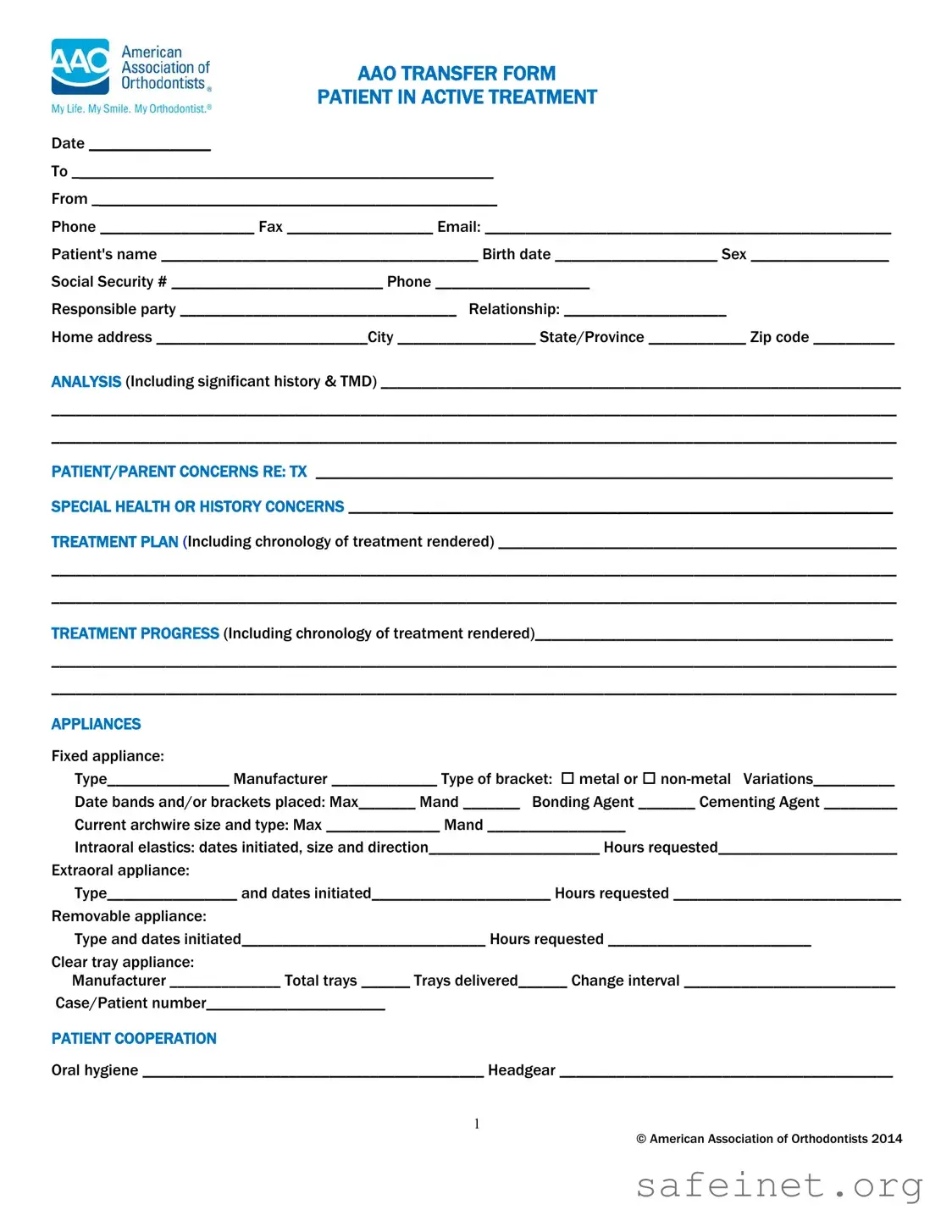
Transitioning between orthodontic providers can be a daunting task, especially when a patient is in the midst of active treatment. The Aao Transfer form plays a crucial role in this process, ensuring a seamless handover of important patient information. This comprehensive document captures essential details such as the patient's name, birth date, and contact information, along with a thorough analysis of their treatment history and any specific concerns they may have. It outlines the treatment plan, progress made, and the types of appliances used, whether fixed, removable, or clear trays. Additionally, it addresses patient cooperation, financial considerations, and recommendations for continued care. Understanding the nuances of this form can significantly ease the transition for both patients and their new orthodontists, facilitating continuity of care and minimizing any potential disruptions in treatment. By providing a clear picture of the patient's journey so far, the Aao Transfer form helps ensure that the new provider is well-equipped to continue the orthodontic journey effectively.


Form Sample

1
© American Association of Orthodontists 2014
AAO TRANSFER FORM
PATIENT IN ACTIVE TREATMENT
Date _______________
To ____________________________________________________
From __________________________________________________
Phone ___________________ Fax __________________ Email: __________________________________________________
Patient's name _______________________________________ Birth date ____________________ Sex _________________
Social Security # __________________________ Phone ___________________
Responsible party __________________________________ Relationship: ____________________
Home address __________________________City _________________ State/Province ____________ Zip code __________
ANALYSIS (Including significant history & TMD) ________________________________________________________________
________________________________________________________________________________________________________
________________________________________________________________________________________________________
PATIENT/PARENT CONCERNS RE: TX _______________________________________________________________________
SPECIAL HEALTH OR HISTORY CONCERNS ___________________________________________________________________
TREATMENT PLAN (Including chronology of treatment rendered) _________________________________________________
________________________________________________________________________________________________________
________________________________________________________________________________________________________
TREATMENT PROGRESS (Including chronology of treatment rendered)____________________________________________
________________________________________________________________________________________________________
________________________________________________________________________________________________________
APPLIANCES
Fixed appliance:
Type_______________ Manufacturer _____________ Type of bracket: metal or non-metal Variations__________
Date bands and/or brackets placed: Max_______ Mand _______ Bonding Agent _______ Cementing Agent _________
Current archwire size and type: Max ______________ Mand _________________
Intraoral elastics: dates initiated, size and direction_____________________ Hours requested______________________
Extraoral appliance:
Type________________ and dates initiated______________________ Hours requested ____________________________
Removable appliance:
Type and dates initiated______________________________ Hours requested _________________________
Clear tray appliance:
Manufacturer _______________ Total trays ______ Trays delivered______ Change interval __________________________
Case/Patient number______________________
PATIENT COOPERATION
Oral hygiene __________________________________________ Headgear _________________________________________
2
© American Association of Orthodontists 2014
Elastics ______________________________________________ Clear trays _______________________________________
Appointments _________________________________________ Broken appliances ________________________________
Patient's attitude toward treatment ________________________________________________________________________
Suggestions for patient motivation _________________________________________________________________________
ACTIVE TX TIME ESTIMATES Original _________________________ Remaining _____ % of active treatment completed
RECOMMENDATIONS FOR CONTINUED TREATMENT __________________________________________________________
______________________________________________________________________________________________________
RECOMMENDATIONS FOR RETENTION _____________________________________________________________________
ADDITIONAL COMMENTS _______________________________________________________________________________
_____________________________________________________________________________________________________
FINANCIAL
Closed ______________ Open End (Fixed) _______________Other ______________________
Fees: Active _______________ Extras ______________________________________________
Terms ________________________________________________________________________
Third party payment ____________________________________________________________
Total charges before transfer _________________________
Total amount paid before transfer _____________________
Unpaid amount still owed transferring office ____________
Balance of original quoted fee not yet charged ______________ or overpaid at transfer ______________
This patient/parent has been advised that orthodontic treatment fees vary widely throughout the country and the world
and it is reasonable for them to expect that a transfer may increase treatment fees and may involve changes in payment
policies. For most people who transfer during their orthodontic treatment, the total treatment cost is likely to increase.
AVAILABLE RECORDS FOR TRANSFER
Casts Initial Date ________ Progress Date ________ Articulator type________
Ceph Initial Date ________ Progress Date ________
Tracings Initial Date ________ Progress Date ________
Panoramic Initial Date ________ Progress Date ________
CBCT Initial Date ________ Progress Date ________
Intra-oral scan Initial Date ________ Progress Date ________
files
Intraoral x-rays Initial Date ________ Progress Date ________
Facial photos Initial Date ________ Progress Date ________
Intraoral photos Initial Date ________ Progress Date ________
Check appropriate status of records:
Record duplicates sent upon request (may be an additional charge to patient) Yes No
Records enclosed Yes No Records sent under separate cover Yes No
Signature: __________________________________________________Date_______________________
(Orthodontist)
3
© American Association of Orthodontists 2014
REQUEST TO TRANSFER RECORDS TO NEW PROVIDER
When a patient moves, or, for other reasons, there is a necessity to change orthodontists during the course of
ongoing orthodontic treatment, it is highly advantageous for all involved parties that the transfer be as prompt and
convenient as possible. Of paramount importance is the identification of an orthodontist who will accept the
patient and successfully complete the treatment.
The American Association of Orthodontists represents over ninety percent of the orthodontic specialists in the U.S.
and Canada. Your current doctor is a member and will assist you in finding a qualified orthodontist.
It is necessary that your records be transferred to assure that the receiving orthodontist is knowledgeable of your
orthodontic condition(s), orthodontic treatment goals, the current treatment plan, and related financial
arrangements. To facilitate the transfer of these records, it is necessary that you complete the following:
I authorize Dr. ____________________ to release all records of ____________________ (patient’s name) for the
purpose of continuation of treatment by Dr. ___________________(new provider’s name).
Signature: __________________________________________________________Date_______________________
(Patient or Guardian)
Print Name ________________________________________
Relationship to Patient ______________________________

Document Specifications

Fact Name Description Governing Law
Patient Information The AAO Transfer Form collects essential patient details, including name, birth date, contact information, and responsible party. This information is crucial for the continuity of care. HIPAA (Health Insurance Portability and Accountability Act)
Treatment Progress The form requires a detailed account of the treatment progress, including chronology and any appliances used. This ensures that the new provider is fully informed of the patient's current status. State Dental Practice Acts
Financial Information It includes a section for financial details, such as active fees and any outstanding balances. This transparency helps manage expectations regarding treatment costs. State Consumer Protection Laws
Record Transfer The form authorizes the transfer of patient records to a new orthodontist, ensuring that all necessary information is shared for continued treatment. HIPAA and State Privacy Laws

Steps to Filling Out Aao Transfer

Filling out the AAO Transfer form is an essential step for ensuring a smooth transition of orthodontic care. This process requires careful attention to detail to provide the new provider with all necessary information regarding the patient's treatment history and current status.

  1. Enter the date at the top of the form.
  2. Fill in the name and contact information of the new provider in the "To" section.
  3. Complete the "From" section with your current provider's details, including phone, fax, and email.
  4. Provide the patient's full name, birth date, sex, and Social Security number in the designated fields.
  5. List the responsible party's name and their relationship to the patient.
  6. Fill in the home address, city, state/province, and zip code of the responsible party.
  7. Detail the analysis, including significant history and TMD, in the provided space.
  8. Document any patient or parent concerns regarding treatment.
  9. Outline any special health or history concerns that may affect treatment.
  10. Describe the treatment plan, including a chronology of treatment rendered.
  11. Summarize treatment progress, including a chronology of treatment rendered.
  12. Specify details about appliances used, including type, manufacturer, and dates initiated.
  13. Detail patient cooperation regarding oral hygiene, headgear, elastics, and appointments.
  14. Provide estimates for active treatment time, including original and remaining time.
  15. List recommendations for continued treatment and retention.
  16. Add any additional comments that may be relevant.
  17. Complete the financial section, detailing the status of payments and fees.
  18. Indicate the available records for transfer and check the appropriate status of records.
  19. Sign and date the form at the bottom, confirming the orthodontist's details.
  20. Fill out the request to transfer records section, including the names of both the current and new providers.
  21. Have the patient or guardian sign and date this section, along with their printed name and relationship to the patient.

More About Aao Transfer

What is the Aao Transfer form?

The Aao Transfer form is a document used to facilitate the transfer of orthodontic records when a patient changes orthodontists during their active treatment. This form ensures that the new provider has all the necessary information about the patient’s treatment history, current status, and any financial arrangements that may be in place.

Why would I need to fill out the Aao Transfer form?

You would need to fill out the Aao Transfer form if you are moving to a new orthodontist or if you feel that a different provider would better meet your orthodontic needs. This form helps ensure that your new orthodontist has all the relevant information to continue your treatment without interruption.

What information is required on the Aao Transfer form?

The form requires various details, including the patient’s name, date of birth, contact information, and social security number. Additionally, it asks for treatment history, concerns, treatment plans, and progress notes. Financial information related to the treatment is also included to provide a complete picture to the new provider.

How does the transfer process work?

Once you complete the Aao Transfer form, your current orthodontist will send the necessary records to your new provider. It’s important to authorize the release of your records by signing the form. This ensures that your new orthodontist can access your treatment history and make informed decisions about your care.

Will transferring orthodontists affect my treatment costs?

Yes, transferring orthodontists may affect your treatment costs. Fees can vary significantly between different providers. It’s important to discuss potential changes in payment policies and treatment costs with your new orthodontist to avoid surprises.

Can I request copies of my records?

Yes, you can request copies of your records. The Aao Transfer form includes options to indicate whether records are being sent directly or if duplicates are available upon request. Keep in mind that there may be an additional charge for duplicate records.

What happens if I don’t fill out the Aao Transfer form?

If you don’t fill out the Aao Transfer form, your new orthodontist may not have access to your treatment history or current status. This could lead to delays in your treatment or complications in your care. It’s crucial to complete the form to ensure a smooth transition.

Who can help me with the Aao Transfer form?

Your current orthodontist can assist you with the Aao Transfer form. They can provide guidance on how to fill it out and answer any questions you may have about the transfer process. Additionally, they can help you find a qualified new orthodontist if needed.

Common mistakes

  1. Incomplete Patient Information: Failing to provide all necessary patient details, such as the patient's full name, birth date, or Social Security number, can lead to delays in processing the transfer.

  2. Missing Signatures: Not signing the authorization section can result in the form being rejected. Both the patient and guardian signatures are essential for the transfer to be valid.

  3. Incorrect Contact Information: Providing wrong phone numbers or email addresses can hinder communication between the current and new orthodontist, complicating the transfer process.

  4. Neglecting to Specify Treatment Details: Omitting significant treatment history or current treatment plans can lead to misunderstandings about the patient's needs, potentially affecting their care.

  5. Forgetting to Check Record Status: Failing to indicate whether records are enclosed or need to be sent separately can cause confusion and delays in obtaining necessary documentation.

  6. Ignoring Financial Information: Not providing accurate financial details, such as outstanding balances or payment terms, may lead to unexpected costs for the patient at the new office.

Documents used along the form

The AAO Transfer Form is a crucial document used when a patient transitions from one orthodontist to another during active treatment. Along with this form, several other documents are often required to ensure a smooth transfer of care. Below is a list of these essential forms and documents.

  • Patient Medical History Form: This form provides a comprehensive overview of the patient's medical history, including allergies, past surgeries, and current medications. It helps the new orthodontist understand any health concerns that may affect treatment.
  • Insurance Information Form: This document outlines the patient's insurance details, including coverage limits and benefits. It is vital for determining the financial responsibilities of both the patient and the new provider.
  • Consent for Treatment Form: This form is signed by the patient or guardian to authorize the new orthodontist to proceed with treatment. It ensures that the patient understands the procedures and potential risks involved.
  • Financial Agreement: This document details the payment terms and conditions agreed upon between the patient and the new orthodontist. It clarifies any outstanding balances and payment plans.
  • Radiographs and Imaging Reports: These include X-rays, CBCT scans, and other imaging studies that provide critical information about the patient's dental and skeletal structure, aiding in effective treatment planning.
  • Treatment Progress Notes: These notes summarize the treatment provided by the previous orthodontist, including any appliances used and the patient's response to treatment. They help the new provider assess the current status.
  • Informed Consent for Transfer: This document ensures that the patient understands the implications of transferring care, including potential changes in treatment costs and procedures.
  • Patient Cooperation Assessment: This form evaluates the patient's adherence to treatment recommendations, such as wearing appliances and maintaining oral hygiene, which is crucial for ongoing success.
  • Referral Letter: A letter from the current orthodontist to the new provider can provide insights into the patient's treatment history and specific needs, facilitating better continuity of care.
  • Additional Records Release Authorization: This document allows the transfer of any additional records not covered by the initial request, ensuring that the new orthodontist has all necessary information.

Gathering these documents alongside the AAO Transfer Form can streamline the transition process, making it easier for both the patient and the new orthodontist to continue effective treatment. Ensuring all relevant information is transferred helps maintain continuity of care and supports the best possible outcomes for the patient.

Similar forms

The AAO Transfer Form shares similarities with the Patient Referral Form. Both documents are used to facilitate the transfer of patient information between healthcare providers. In each case, the patient's medical history, treatment progress, and specific concerns are documented to ensure continuity of care. The information provided helps the new provider understand the patient's background and ongoing treatment needs, making the transition smoother for everyone involved.

Another document akin to the AAO Transfer Form is the Treatment Continuation Form. This form serves a similar purpose by detailing the current treatment plan and progress. It includes specifics about appliances used and patient cooperation, allowing the new provider to pick up right where the previous provider left off. Both forms emphasize the importance of clear communication between providers to maintain effective treatment.

The Medical Records Release Form is also comparable to the AAO Transfer Form. This document grants permission for the transfer of sensitive medical information. Just like the AAO Transfer Form, it requires the patient or guardian's signature to authorize the release. Both forms aim to protect patient confidentiality while ensuring necessary information is shared for continued care.

The Referral for Specialty Care Form is another similar document. It is used when a primary care provider refers a patient to a specialist. Like the AAO Transfer Form, it includes patient details and treatment history to help the specialist understand the patient's needs. This ensures that the specialist can provide the best possible care based on the information received.

The Patient Information Release Form is yet another document that aligns with the AAO Transfer Form. It allows patients to authorize the sharing of their medical information with other healthcare providers. Both forms focus on obtaining patient consent for transferring important health records, ensuring that the receiving provider has all necessary details for effective treatment.

The Continuity of Care Document (CCD) is similar as well. This document summarizes a patient's health status, treatment history, and care plans. It provides a comprehensive overview that aids new providers in understanding the patient's situation. Like the AAO Transfer Form, it is designed to ensure that care is consistent and well-informed.

The Discharge Summary is another document that shares similarities. It is created when a patient is discharged from one provider's care and may include treatment history and recommendations for future care. Both the Discharge Summary and the AAO Transfer Form serve to communicate critical patient information to ensure a seamless transition between providers.

The Care Coordination Form can also be compared to the AAO Transfer Form. It is used to facilitate communication among multiple healthcare providers involved in a patient's care. Both forms help ensure that everyone is on the same page regarding the patient's treatment plan and progress, promoting better health outcomes.

The Insurance Information Transfer Form is another relevant document. This form is used to transfer a patient's insurance details when changing providers. Similar to the AAO Transfer Form, it ensures that the new provider has all necessary information to handle billing and insurance claims efficiently, allowing for a smoother financial transition.

Lastly, the Orthodontic Treatment Plan Document is akin to the AAO Transfer Form. It outlines the specific orthodontic treatment goals and methods. Both documents contain detailed information about the patient's treatment progress and plans, ensuring that the new provider can continue care effectively based on the established treatment path.

Dos and Don'ts

When filling out the AAO Transfer form, consider the following do's and don'ts:

  • Do provide complete and accurate patient information.
  • Do include all relevant medical history and treatment details.
  • Do ensure that the responsible party's information is up-to-date.
  • Do specify the current treatment plan and progress clearly.
  • Do check that all required signatures are obtained.
  • Don't leave any sections blank unless instructed.
  • Don't omit details about financial arrangements and outstanding balances.
  • Don't forget to include the patient's concerns regarding treatment.
  • Don't use abbreviations that may confuse the new provider.
  • Don't delay the transfer process by waiting until the last minute.

Misconceptions

  • Misconception 1: The Aao Transfer form is only for patients who are unhappy with their current orthodontist.
  • This form can be used by any patient who needs to transfer their records, regardless of their satisfaction level. Life changes, such as moving or scheduling conflicts, may prompt a transfer.

  • Misconception 2: Completing the Aao Transfer form guarantees that the new orthodontist will accept the patient.
  • While the form facilitates the transfer of records, acceptance is ultimately at the discretion of the new orthodontist. They may have their own criteria for taking on new patients.

  • Misconception 3: The Aao Transfer form is not necessary if the patient has already informed the new orthodontist.
  • Even if the new provider is aware of the patient's situation, the transfer form is essential for officially releasing records. This ensures that the new orthodontist has all necessary information to continue treatment effectively.

  • Misconception 4: Patients can transfer their records without any additional fees.
  • Some practices may charge for the transfer of records. Patients should inquire about potential fees when completing the Aao Transfer form.

  • Misconception 5: The Aao Transfer form is a one-time requirement and does not need to be updated.
  • As treatment progresses, updates to the form may be necessary. Patients should ensure that their records reflect the most current treatment status and financial arrangements.

  • Misconception 6: The Aao Transfer form is only relevant for orthodontic treatments involving braces.
  • This form applies to all types of orthodontic treatments, including clear aligners and other appliances. It ensures continuity of care, regardless of the treatment method.

Key takeaways

When filling out the AAO Transfer Form, keep the following key takeaways in mind:

  • Accurate Information: Ensure all patient details, including name, birth date, and contact information, are filled out correctly. This prevents delays in treatment and communication.
  • Comprehensive Treatment History: Provide a thorough analysis of the patient's treatment history, including any concerns and the current treatment plan. This information is crucial for the new orthodontist.
  • Financial Details: Clearly outline any financial arrangements, including outstanding balances and payment policies. This transparency helps manage expectations regarding treatment costs.
  • Record Transfer: Indicate which records are being transferred and ensure they are enclosed or sent separately as needed. This facilitates a smooth transition to the new provider.