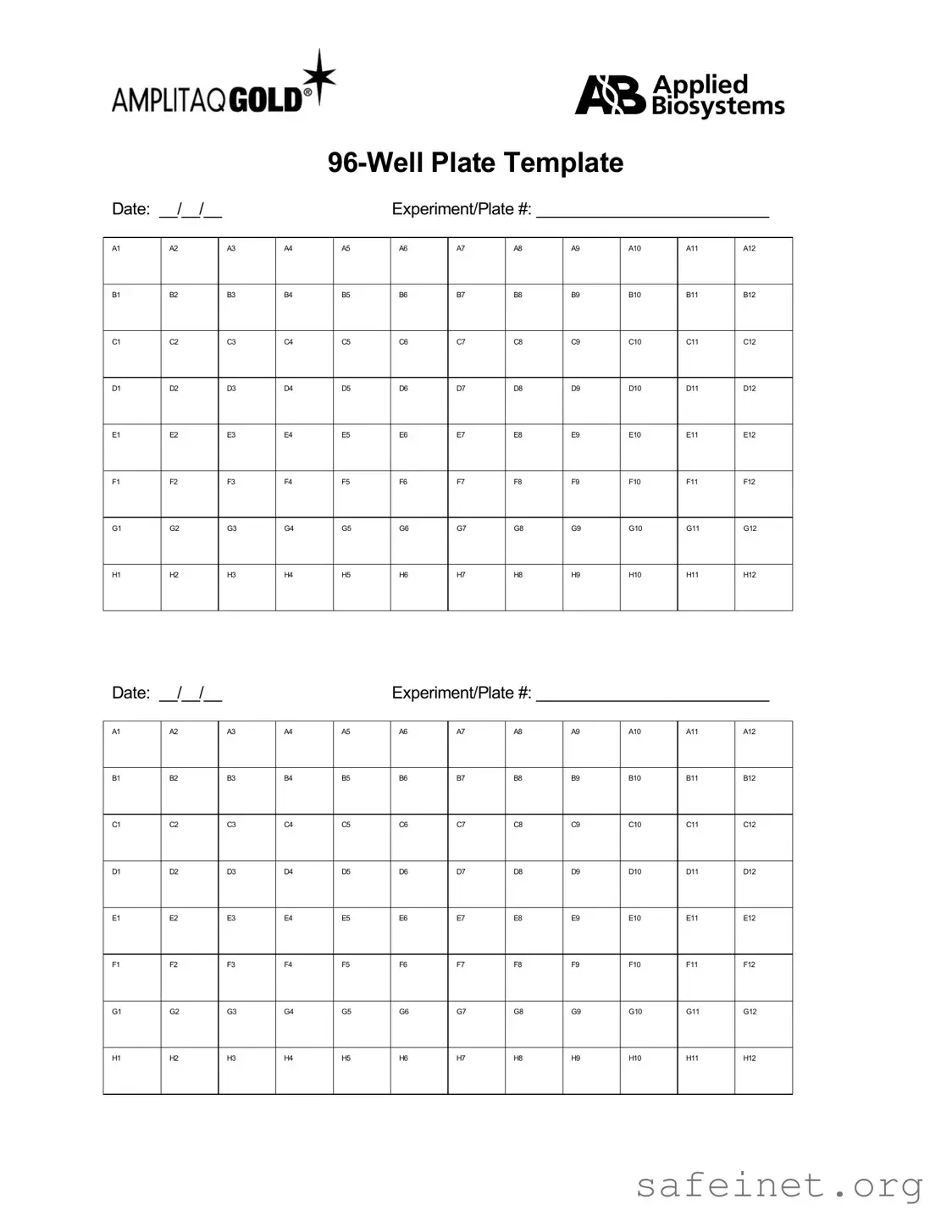
The 96 Well form is a crucial tool commonly used in various scientific and laboratory settings, particularly in the fields of biology and chemistry. Designed to hold up to 96 individual samples, this format allows for efficient organization and testing of multiple substances simultaneously. Each well in the form can accommodate different reagents or samples, making it ideal for experiments that require high-throughput screening. The layout typically consists of an 8x12 grid, which simplifies tracking and identification of samples. Researchers appreciate the versatility of the 96 Well form, as it can be utilized for a range of applications, including enzyme assays, PCR reactions, and cell culture. Additionally, the compatibility with automated pipetting systems enhances its functionality, streamlining workflows and reducing the potential for human error. Overall, the 96 Well form plays a significant role in advancing research by facilitating efficient and reproducible experimentation.
| Fact Name | Description |
|---|---|
| Purpose | The 96 Well form is primarily used for collecting and organizing data in a structured format, often in scientific and research settings. |
| Format | This form typically consists of a grid layout with 96 wells, allowing for multiple samples to be processed simultaneously. |
| Common Use | It is widely utilized in laboratories for applications such as DNA sequencing, protein assays, and chemical reactions. |
| Material | 96 Well plates are usually made from plastic or polystyrene, which are suitable for various laboratory environments. |
| State-Specific Forms | Some states may have specific guidelines governing the use of 96 Well forms, particularly in regulated industries like pharmaceuticals. |
| Governing Laws | In states like California, the use of laboratory forms may be governed by the California Health and Safety Code. |
| Data Management | Data collected in 96 Well formats can be easily transferred to electronic systems for analysis and reporting. |
| Compatibility | Many automated systems and pipetting robots are designed to work with 96 Well plates, enhancing efficiency in laboratory workflows. |
| Environmental Considerations | Recycling options for 96 Well plates are increasingly available, addressing environmental concerns associated with laboratory waste. |
Completing the 96 Well form is a straightforward process that requires attention to detail. Each section of the form must be filled out accurately to ensure that the necessary information is captured effectively. Following the steps outlined below will help in submitting the form correctly and efficiently.
What is the 96 Well form used for?
The 96 Well form is commonly utilized in laboratory settings, particularly in biological and chemical research. It is designed to facilitate the organization and analysis of samples in a standardized format. Each well can hold a small volume of liquid, allowing researchers to conduct multiple experiments simultaneously. This efficiency is crucial for high-throughput screening and various assays.
How do I fill out the 96 Well form correctly?
Filling out the 96 Well form requires careful attention to detail. Each well is typically labeled with a unique identifier, often consisting of a letter and a number. When entering data, ensure that you accurately record the sample type, concentration, and any relevant observations. It is important to maintain consistency in your entries to avoid confusion during analysis. Double-check your work to minimize errors.
What should I do if I make a mistake on the 96 Well form?
In the event of an error, it is essential to correct it promptly. Depending on the protocol, you may either cross out the incorrect entry and write the correct information next to it or use a correction fluid if allowed. Always initial the correction to indicate accountability. If the mistake significantly impacts the results, it may be necessary to document the error and notify your supervisor or team leader.
Can the 96 Well form be used for different types of experiments?
Yes, the 96 Well form is versatile and can be adapted for various types of experiments, including enzyme assays, cell culture, and PCR. Researchers often modify the layout or the information recorded to suit the specific requirements of their study. It is important to ensure that any adaptations maintain clarity and consistency for accurate data interpretation.
Where can I obtain a copy of the 96 Well form?
Copies of the 96 Well form can typically be obtained from your laboratory’s standard operating procedures or templates. Many institutions provide digital versions that can be easily printed. Additionally, you may find templates available online through reputable scientific resources. Always ensure that you are using the most current version to align with your laboratory's protocols.
Filling out the 96 Well form can be a straightforward process, but mistakes can lead to delays or complications. Here are eight common errors people often make:
Leaving out necessary details can cause processing delays. Ensure all required fields are filled in completely.
Using the wrong format for dates, phone numbers, or other entries can lead to confusion. Double-check the required formats before submitting.
If the form is filled out by hand, ensure your handwriting is clear. Illegible entries can result in misunderstandings or errors in processing.
Failing to review the completed form can lead to overlooked mistakes. Always take a moment to go over your entries before submission.
Forgetting to sign the form is a common oversight. Make sure all necessary signatures are included to validate the document.
Using an outdated version of the 96 Well form can result in incorrect submissions. Always download the latest version from the official source.
Each form comes with specific instructions. Ignoring these can lead to errors. Read the instructions carefully before filling out the form.
Failing to confirm receipt of the submitted form can lead to uncertainty. Always follow up to ensure your form was received and is being processed.
By being aware of these common mistakes, you can help ensure that your completion of the 96 Well form is accurate and efficient. Taking a little extra time to review your work can save you from potential issues down the line.
The 96 Well form is a critical document used in various contexts, often related to research, clinical trials, or laboratory settings. It is essential to understand the other forms and documents that may accompany it to ensure comprehensive data collection and adherence to regulatory requirements. Below is a list of documents frequently used alongside the 96 Well form.
Understanding these documents is vital for anyone involved in research or clinical trials. Each form plays a specific role in ensuring that the study is conducted ethically and that the data collected is reliable and valid. Properly managing these documents contributes to the overall success of the research endeavor.
The 96 Well form is often compared to the Laboratory Notebook, which serves as a crucial record-keeping tool in scientific research. Much like the 96 Well form, a Laboratory Notebook documents experiments, observations, and results in a structured manner. Researchers utilize it to track methodologies, data, and conclusions over time. The primary difference lies in the format; while the 96 Well form is typically a standardized grid layout for high-throughput screening, the Laboratory Notebook allows for more narrative detail and flexibility in documenting the research process.
Another document that shares similarities with the 96 Well form is the Sample Tracking Sheet. This sheet is essential for keeping track of samples throughout the research process. Both documents help ensure that data is organized and easily accessible. However, the Sample Tracking Sheet focuses more on the identification and status of individual samples, while the 96 Well form emphasizes the results obtained from experiments conducted in a multi-well format. Together, they contribute to a comprehensive understanding of experimental workflows.
Lastly, the Data Analysis Report can be seen as a sibling to the 96 Well form. This report compiles and interprets the data collected during experiments. Similar to the 96 Well form, which organizes results for easy reference, the Data Analysis Report synthesizes findings and provides insights. However, it goes a step further by analyzing trends, drawing conclusions, and suggesting future directions based on the data. Both documents are vital in the scientific process, as they ensure that results are not only recorded but also understood and utilized effectively.
When filling out the 96 Well form, certain practices can help ensure accuracy and compliance. Here’s a list of what to do and what to avoid:
The 96 Well form is a common tool used in laboratories, particularly in biological and chemical research. However, several misconceptions surround its use and purpose. Here are nine of those misconceptions explained:
While the 96 Well form is often associated with high-throughput screening, it is also useful for other applications, such as basic assays and sample storage.
In a standard 96 Well plate, all wells are typically uniform in size. However, variations exist for specific applications, such as different volumes or shapes.
Although primarily designed for liquids, solid samples can also be used in certain contexts, depending on the experiment's requirements.
Many find the 96 Well form straightforward to use. Clear labeling and organization can simplify the process significantly.
Amateur scientists and educators also use the 96 Well form. Its accessibility makes it a popular choice in various settings.
While the 96 Well form can yield reliable results, accuracy depends on proper technique, calibration, and controls.
Many affordable options exist for 96 Well plates. Costs can vary, but budget-friendly alternatives are available.
The versatility of the 96 Well form allows for various assays, including enzymatic, binding, and cell-based assays.
While many 96 Well plates are designed for single use, some are reusable after proper cleaning and sterilization.
Understanding these misconceptions can help researchers and educators make better use of the 96 Well form in their work.
When working with the 96 Well form, it is essential to understand its purpose and how to fill it out correctly. Here are some key takeaways: