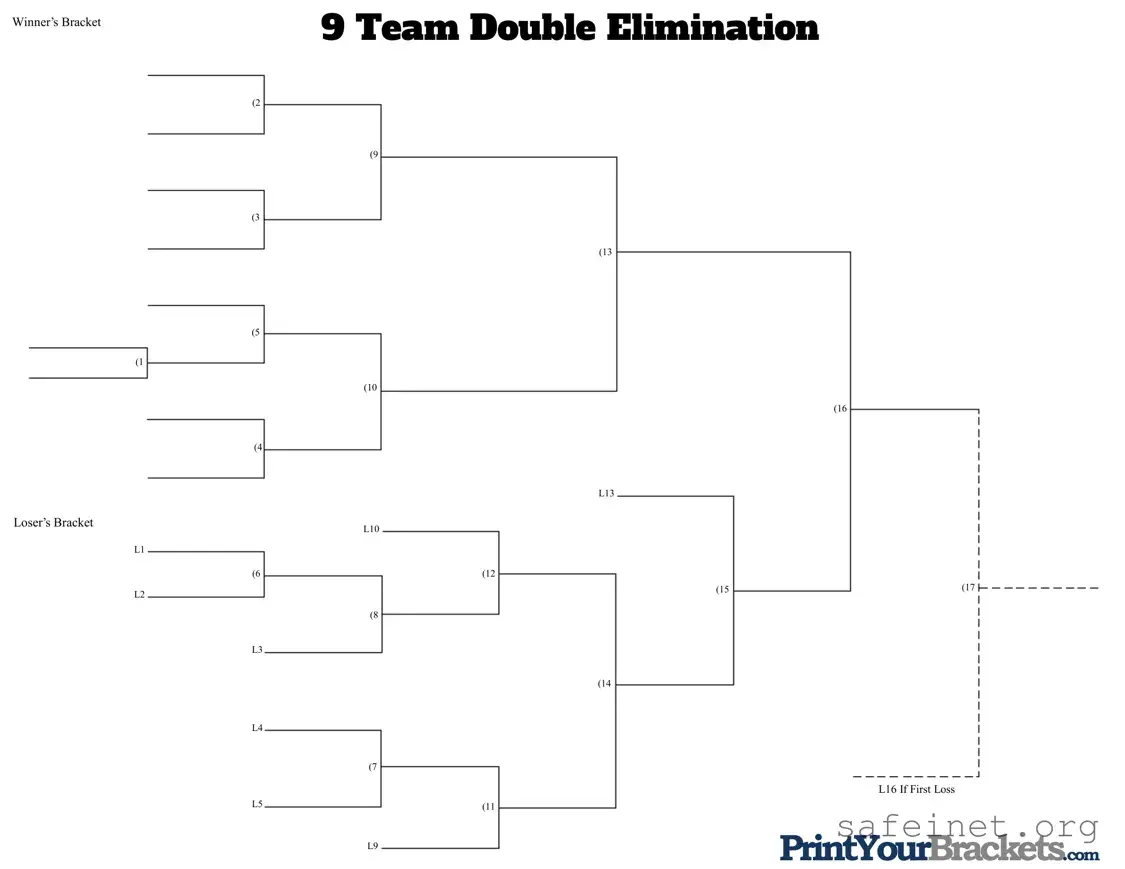
When organizing a tournament, especially one with nine teams, understanding the structure of a double elimination bracket is crucial. This format allows teams to have a second chance, ensuring that even if they lose a match, they can still fight their way back to the finals. In a typical 9 Team Double Elimination Bracket, the competition is divided into two main sections: the Winner’s Bracket and the Loser’s Bracket. The Winner’s Bracket features teams competing in a series of matches, where the winners advance while the losers drop down to the Loser’s Bracket. Here, teams that have lost once get another opportunity to continue their journey. Matches are organized in a way that each team must lose twice to be eliminated from the tournament. This bracket form not only keeps the excitement alive but also ensures that the best teams have a fair chance to showcase their skills. With careful planning, participants can navigate through this dynamic structure, culminating in an engaging championship showdown.

| Fact Name | Description |
|---|---|
| Structure | A 9 Team Double Elimination Bracket consists of two main sections: the Winner's Bracket and the Loser's Bracket. |
| Initial Matchups | In the first round, the top teams compete, with the lowest-seeded teams typically playing against higher-seeded teams. |
| Advancement | Teams that win their matches in the Winner's Bracket continue to advance, while losing teams drop into the Loser's Bracket. |
| Double Elimination | Each team is allowed one loss before being eliminated from the tournament. |
| Loser's Bracket | Teams that lose in the Winner's Bracket have a chance to stay in the tournament by competing in the Loser's Bracket. |
| Finals | The final matchup often features the last remaining team from the Winner's Bracket against the last team standing in the Loser's Bracket. |
| Governing Laws | State-specific forms may be governed by local sports regulations, such as those from the National Federation of State High School Associations (NFHS). |
| Seeding | Teams are typically seeded based on their performance in previous tournaments or regular-season records. |
| Match Format | Matches can vary in format, including single games or best-of-three series, depending on the tournament rules. |
| Record Keeping | Accurate tracking of wins and losses is crucial for maintaining the integrity of the bracket and ensuring fair play. |
After obtaining the 9 Team Double Elimination Bracket form, you will need to fill it out to organize your tournament effectively. This process involves clearly marking the teams and their respective positions in both the winner's and loser's brackets.
What is a 9 Team Double Elimination Bracket?
A 9 Team Double Elimination Bracket allows teams to compete in a tournament where they have to lose twice to be eliminated. This format ensures that every team has a fair chance to compete, even if they lose a match early on.
How does the bracket work?
The bracket is divided into two sections: the Winner’s Bracket and the Loser’s Bracket. Teams that win their matches continue in the Winner’s Bracket, while teams that lose move to the Loser’s Bracket. A team is eliminated only after losing two matches.
How are the matchups determined?
Matchups are typically determined by seeding, which is based on the teams' performance in previous tournaments or their ranking. Higher-seeded teams generally face lower-seeded teams in the initial rounds.
What happens if a team loses in the Winner’s Bracket?
If a team loses in the Winner’s Bracket, they drop down to the Loser’s Bracket. They still have a chance to continue competing, but they must win all subsequent matches to stay in the tournament.
How many matches will each team play?
Each team can play a minimum of two matches and a maximum of four matches, depending on how far they progress in the tournament. Teams that reach the finals from the Loser’s Bracket may need to win two matches against the team from the Winner’s Bracket.
What is the significance of the Loser’s Bracket?
The Loser’s Bracket provides teams with a second chance. It allows teams that lose a match to still compete for the championship. This format adds excitement and keeps more teams engaged throughout the tournament.
How is the champion determined?
The champion is determined through the final matches. If a team from the Winner’s Bracket loses in the finals, they must face the team from the Loser’s Bracket again. This ensures that the ultimate winner has proven themselves against all competition.
Can teams be re-seeded after the first round?
No, teams are not re-seeded after the first round in a double elimination format. The bracket remains fixed after the initial matchups are set, ensuring that the competition follows a consistent path.
What should teams know about scheduling?
Teams should be prepared for a flexible schedule. Matches can be scheduled back-to-back, especially in the Loser’s Bracket. It’s crucial for teams to be ready to play at designated times to keep the tournament running smoothly.
Is there a specific format for scoring or rules?
While the bracket format is standardized, scoring and rules can vary by sport or tournament. Teams should check with the tournament organizers for specific regulations to ensure compliance.
Incorrect Team Names: Participants often fail to input the correct names of the teams. This can lead to confusion during the tournament. Ensure that each team is clearly identified.
Improper Bracket Placement: Teams may be placed in the wrong section of the bracket. It is crucial to follow the structure of the winner's and loser's brackets accurately to maintain the integrity of the tournament.
Missing Matches: Some individuals forget to include all necessary matches. Each round must be accounted for to avoid discrepancies in the tournament flow.
Failure to Update Results: After each match, results should be updated promptly. Neglecting to do so can create confusion about which teams are still in the competition.
When organizing a tournament using a 9 Team Double Elimination Bracket, several other forms and documents can enhance the experience for participants and organizers alike. These documents help manage the tournament effectively, ensuring clarity and smooth operation throughout the event.
Utilizing these documents alongside the 9 Team Double Elimination Bracket can significantly enhance the organization and execution of a tournament. They provide clarity, streamline processes, and contribute to a positive experience for everyone involved.
The 9 Team Double Elimination Bracket form shares similarities with a single-elimination tournament bracket. In a single-elimination format, teams compete in matches, and the loser is eliminated from the tournament. This structure is straightforward, as it progresses through rounds until one team remains. Both brackets visually represent the path teams take toward victory, but the double elimination format allows teams a second chance after their first loss, creating a more complex and engaging experience for participants and spectators alike.
Another document akin to the 9 Team Double Elimination Bracket is the round-robin schedule. In a round-robin tournament, each team competes against every other team. This format ensures that all teams have an equal opportunity to showcase their skills. While the round-robin method emphasizes fairness and comprehensive competition, it lacks the elimination aspect present in the double elimination bracket, where teams can still advance after losing a match.
The playoff bracket is another document that resembles the 9 Team Double Elimination Bracket. Playoffs typically involve a series of elimination rounds leading to a championship match. This format builds excitement and anticipation as teams compete to advance. While both playoff brackets and double elimination brackets serve to determine a champion, the double elimination format allows teams to remain in contention longer, providing a safety net for those who may have a rough start.
A league standings chart is also similar in that it tracks the performance of teams throughout a season. It provides a clear overview of wins, losses, and rankings. While it does not have the visual structure of a bracket, it serves a similar purpose by summarizing the competition and progress of each team. Unlike the double elimination bracket, which focuses on match outcomes to determine advancement, league standings emphasize overall performance over time.
Lastly, the challenge bracket is another document that resembles the 9 Team Double Elimination Bracket. In a challenge bracket, teams face off in matches where the winner challenges the next opponent. This format allows for a dynamic competition and can resemble the double elimination structure when teams are allowed to continue competing after losses. Both formats encourage ongoing engagement and excitement, as teams strive to prove their strength and skill in a competitive environment.
When filling out the 9 Team Double Elimination Bracket form, it is important to follow certain guidelines to ensure accuracy. Here are some things you should and shouldn't do:
Understanding the 9 Team Double Elimination Bracket can be tricky. Here are some common misconceptions that people have:
Understanding how to fill out and use the 9 Team Double Elimination Bracket form can enhance your tournament experience. Here are some key takeaways to help you navigate this format effectively:
By keeping these points in mind, you can effectively manage your double elimination tournament and ensure a smooth experience for all participants.